Category Archives: Faith

Kids Spitting and Truth Telling

To be “clear,” sometimes the truth is “nasty.” The following is adapted from the last chapter of my book, Life Lessons from the School Bus. 

“Unexpected Truth”

Every once in a while a bus driver, or anyone for that matter, may find himself saying, “I didn’t see that one coming!” In other words, every once in a while something happens; somebody says something that you would have never imagined. Let me tell you about one of those “once in a while’s.”

Spitting Accusations

Kids are always doing stuff to each other to be aggravating. You have probably witnessed children throwing spit wads, taking items out of another’s book bag, or hiding a child’s shoe right before her stop. No? Well what about spitting on each other?

Oh, yes, children are well-accustomed to spitting on each other, especially boys. Now, they never admit to doing it; they usually blame it on the one kid with no salivary glands. But there was this one time when a boy on my bus accused a girl of spitting on him when she actually didn’t. How do I know that she didn’t? She showed me proof!

So, “Jack” hollered from the back of the bus, “Mr. Baker! ‘Jill’ spit on me!” Before I could rationally respond, another voice came from the back, the voice of the accused, crying, “No I didn’t – he’s lying!” Since I was in the process of driving and there was no place to pull over and deal with the situation, all I could do at the moment was respond with a simple request: “STOP SPITTING!”

A moment passed, then Jill came up to the seat behind me (which is dangerous and against the rules, by the way). “Mr. Baker,” she said in a tone laced with disgust, “I did not spit on Jack; he spit on himself after he spit on the seat.”

What?” I asked. “He’s spitting on the seat?! That’s gross!”  Incidentally, this is one of those times when I find it appropriate to ask: why do people of any age find enjoyment in recreational spitting? Why waist perfectly good saliva when there’s nothing necessarily nasty to expel from one’s mouth?

Anyway, a moment or two later, Jack came up to share his side of the story. “Mr. Baker, Jill did spit on me! See my shirt? See, this is her spit…she spit on me! See?”

I couldn’t argue with what I saw. There, as plain as the marks on a Dalmatian, were wet spots where something liquidy had collided with his shirt. Somebody had spit on him.

“Jill!” I yelled, “Why did you spit on Jack?” From the back of the bus came an insistent reply, “But I didn’t! He spit on himself just to get me in trouble!”

The Truth Comes Out

Where’s Solomon when you need him? Why can’t school buses be equipped with portable DNA equipment? How was I supposed to determine who spit on whom? How could I prove who needed to be punished with a stern warning and a verbal reprimand? The answer came in a way I never would have dreamed, but I will never forget.

“Mr. Baker…” Jill had made her way back up to the seat behind me, again while I was driving. “Jill, you need to sit down!” I told her.

“But Mr. Baker…” Let me just pause here to try to describe Jill’s way of saying my name. Jill spoke with a slightly non-emotional, matter-of-fact, drawn-out southern drawl. It sounded more like “Miiis-turr Buh-ayyy-kurr…”

“Mr. Baker, I didn’t spit on Jack; he spit on the seats and then on himself to make it look like I did it,” she said. “But I didn’t, and I can prove it.”

“Really,” I asked.

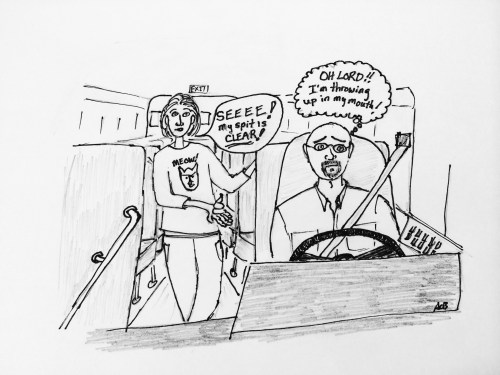
“Yessir,” Jill replied. “You see, Jack was eating green candy, and the spit on his shirt was green – mine is not…SEE!

At that point, just around my right shoulder, came the arm of a little girl. Attached to that arm was a palm, and in that palm was half an ounce of spit – yes, spit! It looked like a blob of clear silicone!

“It wasn’t me that spit, ‘cause my spit is clear, seeeee Mr. Baker?”

I couldn’t argue with her. She proved her point. There was the proof puddled in the palm of her hand, clear as day. I nearly threw up.

Life Lesson

We may not like it, but sometimes the truth is hard to stomach – and nothing like what we expected.

The simple fact is that truth isn’t always pleasant; more often it is nasty. No woman wants to hear the truth when she asks, “Does this dress make me look fat?”  No man wants to hear the truth when he asks, “How did I do with the laundry?” But sometimes the truth has to be told to make a difference. Unfortunately, to play off the words of Jack Nicholson in A Few Good Men, many can’t handle the truth.

For example, there is a saying that goes, “You shall know the truth, and the truth shall make you free.” Do you know where that saying came from? It comes from Jesus. He said, “If you continue in my word, then you are my disciples indeed; and you shall know the truth, and the truth shall set you free” (John 8:31-32). The part that is hard for many to stomach is the part where He says, “If you continue in my word…” In other words, in order to know the truth that will set one free, one must be a follower of Jesus Christ.

Some say that truth is relative, that it changes with the circumstances of life. Others have said that there is no truth, only perception (Gustave Flaubert). However, without truth there can be no lie, no wrong, and no remedy for the spit on some kid’s shirt, not to mention the darkness in our hearts. But when we follow Jesus, we can rest assured there is Truth to know, for He said in John 14:6, “I am the WAY, the TRUTH, and the LIFE…”

Route Suggestions

  • When faced with a tough situation, one that demands you make a wise decision, ask God for help. James 1:5 says, “If any man lack wisdom, let him ask of God…”
  • Don’t ask someone to tell you the truth about how you look, how well you’re doing your job, etc., unless you’re willing to hear the truth.
  • Don’t “kill the messenger.” If someone does try to tell the truth, don’t get angry when they say the dress makes you look fat. Just get angry because they weren’t sensitive enough to change the subject.
  • Read the book of John in the Bible. Make a list of the claims that Jesus made. Was He telling the truth? For the atheist or agnostic, that may be a truth too hard to handle, but it can set you free.

Oh, one more thing… When preparing to write this, I asked the girl in the story what she thought the moral should be. She said, “Sometimes the truth is nasty.”

Truth.
11 Comments

Filed under book review, Faith, General Observations, Humor, Life Lessons, salvation

It’s Saturday…

It’s Saturday.

That’s probably not a shock to most of you, I bet. If you can log on to a computer, check your email, or read a text, then you are most likely capable of knowing what day of the week it is.

It’s Saturday… just Saturday.

But sometime back in the 30’s – the 0030’s – there were some men and women waking up to a Saturday like no other. Their teacher, mentor, leader, Rabbi, and Master had suffered a most horrific death, and now he was in a tomb. This was not a day they expected.

It was Saturday, the Sabbath, and all their hopes and dreams lay cold and lifeless in a sealed grave.

What were they feeling? How does it feel to go from the top of the world with every expectation of glory, to utter despair and the expectation that at any moment the ones who ripped your leader to shreds could soon find you and do the same?

With despair comes shame, anger, blame, and fear. On what was supposed to be a “day of rest,” hearts must have been restless, tumultuous, and breaking, crumbling to dust.

It must have been a long day, that Saturday.

Have you ever lost someone close, like a parent, a spouse, or a child? Have you ever left the hospital or the morgue, gone home in shock, only to be jolted by the piercing pain of reality when you see your loved one’s possessions? The day after my father died my mother and sister experienced a moment like that (I wasn’t there, for I wouldn’t go home that night). My dad’s watch had an alarm set – it was the time he was supposed to get up – there was no getting up this time.

How did Jesus’ disciples feel that Saturday night? Their hopes seemed hopeless…their dreams had become a nightmare…the “Way, the Truth, and the Life” now seemed like nothing more than a dead-end road, a lie, and death.

It was Saturday…

But Sunday was coming.

Leave a comment

Filed under current events, Easter, Faith, Future, God, Theology, worship

“But Some Doubted” What About You?

Doubting George?

Have you ever doubted?

If you have, you’re not alone. Sometimes it might even be the wise thing to do.

Even the most trusting puppy can have his moments. Believe me.

But did the disciples of Jesus ever doubt? Oh, you betcha!

Then the eleven disciples went away into Galilee, into a mountain where Jesus had appointed them. And when they saw him, they worshiped him: but some doubted. – Matthew 28:16-17

Many people have placed faith in Jesus only to lose that faith later, like when they find out the Jesus they thought they knew was not who he claimed to be.

Are you one of those?

Believe it or not, even some of the disciples of the real Jesus found themselves doubting when they saw Him face to face after His resurrection. In the book of Matthew we read that on one particular occasion, after meeting up with the disciples at a pre-determined location, most worshiped, but “some doubted.”

But wait! How is this possible?! Weren’t these the same guys who saw Jesus appear to them when they were hiding, afraid for their lives (Luke 24:36; John 20:19)? Even doubting Thomas finally believed (John 20:28), so who were the the ones doubting in Matthew 28? Could it have been one of them? Possibly, or maybe even one of those who may have tagged along.

Here’s what I think happened…

The disciples were gathered together, Jesus miraculously appeared, and before He could speak, the crowd began to worship Him. Some, however, were a little skeptical; they had seen things before, including fakes, charlatans, and impostors. Who was to say what they saw was really Jesus Himself?

What might have convinced the doubters? I believe it was when Jesus spoke.

And Jesus came and spake unto them, saying, All power is given unto me in heaven and in earth. Go ye therefore, and teach all nations, baptizing them in the name of the Father, and of the Son, and of the Holy Ghost: Teaching them to observe all things whatsoever I have commanded you: and, lo, I am with you alway, even unto the end of the world. Amen. – Matthew 28:18-20 

It’s not like this was the first time Jesus appeared to the disciples, causing not only doubt, but also stark terror. Remember when He walked on the water?

And when the disciples saw him walking on the sea, they were troubled, saying, It is a spirit; and they cried out for fear. – Matthew 14:26

It took Jesus speaking to calm down the frightened boatmen…

But straightway Jesus spake unto them, saying, Be of good cheer; it is I; be not afraid. – Matthew 14:27

Is it possible that some of the disciples present when Jesus met up with them on that mountain had a right to be skeptical? I mean, hey, wasn’t it Jesus himself who earlier warned the disciples that “false Christs” and “false prophets” would arise, deceivers so convincing that, “if it were possible, they [would] deceive the very elect” (Matthew 24:24; Mark 13:22)?

Matthew doesn’t exactly say what happened to those who doubted, but I have my suspicions. I believe it was when Jesus spoke that their doubts disappeared.

On the other hand, if they still doubted, maybe they were only there for the bagels and mountain air.

Jesus answered them, I told you, and ye believed not: the works that I do in my Father’s name, they bear witness of me. But ye believe not, because ye are not of my sheep, as I said unto you. My sheep hear my voice, and I know them, and they follow me: And I give unto them eternal life; and they shall never perish, neither shall any man pluck them out of my hand. – John 10:25-28

It was never Jesus’ plan to convince the world of who He was by physically appearing to everyone. As a matter of fact, Jesus told Thomas, “because thou hast seen me, thou hast believed: blessed are they that have not seen, and yet have believed” (John 20:29).

Are you one of the “blessed”? Do you believe? Are you having doubts?

The Word made flesh (John 1:1) gave us His Word (the Bible).

So, when in doubt, read His voice.


Leave a comment

Filed under Apologetics, Christian Maturity, cults, Faith, God, worship

The Real Problem with the Problem of Evil

This evening at church we will be having an “Ask the Pastor” question-and-answer night. Am I nervous? A little. However, I’ve already warned the congregation that I may not have all the answers and some questions might get a simple, “I’ll have to get back to you on that.” We’ll see. I may even post the questions I get in an upcoming post! Hmmm? 

But, because I have done a little writing on the “problem of evil,” I’ll re-post this article/paper in honor of tonight…and all the questions I still struggle with.

An Old Debate

One of the most common reasons for denying the existence of God is the problem of evil in the world. Just ask any group of atheists to give their top ten reasons for unbelief and surely one will claim as number one, “If there is a God, then why is there so much evil in the world?” For many, this is the pièce de résistance of rebuttals. How could a good God be real and allow all the suffering in the world to continue unabated – assuming He is even good? The eighteenth century philosopher, David Hume described the problem this way in Dialogues concerning Natural Religion, 1779:

“Is God willing to prevent evil, but not able? then he is impotent. Is he able, but not willing? then is he malevolent. Is he both able and willing? whence then is evil?” (Stackhouse 1998, 11)

So, the “problem of evil,” and its source, has been an issue of philosophical debate for centuries.  The existence of evil in the world, along with unanswered questions, has even become evidence enough for some to embrace atheism.  Therefore, because so many philosophers and theologians have tried for ages to reconcile the existence of God with the existence of evil, I dare say that nothing I write will be new.  But, if anyone were to challenge my belief in God, along with my faith in Jesus Christ, with the argument that the problem of evil constitutes proof God does not exist, then I would possibly respond with arguments based on the following thought:

Without the existence of God, there should be no evil to be a problem, and that’s the real problem with “the Problem of Evil.”

Evil? What Is It?

What exactly is “evil?” Now, that may sound like an absurd kind of question to ask, but if the existence of evil is the evidence that is supposed to expose my faith as a fraud, at best, or even a lie, then what is it?  Is it something tangible? Is it metaphysical? Is it theoretical? What is it, exactly? Does it have any particular form? How can it be distinguished from what is called good? On what do the atheists and agnostics base their definition of this thing called “evil?”

Amazingly, the answers are not all the same, nor in some cases even grounded in reality. However, it is imperative to understand that we must define this God-killer, because its definition will determine our conclusions and help to clarify our assumptions.

When C. S. Lewis was an atheist, for example, his “argument against God was that the universe seemed so cruel and unjust.” (Lewis 1989) There he had it, or so he thought. God could not exist because so much evil exists. But how did he arrive at “this idea of just and unjust?” Lewis said, “A man does not call a line crooked unless he has some idea of a straight line.” (Lewis 1989) “Tell me,” I would say, “what is evil, and how do you recognize it when you see it?

The Adjective

To start, evil must be understood to be an adjective. Evil is a description of something that is not good. Evil is not a thing. The word “evil” only describes the thing, the thought, and the action. Technically, “evil” does not exist, only what it describes.

Some people say that they cannot believe in God because why or how could a good God, if He was perfect, create evil? They think of evil as something that must have not existed until God made it. But evil “isn’t a kind of molecule or a virus…infecting or affecting everything it encounters.  There was no time when God said, ‘Let there be evil,’ and there was evil.” (Stackhouse 1998)  As John G. Stackhouse put it, “evil becomes a noun only in the abstract.” Additionally, in his book Can God Be Trusted, Stackhouse says of evil:

“An action can be evil, or an event can be evil, or a quality can be evil, or a being can be evil. And we can lump all these particular evils together in our minds and come up with a category ‘evil.’ We can even go on to discuss it as if it were a particular thing, so long as we do not forget that we are always dealing with a category or group of particular evil things, not a thing itself.” (Stackhouse 1998, 31)

So then, if evil is a description, how is it that we come to use the adjective, or as Lewis put it, the “crooked line,” without first having some idea of what is a “straight” one?  Defining what is good is as important as defining evil. To know what is evil, we must first have some assumption as to what is not evil.

The crazy thing is that if God does not exist, and man is nothing more than a collection of random matter, both good and evil are purely relative – their existence is based purely on one’s perspective.  So, in other words, the one who says that there is no God, based on the existence of evil, is literally basing his belief on pure opinion, not on anything objective. Therefore, in order to bring an accusation against the goodness of God, one must have a base line. What is the standard by which we determine what is good and what is evil?

The Standard

Some use Man as the baseline. They compare God to the standard set by what is thought to be good behavior in this world. They rationalize that if God is real, at least according to monotheistic dogma, He must be all-powerful, perfectly good, and the supreme example of love, kindness, and providential care. Because it is preached that God is a better Father than earthly fathers, Mark Twain took it upon himself to write:

The best minds will tell you that when a man has begotten a child he is morally bound to tenderly care for it…[yet], God’s treatment of his earthly children, every day and every night, is the exact opposite of that, yet those minds warmly justify those crimes…when he commits them.” (Tonie Doe Media 2007)

So then, according to Twain, God could not exist because if He did, He would act consistent with our understanding of what a good and loving earthly father would do.  In other words, if God cannot, in all His perfection, behave better toward His children than the most common man, His credentials are therefore revoked, and He must cease to exist.  However, this is so illogical.

Who are we to say that God, if He is perfect, and we are imperfect, ever treats His children poorly? Do the protesting cries of a toddler who has had poison taken from his grasp carry more weight than the decision of the earthly father to take it away? How, then, are we to automatically assume that the infantile tendencies of finite man are wiser than the infinitely Mature?

Using Man as a baseline for what is good and evil is pure arrogance.

Whose Line Is It?

In reality, the problem of evil is really a problem for the atheist. He, who denies the existence of a Creator and accepts only the realities of evil in the world, essentially has nothing about which to complain.  Everything should be just fine and dandy, but it’s not.  The atheist knows that evil things happen to both good and bad people.

He sees the hurt, feels the pain, and begs for justice. The reality of evil in the world causes men to cry out for justice; for things to be made right. This is a problem, though, because knowing that a crooked line is not straight hints at the fact that a Line-drawer exists.

The Followers’ Fault

Others take a different approach. They claim that God does not exist except in the evil intentions of his followers to control others through guilt. They claim that God is just a fabrication of priests to keep mankind from behaving “naturally.”

They say that nature is good, and if anything, God is evil for trying to get man to behave contrary to the very way he was created to behave. One guru said, “It seems that for those who worship God, the opposite to God is not that which is ‘evil,’ but that which is natural.” He said of animals, comparing them to men, “They don’t worship God, they don’t go to church, they don’t have any theology.  They don’t have any feeling of guilt, they are simply natural.” (Osho 2009)  In other words, if there is evil in the world, it is because our belief in God has inflicted it.

The Majority Response

But for the majority of the hurting world, pain is real, loss is real, and evil is manifested daily.  Many see the things that happen to innocent people, especially children, and wonder, “If there is a loving God, why doesn’t he do anything about this?

These people, many of which hold on to hope as long as they can, finally succumb to their doubts and conclude that the only way to explain away the pain is to admit that it is just part of life, part of the natural world, part of what makes us human; alone, in our quest to make life easier, free of pain, free from evil; alone, without God.

These are the ones, I believe, that lure more away from the faith than any Darwinist.  They are the ones who have seen evil face-to-face and cannot fathom a God who would allow it to continue.  And because their experiences are so painful and tragic, the devout are left speechless and without explanation. Ellie Wiesel is a good example.

Wiesel’s Observation

Wiesel was a teenager when he saw his family murdered in the Nazi death camps.  But it was only after witnessing one particular act of horror – the slow, hanging death of a young boy – that he turned away from his faith in God.

In the book Night, his Nobel prize-winning autobiography, Wiesel said he heard a man behind him ask, “Where is God now?” As he stood there, being forced to stare into a pitiful, wide-eyed, swollen face of a dying child, a voice within replied, “Where is He? Here He is – He is hanging here on the gallows…” (Wiesel 1982) Because there was no justification, even in the big scheme of things, Ellie Wiesel’s God died with the executed boy.

But as sad as it is, without God, who can say what happened to that boy was any worse than the slaughter of an animal?  Are we not all just animals – some more evolved than others?

The Real Problem

To me, the problem of evil is not a problem for the believer to explain, but one for the non-believer.  Aside from the theological arguments about the character of God, without God, to turn Hume’s question around, “whence then is evil?

Without God, evil is relative to one’s desires and personal pleasure.  Does it really even matter whether or not God could do anything about evil in the world when the whole question is moot if He didn’t exist?

With God, evil is defined as that which is against His law, that which stands opposed to His standards, and that which describes all who take pleasure in such rebellion. Without God, evil is just a matter of opinion.

That is the real “problem of evil.”


Works Cited

Lewis, C. S. “Atheism.” In The Quotable Lewis, by C. S. Lewis, 59. Wheaton: Tyndale House Publishers, Inc., 1989.

Osho. The God Conspiracy: the path from superstition to superconsciousness. New York: Osho Media International, 2009.

Stackhouse, John G. Can God Be Trusted. New York: Oxford University Press, 1998.

Tonie Doe Media. In The Atheist’s Bible, 129. New York: Harper Collins, 2007.

Wiesel, Ellie. Night. New York: Bantam Books, 1982.

4 Comments

Filed under Apologetics, Culture Wars, Faith, General Observations, Life/Death, Struggles and Trials

Is Faith an Irresistible Gift?

For your consideration…a fresh new video from Soteriology101.com

1 Comment

Filed under Faith, salvation, Theology

Observations from a Middle-Georgia Pastorate: Listen to the Locals

“In the Middle Of…”

When I first traveled down to this part of Georgia, having no knowledge of what was around, I used a common term to describe the area. I told others it was “in the middle of nowhere.”

Since then, I have felt bad about saying that. First, unless Warthen was in the middle of nowhere – like some outpost in the middle of Antarctica – the term could be considered derogatory. Coming across as bigoted isn’t helpful.

Secondly, nowhere is actually nowhere; everywhere is somewhere because God is there. In reality, I’m right in the middle of where I’m supposed to be.

So, there’s that.

Listen to the Locals

But when it comes to getting around and finding what you need, the somewhere might not be “nowhere,” but finding anywhere when you’re there can prove difficult, if not leave you stranded with an empty gas tank and no filling station for miles. That is why before you start exploring, listen to the locals!

One of the first things that bothered me (and, I know, this is more of a first-world problem) was that there seemed to be no restaurants. My wife and I had pretty much resigned ourselves to the fact that there would be no nice place to go on a date. But what we came to find out was that if we were only willing to drive a few minutes, and if we were willing to trust our local guides, we would find exactly what we were looking for.

For example, last week a couple from our church invited us to join them for a movie and dinner. After the movie, they took us to a steak house. But if we had not trusted the suggestion of our new friends, we wouldn’t have even given the place a chance. I mean this place was the quintessential example of “hole in the wall.” It was literally a steak house.

In front of Tumpies, the “Best little steakhouse this side of Texas.” It’s not too far away in Dublin, GA. It was a house built in the 1880s, but now a great place to eat!

But the food was some of the best I have ever had – ever. It will be a destination when we host friends from out of town.

Another thing that bothered me was that I didn’t think there were any coffee shops around. Again, when I listened to the locals I found out about a great coffee place not far away from where I will be meeting a new preacher friend every week to talk shop.

So, no, my place in the middle of Georgia might not be Nashville, Chattanooga, Atlanta, or the like, but it has everything I thought I was going to miss and everything I need. I mean, come on, it’s got steak and coffee!

Been Where We’re Going

You know, the children of Israel, under the leadership of Joshua, were faced with a similar situation when they were about to cross over the Jordan River. In chapter 3, the Lord told Joshua to send the Levites and the Ark of the Covenant ahead of the people. The reason was pretty clear.

“But keep a distance of about a thousand yards between yourselves and the ark. Don’t go near it, so that you can see the way to go, for you haven’t traveled this way before.” – Joshua 3:4 (CSB)

If there is there anyone we should listen to, it’s the Lord. Do you realize there is not a place He has never walked? Do you know there is not a place, not a situation, not a wilderness, where He has not already worn the straight and narrow path?

Think how much time and effort I saved after listening to the locals who’ve lived in this little town for years and years! How much more would all of us benefit if we’d just trust the One who’s already been where we’re going?

If you can trust the locals, you can certainly trust the Lord – He knows where everything is.

5 Comments

Filed under Christianity, Church, community, Faith, Food, God, ministry

Observations from a Middle-Georgia Pastorate: It’s War, but Faith Beats Fear

This blog was never intended to become a ministerial diary, of sorts, but reality is what reality is, not what we want or perceive it to be.

Therefore, I will continue to share my observations as we press forward in this new (to us) work in Georgia.

Reality Check

Getting strait to the point, there is a spiritual war going on, and you and I are involved in the conflict. It doesn’t matter where you and I are; the war is on-going and world-wide. We will never escape it until it’s over.

Unfortunately, too many think that life, with all its problems, is rarely affected by the spiritual conflict that rages all around us, even within us. Yet, the reality is that nearly everything we experience in this life is tactically connected to innumerable, web-like strategies meant to bring either victory of defeat. And depending on which side you are on – and that is debatable – victory may mean either bondage and destruction, or hope and deliverance.

There are no coincidences, and no small decision is devoid of long-reaching consequences. This is reality, and that’s a check you can cash.

The Influence Factor

To be fair, it doesn’t matter who you are, where you are, or what responsibility you’ve been given: you’ll never know the full extent of how your life and your decisions will affect others. However, what is equally true is that the more influence a person has, the more of a “high-value” target he or she becomes. And because we are in a spiritual war, this is especially true for those in ministry.

Just since the last post I wrote, the one about “Food and Fur,” I have been reminded that the more influence one has, the more the enemy will attack. I have been reminded that the enemy will wait until we are comfortable, then strike where we are least expecting it, and usually with weapons and tactics for which we have little defense. Or, rather, the defense we do have is more than adequate, but the enemy knows we have not done much training on how to use it.  Either way, the attack is meant to knock us back and reconsider our ability to continue the fight.

This is why it should never be an aspiration for a minister to obtain a “larger church” or anything like that, for unless it’s in God’s timing, and unless the minister and his family are equipped, because of the “influence factor,” they – and I do say “they” – may not be able to handle it. The more influence over the lives of others, the more the Enemy will desire your destruction.

The “Fear” Factor

You do remember the TV show Fear Factor, don’t you? Do you remember how that it was perfectly possible for every contestant to complete the required challenges, if only they could conquer their own fears? They all had the strength, the coordination, and the skill, but it was so often the fear that immobilized the contestant who failed. So often in this spiritual warfare what we find is that we’ve been given all we need by the Holy Spirit to be victorious, but fear – fear of failure, fear of exposure, fear of sacrifice, fear of inadequacy, fear of the Enemy – saps our strength, makes us weak in the knees, causes us to run, or convinces us to surrender.

This week (even yesterday) my family was threatened. The threat is hard to assess, but it is being taken seriously, so much so that police departments in two states are now involved. Yet, should we live in fear? Should we be intimidated?

Or, should we refuse to cower and hide, put feet on our faith, and trust our God to deliver?

In the Messianic Psalm 91, David wrote of how he would handle threats. He wrote:

“He who dwells in the secret place of the Most High shall abide under the shadow of the Almighty. I will say of the Lord, ‘He is my refuge and my fortress; my God, in Him will I trust’” (Psa. 91:1-2).

Later in verse five he writes: “You shall not be afraid of the terror by night, nor of the arrow that flies by day.”

Then King Solomon, David’s son, echoes these very words when he describes the kind of peace one can enjoy when he puts his faith in the true God and trusts His word:

“Trust in the Lord with all thine heart, and lean not unto your own understanding: in all your ways acknowledge Him, and He will direct your paths…When you lie down, you will not be afraid; yes, you will lie down and your sleep will be sweet. Do not be afraid of sudden terror, nor of trouble from the wicked when it comes; for the LORD will be your confidence, and will keep your foot from being caught” (Proverbs 3:5-6, 24-26).

Believe me, I am concerned. I am concerned for the safety of my daughters, my family in general, myself, and even my friends and congregation. But I refuse to live in fear! I refuse to live in hiding. I refuse to accept that threats from enemies of God – the God of Abraham, Isaac, and Jacob, the Father of our Lord Jesus Christ and my Father in Heaven, the One who tells me to call Him “Abba” (Daddy) – carry more weight than the promises from God’s Word!

Conclusion

Since I’m already at 907 words, I should bring this “Observation” to a conclusion.

First, I don’t think it’s wise to share specific details about what is going on that made me write this post. Doing so would not help keep anyone safe any more than what is already being done. So, don’t expect any real details to come out in future posts.

However, I will say this: Even in America there are those who will swear they are not radical, but will nevertheless use the “fear card” credit their fellow faith-members have earned as a tool. Even should their veiled threats be hollow and only mean, it is impossible to know what is truly in the heart or intended, and should therefore be taken seriously.

Evidently, the Enemy wants to put a stop to what God is doing, and he’s not going to play nice. When people down here said they’d heard I was stirring things up, this wasn’t exactly what I had in mind! And whether or not what we are going through right now as a family is related at all to the overall plan here in Georgia, in reality, it’s all related.

So, pray for us.

Your soldiers on the battlefield in middle Georgia


BONUS: Here’s a song my daughter Katie sang several years ago (I think she was 17). I think it’s pretty appropriate for today. Are we fearless, or full of faith?

21 Comments

Filed under Christianity, Culture Wars, Faith, Family, General Observations, ministry

10 Easy Tips to Spark Up Your Love Life (Conservative Evangelical Edition)

I’m still pretty busy getting settled, so I’m still re-posting some older posts. Here is a good one 🙂

Your Requests

Lately I have been getting a lot of requests* from my readers and random people I meet on the street. They have been asking things like, “Hey, Anthony! Why don’t you write a blog post that deals with relationships and dating?”

There have also been multiple married couples** across the country come up to me and point-blank beg me to share my thoughts on marriage, keeping the love alive, etc. Probably 25 couples*** specifically asked, “Can you enumerate a list of actions we as couples can take to ‘spark’ things up, but in a Baptist way?”

So, what else can I do but give my readers what they ask for, right?

Therefore, as requested, here are approximately 10 easy tips to spark up your love life – if you are a conservative Evangelical or Baptist, of course.

10 Easy Tips to Spark Up Your Love Life

Men:

  1. Open the car door. I know, it may sound old fashioned, but the ladies really to like it when you open and hold the door to the car, especially when other people with bad marriages are looking. NOTE: Make sure you hold it open and watch your wife/fiance/date actually complete the task of getting all the way in before you turn your head and shut the door. Remember, it’s not your responsibility to notice the ooo-ing onlookers touched by your chivalry; that’s the female’s place…you don’t want to break her ankle.
  2. Buy her flowers. Christian girls adore God’s creation just as much as the nearest tree-hugging liberal. Therefore, don’t forget to buy your woman some flowers now and then. NOTE: Make sure beforehand if she is allergic to any particular specimen. Otherwise, make sure you have some anointing oil handy, along with someone who can demand that the spirit of asthma be gone.
  3. Choose the right restaurant. When your better half wants to go out to dinner, or when you suggest it, ask where she would like to eat. When she then says, “Oh, it doesn’t matter; wherever you want to go,” you softly say, “I think I would like to go to _______.” With what do you fill in the blank? The restaurant SHE likes, NOT where you would actually want to go.
  4. Tell her she looks beautiful. Married guys, right when you roll over in the morning and see your wife, tell her you love her AND “you look beautiful this morning!” No, she won’t believe you, but she will enjoy hearing it. Then, later in the day, say it again, right when she doesn’t expect it. NOTE: Don’t tell her she looks beautiful more than twice in the same day – she’ll know you’re up to something and the plan will backfire. Single guys, just tell her she’s “pretty” and save the rest for marriage.

Women:

  1. Tell your man you’re proud of him. In all seriousness, if there is anything a man wants, it is to be respected. Even if he’s been acting like an idiot and messing up everything he touches, let him know you are proud of him for trying. The last thing you want to live with is a bumbling idiot whose depressed, too.
  2. Brag on your husband. Don’t misunderstand, bragging on your husband is just the half of it. What you need to do to spark things up is brag on him to other women, and do it is such a way that he is not supposed to know what you said, but you “accidentally” let him find out. For example, send an email or text to your BFF saying something like, “God gave me the best husband any woman could ever dream of! I’m sorry your husband isn’t as wonderful as mine…#praying4u” Then, leave your computer on, or “accidentally” forward him a copy.
  3. Surprise him with tickets to a manly-man guy flick. Believe me, ladies, if you want to make your man feel special, accepted, loved, and adored, say to him, “Honey, guess what? I got us both tickets to go see Star Wars! Unless, of course, you’d like to go see The Day the World Was Saved by Blowing Up Stuff; I’d really like to see that, too.”
  4. Pick some flowers for him. First, you’d be amazed at how guys can be touched by something as sensitive and caring as you giving him flowers. But, keep this in mind – don’t buy them! Your man will be far less stressed if you don’t spend money on stupid stuff like flowers that are only going to die in a day or two, anyway. Pick the flowers and he will love them – and you!

TransGender & LGBT Folk:

NOTE: I can’t help you. However, see the United Methodist, Presbyterian (USA), Unitarian Church, Alliance of Baptists, and Ecumenical Catholic websites, to name a few, for further information. Or, just look for wherever the co-opted symbol of the rainbow is displayed.

For Couples (heterosexual, married, and not just living together):

  1. Pray together. Don’t just pray for each other; pray WITH each other.
  2. Go to church together. Don’t just go to church, however; sit with each other and worship together. NOTE: if you have children that seem to require the whole pew and it forces the both of you to separate and sit at either end, see my other post entitled “Spare the Rod, Spoil the Child.”
  3. 1 Corinthians 7:3-5. That’s all I’m going to say about that; you’ll need to look that up on your own.

BONUS: Spend the evening together at your local Lifeway Christian Book Store… oh, never mind… they closed all their stores. I guess you could pop some corn and sit in front of a computer and scroll through their website together.

Conclusion

The last bit of advice I can give is this: Put God first in your relationships and He will provide whatever you need to make it great and make it last.


* Not really.

**Again, not really. I’m joking.

***Ditto.

3 Comments

Filed under baptist, Christian Living, Defending Traditional Marriage, Faith, Humor, Relationships and Family, wisdom

If Ever I Loved Thee

Today is Haley’s 19th birthday! Yay Haley!! And since we are back in Chattanooga for the event, I thought I’d repost something from the past – since I’m not preaching anywhere, today (we’re going to church with Haley).

Next week: Bethlehem Baptist – see you there!

A Hymn Sermon

One of the greatest hymns, at least one of my favorites, is “My Jesus, I Love Thee.” This past Sunday morning I preached a sermon based on the four verses from this song.

Below is a copy of the simple outline I took to the pulpit. I must admit, it got me a little wound up. (Can I get an “Amen!“)

“My Jesus I Love Thee”

My Jesus, I love Thee, I know Thou art mine; (Jn 21:15-17)
For Thee all the follies of sin I resign; (2 Tim. 2:19)
My gracious Redeemer, my Savior art Thou; (Ruth 2:10)
If ever I loved Thee, my Jesus, ’tis now. (The Place of Regeneration)

I love Thee because Thou hast first loved me, (1 John 4:19)
And purchased my pardon on Calvary’s tree; (1 Peter 1:18-19)
I love Thee for wearing the thorns on Thy brow; (Mt 27, Mk 15, Jn 19:2)
If ever I loved Thee, my Jesus, ’tis now. (The Place of Realization)

I’ll love Thee in life, I will love Thee in death, (Job 13:15)
And praise Thee as long as Thou lendest me breath; (Job 33:4)
And say when the death dew lies cold on my brow, (Ps. 116:15)

If ever I loved Thee, my Jesus, ’tis now. (The Place of Resignation)

In mansions of glory and endless delight, (Jn 14:2)
I’ll ever adore Thee in heaven so bright; (Rev 21:23)

I’ll sing with the glittering crown on my brow, (2 Tim 4:8)
If ever I loved Thee, my Jesus, ’tis now. (The Place of Revelation)

-William Ralph Featherstone (1864)

Regeneration. As I read the lyrics, I began to see a logical progression through the believer’s life. First, there was the love for Jesus that comes when one is born again – that moment of regeneration, when one is “saved.” The love we have for Christ is evident by our desire to repent of our sin and turn from its “follies.” Along with that there’s the humble heart that asks, as Ruth, “Why have I found grace in thine eyes, that thou shouldest take knowledge of me?”

Realization. The second verse describes a maturing love for our Lord that, over time, gains an appreciation for what Christ actually did to save us. Our love deepens when we begin to realize all those little sins, even the most petty, caused the sinless Son of God to have to endure unimaginable pain and humiliation, not out of obligation, but because of His love for us. His cross should have been mine, but He loved me first; therefore, I love Him.

Resignation. Thirdly, there’s that place in life when we must ultimately resign everything – our hopes, our dreams, our lives – to the One who ultimately lends us each breath. This deep, trusting love comes from a life that has witnessed the enduring faithfulness of our Savior, leading us to echo the words of Job, “though He slay me, yet will I trust Him.”

Revelation. Then, finally, there will be the place of revelation that will send our love for Christ soaring to infinite heights. We will know as we are known. We will have no more need of faith, for faith shall become sight. We will be eternally overwhelmed by the Love of the ages, forcing us to cry out, “If ever I loved thee, my Jesus tis now!

Just thought I’d share 😉

Sermon: “My Jesus I Love Thee!”

2 Comments

Filed under Christian Maturity, Faith, God, Love of God, Preaching, salvation, worship

A Thought for Monday

Today is Monday, but you’ve probably figured that out, haven’t you?

Coffee always helps.

Coffee always helps.

How did you wake up? Was it with a sense of dread? Instead of turning off the alarm clock that woke you up, did you strike it like a mosquito that had been buzzing around your head for an hour?

I don’t like Mondays any more than you. As a matter of fact, if it wasn’t for the fact that an iPhone is so expensive, I’d thrown mine across the room already. That snooze alarm can be soooooo annoying!

However, the Psalmist (David) says…

This [is] the day [which] the LORD hath made; we will rejoice and be glad in it. – Psalm 118:24 

Today…this Monday…every Monday…this is the day which the Lord has made. As a matter of fact, He has made every day. So, what will we do? Will we bemoan the blessing of waking up? Will we cry “foul” even before we enter the game? Will we start the day with the expectation that Monday will be like every other Monday?

This day was made by God. He knows what He is doing. Nothing will come our way that God is not already planning to use for our good – for those who love Him.

Today you may face a storm that leaves you feeling abandoned by God. You may feel like the disciples who were out on the Sea of Galilee all night fighting winds and waves. You may think that your Savior has forgotten you. Just remember that even in the worst storm, on the worst day, Jesus knows where you are. When the time is right you might even get an invitation to surf the waves of adversity (Matthew 14:27).

So, rejoice! Be glad! Seize the day! It’s been custom-made for you!

7 Comments

Filed under Christian Living, current events, Faith, God, Life Lessons, worship