Category Archives: baptist

baptist

Should We Pay the Preacher?

Preacher ‘Preesheeashun
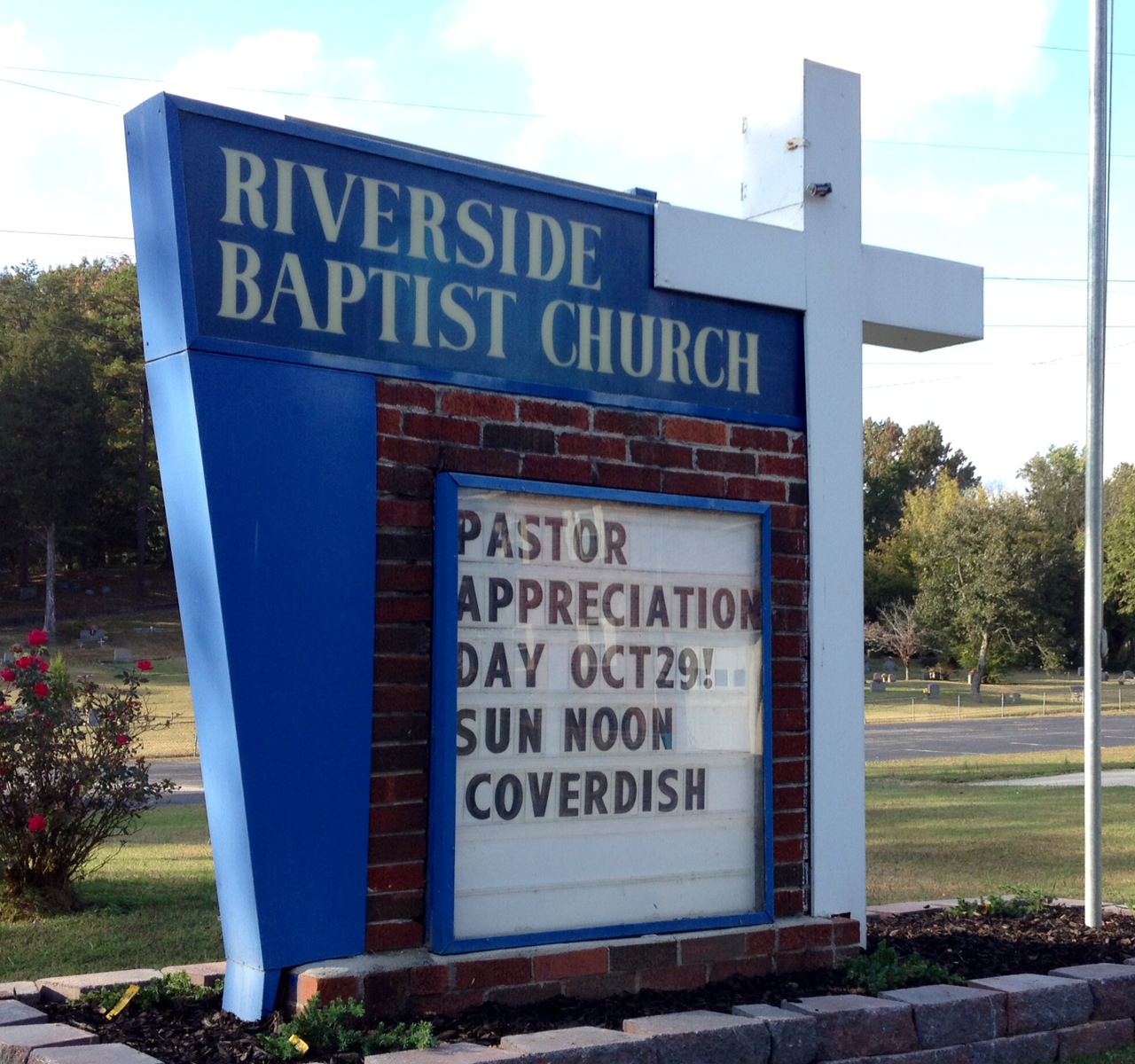
Pastor Appreciation DayOctober is “Pastor Appreciation Month” here in America. Churches all over the place are planning different ways to show their pastors how much they care. Thankfully, Riverside (my church) is no exception: this Sunday, after the morning worship, a covered dish luncheon has been planned. Even though I don’t think anyone is planning on giving me the keys to a new Cadillac, Mexican cornbread would be nice.

The Reason for This Post. Because of all this ‘preecheeashun talk, I feel it is appropriate to address something rarely discussed: pastoral compensation.

In a recent edition (Aug. 16) of the Sword of the Lord newspaper, the editor ripped some comments historian David Barton made during an interview with Glenn Beck. The issue being debated was whether or not a pastor should receive an income from the church.

Should pastors be paid to be pastors? Should they earn their living elsewhere? What does the Bible say? Barton and the Sword of the Lord stand in opposition on this subject. I wonder where my opinion will fall?

Barton’s Belief

In June of 2013, ChristianPost.com discussed an interview historian David Barton had with conservative radio personality Glenn Beck. In that interview Barton spoke of the need for pastors to be more like Paul and become “bivocational.” Anything else he considered “church welfare.”

david barton

David Barton, Wallbuilders.com

“What they (pastors) believe is that they can’t survive without it. Now, I’m a big believer in the way Paul did it. Paul was bivocational. He had his own income so that he wasn’t dependent on a church…Right now what happens is so many ministers depend on their church, and I’m sorry, I often call it church welfare. These are guys that get their check from the church and they don’t want to mess with their check, don’t want to jeopardize that.”

It’s time for more pastors to become bivocational so that nobody can tell them what to do with their money. They own their own money…If the church money dries up, great, they are still ministers and they can still preach because they’ve got an income. So I’m really into that mold. And until we get out of the church welfare mold, the church takes care of me and I can’t afford to lose my check from the church. It’s going to be really tough to get the guys in a different direction.” – from ChristianPost.com

Essentially, Barton believes that a pastor should get a job outside of ministry so that he (the pastor) can better perform the work of ministry. In other words, a self-funded pastor is better than a fully-funded pastor.

Note: someone should inform David Barton of the statistics…most pastors are already bivocational. The economy and declining church attendance has made sure of that.

The Sword’s Swipe

In response to David Barton, the Sword of the Lord editor, Dr. Shelton Smith, wrote the following:

dr-shelton-smith-bio

Dr. Shelton Smith, editor of Sword of the Lord

“Barton is ill advised on this. First of all, it is totally scriptural for pastors to be paid and paid well (1 Tim. 5:17,18).

Secondly, if a pastor hesitates to “take a stand” because he is “taking a salary,” he needs to get a backbone and use it. If he can’t figure out something so simple as how to “take a stand and a salary” without flinching, then your church doesn’t need him as pastor.

Third, any church that would hold the salary over the pastor’s head in an attempt to throttle his voice is not a church where I want to be a member.

Fourth, pastors need to be fully funded so that they can invest themselves fully in prayer, preaching, teaching, soul winning, administering the work, and shepherding the flock. If a man does well with all his responsibilities as pastor, he won’t have a lot of time left to make his living elsewhere.”

Booyah! In your face, Mr. Barton! Seriously, this was a good response, but I do have some minor issues with it.

My Perspective

in old office

My study before I built my new book cases. I was making final notes before a Sunday service. Preparation time is more limited when you’re bivocational.

If you are still reading, I would like to make a few observations. If you are not still reading, then you won’t mind that this piece is a little longer than the average blog post.

Firstjust in case you don’t understand the difference, bivocational pastors are not necessarily “part-time” pastors; they do full-time work for part-time pay. “Part-time” is a misnomer. Bivocational guys need to have other sources of income because the congregations they serve cannot afford to “fully fund” them. The amount of responsibility is often the same.

Also, what we are talking about here are pastors of congregational-type churches, not ones who are paid regardless of where or how they perform the duties of their calling.

Second, I would love to be fully funded (“full time”), but the compensation my congregation can afford is not enough to provide for of a family of four (in this culture), especially when my wife cannot do any regular work. If I were able to walk away from my other jobs (driving a bus, etc.) to spend more time in study, prayer, and other aspects of ministry, that would be wonderful. However, I must deal with the cards I am dealt, and God holds the deck.

Third, regarding David Barton’s thoughts, it would be great if every preacher could be like Paul, but we are not. It is unwise to use Paul as the sole template for pastors, for even though Paul was a tent maker, he spoke several times about the appropriateness of meeting the temporal needs of ministers (1 Timothy 5:17; Romans 15:27; 1 Corinthians 9:9-14; Galatians 6:6).

pastors praying

Bivocational pastors praying for each other at a conference in Pigeon Forge, TN. Small churches; big men.

Fourth, I believe the Sword of the Lord comment is perpetuating a tendency to think of bivocational pastors as second-class ministers. The editor starts off his fourth point by saying “pastors need to be fully funded so that they can…” Can? Are we to understand that pastors who are not fully funded are not able to do what they are called to do? Intentional or not, the Sword is implying that if you want to find a good pastor, you must first look for ones who are paid well. Essentially, if the part-time guy was a better preacher he might have a bigger pay check.

Let me be clear about this. God is the one who ultimately chooses the fields in which His undershepherds are to minister.

“And I will give you pastors according to mine heart, which shall feed you with knowledge and understanding.” – Jeremiah 3:15

“And he gave some, apostles; and some, prophets; and some, evangelists; and some, pastors and teachers; For the perfecting of the saints, for the work of the ministry, for the edifying of the body of Christ:” – Ephesians 4:11-12

Many great men of God faithfully serve smaller congregations, while there are some real heathen leading churches running in the thousands. A man who has a jet is not automatically a man who spends more time in prayer and study. Where one serves should not be an automatic indication of ability.

Finally, it is true that a pastor should faithfully expound the Word without fear. However, without question there are those who fear saying anything to offend the one “holding the purse strings.” But on the other hand, knowing where one’s paycheck comes from can be a useful check on ones ego, brashness, and tendency to run off at the mouth without thinking. Nevertheless, a pastor who muzzles the Spirit for fear of losing his income is no worse than a pastor who’s in the ministry to get rich, and there are a lot of wealthy preachers who fit that bill.

bible“Preach the word of God. Be prepared, whether the time [or pay] is favorable or not. Patiently correct, rebuke, and encourage your people with good teaching [despite your income or other obligations]. For a time is coming when people will no longer listen to sound and wholesome teaching. They will follow their own desires and will look for teachers who will tell them whatever their itching ears want to hear. They will reject the truth and chase after myths. [So, at that point they’re gonna fire you, anyway.]” – 2 Timothy 4:2-4 NLT

To my fellow pastors, keep up the good work and finish well. Our reward is yet to come.

15 Comments

Filed under baptist, General Observations, ministry, Preaching

What to Wear to Church?

“What to wear to church?” has consistently been the number one search entry leading people to The Recovering Legalist. What does that tell you?

If you’ve never read my thoughts on this before, this is the post all the search engines bring up. It was written back in 2010.

Clothing

Recently, I was asked to be the guest speaker at a larger, more contemporary church. Out of respect for each other, the pastor of that church and I jokingly discussed what I should wear. You see, he never wears a suit, while I almost always do. His congregation has become more “contemporary,” while my congregation remains more “traditional.” So, to make me comfortable, the pastor told me whatever I wanted to wear was fine. Therefore, I will compromise – I will probably wear a sport coat, khakis, and flip flops…not really.

The way I dress to go to church may not be the way you dress. My style may not suit your tastes, nor yours mine. But the fact of the matter is that unless you’re totally too liberal, or don’t go at all, you wear some kind of clothing to church, correct? Well, have you ever wondered if what you wear to church is appropriate?

Below are some of my thoughts on the subject.

It’s Not About You

If you are planning to attend a worship service where God is supposed to be the center of attention, don’t dress like a clown! Don’t dress like you are going to an L.A. premier of Lady Gaga’s new movie, It’s All About Me.

Some cultures believe people should come to church in clothing that could damage someone’s retina. Gettin’ “fancied up” is what’s expected. But it’s this type of clothing, in most cases, that draws attention to the congregant, not Christ. My advice is to stay away from neon suits and flashing bow ties. Church clothing should be a covering, not a calling card.

Show Some Respect

Some people think it is totally appropriate to wear enough jewelry and feathers to keep pawn shops in business and all geese naked. Others think it is completely acceptable to look like a drunk that slept in an alley all night (no offense to the drunk). Neither shows a sense of respect. The first steals God’s glory, while the second implies God’s house is no different than anywhere else.

Here’s a couple suggestions. Try going to a White House dinner looking like a hobo or a hippie from the 60’s. Receive an invitation to tea from Queen Elizabeth and show up looking like you just got out of bed and never took a shower. Unless you’re a bonafide rock star, security personnel may escort you to a private room to “get acquainted.” So then, if dignitaries of earthly kingdoms demand respect, why shouldn’t we offer it to our Heavenly King? Is God not greater than Obama? (clear throat)

Beware of Legalistic Standards

However, whatever you wear, don’t be too quick to judge another’s spiritual condition by what they wear. Only God knows the heart.

Who art thou that judgest another man’s servant? to his own master he standeth or falleth. Yea, he shall be holden up: for God is able to make him stand. – Rom 14:4 KJV

Sadly, I have been around many believers who consider one style of clothing a sign of spiritual maturity, while another style a sign of spiritual waywardness.  And you know what’s funny? It doesn’t matter which side of the spiritual tracks, there’s always somebody looking at another thinking, “They’re not right with God.”

Legalism cuts both ways, dear friend. For example, I have been to churches that ridiculed any woman who wears pants, or a man who never tucks in his shirt. On the other hand, I have been in congregations that blatantly condemned all dress and tie-wearers as right-wing, self-righteous, fundamentalist, nut jobs. In both cases someone judged another’s spirituality based on outward appearances, alone. In both cases one group’s set of standards were being used as a guide to what is spiritual behavior, and what is not. That’s LEGALISM!

Believe it or not, the most modern, non-denominational, praise-and-worship-style congregation can be just as legalistic as the narrow-minded traditionalist. I may not prefer to preach in blue jeans on Sunday morning, but I’m not going to condemn someone who does. Likewise, when I don’t wear a suit and tie on Sunday night, I am not going to condemn someone who dresses like he’s going to a funeral.

Context, Context, Context

Ultimately, how you dress should be determined by the context of your community. Small, rural congregations might not feel comfortable dressing for church in the same way a metropolitan First Baptist may. Similarly, churches in depressed economies may adopt different dress codes than upwardly mobile societies. The key is to be respectful, honorable, and considerate of the holy moment at hand. Whatever fits that bill is good enough.

Just keep this principle in mind:  Grace accepts, Maturity develops, and Love constrains.

Don’t make appearances the only thing about which you’re concerned. The Gospel of Jesus Christ is far too important a message to be drowned in petty arguments about whether it is appropriate to dress up for church, or go dress-casual. Many people in the world have to worship Christ underground – literally. Dress codes are the least of their worries. Additionally, the drug addict who needs hope and help may not have any clothes left that he hasn’t already sold to get high. The single mother of five that walks into your church may have barely enough energy to survive, much less do her hair.

Do all things to the glory of the Lord, but keep things in perspective, OK?

My brothers, as believers in our glorious Lord Jesus Christ, don’t show favoritism [or be legalistic]. Suppose a man comes into your meeting wearing a gold ring and fine clothes, and a poor man in shabby clothes also comes in. If you show special attention to the man wearing fine clothes and say, “Here’s a good seat for you,” but say to the poor man, “You stand there” or “Sit on the floor by my feet,” have you not discriminated among yourselves and become judges with evil thoughts? Listen, my dear brothers: Has not God chosen those who are poor in the eyes of the world to be rich in faith and to inherit the kingdom he promised those who love him? – Jam 2:1-5 NIV

8 Comments

Filed under baptist, Christian Living, Christian Maturity, Christian Unity, Culture Wars, Do not judge, Independent Baptist, legalism, Southern Baptist

Examining a “Hissy Fit”

Introduction

The following piece is meant to be informative, not critical, even though I may criticize a little, and I apologize in advance for the length. All in all, I hope that it will help lead people away from unhealthy, legalistic, and abusive churches by helping them recognize “red flags.”

Not all pastors are abusive megalomaniacs. The ones that are should be called out and held accountable, for their poor witness harms not only the Church, but the world to which we are called to be witnesses.

Hissy Fit

Several months ago a video was posted on YouTube. That video shows Dr. Jim Standridge, pastor of Immanuel Baptist Church in Skiatook, Oklahoma, publicly chastising members of his congregation.

Since its release, the video has gone viral with over 700,000 views, so far. I was made aware of this video a couple of months ago when friend on Facebook posted it to her wall and created a stir. It was originally posted on a website called Stuff Fundies Like.

Personally, I think it is a shame that something like this has been put out for all to see, for it damages the reputation of all who sincerely follow Christ. I even have problems with the website that originally made this widely available. But since it is out there and not going away, I feel it should be addressed.

Context

It is important to look at things in their proper contexts before we come to conclusions. That is why I wanted to find the video of Dr. Standridge’s entire sermon. I found it on Immanuel Baptist Church’s website and watched the entire thing, making plenty of notes.

Those commenting in defense of this video have said things like: “You shouldn’t judge a man based on this one video…we don’t know what led up to him talking this way.” In an interview with The Christian Post, even Dr. Standridge said, “…you can’t judge a man by one message.”

But is that entirely so? During the time it took to watch the hour-long sermon I noticed several “red flags” that told me this was probably not an isolated incident.

Full Sermon (see if you can spot the red flags)

NOTE: The video was taken down, so I’m glad I reviewed it when I did!

http://vimeo.com/66510051

Red Flags

The term “red flag” is used to describe a warning sign. The following are some of the red flags I noticed while watching the full sermon preached by Dr. Standridge on May 19, 2013.

1) The need to express self-importance, along with possessiveness.

In less than two minutes into the sermon (1:13), Dr. Standridge first addresses the boy that was to fall asleep. He says: “Son, look at me – I’m the man, baby.” Later (39:23), he addresses the boy again and says: “I’m somebody…now you might do your English teacher thataway [sic], but I’m not teaching English…”

To the same boy he says, “I’m not some little hireling” (20:55). Then, at the 48:20 mark: “I don’t care…I do care, but I don’t care…It’s like that young boy right there, he don’t know who I am.”

In the infamous part where Dr. Standridge talks to Mr. Cox, the man in the video room, he says: “…you don’t care about what I want to do right…if you loved me, and you submitted to me, you’d know what my heart is and my message is…(43:00). Then, at the 47:25 mark he says: “You may be the best sound man…but that’s my sound room before it’s yours!”

Towards the end Dr. Standridge confronts a girl named Wendy (1:01:39) and plays the guilt card: “You count my life as something, well, very secondary, if anything.”

2) Belittling others.

In one hour Dr. Standridge manages to put down skateboards, comparing them to witch’s brooms (1:13; 4:39), texting (54:35-55:20), secular college education (1:01:39), the right of a mother to be upset (48:11), a woman’s needs (3:50), and a wife’s spirituality and intelligence (6:50-7:25).

3) Threats

In several places Dr. Standridge threatens to leave the church if the congregation doesn’t want to hear what he has to say. “Now if you don’t want me…”(40:50).

4) Publicly announcing church members’ faults.

What gets Dr. Standridge into so much trouble is where he calls out Mr. Cox in the sound/video room and the young couple about to get married (as seen in the YouTube clip). But where some want to say that was just an isolated incident, the reality is that he did this from the beginning to the end of the sermon!

The fact that he would say in front of the church that a young man was “one of the sorriest church members” and “not worth 15 cents” (39:50) was completely inexcusable. And, telling Angela, a young wife, that she should quit questioning her husband and start submitting to him (6:50-7:25) was completely out of line.

5) Following abuse with “You know I love you.

It was really hard to keep track of how many times Dr. Standridge followed a stinging comment or snide remark with something like, “You know I love you, don’t you?” He said this to Mr. Cox and put him on the spot with a hug (39:50ff) right after telling him he wasn’t worth 15 cents! He even asked the poor skater boy: “Have I convinced you I love you? You better nod your head yes.” (39:23ff)

Even more, his love comments were commonly used as a justification to the congregation for his actions: “I love that boy right there” (1:13);  “Now, let me tell everybody here how much I love these kids” (referring to Mr. Underwood and his bride to be). This is what abusive husbands do, not pastors.

Scripture

1 Timothy 5:20 says: “Them that sin rebuke before all, that others also may fear.” The only problem with using that verse to justify what Dr. Standridge did/does is that this verse was meant for elders…Pastors (vs. 18-19)I cannot see any reason why it had to come to a point where the pastor of a church called out so many people for their supposed sins and inconsistencies.

Long before any of the people chastised by Dr. Standridge should have been publicly reprimanded, Jesus set the pattern for how to deal with church issues…privately, with one or two, then before the church.

“Moreover if your brother sins against you, go and tell him his fault between you and him alone. If he hears you, you have gained your brother. “But if he will not hear, take with you one or two more, that ‘by the mouth of two or three witnesses every word may be established.’ “And if he refuses to hear them, tell [it] to the church. But if he refuses even to hear the church, let him be to you like a heathen and a tax collector.” (Matthew 18:15-17 NKJV)

So much pain and embarrassment, both for the individuals involved and the church in general, could have been spared had Dr. Standridge heeded the wisdom of Solomon: “He who covers a transgression seeks love, But he who repeats a matter separates friends.” (Proverbs 17:9 NKJV)

Final Thoughts

As I see it, Dr. Standridge should have been asked to resign after this sermon, but as with any abused wife, the congregation defends what he said. When I spoke of it to my congregation, they agreed that if I had done anything similar I would be looking for a job.

Not all pastors are like Dr. Standridge, even on a bad day; those who are should be called to the carpet (1 Timothy 5:20). Sure, we make mistakes and say things we regret, but most of us aren’t arrogant and abusive. We love our flocks to the point of laying down our own lives (John 10:11). The last thing we want to do is embarrass and shame people; we want to see them restored, edified, and molded into the image of Christ (Romans 8:29).

7 Comments

Filed under abuse, baptist, Christian Maturity, Christian Unity, Independent Baptist, legalism, Preaching

Tent Makers Unite!

In February of 2012 my wife and I decided to attend a special retreat for bivocational ministers and their wives. The retreat was held in Pigeon Forge, TN, at the Music Road Hotel and Convention Center.

We had a great time.

Bi-Vocational

Just in case the above term is unfamiliar to you, a bivocational minister is one who performs the duties expected of a full-time minister/pastor, while also having to maintain other (secular) employment. The size of their church or congregation (or how much they are compensated) has no bearing on their abilities or calling. They are only serving where God has sent them.

Unfortunately, bivocational pastors are often stigmatized as “second-rate” leaders. Some people think that if they were more qualified, more gifted, or better speakers they would pastor larger churches. The fact is that most churches, especially in my denomination, are led by men who are more than qualified to maintain a “higher station.” However, the real issue is that most congregations are smaller (35-100) and cannot afford to pay a full-time pastor.

Tent Makers

So, bivocational pastors carry on in the tradition of the Apostle Paul. Although Paul said in 1 Corinthians 9:14 that it is perfectly acceptable for “those who preach the Good News [to] be supported by those who benefit from it (NLT),” he chose to continue to make tents (Acts 18:1-3). But unlike Paul, many of today’s bivocational pastors have to work another job in order to survive. Some do it by choice, but most do it out of necessity, especially those with families.

Now, it may sound bad, but there is an upside to being bivocational: we know what it is like to live in the real world. We have to deal with employers and employees. We know what it’s like to have problems at work, then go to church. We have schedules to juggle, bills to pay, etc. We are just like the people to which we minister. We don’t live in ivory towers.

Extra Tough

But one of the real downsides to being a bivocational pastor is the loneliness. Many don’t understand that we have the same demands, if not more, as pastors of larger churches – yet, with no staff. On top of that, we don’t have time to go on ministry retreats, sabbaticals, or attend conferences during the week. We can’t even get together with other pastors for breakfast to “talk shop” like full-time ministers do – because we’re usually at work. And because of all of this, we get lonely. We get discouraged. We get tired. But it doesn’t have to be that way all the time.

Bivocational Pastors and Wives Retreat

I’ve said a lot to say this: even though it is hard to make the time, sometimes we have to make the time, regardless. That is why, even though it was inconvenient, my wife and I went to the retreat in Pigeon Forge. We needed the encouragement. We needed to be around others in the same boat, on the same sea.

If you are a bivocational minister, you need to seek out and maintain friendships with other men you can trust, especially men in the same kind of ministry. It is so important that you don’t try to do things alone. Likewise, there are probably other men out there who could use your friendship.

Churches, do your pastor and yourselves a favor: plan to send your pastor and his wife on a retreat. Both of you will benefit from the encouragement. He will be strengthened, and his burden will be lightened.

Towards the end of our retreat, a beautiful time of prayer took place. It was a little impractical for us to wash each other’s feet, but we did do something special. Scripture says “how beautiful are the feet of those who bring good news,” but sometimes those feet don’t feel so beautiful, or loved. I wish all of you could have heard the weeping and seen the tears as grown men, God’s men, got on their knees and humbly prayed over the feet of their brothers. I felt like I was in a room full of heroes.

One member came up to me the Sunday after the retreat and asked, “Something happened to you last week when you were gone, didn’t it?

I said, “Sure did…

9 Comments

Filed under baptist, Christian Living, Christian Maturity, Christian Unity, God, ministry, Preaching, Relationships and Family, Southern Baptist, worship

Sunday School – Something Has to Change!

 This week I was given a discussion question. I was asked to “present a list of diagnostic questions that can be used to evaluate the theological foundations of the discipleship program of a local church.” At least three of the diagnostic questions needed to address God, Jesus Christ, and the Holy Spirit. Therefore, in response, I prepared several evaluation questions aimed at discovering how God, Jesus, and the Holy Spirit are being presented to our youth, including questions aimed at discovering the level of understanding regarding the importance of teaching theology on an applicable level.

Questions to Evaluate the Theological Foundations of a Youth Discipleship Program

In The Teaching Ministry of the Church Octavio J. Esqueda defined the word theology as “the study of God,” which comes from the Greek words theos (God) and logos (speech, reason, word). Then he went on to say, “To do theology is to reflect on God. Our theology, or the lack of it, affects the way we think and live.”[1] So, the first question is

“What are we teaching our youth about God that will not only inform them of his nature, but will cause them to live differently than they are taught in the world?”

How we think about God should affect how we live, but even though many may learn about God’s attributes, they rarely learn to appropriate the truth that He is ever-present, all-knowing, and all-powerful in their lives. The problem that many churches face, including ours, is scores of children who learn enough about God to describe him intellectually, but know little of him from an experiential perspective. Do they fear Him? Have they ever made the personal connection that what God did to his Son should have been done to them? Do they know that how they live outside of church is more important than their Sunday school attendance? How they really understand God as a real person will affect how they think and live outside of the classroom. They need to be imitators of God (Ephesians 5:1) in the world, not just church.

In two different places (Matt. 16:13; Mk. 8:27) we read how Jesus asked, “Who do men say that I am?” Who do our youth say that Jesus is? Is He a perpetual baby wrapped in swaddling clothes? Is He just the namesake of the club (the church) they were forced by their parents to join? Do they think of Him as God, or as a moral teacher akin to the founders of other “great” religions? Michael J. Anthony wrote in A Theology for Christian Education that being able to articulate one’s understanding of the deity, humanity, earthly ministry, and work of Christ is essential to one’s spiritual maturity.[2] Are we turning out “mature” young adults when they leave our youth department? The second question is…

“How are we teaching who Jesus Christ is, and in what ways can we determine what we are teaching is effective?”

When it comes to the Holy Spirit, Baptists are typically scared to death. They are more likely to talk about fried chicken than the “fire” of the Holy Ghost. However, Jesus spoke very clearly when he said that he would send another Comforter to abide with us (John 14:16). The Holy Spirit is not only critical to our ability to teach, but to understand the Bible, the core of our curriculum. Do we ever teach our young people about the indwelling power of the Spirit which enables them to deal with peer pressure and temptation? Do they know about His ability to help them understand the “bronze-aged” document their atheist professors routinely ridicule? Therefore, the third question is…

“What are we teaching our youth about the Holy Spirit?”

The sad truth is that many youth programs, if not the majority, lack quality teaching, and we are sending our youth into the unbelieving world unprepared. Just take the word school in “Sunday school” – it’s a misnomer – it doesn’t exist. If it does exist, then most youth programs are the equivalent of a high school that sends students to college without ever teaching them how to read!

Something drastic has to be done, that is for sure. Regular teachers in regular schools try to prepare students to deal with life once they graduate. They teach with a goal in mind. They have lesson plans. They are forced to show that their students are learning. What are we doing in the church? Are our children any more prepared for the world than when they first started coming? Will their faith endure or fall apart once they reach college?

We have such a narrow window through which to teach our youth how to be Christians, not just wear a label. They spend eight hours a day in a school that teaches them how to “gain the world,” but what will if profit them, or us, if they lose their soul (Mark 8:36) due to one hour a week of poor Christian education? Proverbs 22:6 says, “Train up a child in the way he should go: and when he is old, he will not depart from it.” The reason so many are departing is not because the proverb is false; it’s because they have never been taught.

God help us. One day we will give an account.


[1] William R. Yount. The Teaching Ministry of the Church. 2nd edition. (Nashville: B&H Publishing, 2008), 32.

[2] James R. Estep, Jr., Michael J. Anthony, and Gregg R. Allison. A Theology for Christian Education. (Nashville: B&H Publishing, 2008), 125.

1 Comment

Filed under baptist, Christian Maturity, Faith, General Observations, Southern Baptist, Theology, Uncategorized, Witnessing

Block Party 2012

What is Evangelism?

I know a whole lot of Christians who would disagree with what we did at Riverside Baptist, today. They would say, “You never preached, handed out a tract, or sang a gospel song. You call this outreach?

Why, yes I do.

You see, there are many in the Church who think that there is only one way to evangelize the lost and reach the back-slidden. They would never even consider having  an event where no one preached, handed out literature, or did a mock hell pit with straw-men torches. They would consider our event a failure.

But what is evangelism? Is there only one way of reaching people with the gospel? Is there only one way to show people you care about them?

An Old Adage

Painting faces.

I believe it was Zig Ziglar who said, “People will never care what you know until they know how much you care.” That is the absolute truth, too. And that was the mission of our block party.

There are so many who are not in church simply because they feel unloved and unwanted. They think that all Christians want to do is take up offerings and sing old hymns. The last thing they ever think is that we are real people who really care about their lives. If they could only know that we care, they might want to hear what we believe.

Instructions

As pastor of Riverside, I gave instructions to all who were to participate at this event. I did my best to make it perfectly clear what was expected of each of us.

  • Kids in a fire engine.

    First, this was not to be a church service. We invited people to a party, not communion.

  • Secondly, everything was to be free. No asking for donations. No admission. No charge for “stuff” that was done.
  • Next, it didn’t matter who showed up, they were to be talked to and befriended. I asked all of my congregation to show up, if for no other reason than to just sit and talk. People like to sit and talk about their lives to somebody who actually listens – and cares.
  • Have fun without any expectations.

This event was to be a seed-planting event. It was to be a time to let the community know that we are here. It was to be a time to let the Holy Spirit work through us in the way that we cared.

The Results

Eating inside where it was cool.

My legalistic friends (do I have any legalistic friends?) might like to ask me how things turned out. I am sure they would want to know how many got saved. I am sure that they would love to ask me at what point I stood up and shared the gospel with all the visitors. I am sure that they would love to point out that this event was a failure, since there was not one conversion.

I would totally disagree.

Our little church had scores of people show up today. Many of them did not attend any church. How do I know that? Because they told me so. They filled out cards in order to register for genuinely nice door prizes.

I got to talk with one young mother who wanted to go to church, but thought people would make fun of her tattoos.

I spoke with a young mother of four who wanted to go to church, but felt that her life was too messed up. Oh, really? I told her we would love to have her. I told her about how God’s grace and forgiveness was there for her.

The Expectations

What do I expect? I expect to see visitors at church in the morning. I expect our members to come to church tired, but with a feeling of hope. I expect people to show up that didn’t even come to the block party (because that’s how God works).

Smiling coming and going.

I expect kids on my bus to mention to their families that their bus driver is a preacher, but he is cool.

I expect people who never talked about this little church to talk about this little church and say, “Hey, those people are really nice. Why don’t we go hear that guy preach?”

I expect more things to come.

2 Comments

Filed under baptist, Food, legalism, salvation, Witnessing

Monday Monkey “Graduation 2012” (Episode 21)

Graduation Day

Well, technically, my degree was conferred in December, 2011. However, this was the day when everybody walked. So, what was I supposed to do? Miss the opportunity to take Mr. Monkey?

The poignant thing is that my dad went to TTU from 1972-73. He never actually graduated. He would be proud to have been here, today.

Long Time Coming

I graduated high school in 1985. I got my Associates in 1995. Even after two additional years of study which was non-accredited, I decided to go back and take 2 more years in order to get my Bachelor of Science in Bible (Pastoral Studies).

I owe a great debt to my wife, Valerie, and my girls for putting up with me.

1 Comment

Filed under baptist, Christian Maturity, Life Lessons, ministry, Monday Monkey, Southern Baptist, Theology

It’s Only a Steeple. Really?

A Steeple

If there is one bit of architecture that characterizes a Christian church, it is the steeple. Compared to the one at Woodland Park Baptist, Chattanooga, TN, ours is a fiberglass toothpick.

The first time I saw their steeple it took my breath away. A friend of mine and I were driving down the road, then all of a sudden there it was, just piercing the sky like a spear. Actually, it was sorta scary, sorta intimidating.

When my girls and I were out today, I drove them by the church to see this hazard to low-flying aircraft. They were equally impressed. Even though this portion of the church building is still under construction, the grounds are not finished, but who cares when you’re looking up?

Only a Steeple. Really?

One needs to remember, though, that a church a steeple does not make. The true Church is not even a building, but the body of Christ made up of believers in Jesus. We don’t worship steeples, or buildings, or people who build them. They are only things. The Church doesn’t need a steeple to be a church, nor does it need a steeple to point toward the risen Savior of the World. Steeples are just nice.

But as we drove away, today, I had a conspiratorial thought. What if what Woodland Park has built is not just a steeple, but something far different?

What could it be?

  • A camouflaged intercontinental missile developed in conjunction with the former George W. Bush administration?
  • A tower in which to house Bill Maher, Rachel Maddow, Chris Matthews, and all other left-wing media once Santorum is elected President?
  • A secret Holy Spirit antennae which allows Dr. Wayne Barber to receive knowledge unavailable to the common Christian?
  • A high-frequency radio signal tower that is sending out subliminal messages, making Independent Baptists join the Southern Baptist Convention?
  • A “Rapture Rocket.” In the even that the rapture skeptics are correct in their eschatology, select Woodland Park members, such as those who publish their own Bible studies, will leave Earth for the third heaven?

You just never know, do you?

7 Comments

Filed under baptist, General Observations, Humor, Southern Baptist

What to Wear to Church?

Clothing

Recently, I was asked to be the guest speaker at a larger, more contemporary church. Out of respect for each other, the pastor of that church and I jokingly discussed what I should wear. You see, he never wears a suit, while I almost always do. His congregation has become more “contemporary,” while my congregation remains more “traditional.” So, to make me comfortable, the pastor told me whatever I wanted to wear was fine. Therefore, I will compromise – I will probably wear a sport coat, khakis, and flip flops…not really.

The way I dress to go to church may not be the way you dress. My style may not suit your tastes, nor yours mine. But the fact of the matter is that unless you’re totally too liberal, or don’t go at all, you wear some kind of clothing to church, correct? Well, have you ever wondered if what you wear to church is appropriate?

Below are some of my thoughts on the subject.

It’s Not About You

If you are planning to attend a worship service where God is supposed to be the center of attention, don’t dress like a clown! Don’t dress like you are going to an L.A. premier of Lady Gaga’s new movie, It’s All About Me.

Some cultures believe people should come to church in clothing that could damage someone’s retina. Gettin’ “fancied up” is what’s expected. But it’s this type of clothing, in most cases, that draws attention to the congregant, not Christ. My advice is to stay away from neon suits and flashing bow ties. Church clothing should be a covering, not a calling card.

Show Some Respect

Some people think it is totally appropriate to wear enough jewelry and feathers to keep pawn shops in business and all geese naked. Others think it is completely acceptable to look like a drunk that slept in an alley all night (no offense to the drunk). Neither shows a sense of respect. The first steals God’s glory, while the second implies God’s house is no different than anywhere else.

Here’s a couple suggestions. Try going to a White House dinner looking like a hobo or a hippie from the 60’s. Receive an invitation to tea from Queen Elizabeth and show up looking like you just got out of bed and never took a shower. Unless you’re a bonafide rock star, security personnel may escort you to a private room to “get acquainted.” So then, if dignitaries of earthly kingdoms demand respect, why shouldn’t we offer it to our Heavenly King? Is God not greater than Obama? (clear throat)

Beware of Legalistic Standards

However, whatever you wear, don’t be too quick to judge another’s spiritual condition by what they wear. Only God knows the heart.

Who art thou that judgest another man’s servant? to his own master he standeth or falleth. Yea, he shall be holden up: for God is able to make him stand. – Rom 14:4 KJV

Sadly, I have been around many believers who consider one style of clothing a sign of spiritual maturity, while another style a sign of spiritual waywardness.  And you know what’s funny? It doesn’t matter which side of the spiritual tracks, there’s always somebody looking at another thinking, “They’re not right with God.”

Legalism cuts both ways, dear friend. For example, I have been to churches that ridiculed any woman who wears pants, or a man who never tucks in his shirt. On the other hand, I have been in congregations that blatantly condemned all dress and tie-wearers as right-wing, self-righteous, fundamentalist, nut jobs. In both cases someone judged another’s spirituality based on outward appearances, alone. In both cases one group’s set of standards were being used as a guide to what is spiritual behavior, and what is not. That’s LEGALISM!

Believe it or not, the most modern, non-denominational, praise-and-worship-style congregation can be just as legalistic as the narrow-minded traditionalist. I may not prefer to preach in blue jeans on Sunday morning, but I’m not going to condemn someone who does. Likewise, when I don’t wear a suit and tie on Sunday night, I am not going to condemn someone who dresses like he’s going to a funeral.

Context, Context, Context

Ultimately, how you dress should be determined by the context of your community. Small, rural congregations might not feel comfortable dressing for church in the same way a metropolitan First Baptist may. Similarly, churches in depressed economies may adopt different dress codes than upwardly mobile societies. The key is to be respectful, honorable, and considerate of the holy moment at hand. Whatever fits that bill is good enough.

Just keep this principle in mind:  Grace accepts, Maturity develops, and Love constrains.

Don’t make appearances the only thing about which you’re concerned. The Gospel of Jesus Christ is far too important a message to be drowned in petty arguments about whether it is appropriate to dress up for church, or go dress-casual. Many people in the world have to worship Christ underground – literally. Dress codes are the least of their worries. Additionally, the drug addict who needs hope and help may not have any clothes left that he hasn’t already sold to get high. The single mother of five that walks into your church may have barely enough energy to survive, much less do her hair.

Do all things to the glory of the Lord, but keep things in perspective, OK?

My brothers, as believers in our glorious Lord Jesus Christ, don’t show favoritism [or be legalistic]. Suppose a man comes into your meeting wearing a gold ring and fine clothes, and a poor man in shabby clothes also comes in. If you show special attention to the man wearing fine clothes and say, “Here’s a good seat for you,” but say to the poor man, “You stand there” or “Sit on the floor by my feet,” have you not discriminated among yourselves and become judges with evil thoughts? Listen, my dear brothers: Has not God chosen those who are poor in the eyes of the world to be rich in faith and to inherit the kingdom he promised those who love him? – Jam 2:1-5 NIV

13 Comments

Filed under baptist, Christian Living, Christian Maturity, Christian Unity, Culture Wars, Do not judge, Independent Baptist, legalism, Southern Baptist

Glass or Wood? Depends On What You’re Hiding.

It may have never crossed your mind, but for some it is a question more important than whether or not someone chooses to be a Calvinist…

Glass or Wood?

What am I talking about? Pulpits. Sacred desks. Lecturns. The piece of furniture behind which preachers stand and do battle with the devil, not to mention anoint the blessed on the front row with sanctified spittle.

Believe it or not, many have nearly gone to fists over whether the wooden pulpit should be replaced with a more modern, see-through, beautifully-etched glass one. I don’t know why it is such a big deal, except for pastors who might feel totally naked with nothing to hide behind.

On the other hand, glass pulpits have one major disadvantage – you can’t put stuff in them. If you don’t think that is a problem, then you have never looked inside one. Or, maybe you have never been in a service that required the items contained behind those sacred doors.

I’ll never forget the first time I took a pastorate and decided to inventory the items in the pulpit. I opened the doors, sat down on the floor, and quickly realized that this was a place few ever saw. If they had, they may have claimed some of the items in there for themselves, if not for the owners (which had probably been buried in the church cemetery 10 years ago).

There were old bulletins, vials of olive oil, broken pencils and pens with dry ink. There were 20-year-old mother’s day poems, and stale breath mints. In one corner was a single gold earring, a half-stick of hard chewing gum, and a dead ant. To one side was a hymnal with pages missing and a Gideon Bible. To the other side were the minutes from a 1980 business meeting and a cassette tape. There were even old illustrations typed on 3×5 cards, a laminated obituary, three Happy Meal toys, and ten broken crayons.

None of those things would look good in front of a preacher’s knees, so a see-through pulpit would be unacceptable. Even if I had a big, rotating, golden skeleton of the earth behind me when I preached, someone would get distracted. You never see Joel Olsteen standing behind stacks of paper and old candy, do you? NO!

But if we are going to keep the old pulpits in many of our churches, shouldn’t we make better use of them? Why hide away useless memorabilia, tasteless mints, and dead bugs? Why not make it a tool shed? Why not store things that could actually be used in an emergency?

Here are some suggestions:

1. A cooler. Wouldn’t that be more convenient than having a deacon bring you water that sits out and gets warm during the message?

2. An air horn. This would be to wake up the 3rd-shifters that nod off in the service.

3. Altoids.

4. Kittens. You would never have to worry about losing anyone’s attention again. When the message starts to get dull, bring out a kitten and everybody wins.

5. Flame Thrower. Would be good for self-defense and an awesome illustrative tool for evangelistic services.

6. A Fire Extinguisher. For when illustrations go wrong. Safety first, you know.

7. Sermons that Work. For those days when nothing else seems to do the trick, a book of pre-written messages could help keep the preacher from looking like he didn’t study.

Well, whichever you choose for your church, just keep one thing in mind…

2 Timothy 4:2-4 “Preach the word; be instant in season, out of season; reprove, rebuke, exhort with all longsuffering and doctrine. For the time will come when they will not endure sound doctrine; but after their own lusts shall they heap to themselves teachers, having itching ears; And they shall turn away their ears from the truth, and shall be turned unto fables.”

4 Comments

Filed under baptist, General Observations, ministry, Preaching, Southern Baptist