Category Archives: Preaching

Preach Civility At the Very Least!

To be honest, I’ve had people tell me that I preach too much politics from the pulpit. Some of them have been members of churches where I pastored, and some of them have left to find other places to worship (presumably). But if you think I’m going to apologize at this point, you’re mistaken.

I have nothing to apologize for (not even for ending this sentence with a preposition – which I despise, by the way). Despite what the complainers may say, I don’t stand behind a pulpit and tell people whom to vote for or what party to which they should belong. When the subject needs to be addressed, or especially when it falls in line with a topic within an expositional study of Scripture, what I do is address the issue from a biblical position so that believers know what the Bible has to say. After all, if the Word of God is to be our rule and guide for life, shouldn’t it guide the way we act as citizens?

During the last presidential election cycle I never once told anyone to vote against Hillary Clinton and for another candidate. However, I did not hide what I believed would happen, specifically to the churches of America, should Hillary Clinton be elected president, and I based that entirely on her statements and precedent set by the past administration. But at the same time (and I have the recording to prove it), when preaching through the book of Acts, I came to the passage where Paul dealt with an oracle that had a “pythian spirit” and warned against the dangers of electing a man who considered Paula White a spiritual counselor.

The fact of the matter is that, as a shepherd, a pastor has the responsibility to not only preach biblical truth but to apply that truth in the context of the lives of the congregation. After all, why teach of the “sufficiency of Scripture” if I don’t practice what I preach by offering Scripture as a guide for every-day decisions? Especially when those decisions can have a real and tangible bearing on the future of the whole congregation!

Yet, there will be those who disagree with me. They will condemn any preacher like me who dares address any subject that might overlap with an official party platform. Even the appearance of disagreeing with a politician’s actions or beliefs will be used as an opportunity to say that I’m too political.

Is it too political to preach against slavery?

Is it too political to preach the dignity of humanity as the result of being made in the image of God?

Is it too political to preach that women and men are of equal value, not only before God but in the Church?

Is it too political to preach that Jesus loves children and doesn’t want them – or widows – to starve?

Is it considered too political to preach against killing infants in the womb? Evidently.

Is it too political to preach against infidelity, lying, immorality, etc.? Depends. If it’s about Donald Trump, then it’s all good.

Is it too political to call for prayers of peace? To pray for our leaders? During the Trump administration, evidently yes. Now, if I were to be like another pastor who said, “God d**n America!”, that would be just fine.

But I digress.

What about civility? What about praying for our leaders? What about loving our enemies? What about giving our enemies food when they are hungry and something to drink when they thirst? Again, that’s all too political if you don’t support same-sex marriage, abortion, transgender scout leaders, sex education in kindergarten, and anything else that winds up falling under the liberal left’s rainbow umbrella.

But now we have elected officials and public media calling for harassment, abuse, and even harm against anyone remotely connected with the current administration. Does the Bible have anything to say about that? And, if the Bible does address these issues in clear and blunt language, isn’t it worth preaching?

Bless them that curse you, and pray for them which despitefully use you.  – Luke 6:28

I exhort therefore, that, first of all, supplications, prayers, intercessions, [and] giving of thanks, be made for all men;  For kings, and [for] all that are in authority; that we may lead a quiet and peaceable life in all godliness and honesty.  For this [is] good and acceptable in the sight of God our Saviour;  Who will have all men to be saved, and to come unto the knowledge of the truth. – 1 Timothy 2:1-4

Recompense to no man evil for evil. Provide things honest in the sight of all men. If it be possible, as much as lieth in you, live peaceably with all men. Dearly beloved, avenge not yourselves, but [rather] give place unto wrath: for it is written, Vengeance [is] mine; I will repay, saith the Lord. Therefore if thine enemy hunger, feed him; if he thirst, give him drink: for in so doing thou shalt heap coals of fire on his head. Be not overcome of evil, but overcome evil with good. – Romans 12:17-21

I guess if Jesus and Paul said it, it must be too political.

But I don’t preach politics; I preach the Word.

I charge [thee] therefore before God, and the Lord Jesus Christ, who shall judge the quick and the dead at his appearing and his kingdom; Preach the word; be instant in season, out of season; reprove, rebuke, exhort with all longsuffering and doctrine. For the time will come when they will not endure sound doctrine; but after their own lusts shall they heap to themselves teachers, having itching ears; And they shall turn away [their] ears from the truth, and shall be turned unto fables. – 2 Timothy 4:1-4

That’s the real reason people get upset. I really hate it for them. I really do.

But I have a charge, and I must give an account to God, not man. So, I will preach.

Would to God we had more pastors who’d do the same.
7 Comments

Filed under America, politics, Preaching, Uncategorized

Three Things About Barnabas

Preaching Through Acts

For several months I have been preaching through the Book of Acts again, both in our Wednesday-night Bible study and for Bible school classes at Covington Seminary. It’s always a blessing, to say the least.

The Book of Acts is Luke’s written record of the early Christian church. In it, he records for us key events and people through which God, through the power of the Holy Spirit, birthed, nurtured, and sent out those who would “turn the world upside down” (Acts 17:6).

Taking a few verses at a time, I have sought to deliver what it is God wants our little congregation to learn and apply in our context, especially at this time in which we are in.

Barnabas

One of the key personalities in Acts is a man by the name of Barnabas. He was a Levite from the country of Cyprus who became a follower of Christ. He was a generous man, a godly man, and one whose name fit his personality; he was the “son of consolation” (Acts 4:36-37).

Barnabas was the type of guy that truly cared about people and wanted to see them succeed. He was more than just a team player; he was a motivator, the kind of man who would step down from the pedestal so that someone else could shine. As a matter of fact, it was Barnabas who introduced Saul (Paul), the former persecutor of Christians, to the church at Jerusalem (talk about having someone’s back!).

But in preaching through chapter 11 of Acts, I came across a description of Barnabas that left me very convicted. The way Barnabas was described should be how we are described: good people, full of the Holy Ghost, and full of faith (11:24).
A Good Man

The first thing said about Barnabas was that he was “a good man.” Now, a lot of people think they are good people, but not all are. As a matter of fact, there’s no other place in Acts where Luke describes a person as “good.” Only Barnabas gets that distinction.

Being described as “good” meant that he was a man with whom no one could find fault. He must have been a man of strong character, a man who kept his word, and a man who would do anything for anybody, including give the last coin to one in need. He was the kind of man Jesus was talking about when He said, “A good man out of the good treasure of his heart bringeth forth that which is good” (Luke 6:45). Barnabas was genuine, the “real deal.”

Full of the Holy Ghost

Barnabas was also “full of the Holy Ghost.” What does that mean? Well first off, let’s think about the description of “full.”

The Greek word translated as “full” is one that meant not only to be filled up but filled up to the point of overflowing. Barnabas was totally yielded and filled with the Spirit, so much so that His presence spilled over onto others. The “son of consolation” was an encourager, just like the Spirit controlling and empowering him.

Full of Faith

Barnabas was not only full of the Holy Ghost but also of faith. Simply put, Barnabas was fully convinced and persuaded with what he believed to be true. There was no doubting, no hesitation, no reluctance, no hiding, no timidity. Barnabas was sure in the gospel of Jesus Christ, and that is one reason he was sent by the church in Jerusalem to see what was going on in Antioch of Syria.

The Result

Now, let’s look at what happened because of Barnabas’ character, his spiritual power, and his sure faith.

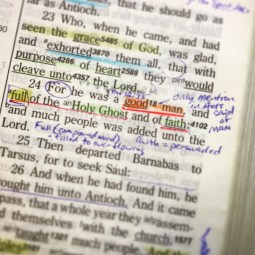
“Who, when he came, and had seen the grace of God, was glad, and exhorted them all, that with purpose of heart they would cleave unto the Lord. For he was a good man, and full of the Holy Ghost and of faith: and much people was added unto the Lord.” – Acts 11:23-24 

First, because he was a good man, he was not jealous of the good things happening in Antioch; he rejoiced that the grace of God had been poured out on the believers there!

Second, because he was full of the Holy Ghost, what was in his heart (as Jesus described) had to be shared, so he “exhorted” them and encouraged them in their faith.

Third, because Barnabas knew what temptations and trials could come, especially with the persecution following Stephen’s death fresh on his mind, he encouraged the new believers to be pro-active in their devotion to the Christ. He knew that the only way to have a strong faith is to purposefully “cleave unto the Lord.”

Fourth, many people were added unto the Lord! Because of the spirituality and faith and character of godly Barnabas, not only were new believers in Antioch strengthened, but many more people came to know Christ!

The Challenge

Here’s the thing. Why aren’t more people coming to a saving faith in Jesus? Why aren’t more of our churches encouraged? Why aren’t more Christians spiritually maturing in their faith? It’s because we don’t have enough men and women like Barnabas.

Be a good person! Seriously, be the type of man or woman that people can trust and rely on. Be the type of person that people can tell you care. Be generous, compassionate, trustworthy, and consistent. Be people of honor and character.

Be filled with the Spirit! Do you know what it means to be completely filled with the Holy Ghost of God? It means there are no little rooms, closets, or boxes in your heart where there is written a note to God which says, “Private! Hands off!” Every are of your life – every secret part – should be yielded to and controlled by the Spirit of God. Otherwise, you are self-controlled and rebellious, and thereby powerless.

Be full of faith! Grow your faith. Study God’s Word. Know why you believe what you believe. Don’t be a coward! If you are shy or feel intimidated to share your faith with others, ask yourself why that’s so!

Would you be afraid to warn your neighbor a murderer was crawling through his bedroom window? Would you be afraid to yell “fire!” if flames were engulfing the rooms of a hotel where people were sleeping? It’s only because you are NOT full of faith that you are not bold; you have doubts the fire is real and the murderer really means to harm.

You and I need to be more like Barnabas.

15 Comments

Filed under Bible Study, Faith, Preaching

Yes, I’m Still At It

“You Still Preaching?”

I don’t hear it too much anymore, but I used to hear it rather frequently. Family members, old friends, former acquaintances, and the average person I never wanted to see again would come up to me and ask, “Hey, you still preaching?”

Maybe it’s the thing to do. Maybe it is customary to ask a person if they are still doing what they were doing the last time you saw them. It makes sense. I can’t tell you how many times I’ve thought of asking:

  • “Are you still unemployed?”
  • “You still sick with that sickness thing?”
  • “You still married?”
  • “You still running off at the mouth about things you know nothing about?”
  • “You still planning to party with Hitler for eternity?”
  • Are you still as stupid as you used to be?

I just don’t get why people ask if I am still preaching. It’s like they think I’ll change my mind or walk away from the ministry, or something.

Some Statistics

In reality, it’s not that unreasonable to ask someone who once accepted the call to ministry if he is still preaching. Even though it sorta feels like an insult, I shouldn’t be surprised by other people’s shock. I mean, it has been 34 years since I made my calling public. I’ve known more than one who has walked away the first year.

If more people knew the statistics, few would ever enter the ministry. Stop and think about it, would you enter a career with the highest rate of heart attacks? Would you take out student loans for a degree that demands you work multiple jobs? Consider these sad facts…

  • 70% felt God called them to pastoral ministry before their ministry began, but after three years of ministry, only fifty percent still felt called.
  • 80% of pastors’ spouses wish their spouse would choose another profession.
  • 70% of pastors constantly fight depression.
  • 80% of adult children of pastors surveyed have had to seek professional help for depression.
  • 70% of pastors do not have a close friend, confidant, or mentor.
  • 80% of seminary and Bible school graduates who enter the ministry will leave the ministry within the first five years.

Still Preaching

Yet, I’m still preaching. It may surprise people who haven’t seen me in a while, but I’m still doing the Lord’s work and still following the call I first heard when I was 16. It may sound strange, but I can’t help it.

“But if I say I’ll never mention the LORD or speak in his name, his word burns in my heart like a fire. It’s like a fire in my bones! I am worn out trying to hold it in! I can’t do it!” – Jeremiah 20:9 NLT

“For though I preach the gospel, I have nothing to glory of: for necessity is laid upon me; yea, woe is unto me, if I preach not the gospel!” – 1 Corinthians 9:16 KJV

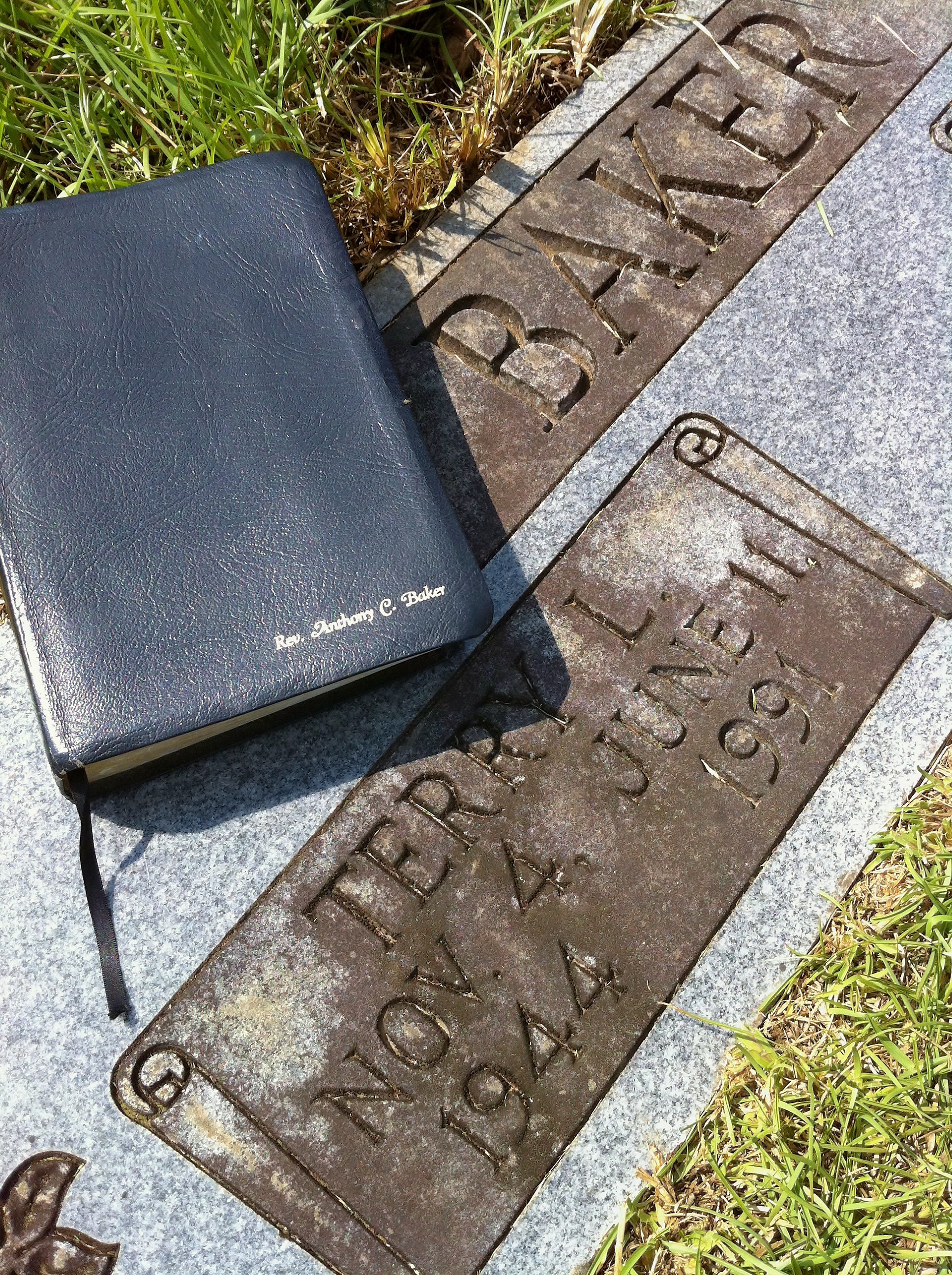
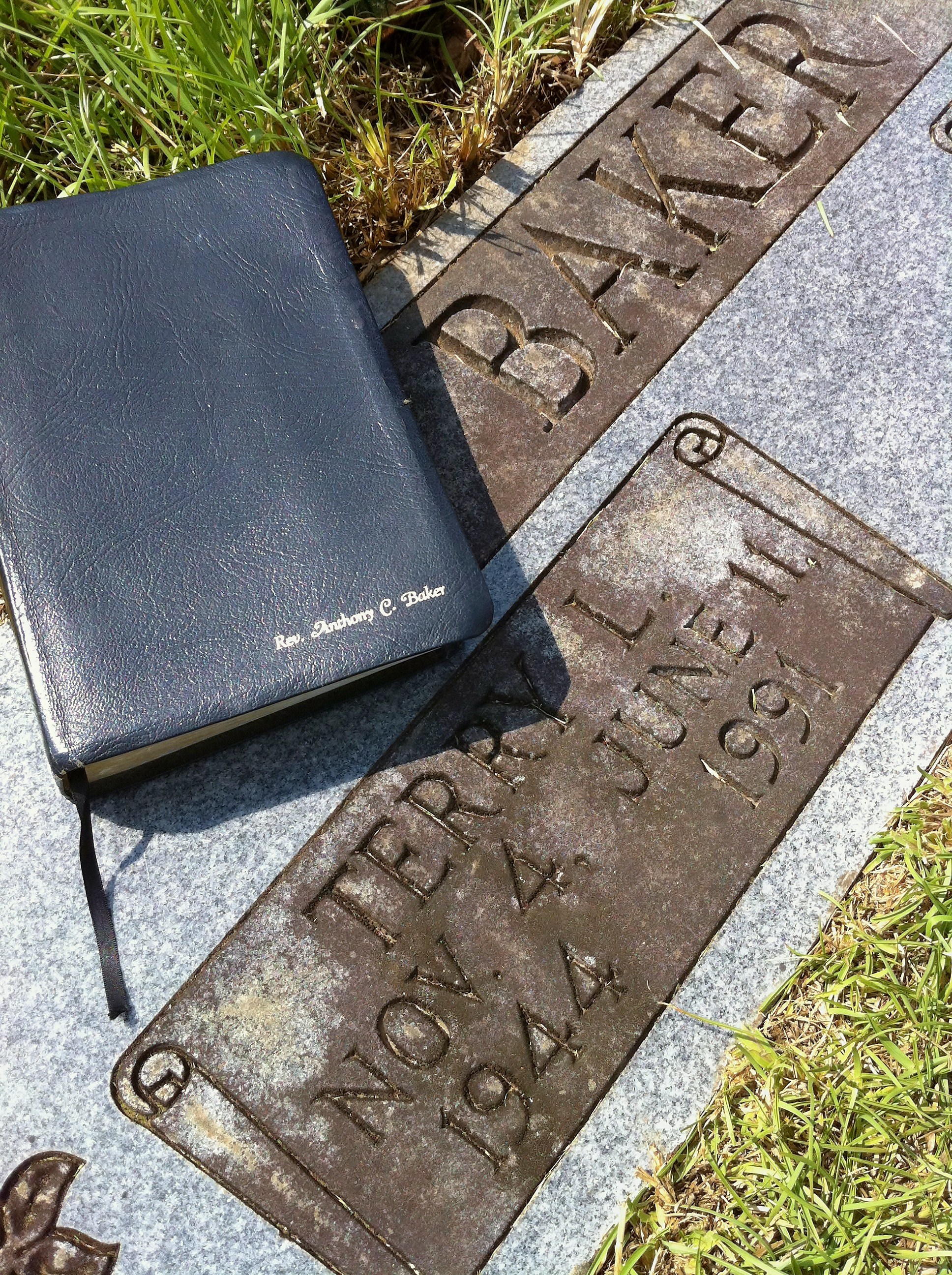
photo (16)June 11 was the anniversary of my father’s death. He died the week before Father’s day (just like my wife’s father did last week). Not long ago I went to his grave and placed my Bible on his tombstone. There, glistening in the sun, were the gilded words “Rev. Anthony C. Baker.”

“Daddy,” I said, “I’m still at it.”

8 Comments

Filed under Christian Maturity, Church, Life/Death, ministry, Preaching, Relationships and Family

In My Father’s Honor

Remembering the Day

I woke up this morning and saw the sun, which is something my dad never got the chance to experience on June 11, 1991. Upon closing his eyes in death while working the night shift as a security guard, he woke to eternal day where the Son is the Light. What an awesome moment that must have must have been for him!

However, for me, it was a very difficult day 27 years ago. For that matter, it was a difficult day for many. He was only 46 at the time of his homegoing, but the impact he made on the lives of others will reverberate for many decades to come, and all of us were heartbroken when he left.

Tough, Yet Humble

My dad.

My dad.

Those who knew my dad before he became a Christian would testify to the fact that he was no wimp. He was a man’s man.

My dad could build an engine and race a car – including the kind in which he used to haul moonshine. He knew how to fight, fish, and fire a weapon; between him and my uncle Don (his brother), there weren’t too many men willing to be their enemies.

Yet, once he accepted Christ, he became the perfect example of gentleness, kindness, grace, and compassion. I know of no one any more humble than he was. (Oh, and when his brother finally became a believer in Jesus, the same transformation took place)

Preachers

My dad was also a preacher. He might not have been the most eloquent, but he loved the Word and he loved telling people about Jesus. Had he been alive today, he would have wept at the state of our nation, but he would have cared more about sharing the gospel with the homeless drunk under the bridge, the prisoner in the jail, or the disabled and orphaned teen in need of hope.

More than a man who’d kindly give you the shirt off his back, he’d find a way to tell you about a Saviour who bore a cross on His. If my dad was still alive, he’d still be preaching.

Still Fighting the Good Fight

Still Fighting the Good Fight

I am proud to say that I am carrying on my father’s legacy. I am proud to say that should the Lord allow me to live another 50 years, I will continue to preach the Gospel, stand for Truth, and love people the best I can. As a matter of fact, here is something I recently posted on Facebook.

Backbone, preachers…now’s the time for some honest-to-goodness, strong-as-steel, George S. Patton and John Wayne-like BACKBONE!

I don’t care if you’re Baptist, Presbyterian, Pentecostal, Nazarene, Methodist, or whatever…MAN UP!! Stand in the gap! Quit being a politically motivated, crowd-pleasing, purse string-tying wimp and PREACH THE WORD!

Check out what’s going on in the world and what’s coming to America. Do you think things are all going to turn out like a big Hillsong praise service if you keep preaching like Joel Osteen?! Folks, what we need now more than ever are some Elijahs, some John the Baptists, some old-school Billy Grahams, some D. L. Moodys, etc. We need more men of God who know the difference between the Word of God and a motivational speech!

Don’t try to be popular. Don’t try to be “cool” and “hip” with the younger generations. Quit fighting over the styles of worship if your congregation doesn’t even know HOW to worship! Forget trying to become more “seeker-friendly,” and just SEEK THE LOST! The world is going to Hell and we are greasing the skids.

Be real. Be humble. Be yourself. Love your enemies. But for the love of God, pastors and preachers, “Watch ye, stand fast in the faith, quit you like men, be strong” (1 Corinthians 16:13). In other words, take off the liberal mom jeans and put on some prophet-worthy overalls and get to work. 

His Voice

I wish all of you could have met my dad, Terry L. Baker. Like my wife noted when she heard a recording, “He sounds about as country as they come.” Fortunately for all of us, I still have a few recordings of his preaching.

Below is an edited version of a message my dad preached back in 1981. At that time he was doing a radio program on WMOC for a local children’s ministry.

On a side note, I do a radio program just like my dad did, but he used to record his sermons on a Radio Shack cassette recorder while I use an iPhone 7 with a Rode smartLav+ mic. Funny, the sermon below sounds just as good as anything recorded today!

Fittingly, the sermon from my late father, based on Deuteronomy 6:4-7, concerns how to raise a godly family. Tell me if you think he sounds a little like me 😉

All honor and glory be to my Father in Heaven, the One who graciously gifted me with an earthly father who loved Jesus and taught me how to do the same.


3 Comments

Filed under Christian Living, Christian Maturity, Life Lessons, ministry, Parenting, Preaching, Relationships and Family

Why Should We Pray Before Meals?

I don’t know if there are any reliable statistics on the subject, but I would guess that there are still a good many who still pray before they eat. What about you?

Personally, I try to say a short prayer before every meal I eat, sometimes even before something like a sandwich in between regular meals. I call it “saying the blessing,” but you may call it something else, like “returning thanks,” “saying grace,” etc.

Whatever we call it, I’d bet most of us either do it regularly or at least occasionally.

But this past Sunday morning I delivered a sermon which addressed the reasons for praying before a meal, both good and bad – yes, there are bad reasons. Below is both an outline (which didn’t like being translated to WordPress for some reason) and the recording of the actual sermon (which may vary slightly from the outline).

I’d love to hear your thoughts on this subject, so leave a comment. It would be MUCH appreciated 🙂


Click on the picture to listen.

Do You Pray Before Meals? Why?

     Illustration: Boy asking why dad thanks God.

I.       Bad Reasons

a.       Simple Habit… Matthew 6:7 – But when ye pray, use not vain repetitions, as the heathen do: for they think that they shall be heard for their much speaking.

b.      Superstition… Acts 17:22 – Then Paul stood in the midst of Mars’ hill, and said, Ye men of Athens, I perceive that in all things ye are too superstitious.

                  i.      Definition of Superstition: “…a belief or practice resulting from ignorance, fear of the unknown, trust in magic or chance, or a false conception of causation.” (Merriam-Webster.com)

ii.      Earn favor (Ephesians 2:8-9)

iii.      To make it healthy/less harmful (Wrong idea of “blessing”). It’s not an incantation!

II.       Good Reasons (Should go without saying that we should imitate Christ)

a.       Thankful Heart… Ephesians 5:20 – Giving thanks always for all things…  1 Thessalonians 5:18 – In every thing give thanks: for this is the will of God in Christ Jesus concerning you.

                   i.      “Dark Side of Abundance”

“Those of us who live in prosperous regions of the globe and have never known food scarcity perhaps don’t feel much awe in it… God is kind not to give us heaven, yet. We would not appreciate more than a fraction of it.” –  John Piper

“Complaining about the food we have is a luxury very few have experienced in world history. If we lack gratitude, repentance is the only appropriate response.” – John Piper (https://www.desiringgod.org/articles/why-we-pray-for-our-meals)

ii.      False Assumption of Righteousness… Psalm 37:25 – I have been young, and now am old; yet have I not seen the righteous forsaken, nor his seed begging bread.

III.       Recognition of the Provider (1 Chronicles 29:10-13)

a.       Who He Is

b.      That He Provides

IV.       To Be a Witness… Acts 27:35 – And when he had thus spoken, he took bread, and gave thanks to God in presence of them all: and when he had broken it, he began to eat.

           Illustration: Chuck Colson praying at a diner while on a book tour.

1 Corinthians 10:31 – Whether therefore ye eat, or drink, or whatsoever ye do, do all to the glory of God.

1 Timothy 4:4-5 – For every creature of God is good, and nothing to be refused, if it be received with thanksgiving: For it is sanctified by the word of God and prayer.

NOTE: Sometimes we should pray AFTER a meal.

Deuteronomy 8:10 – When thou hast eaten and art full, then thou shalt bless the LORD thy God for the good land which he hath given thee.

1 Comment

Filed under Christianity, Food, legalism, Prayer, Preaching

A Universal Gospel?

The following is an outline (nothing but an outline) that I prepared to preach one Sunday several years ago. I found it while searching through some documents on my computer and felt led to share it with you. Feel free to use it, if you’d like.

Happy Monday!


“Examining the Universality of the Gospel”

I.   Introduction

Luke 2:9-10. Is the Gospel good news for all people?

The word “people” was “pointing specially to the people of Israel.”

II.  What does it mean to be universal?

The term universal is described by one dictionary as an “adjective relating to or done by all people or things in the world or in a particular group; applicable to all cases.”

III. What is the Gospel?

Dictionary Definition:

The gospel is the The Eng. word “gospel,” i.e. “good message,” is the equivalent of euangelion (Eng., “evangel”). In the NT it denotes the “good tidings” of the Kingdom of God and of salvation through Christ, to be received by faith, on the basis of His expiatory death, His burial, resurrection, and ascension, e.g., Act 15:7; 20:24; 1Pe 4:17.[3]

Paul’s Definition: In 1 Corinthians 15:1-4 Paul makes it very clear that the gospel is simple, not complicated, and consists of two central features:

  • Jesus the Messiah died on the cross and
  • He rose from the dead according to the Scriptures.[4]

IV. Objections and False Gospels  Some object to a Universal Gospel because race, culture, past experiences, etc.

  1. From those who have been hurt or don’t understand. “You say that you are sent to instruct us how to worship the Great Spirit agreeably to His mind; and, if we do not take hold of the religion which you white people teach we shall be unhappy hereafter. You say that you are right and we are lost. How do we know this to be true? We understand that your religion is written in a Book. If it was intended for us, as well as you, why has not the Great Spirit given to us, and not only to us, but why did He not give to our forefathers the knowledge of that Book, with the means of understanding it rightly. We only know what you tell us about it. How shall we know when to believe, being so often deceived by the white people?”[5] – Chief Red Jacket, 1805, in a speech to the Six Nations and an American missionary, Mr. Cram.
  2. The Jews. In the eleventh chapter of the book of Acts, for instance, we read how that Peter, when he went to Jerusalem, “contended” with the Jews over the issue of the gospel being presented to the Gentiles. In 1 Thessalonians 2:14-16 Paul mentioned those who forbade him to “speak to the Gentiles that they might be saved.”
  3. Prosperity Gospel. It is certainly not a gospel that expects “blessing and favor” as evidence of God’s grace.

V.   A Gospel that IS Universal

  • Not limited by race, gender, age, nationality, boundary of any kind, or economic status. It is truly “good news” to anyone and everyone as long as they first realize they have a need for it.
  • Meet the most basic needs of Humanity.
  1. Sin. All men have sinned and fallen short of the glory of God (Rom. 3:23). Because of Adam, sin entered the world, and death by sin; therefore death has passed as a consequence upon all men (Rom. 5:12). Jesus Christ died for the sins of all, and whosoever shall call upon the name of the Lord shall be saved (Acts 2:21; Romans 10:13).
  2. The gospel is universal because it addresses the world we all live in. It answers the questions of pain and suffering. It gives meaning to the struggles of life. The gospel is not a drug or panacea of some sort; it is a reality pill.
  3. Love and Compassion. Mother Teresa said, “Maybe they are starved for bread in Africa. You are starved for love in the United States.”[6] What greater message of love can one share than that of the gospel of Jesus? “Hereby perceive we the love of God, because he laid down his life for us: and we ought to lay down our lives for the brethren” (1 John 3:16).

 VI. Conclusion  The gospel that is truly universal in its scope and application.

  1. All men are born in sin – Romans 5:12
  2. There is none righteous – Romans 3:10
  3. All have sinned – Romans 3:23

But…

  1. Jesus is the only Way – John 14:6
  2. One day ever knee will bow and ever tongue will confess – Phil. 2:10-11

“And he said unto them, Go ye into all the world, and preach the gospel to every creature.” – Mark 16:15 KJV

A message of love to every “creature” (κτίσις , εως f creation, what is created, created order, creature [7]) – how much more “universal” can a gospel get?


[1] Marvin Richardson Vincent, Word Studies in the New Testament (New York: Charles Scribner’s Sons, 1887), Lk 2:10.

[2] Catherine Soanes and Angus Stevenson, Concise Oxford English Dictionary, 11th ed. (Oxford: Oxford University Press, 2004).

[3] W. E. Vine, “Gospel (Noun and Verb: to Preach)”, Vine’s Expository Dictionary of New Testament Words. Blue Letter Bible. 1940. 24 June, 1996 3 Dec 2012.

[4] Donny Mathis, “Gospel” In , in Holman Illustrated Bible Dictionary, ed. Chad Brand, Charles Draper, Archie England et al. (Nashville, TN: Holman Bible Publishers, 2003), 671.

[5] Bryan, William Jennings, ed. The World’s Famous Orations. New York: Funk and Wagnalls, 1906; New York: Bartleby.com, 2003. www.bartleby.com/268/. [Accessed Dec. 2, 2012].

[6] G. Curtis Jones, 1000 Illustrations for Preaching and Teaching (Nashville, TN: Broadman Press, 1986), 257.

[7] Barclay M. Newman, Jr., A Concise Greek-English Dictionary of the New Testament. (Stuttgart, Germany: Deutsche Bibelgesellschaft; United Bible Societies, 1993), 104.

Leave a comment

Filed under Church, Preaching

Memorial Day Sermon (2018)

For those of you who may be interested, I’m attaching a link to a sermon I delivered this morning (Sunday, May 27) in honor of Memorial Day.

Some of you may get triggered by the sight of American Flags, but don’t worry – this is not an uber-nationalistic, overly-patriotic, American-Christianity-like sermon. So chill.

However, this sermon is one about being a faithful soldier in the army of God (not the jihadi kind). Therefore, if military references offend you, consider this a “trigger warning.”

However, I would like to point out that at the beginning of the recording you will hear me play my guitar and sing an original song I wrote about 11 years ago in honor of a fallen soldier from our neighborhood.  It’s called “No Greater Love.”

Then, towards the end of the sermon, I’d like for you to take special note of the “Battle Cry” I read. All of us should be able to stand and recite it.

Click On the Picture to Listen

May God bless and keep you this holiday weekend.

God bless those who serve and the families who wait for them.

To all those who’ve fought for our freedom, we salute you.

To those who have fallen, we will remember.


Leave a comment

Filed under America, Christianity, music, Preaching

But the Church Prayed

It Happened In Acts

It may come as a shock to some of you, but, believe it or not, there’s a lot more to the book of Acts than chapter 2.

As a matter of fact, the book of Acts is full of exciting, foundation-rattling accounts of God moving through the Church by the power of the Holy Spirit. Chapter 12 is no exception.

In Acts 12 we read Luke’s account of how Herod Agrippa (the 1st) thought he’d found a way to demoralize and ultimately defeat the young Church. After seeing that killing the apostle James made the Jews happy, he then arrested Peter with the intent of doing the same. It seemed like a fool-proof plan…

…but prayer was made without ceasing by the church unto God for him” (Acts 12:5).

That was the hinge on which the door swung…the church prayed.

Think of all the insurmountable obstacles we’ve encountered. How many times have we (as the Church or individuals) been faced with situations where there seemed to be no way out, no positive solution, no hope? What has been our usual response? Has it been fervent, unceasing, continual prayer? Not usually.

Imagine what would have happened to Peter had the story been more like: “Herod was going to kill Peter, but the church hired the best Gentile lawyer from Rome.” Or, maybe Acts 12:5 could have read like: “Herod was planning on killing Peter, but the church hatched a full-proof escape plan.”

No, the Bible says that the church in Jerusalem did what all of us should do – but we usually don’t – they prayed without ceasing.

If Acts is supposed to be an example of how the Holy Spirit can work through the Body of Christ (the Church), then I have a feeling we’ve lost a lot of battles by ignoring our most powerful weapon – PRAYER.

It’s Happing in Soddy Daisy

Well, my friends, I pastor a small church in Soddy Daisy, TN, that needs a few miracles. We need some locked doors opened…some chains to fall off…some manna from heaven…some pioneering workers for the field.

We need people who will work. We want to see souls saved. We want to make an impact on our community. We want to build the Kingdom. We want God to receive the glory for rescuing what many have deemed a lost cause.

So, we’re praying.

Every evening we are meeting to pour our hearts out in prayer. Every evening we are asking God to meet our needs. Every evening I am hoping others will join us, preferably in person. You are invited.

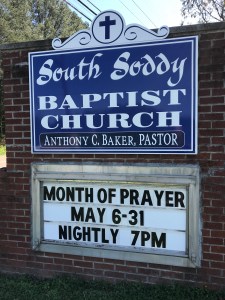
This past Sunday (May 6) I preached a sermon that laid out the context for Acts 12:1-5. I then called upon our congregation to join with me in serious, desperate, concentrated prayer for the rest of the month. You can listen to the sermon by clicking on the link below or the picture of our church sign.

Let us look forward to what God is going to do, but don’t be too surprised if He answers in a way that has never even crossed our minds.

“Now About This Time: The Church Prayed”

6 Comments

Filed under Church, community, Prayer, Preaching

Arguments for Eternal Security

My Outline

bibleBecause I just commented on a post by a fellow blogger who believes one can lose his salvation, I am re-posting this sermon outline.

The following is an outline I used a couple of years ago. It starts off with some arguments against the “once-saved-always-saved” position. The next part lists six basic arguments in favor of the eternal security of the believer.

Of course, this is only an outline, not the sermon. However, you can click below for a link to the audio.

“Eternal Security” 

Arguments Against “Once Saved, Always Saved”

  1. Observational – How people live that believe it.
  2. Free Will – We are created with a will; we’re not slaves.
  3. Scriptural (Hebrews 6; 1 John 3:9; 5:18)

Arguments FOR “Eternal Security”

  1. Creational Argument: We are New Creations (2 Cor. 5:17)
    1. It took a supernatural act to change us
    2. We can’t act supernaturally to change us back
  2. New Birth Argument: We are Born Again (John 3:7,16)
    1. By the Spirit – Jn 3:6
    2. By the Word of God – 1 Peter 1:23
    3. We are not God, so we must remain “born again”
  3. Children of God Argument
    1. Born that way – 1 John 5:1; 1 Peter 1:23
    2. Adopted – Rom. 8:15; Gal. 4:5; Eph. 1:5
    3. Abba – Gal. 4:1-7
  4. The Possession Argument – We belong to Christ
    1. Purchased – 1 Cor. 6:19-20; 7:23 (Bought with a Price)
    2. Given by the Father – Jn. 6:37-40; 10:28-30
    3. Will never be separated – Rom. 8:35-39
    4. Romans 14:8 – For whether we live, we live unto the Lord; and whether we die, we die unto the Lord: whether we live therefore, or die, we are the Lord’s.
    5. He can keep what is His – 2 Tim. 1:12 “…for I know whom I have believed, and am persuaded that he is able to keep that which I have committed unto him against that day.” See also: 2 Timothy 4:18 And the Lord shall deliver me from every evil work, and will preserve [me] unto his heavenly kingdom: to whom [be] glory for ever and ever. Amen.
  5. The Marriage Argument
    1. Ephesians 5:25-28, 31-32 – Husbands, love your wives, even as Christ also loved the church…This is a great mystery: but I speak concerning Christ and the church.
    2. He is faithful, even when we are not.
      1. 2 Timothy 2:11-13 “…if we believe not, yet he abideth faithful…”
      2. He is God, not man! – Hosea 11:7-9
  6. It’s a Gift
    1. 2:8-9 Gift of God, by grace
    2. Romans 11:29 KJV – For the gifts and calling of God [are] without repentance (irrevocable)

Click on the link below to listen to the audio. As you might be able to tell by the opening remarks, I believe it was a sermon we needed, but the devil was opposing. Nevertheless, hearts were encouraged.

https://riversidesermons.sermon.net/main/main/20657994

28 Comments

Filed under Bible Study, Preaching, salvation

A Sermon On Legalism

You can go to other posts I’ve written and read why some people choose to be legalists. This, however, is a message I preached this past Sunday morning.

Maybe some of you will find it encouraging or helpful.

Click here to listen to “Romans 14: A Sermon On Legalism”

9 Comments

Filed under Christian Maturity, Church, legalism, Preaching