Category Archives: God

Something Good Worth Waiting For

I waited patiently for the LORD; and he inclined unto me, and heard my cry. – Psalm 40:1

There’s an old saying, “good things come to those who wait.” Where did it come from? Who said it first? I don’t know, although I’m sure it’s traceable. All I know is that the first verse of Psalm 40 says almost the same thing, only what comes to the one waiting is better than anything this world can offer.

Something’s Wrong

Let’s think about some things that have to be going on for this verse to make any sense. First, something is wrong. Why else would David be crying out to God? Something is wrong. Why else would he be wanting God to do something.

Last night I dealt with some serious prayer requests. One thing led to another and I brought up the question that so many ask: “If there’s a God, then why is there pain? Why do good people suffer?” Here’s another question, though: If there is no God, and still there is pain and suffering, then what’s the point? Either there is pain and suffering and people going through bad times for no reason whatsoever, or there is a great plan beyond our understanding, one being worked out by a loving God.

The pain is there, regardless. Why not believe there’s hope?

In God’s Time

The second thing to observe is the fact that God works on His own time table. David cried out, for how long we don’t know, but God’s response was not immediate.

How often to we find ourselves calling out in prayer, “Do something! Do it NOW!” In David’s case, whatever was wrong was more than he could handle on his own; he needed divine intervention. How often do search for immediate answers? How often do we question God and His timing all because we know more about what is really needed at the moment?

David waited patiently. Patience requires faith. It is impossible to please God without faith (Hebrews 11:6). Are you waiting patiently?

To Those Who Wait

To those who wait patiently on the Lord; to those who have faith that God will indeed do what is best; to those who wait God gives something that most do not realize they never truly have – His undivided attention. David waited patiently on the Lord, and He “inclined” unto him.

Picture two people sitting at a table. Lots of other people are at the table, too, just going on and on about all manner of stuff. One person tries to talk to the other, but there are so many distractions. Eventually, when the other notices how much the one wants to talk, he leans over, rests on an elbow, bends an ear, and says, “Now, what were you saying?”

God is omniscient; it’s not like He can’t hear all prayers. But within this verse we get a glimpse into the reality that there is something special, a sweet privilege that comes to those who “wait patiently on the Lord.” To reach that point of communion with the Creator of the universe, to know you have His ear: now that’s a good thing for which to wait, don’t you think?

1 Comment

Filed under Bible Study, God, Love of God, Theology

I’ve Got a Mighty, Mighty Friend

Tough Times

All of us are living in tough and troubling times. For some of you, the road you’re on has far more bumps and potholes than the roads of others. Yet, all of us will agree that, wherever we are, the world is not getting any better.

Times are tough, and they’re only getting tougher.

But…

But, I have a Mighty Friend who is not affected by the whims of men or the winds of time. As a matter of fact, my Friend is the One who created man and started time.

Several years ago (2007) I wrote a song for my little girls to sing. Not long ago, while doing some stuff at church, I listened to a recording of the song …and shouted…literally, I kicked up my heels, pumped my fists, waved my hands, and shouted “Praise GOD!

Maybe you need some encouragement? Just read the lyrics I have included below, and if God is your friend, don’t worry (Matthew 6:30-34).

Mighty Friend

Well I may not be as tall as a building or strong as a big ol train
I may not be as smart as a scientist doing things I can’t explain
But I know the One who made the tallest mountain and can whip up a hurricane
And the very One who invented gravity says He even knows my name.
 
Well I may not know what’s comin’ in the mornin’, or what the day may bring
Good or bad, I’m not gonna worry, ‘cause Jesus knows everything.
So I’ll do the best with what God has given me as long as there is time
‘Cause the One that got the clocks a-tick’n told me it’ll all be fine.
 
When the devil acts like a bully, putting on a scary show
Before you run away and hide in a corner there’s something you need to know
The One who spoke the world into existence is standing by your side
And if you look close the devil’s knees are shakin’ cause he knows he’ll lose the fight
 
Chorus:
Cause I’ve got a Mighty, Mighty Friend who watches over me
And He’s the Mighty, Mighty Savior who died to set me free
Well I may not be the greatest at anything, but this one thing is so
The God that is the greatest at everything loves me, this I know.
 

© 2007, Anthony C. Baker (BMI)

Katie is going to hate me for doing this…

…but I am going to include the recording I was talking about. This was recorded back when she (Katie, the one on the far left) was only 10 or 11 years-old. It’s not Nashville quality, but it’s precious. So, as so many people say before they sing in church, “Don’t listen to how we sing, just listen to the words.”

“Mighty Friend”

Katie, Valerie, Alicia, and Haley


4 Comments

Filed under Faith, God, music, Relationships and Family

A Doctrine from Eden Repackaged (Faith In Words)

The Beginning

In order to put things in perspective, we must start with the beginning. And when I say beginning, I mean THE beginning. Please consider the following verses, for they are critical:

Genesis 1:1 In the beginning, God created the heavens and the earth.

John 1:1 In the beginning was the Word, and the Word was with God, and the Word was God.

John 1:14 And the Word was made flesh, and dwelt among us, (and we beheld his glory, the glory as of the only begotten of the Father,) full of grace and truth.

It should be obvious, according to the above verses, that not only did God create the universe, but that the Word which He spoke was none other than Jesus Christ. The doctrine that Jesus is the “express image” of God the Father, even God Himself (Hebrews 1:3), is at the core of orthodox Christianity.

Jesus was not just a good man or prophet, and neither were the words of God at creation just words spoken in faith.

Did you get that last part? That’s the part I want to address.

Faith in Words

There is a teaching still being taught that essentially says: “If you have faith in your words, as God had faith when He spoke the worlds into being, you can also create a miracle, your own reality. You can be like God, if you have the faith of God.

Excuse me? God had faith? Really? If so, in what?

Well, if you’re like Kenneth Copeland, you’ll believe God had faith in His own words when He “spoke to the Spirit” on the day He created man…

“[We] can see that man’s body was formed from dust, but he became a living spirit when God spoke to Himself and breathed life into his physical body. … In short, we must always remember that unlike any other creature, man was both formed from dust and created with words of faith.” (Source)

Or then there’s this:

“God used words when He created the heaven and the earth….Each time God spoke, He released His faith — the creative power to bring His words to pass.”
Kenneth Copeland, The Power of the Tongue (Fort Worth: KCP Publications, 1980), 4.

First, stop and think about this! Do you realize that God is the Giver and Author of faith (Hebrews 12:1-2), not One who puts His faith in something or someone? There is something fundamentally wrong with the idea that Omnipotence would have any reason to have faith, for the very definition of faith requires a sense of dependence on a power outside yourself.

When God speaks, things happen; not because of His faith, but because He’s God!

Secondly, ask yourself: “If God had faith in His Word, then would that make Him the first Christian?” How silly does that sound? But in reality, if we are to believe that God had faith in His words, which brought about creation, then would it not stand to reason, – if John 1:1 is correct – that God the Father put His faith in Jesus? Was not Jesus the Word by which all things were created?

Crazy, right?

Then, there is the worst part…

Words of the Serpent

Do you remember how Satan tempted eve in the garden of Eden? Remember how he tried to convince her that by eating the fruit, she could “be as gods?” How similar, then, is the promise, “If you have faith in your words, as God had faith in His words, you can create like God did?”

If you think I’m making this stuff up, my friends, consider the following statements by one of the foremost teachers of this false doctrine (and you can find more on YouTube):

Image result for kenneth copeland images“You have the same creative faith and ability on the inside of you that God used when he created the heavens and the earth.”

Kenneth Copeland, ‘Inner Image of the Covenant,’ side 2.

“On the cross, Jesus won the right for believers to be born again back into the god-class. Adam was created, not subordinate to God, but as a god; he lost it, and in Christ we are taken back to the god-class.” ~ Kenneth Copeland (AZQuotes.com)

“I say this with all respect so that it don’t upset you too bad, but I say it anyway. When I read in the Bible where he [Jesus] says, ‘I Am,’ I just smile and say, ‘Yes, I Am, too!'” ~ Kenneth Copeland (AZQuotes.com)

It may anger some of you, my readers, but please don’t be offended. Do as Paul told Timothy, “take heed unto thyself, and to [thy] doctrine” (1 Timothy 4:16).

Please understand, to claim one has the power to create, as God created, is heresy! Faith in our words, outside of faith in God, especially in order to bring about our will, as opposed to, or in spite of God’s will, is nothing less than witchcraft.

Even more, it is the doctrine of Eden reborn: “you shall be as gods.”

9 Comments

Filed under Christian Maturity, cults, God, ministry, Theology

Love Is Love?

The following, posted in March of last year, holds profound meaning for a day like today.

Especially today.


Not long ago I was riding with my youngest daughter through the Nashville, TN area. We were visiting a couple of colleges that she is thinking of attending, one of them being MTSU.

Since I was the one riding, and since I wasn’t too afraid that Haley would get us killed, I felt more comfortable looking at the sights. One of the sights I saw was a little sticker placed on the back window of a vehicle in the lane next to us.

The first thing I did when I saw it was say out loud what I was thinking: “Love is love? What kind of definition is that?”

And that’s really the point of this little post (rant) of mine: What does it mean when you say “Love Is Love”?

Let’s change the words a little and see if the same way of defining love works with other stuff.

  • Rock is Rock.
  • Lamb is Lamb.
  • Bob is Bob.
  • Cola is Cola.
  • Dirt is Dirt.
  • Poison is Poison.
  • Hate is Hate.

As you can see, the words above are not as easy to define by stating that one is what it is. To say that a rock is a rock is to say a diamond is a piece of driveway gravel. To say that dirt is dirt is to equate what my flowers are growing in with stuff people dig up to smear politicians.

Is every Bob the same as every other Bob? Is Coke really as nasty as the generic stuff? Is a stuffed lamb in a toy store the same as the living, breathing, pooping animal capable of growing wool?

If “hate is hate,” then is it equally immoral to hate murder as I could hate my neighbor?

LOVE IS LOVE tells us nothing. All it does is confuse, belittle, elevate what is not the real thing, and degrade what is priceless.

Is there no standard for what love is supposed to be? Is self-love the same as sacrificial love? Stating that “love is love” doesn’t even clarify whether or not love is a verb or a noun?

That is why the Holy Spirit inspired the Apostle John to write (1 John 4:8,16): “God is love.”

What love is supposed to be is directly related to the nature of God. God is the standard. God is the Definer.

Love without God in the equation is a scary, vague, unstable, dangerous, self-serving, undefinable, always-changing emotional term that can be used to justify anything (which can be verified by doing a Google search of “Love Is Love” memes).

Poison isn’t just poison, but love without God is a poison that blinds the heart. 


2 Comments

Filed under Culture Wars, General Observations, God, Love of God

If Ever I Loved Thee, Tis Now

A Hymn Sermon

One of the greatest hymns, at least one of my favorites, is “My Jesus, I Love Thee.” A few years ago I preached a sermon based on the four verses from this song.

Below is a copy of the simple outline I took to the pulpit. I must admit, it got me a little wound up. (Can I get an “Amen!“)

“My Jesus I Love Thee”

My Jesus, I love Thee, I know Thou art mine; (Jn 21:15-17)
For Thee all the follies of sin I resign; (2 Tim. 2:19)
My gracious Redeemer, my Savior art Thou; (Ruth 2:10)
If ever I loved Thee, my Jesus, ’tis now. (The Place of Regeneration)

I love Thee because Thou hast first loved me, (1 John 4:19)
And purchased my pardon on Calvary’s tree; (1 Peter 1:18-19)
I love Thee for wearing the thorns on Thy brow; (Mt 27, Mk 15, Jn 19:2)
If ever I loved Thee, my Jesus, ’tis now. (The Place of Realization)

I’ll love Thee in life, I will love Thee in death, (Job 13:15)
And praise Thee as long as Thou lendest me breath; (Job 33:4)
And say when the death dew lies cold on my brow, (Ps. 116:15)

If ever I loved Thee, my Jesus, ’tis now. (The Place of Resignation)

In mansions of glory and endless delight, (Jn 14:2)
I’ll ever adore Thee in heaven so bright; (Rev 21:23)

I’ll sing with the glittering crown on my brow, (2 Tim 4:8)
If ever I loved Thee, my Jesus, ’tis now. (The Place of Revelation)

-William Ralph Featherstone (1864)

Regeneration. As I read the lyrics, I began to see a logical progression through the believer’s life. First, there was the love for Jesus that comes when one is born again – that moment of regeneration, when one is “saved.” The love we have for Christ is evident by our desire to repent of our sin and turn from its “follies.” Along with that, there’s the humble heart that asks, like Ruth, “Why have I found grace in thine eyes, that thou shouldest take knowledge of me?”

Realization. The second verse describes a maturing love for our Lord that, over time, gains an appreciation for what Christ actually did to save us. Our love deepens when we begin to realize all those little sins, even the pettiest, caused the sinless Son of God to have to endure unimaginable pain and humiliation, not out of obligation, but because of His love for us. His cross should have been mine, but He loved me first; therefore, I love Him.

Resignation. Thirdly, there’s that place in life when we must ultimately resign everything – our hopes, our dreams, our lives – to the One who ultimately lends us each breath. This deep, trusting love comes from a life that has witnessed the enduring faithfulness of our Savior, leading us to echo the words of Job, “Though He slay me, yet will I trust Him.”

Revelation. Then, finally, there will be the place of revelation that will send our love for Christ soaring to infinite heights. We will know as we are known. We will have no more need of faith, for faith shall become sight. We will be eternally overwhelmed by the Love of the ages, forcing us to cry out, “If ever I loved thee, my Jesus tis now!

Just thought I’d share 😉

Sermon: “My Jesus I Love Thee!”

3 Comments

Filed under Christian Maturity, Faith, God, Love of God, Preaching, salvation, worship

You Believe WHAT About God? Tuesday Thoughts 21 January 2020

Just the other day I shared a post from Pastor Randy which generated a lot of response, some not so positive. Well, I guess I’m a sucker for punishment because I’m going to do it again.

I don’t want to give any spoilers, but I, too, have heard some seriously stupid answers to the question of “why?” when it comes to the death of children (I worked in a funeral home for several years). The “angel” and “He needed them” reasons were also sickening to me. Yet, some of my Calvinist friends have also attempted to give some pretty sad excuses (ask John Piper), but that’s another argument for another day.

Anyway, “be still and know that I am God” is in vinyl lettering (from Hobby Lobby) above the mantle in our dining room.

Pastor Randy's avatarKingdom Pastor

I thought this Tuesday Thoughts edition was going to take a while to figure out what to write. I was wrong. It comes out of something that happened last week: 4 year old Wyatt Spann died from cancer. And this reminded me of something that happened a few years ago–the death of another young child, Noah Crowe, from cancer. It’s not “MY” feelings about these tragedies, but the things “some” people say. To be more specific: What some who call themselves ‘Christians’ say to broken and grieving hearts. It’s not only at funeral homes where they speak these abominations, but being active in disaster response, I’ve heard some of the same poor, DEPLORABLE theology.

Below are some of the DESPICABLE, VILE, LOATHSOME AND WRETCHED things some people believe, and Dear Lord In Heaven, say to people in the worst moment of their lives:

  • God needed them more than you. Really?…

View original post 381 more words

8 Comments

Filed under God, Life/Death, Struggles and Trials, Theology

Where Do You Go When You Hide?

I was thinking of the words to an old hymn, Hide Thou Me

Sometimes I feel discouraged and think my life in vain,
I’m tempted oft to murmur, to grumble and complain;
But when I think of Jesus and what He’s done for me,
Then I cry, to the Rock of Ages, hide thou me.

There are times when the burdens of life get so heavy; when the struggles get so hard; when no matter what, we still worry; that we have to cry out to Jesus, “Hide me!” Thankfully, He does. Back around 1880 Vernon Charlesworth wrote, “The Lord’s our Rock, in Him we hide, A Shelter in the time of storm; Secure whatever ill betide, A Shelter in the time of storm.

How different it is for the unbeliever.

Where does the atheist turn when his world is falling apart? When all friends forsake him? When the doctors say, “I’m sorry, but we’ve done all we can do?” When someone sings “The Sun Will Come Up Tomorrow,” but he knows he won’t see it?”

Where does the unbeliever hide? In drugs? Alcohol? Meditation? Sex? Nietzsche? Nature (which he believes is nothing more than the product of random chance and void of meaning)?

Scripture (Revelation 6:16) speaks of a day when men who chose to run from the Rock will “cry to the mountains and rocks” to “Fall on us, and hide us from the face of him that sitteth on the throne…” Ironic, isn’t it?

Oh, “Rock of Ages, cleft for me, let me hide myself in Thee.”

5 Comments

Filed under Christian Living, Future, God, music, salvation, the future, Uncategorized, World View, worship

Do You Have After-Christmas Gifts?

“And when they were come into the house, they saw the young child with Mary his mother, and fell down, and worshiped him: and when they had opened their treasures, they presented unto him gifts; gold, and frankincense, and myrrh.” – Matthew 2:11

Late-Comers

Part of the Christmas story can be found in the book of Matthew, the first book in the New Testament. There, in chapter two, we read of several wise men, Magi, who followed the star till it rested over the place where the young Jesus was living.

But what most people fail to notice is that only the shepherds came to visit Jesus while he was still a baby in a manger. The Magi came later, once they were living “in the house” and Jesus was a “young child.” And, based on Herod’s decree that all male children 2 years old and younger should be killed (Matt. 2:16), Jesus could have been a toddler up and walking.

Simply put, generally, every manger scene protested against by atheists is not a faithful representation of the Christmas story. How ironic is that? But I digress…

The Gifts

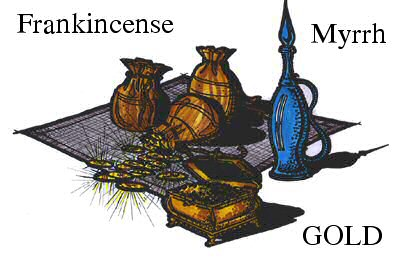
When the Magi came to Bethlehem in search of “he that is born King of the Jews” (Matt. 2:2), they brought with them three very rare and valuable gifts: gold, frankincense, and myrrh. They were not random gifts, but ones with specific political, spiritual, and practical importance; they were meant to recognize a literal, earthly, but also heavenly King.

gold frankincense and myrrhGold was a universally recognized precious metal, symbolic of all wealth. Frankincense was a substance primarily used as incense, but also mixed with other substances to create the holy anointing oil placed on high priests and kings. Myrrh was a substance used for things ranging all the way from cosmetics and antiseptics, to perfuming the living and embalming the dead.

According to Matthew 2:11, the Magi fell down before Jesus, which would have been an appropriate response when in the presence of royalty (and these men knew the difference). But the wise men did more than fall prostrate before royalty, they “worshiped him.”  This young king was more than just “King of the Jews,” but the long-promised Messiah, and they offered their gift to the Son of God.

Are You Wise?

As long as I can remember there have been sermons preached during and before Christmas entitled, “Wise Men Still Seek Him.” The sermons focus primarily on the seeking leading up to Christmas, but rarely, if ever, on the gifts given after the celebration is over. But today is different.

Today, I am going to ask you to consider three gifts we should give, now that the birthday celebration is over.

  • Gold. Gold represented wealth. In your worship of the King, will you give Him your wealth? In reality, God owns everything, including everything He loans unto you. But with your heart, are you willing to lay everything that is most valuable to you at His feet?
  • Frankincense. Frankincense represented worship. Would you be willing to fall down before Jesus, or do you hold back some of your Frankincense in reserve? Are there idols in your life – people or things – for which you reserve a little of that anointing oil, making those things lords of your life? Would you be willing to make Jesus Lord of all? Will you worship him without reservation?
  • Myrrh. Myrrh was symbolic of the beauty of life, from beginning to end. Would you give to Jesus everything that makes you happy? Everything that brings you hope? Everything that is sweet-smelling? Everything that hides your faults and failures, disguising your true self? Would you give Jesus your life? He can do more with it than you can do on your own.

Returns

For several days after Christmas people will stand in line to return and/or exchange unwanted gifts. Many will trade what others gave them for something they want more. Others will just ask for a refund or in-store credit.

Rest assured that when you give your gifts to Jesus, he will not return them, exchange them, or re-gift them next year. But will you, once you realize what you’ve given, want to take something back?

Don’t wait for a New Year’s resolution. Now that Christmas is over, be like the Magi and leave everything at Jesus’ feet, then “depart…another way.” Once you give Jesus those three gifts, you’ll never be the same.

2 Comments

Filed under Christian Living, Christmas, God, Love of God, salvation, wisdom, worship

Thanking and the Thankee

I’m Thankful For…

So many people will be celebrating tomorrow (Thanksgiving) by starting off sentences with the words, “I’m thankful for…” Traditionalists will say it before carving a turkey. Vegans will say it before carving a large piece of vegetable protein disguised as something they secretly wish they could eat. Children will even say it just to please their grandparents and to be assured an extra scoop of Cool Whip on their pumpkin pie.

But one thing’s for sure, being thankful implies the influence of an outside source and suggests things could have been different, despite a person’s will. And even though it might sound crazy, being thankful suggests there is someone to be thankful to.

Thankful to Whom?

Maybe you have never stopped to think about it, but being thankful for anything is pretty ridiculous when there is no one to be thankful to. The Concise Oxford English Dictionary* defines “thanks” as  a “plural noun…an expression of gratitude…another way of saying THANK YOU.” So, who is the “YOU” that you are thankful to?

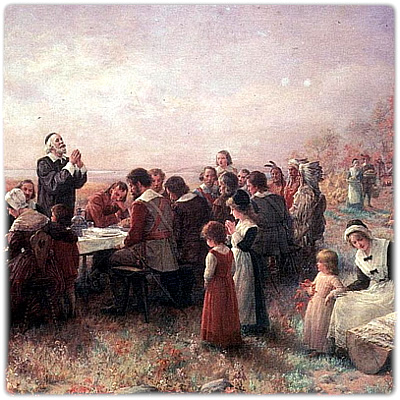
According to many of the stories I have heard, especially in public schools, the original celebrants of Thanksgiving were thankful only to the Indians (Native Americans). According to many accounts, the Pilgrims were so happy that the Indians provided them with food and land that a party was necessary. So, in other words, the first “thanks” of Thanksgiving was given to Squanto and the Wampanoag people.

That’s not totally correct.

Thankful to God

Like those who celebrated in 1623, I am thankful to God. Unlike the common history lessons, the Pilgrims recognized the true Source of blessing.

“Inasmuch as the great Father has given us this year an abundant harvest of Indian corn, wheat, peas, beans, squashes, and garden vegetables, and has made the forests to abound with game and the sea with fish and clams, and inasmuch as He has protected us from the ravages of the savages, has spared us from pestilence and disease, has granted us freedom to worship God according to the dictates of our own conscience.

‎ Now I, your magistrate, do proclaim that all ye Pilgrims, with your wives and ye little ones, do gather at ye meeting house, on ye hill, between the hours of 9 and 12 in the day time, on Thursday, November 29th, of the year of our Lord one thousand six hundred and twenty-three and the third year since ye Pilgrims landed on ye Pilgrim Rock, there to listen to ye pastor and render thanksgiving to ye Almighty God for all His blessings.”

‎—William Bradford, Ye Governor of Ye Colony

If I am going to be thankful, I am going to be thankful to the “great Father…who has granted us freedom to worship [Him] according to the dictates of our own conscience.” As a pastor, I will lead my congregants in praise to the “Almighty God for all His blessings.

What am I thankful for?

I am most thankful for those things which I could not have had if it were not for the grace of God. Among those things are mercy and forgiveness; a family; a peace that passes all understanding; joy unspeakable and full of glory; and even a love for my enemies.

I am also thankful for and to those who serve this great nation, putting their lives at risk for my (and others’) freedom.

I am thankful for and to those who enforce the laws and keep the peace here at home, and for those who brave dangers to rescue us from harm.

“O give thanks unto the LORD, for he is good: for his mercy endureth for ever.” – Psalm 107:1

And ultimately, I am thankful for all the blessings which I do not deserve, including all of you who read this blog, even those who do not believe a word of what I am saying.

One More Thing

One more thing…being that I have some Cherokee blood in me, I understand that Thanksgiving may not be a Native American’s favorite holiday, but the principle of thanksgiving remains. When we give thanks, to whom do we give it?

“All nations whom thou hast made shall come and worship before thee, O Lord; and shall glorify thy name.” – Psalm 86:9 

“O praise the LORD, all ye nations: praise him, all ye people.” – Psalm 117:1 

“After this I beheld, and, lo, a great multitude, which no man could number, of all nations, and kindreds, and people, and tongues, stood before the throne, and before the Lamb, clothed with white robes, and palms in their hands;” – Revelation 7:9 

One day, when all is said and done, we all will stand before God and give thanks, for He is the God of us all, despite what we have done to each other.

Happy Thanksgiving!


*Catherine Soanes and Angus Stevenson, Concise Oxford English Dictionary, 11th ed. (Oxford: Oxford University Press, 2004).

7 Comments

Filed under America, Christian Living, Culture Wars, Faith, God, Thanksgiving, worship

It’s Saturday…

It’s Saturday.

That’s probably not a shock to most of you, I bet. If you can log on to a computer, check your email, or read a text, then you are most likely capable of knowing what day of the week it is.

It’s Saturday… just Saturday.

But sometime back in the 30’s – the 0030’s – there were some men and women waking up to a Saturday like no other. Their teacher, mentor, leader, Rabbi, and Master had suffered a most horrific death, and now he was in a tomb. This was not a day they expected.

It was Saturday, the Sabbath, and all their hopes and dreams lay cold and lifeless in a sealed grave.

What were they feeling? How does it feel to go from the top of the world with every expectation of glory, to utter despair and the expectation that at any moment the ones who ripped your leader to shreds could soon find you and do the same?

With despair comes shame, anger, blame, and fear. On what was supposed to be a “day of rest,” hearts must have been restless, tumultuous, and breaking, crumbling to dust.

It must have been a long day, that Saturday.

Have you ever lost someone close, like a parent, a spouse, or a child? Have you ever left the hospital or the morgue, gone home in shock, only to be jolted by the piercing pain of reality when you see your loved one’s possessions? The day after my father died my mother and sister experienced a moment like that (I wasn’t there, for I wouldn’t go home that night). My dad’s watch had an alarm set – it was the time he was supposed to get up – there was no getting up this time.

How did Jesus’ disciples feel that Saturday night? Their hopes seemed hopeless…their dreams had become a nightmare…the “Way, the Truth, and the Life” now seemed like nothing more than a dead-end road, a lie, and death.

It was Saturday…

But Sunday was coming.

Leave a comment

Filed under current events, Easter, Faith, Future, God, Theology, worship