Category Archives: God

A Dream of Prayer

I Had a Dream

Last night, maybe because I went to bed early, maybe because I was sickly (still am), or maybe because I ate home-made salsa, I had a lengthy, detailed dream.

We all dream to some degree or another, don’t we? How often to you have dreams that cause you to sit up and take notes so you won’t forget it? Well, last night was one of those times.

A Stressful Start

Have you ever had times when you are so stressed about something, like a term paper or work project, that you dream about it? Last night’s dream started with me doing something I need to more often: prospecting.

I have been doing some work in the credit card processing area for about a year. However, I haven’t been very successful (made a lot of money) because I haven’t been seeing enough people. In other words, I could be more successful and bring in more income if I would only knock on a lot more doors, so to speak. But, as with most sales careers, prospecting is the worst part. So, I’ve been stressing.

Anyway, the last night’s dream started out with a guy I work with and myself going into a business to talk about their credit card processing options. That’s when things got interesting.

The Prayer

There in the main office area of what seemed to be a print shop, an advertising firm, or something like that, we walked up to the counter and begin talking to a lady. My friend asked, “How have you been doing, lately?” (as if there had been some kind of previous relationship). The dark-haired, middle-aged business woman solemnly replied, “I was diagnosed with cancer this week.

Normally, if it were any other time, I would let my partner (the more experienced one) continue with the conversation. But this time I said, “Excuse me, I don’t mean to interrupt, but would you mind if I pray for you?” The lady looked puzzled that I would even ask such a question, and sort of recoiled. I said, “It’s OK, I’m not asking you to do anything…I’m not talking about anything crazy…I just want to pray for you.

Sensing I was sincere, not kooky, the lady complied with my request and said, “OK, sure, I would appreciate that.” At that moment, I turned around and faced the other people in the office to ask if they would like to join us. As soon as I turned, there was a man standing beside me, reaching to put his hand on my shoulder. Others got up from their desks and came to the the counter, each holding hands or placing arms upon shoulders. “We would like to pray with you,” they said.

I started praying for the lady, but here’s where things got weird. I started asking God to bless or heal those with certain needs, but as soon as I did, anytime I would mention the type of need, someone in the office would speak out a specific name! For example, I would pray something like, “Lord, there may be someone here that is discouraged,” and that’s when a man on his knees would speak out “JIM!” I would then continue with the prayer, saying, “Lord, encourage Jim with your grace and mercy. Let Jim know You love him.”

This went on and on until my partner, along with other people that were with us (I didn’t know there were more than two of us), left me alone and went out to the car. I don’t know how much time went by, but I finally had to say, “I’m sorry, but I have to go.”

What started out as a business visit ended in a prayer meeting.

The Point

I don’t know what to think, but trying to interpret dreams can be dangerous, if not simply an exercise in foolish hypothesizing. However, there was something about this dream that pointed to a truth worth pursuing: people need prayer.

Bi-vocational pastors praying for each other at a conference in Pigeon Forge, TN.

Bi-vocational pastors praying for each other at a conference in Pigeon Forge, TN.

Not long ago I felt the Lord leading our church in a slightly different direction. Instead of going out and knocking on doors, asking the usual questions, or smacking anyone in the head with a 2-pound Bible, I feel He wants us to take prayer to the streets, prayer-walking a different street each week. As we meet people, the simple goal is to ask if we can pray with them about anything, letting the Holy Spirit set the pace and direction. Praying for someone let’s them know we care.

Believe me, a lot can happen when you begin with prayer. Maybe the dream I had was the result of too much jalapeno and habenero salsa. Maybe, as my wife suggested, I’m missing opportunities to minister by not prospecting. But, on the other hand, maybe the dream I had was simply a confirmation to my spirit of what the Holy Spirit wants to do through those of us who are willing to simply ask…

Could I pray for you?

3 Comments

Filed under America, Christian Unity, Faith, God, ministry, Witnessing

I’ve Got a Mighty, Mighty Friend

Tough Times

A few minutes ago I was reading a post from a friend. He expressed several needs, yet praised the Lord for being in control (Romans 8:28). Aren’t you glad we serve a Mighty God?

All of us are living in tough and troubling times. For some of you, the road you’re on has far more bumps and potholes than the roads of others. Yet, all of us will agree, wherever we are, that the world is not getting any better. Times are tough, and are only going to get tougher.

But…

But, I have a Mighty Friend who is not affected by the whims of men or the winds of time. As a matter of fact, my Friend is the One who created man and started time.

Several years ago (2007) I wrote a song for my little girls to sing. Not long ago, while preparing for a banquet in our church gym, I listened to a recording of the song …and shouted…literally, I kicked up my heels, pumped my fists, waved my hands, and shouted “Praise GOD!

Maybe you need some encouragement? Just read the lyrics I have included below, and if God is your friend, don’t worry (Matthew 6:30-34).

Mighty Friend

Well I may not be as tall as a building or strong as a big ol train
I may not be as smart as a scientist doing things I can’t explain
But I know the One who made the tallest mountain and can whip up a hurricane
And the very One who invented gravity says He even knows my name.
 
Well I may not know what’s comin’ in the mornin’, or what the day may bring
Good or bad, I’m not gonna worry, ‘cause Jesus knows everything.
So I’ll do the best with what God has given me as long as there is time
‘Cause the One that got the clocks a-tick’n told me it’ll all be fine.
 
When the devil acts like a bully, putting on a scary show
Before you run away and hide in a corner there’s something you need to know
The One who spoke the world into existence is standing by your side
And if you look close the devil’s knees are shakin’ cause he knows he’ll lose the fight
 
Chorus:
Cause I’ve got a Mighty, Mighty Friend who watches over me
And He’s the Mighty, Mighty Savior who died to set me free
Well I may not be the greatest at anything, but this one thing is so
The God that is the greatest at everything loves me, this I know.
 

© 2007, Anthony C. Baker (BMI)

Katie is going to hate me for doing this…

…but I am going to include the recording I was talking about. This was recorded back when she (Katie) was only 10 or 11 years-old. It’s not Nashville quality, but it’s precious. So, as so many people say before they sing in church, “Don’t listen to how we sing, just listen to the words.”

“Mighty Friend”


3 Comments

Filed under Faith, God, music, Relationships and Family

The Hands of God

Good Monday, everyone!

bibleYesterday morning at Riverside I preached a sermon entitled “The Hands of God.” I would like to give the basic outline, along with an edited version of the recording sent to the radio. The recording was made before Sunday, but the message was essentially the same.

There are several things about the hands of God worth noting.

  1. They Created Man (Gen. 2:7). As much as we would like to think that we are self-made, there is a Hand that formed us from the dust of the earth. We are not like the rest of creation which was simply spoken into existence; we were fashioned by the loving, artistic hand of the Creator, and His fingerprints are all over us.
  2. They Contain the Believer (John 10:27-29). The believer should never worry about his salvation. He should never worry about being stolen away. Thank God that we are in His hand, and nothing, not even ourselves, can remove us from His omnipotent protection.
  3. They Chastise the Child (Prov. 3:12; 13:24; 22:15; 19:18; Deut. 8:5; Rev. 3:19). God is not a Father who encourages “time outs;” He knows how to apply loving discipline to our seats of instruction. If more parents would worry less about the world’s wisdom and suggestions and follow the wise instruction of Scripture, we might not have as many entitlement-claiming, over-grown bratty children running the streets demanding their own way.
  4. They Carry the Broken (Isa. 40:11). Praise the Lord for His mercy and love! As the gentle shepherd who must sometimes break the leg of the wandering lamb, God must discipline us. However, it is then that He carries us close to his bosom where we learn to love being in His presence.
  5. They Catch the Stumbler (Psa. 37:23-24). There are times when we stumble, but because He is holding our hand, we will not “utterly” fall.

As Jonathan Edwards preached in 1741, it is a “fearful thing to fall into the hands of an angry God.” But as a child of God, there is no better place to be. David said, even after he had sinned, “Let me fall into the hand of the Lord…” (1 Chron. 21:13). He knew the truth that brought comfort, a comfort the world does not know, “The LORD will not cast off his people…” (Psa. 94:14).

Listen to the Radio Version below:

6 Comments

Filed under God, Love of God, ministry, Preaching

If Ever I Loved Thee

A Hymn Sermon

One of the greatest hymns, at least one of my favorites, is “My Jesus, I Love Thee.” This past Sunday morning I preached a sermon based on the four verses from this song.

Below is a copy of the simple outline I took to the pulpit. I must admit, it got me a little wound up. (Can I get an “Amen!“)

“My Jesus I Love Thee”

My Jesus, I love Thee, I know Thou art mine; (Jn 21:15-17)
For Thee all the follies of sin I resign; (2 Tim. 2:19)
My gracious Redeemer, my Savior art Thou; (Ruth 2:10)
If ever I loved Thee, my Jesus, ’tis now. (The Place of Regeneration)

I love Thee because Thou hast first loved me, (1 John 4:19)
And purchased my pardon on Calvary’s tree; (1 Peter 1:18-19)
I love Thee for wearing the thorns on Thy brow; (Mt 27, Mk 15, Jn 19:2)
If ever I loved Thee, my Jesus, ’tis now. (The Place of Realization)

I’ll love Thee in life, I will love Thee in death, (Job 13:15)
And praise Thee as long as Thou lendest me breath; (Job 33:4)
And say when the death dew lies cold on my brow, (Ps. 116:15)

If ever I loved Thee, my Jesus, ’tis now. (The Place of Resignation)

In mansions of glory and endless delight, (Jn 14:2)
I’ll ever adore Thee in heaven so bright; (Rev 21:23)

I’ll sing with the glittering crown on my brow, (2 Tim 4:8)
If ever I loved Thee, my Jesus, ’tis now. (The Place of Revelation)

-William Ralph Featherstone (1864)

Regeneration. As I read the lyrics, I began to see a logical progression through the believer’s life. First, there was the love for Jesus that comes when one is born again – that moment of regeneration, when one is “saved.” The love we have for Christ is evident by our desire to repent of our sin and turn from its “follies.” Along with that there’s the humble heart that asks, as Ruth, “Why have I found grace in thine eyes, that thou shouldest take knowledge of me?”

Realization. The second verse describes a maturing love for our Lord that, over time, gains an appreciation for what Christ actually did to save us. Our love deepens when we begin to realize all those little sins, even the most petty, caused the sinless Son of God to have to endure unimaginable pain and humiliation, not out of obligation, but because of His love for us. His cross should have been mine, but He loved me first; therefore, I love Him.

Resignation. Thirdly, there’s that place in life when we must ultimately resign everything – our hopes, our dreams, our lives – to the One who ultimately lends us each breath. This deep, trusting love comes from a life that has witnessed the enduring faithfulness of our Savior, leading us to echo the words of Job, “though He slay me, yet will I trust Him.”

Revelation. Then, finally, there will be the place of revelation that will send our love for Christ soaring to infinite heights. We will know as we are known. We will have no more need of faith, for faith shall become sight. We will be eternally overwhelmed by the Love of the ages, forcing us to cry out, “If ever I loved thee, my Jesus tis now!

Just thought I’d share 😉

Sermon: “My Jesus I Love Thee!”

2 Comments

Filed under Christian Maturity, Faith, God, Love of God, Preaching, salvation, worship

Radio Sermon (Thou Art Good)

If hearing my Southern accent and pronouncification of words makes me sound illiterate or grates your nerves, then by all means skip the attached audio. On the other hand, if hearing my Southern accent reminds you of heavenly manna for the ear, click the link and be fed.

Seriously, I know what it’s like to listen to someones’s voice, someone whom you’ve read, only to be disappointed by hear. Reading my posts may have given you the idea that I sound like Charlton Heston, and if that’s the case, the you will certainly be disappointed. But if by reading my posts you have come to the conclusion I may sound like Pee Wee Herman, then you’ll be amazed – I actually sound more like Dave Ramsey (the financial guy).

Today, as I have done several times in the past, I am going to share with you the sermon that will air this Sunday on a local AM radio station. You get to hear it before everyone else does!

This recording was made in my study using a large diaphragm microphone and a digital Tascam 8-track recorder. I then edited it on my computer with Audacity, a free audio editing program. The process takes longer than recording on my iPhone, but the end product sounds better.

Also, on this recording I include a song from the Sonlife Quartet, a group I played bass with back in the late 90’s.

“Thou Art Good, and Thou Doest Good”

2 Comments

Filed under God, Love of God, Preaching

After-Christmas Gifts

“And when they were come into the house, they saw the young child with Mary his mother, and fell down, and worshiped him: and when they had opened their treasures, they presented unto him gifts; gold, and frankincense, and myrrh.” – Matthew 2:11

Late-Comers

Part of the Christmas story can be found in the book of Matthew, the first book in the New Testament. There, in chapter two, we read of several wise men, Magi, who followed the star till it rested over the place where the young Jesus was living.

But what most people fail to notice is that only the shepherds came to visit Jesus while he was still a baby in a manger. The Magi came later, once they were living “in the house” and Jesus was a “young child.” And, based on Herod’s decree that all male children 2 years old and younger should be killed (Matt. 2:16), Jesus could have been a toddler up and walking.

Simply put, generally ever manger scene protested against by atheists is not a faithful representation of the Christmas story. How ironic is that? But I digress…

The Gifts

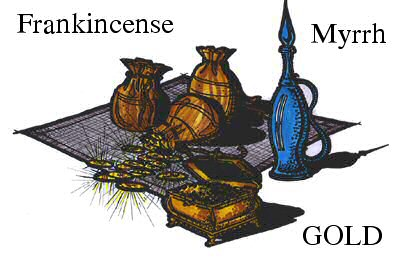
When the Magi came to Bethlehem in search of “he that is born King of the Jews” (Matt. 2:2), they brought with them three very rare and valuable gifts: gold, frankincense, and myrrh. They were not random gifts, but ones with specific political, spiritual, and practical importance; they were meant to recognize a literal, earthly, but also heavenly King.

gold frankincense and myrrhGold was a universally recognized precious metal, symbolic of all wealth. Frankincense was a substance primarily used as incense, but also mixed with other substances to create the holy anointing oil placed on high priests and kings. Myrrh was a substance used for things ranging all the way from cosmetics and antiseptics, to perfuming the living and embalming the dead.

According to Matthew 2:11, the Magi fell down before Jesus, which would have been an appropriate response when in the presence of royalty (and these men knew the difference). But the wise men did more than fall prostrate before royalty, they “worshiped him.”  This young king was more than just “King of the Jews,” but the long-promised Messiah, and they offered their gift to the Son of God.

Are You Wise?

As long as I can remember there have been sermons preached during and before Christmas entitled, “Wise Men Still Seek Him.” The sermons focus primarily on the seeking leading up to Christmas, but rarely, if ever, on the gifts given after the celebration is over. But today is different.

Today, I am going to ask you to consider three gifts we should give, now that the birthday celebration is over.

  • Gold. Gold represented wealth. In your worship of the King, will you give Him your wealth? In reality, God owns everything, including everything He loans unto you. But with your heart, are you willing to lay everything that is most valuable to you at His feet?
  • Frankincense. Frankincense represented worship. Would you be willing to fall down before Jesus, or do you hold back some of your Frankincense in reserve? Are there idols in your life – people or things – for which you reserve a little of that anointing oil, making those things lords of your life? Would you be willing to make Jesus Lord of all? Will you worship him without reservation?
  • Myrrh. Myrrh was symbolic of the beauty of life, from beginning to end. Would you give to Jesus everything that makes you happy? Everything that brings you hope? Everything that is sweet-smelling? Everything that hides your faults and failures, disguising your true self? Would you give Jesus your life? He can do more with it than you can do on your own.

Returns

For several days after Christmas people will stand in line to return and/or exchange unwanted gifts. Many will trade what others gave them for something they want more. Others will just ask for a refund or in-store credit.

Rest assured that when you give your gifts to Jesus, he will not return them, exchange them, or re-gift them next year. But will you, once you realize what you’ve given, want to take something back?

Don’t wait for a New Year’s resolution. Now that Christmas is over, be like the Magi and leave everything at Jesus’ feet, then “depart…another way.” Once you give Jesus those three gifts, you’ll never be the same.

2 Comments

Filed under Christian Living, Christmas, God, Love of God, salvation, wisdom, worship

Nevertheless, I’m Blessed

The following is from a study I did for my other blog, Proverbial Thought. Going into this weekend, knowing some difficulties my family is going to have to face (a prayer for provision would be appreciated), I really needed to be reminded of the goodness of God. Maybe you do, too.

Also, I just finished re-preaching a sermon I preached last night for the radio. The title of the message is “Praying for Those with Disease.” I needed it…we all need it. I hope it can be blessing to you.

“Praying for Those with Disease”

“Blessings are upon the head of the just: but violence covereth the mouth of the wicked.”Proverbs 10:6 KJV

Nothing Stays

Have you ever heard the old adage, “Like water off a duck’s back?” The reason for that saying comes from the fact that ducks never get “wet,” just in the water (now that will preach!). You see, because of the oil in a duck’s feathers, the duck can be in the water, have water poured over it, etc., but never actually get wet. The water doesn’t soak in, but runs off.

My head is similar to a duck’s back. There is nothing on my head to make anything stay put. Everything just runs off, down my neck, and under my shirt, especially when it rains. The upside is that I never have to dry my hair when I get out of the shower.

Except Blessings

But the awesome thing is that no matter how slick my bald head is, God is able to heap blessing after blessing on top of it. My glasses won’t stay put; hats get blown off; I cant wear flowers; but the Lord can pile blessings as high as He wants. How is that? Must be a God thing.

I don’t deserve blessings. I don’t deserve anything from God. If you only knew me like I know me, you’d wonder how any blessing would stay on my head. Yet, my Lord is merciful. He is able to do what man and water can’t.

The Wicked

The mouth of the wicked, on the other hand, is covered up with violence. What that means exactly is debatable, but the idea implied is that one usually gets what he deserves. The wicked can be compared to a swimmer in wool clothing and a wool coat. When he gets in the water, he’s sunk.

In General

Generally speaking, this proverb tells us that there are consequences for our actions. The way we live will come back either to bless or haunt us. Right living brings peace, while wicked living never ends well.

Do you want to be thought well of? Live justly. Do you want to reap the rewards of righteousness? Live right. Otherwise, even though there may be some temporary benefits to living like the Devil, the end result of wickedness will have you covering your mouth in shame.

A Prayer

Jesus, even though I am not worthy, thank you for your blessings. My righteousness is in you. I am only “just” because “the just shall live by faith.”  Thank you for your mercy, for when I was yet wicked, you saved me, cleansed me, and put a crown on my head. You are my glory, and I will praise you for your immeasurable goodness to me.

5 Comments

Filed under Christian Maturity, Faith, General Observations, God, Life Lessons, Love of God, Preaching, the future, worship

A Long Post About “Begotten” and Awkward Outbursts

I hate it when someone tells me that they are listening to me, but then do other things while I am talking. For example, when I talk to my wife, I prefer that she put down the phone, the dishes, the laundry, and quit sending emails and texts when I have something important to tell her (notice I used the word “and,” not “or” in the list of things she does). Call me selfish, but it is important to me that I know someone is listening when she says she is.

The reasoning for this preference of mine became embarrassingly evident last night at Taco Bell. My wife said she was listening to me, but only partly so. I will now share with you how I know this to be true.

The Subject

Yesterday (Sunday) morning I preached a sermon drawn from John 3:16. It was a powerful message stressing the grace of a loving God who would give His One and Only Son, Jesus, as a ransom for our souls. It was a message that also stressed, among other things, the uniqueness of Jesus Christ. Therefore, part of the sermon dealt the Greek word monogenēs (translated “only begotten”).

So, last night, after church and choir practice, my family and a friend went to Taco Bell for a late night gut bomb. As we sat there in the restaurant, my wife asked me to go back over some of the things I shared regarding the King James word “only begotten.” As I began to do so, I noticed she was only half-listening as she tried to maintain another conversation with our two daughters sitting with us.

I shared how that it was unfortunate for so many KJV-only-ers to come down harshly on other translations that change “only begotten Son” to “One and Only Son.” Many claim that the change is an attempt to pervert Scripture; to deny the divinity of Jesus. Yet, what many don’t understand is that the word “begotten” is not the best word that could be chosen to support the very biblical doctrine of the Trinity.

“Only-Begotten”

The King James Study Bible’s notes on John 3:16 explain monogenēs (translated “only begotten”) in the following way (note the highlighted parts):

The Greek word monogenēs is used by John to convey only the unique relationship between God the Father and Jesus as the Son of the Father. It serves to distinguish Christ as the only Son of God, in contrast with the many children of God. The uniqueness of this relationship is further emphasized by the fact that we become the children of God whereas Jesus always was the Son of God.[1]

Note, nothing is said about why the word “begotten” was used in the first place, nor what the  definition of monogenēs actually is. According to sources such as A Concise Greek-English Dictionary of the New Testament, the Louw-Nida Greek Lexicon, the Lexham Analytical Lexicon to the Septuagint, and the Greek Lexicon of the Septuagint, the word translated “only-begotten” actually means “unique,” “only,” and “the only member of a kin, only-begotten, only (of children) Jgs 11,34; id. (of God) Od 14,13; alone in its kind, one only.”[2]

So, even though “only-begotten” can be used to translate monogenēs, it is obvious that the actual theological meaning implied is that Jesus is the One and Only, totally unique, never created, always God, Son of God – the Word made flesh. Therefore, in my opinion, it is unnecessary for KJV-onlyists to condemn the translating of monogenēs into language that more accurately reflects the theology they are actually trying to preserve.

I find the following selection from Eardmans Bible Dictionary very interesting…

The KJV translation of Gk. monogenḗs “only, unique, one of a kind,” used (following Vulg. Lat. unigenitus) with reference to both Jesus Christ (John 1:14, 18; 3:16, 18; 1 John 4:9) and Issac (Heb. 11:17). Most other translations consistently read “only,” while the NIV translates “the one and only” with regard to Jesus. In English “only begotten” implies a created being, an implication not conveyed by the Greek term (cf. Luke 7:12; 8:42; 9:38).[3]

As I explained to my wife and a friend, there is nothing wrong with changing a word to better reflect the actual meaning, especially when the modern understanding of the word being used tends to give credence to an un-biblical, heretical theology!! Consider the following section (especially the bolded parts) from Baker Encyclopedia of the Bible

The phrase “only-begotten” is not an accurate translation and should not be used in any of the nine passages. This phrase is derived from the Latin Vulgate (a translation of the Bible from about the 5th century which has been quite influential on other translations) and reflects certain theological debates about the person of Christ. …Ultimately the phrase “begotten not made” leads to what theologians call the doctrine of the eternal generation of the Son. …“Only-begotten” is an incorrect translation. The idea being stressed is the uniqueness of Jesus’ relation to the Father. [4]

The irony is that I am the one who will be slammed and denigrated as a liberal “operative of Satan” who wants to change the Truth of Scripture. In the meantime, I am doing nothing but trying to “take heed unto…thy doctrine” (1 Timothy 4:16).

The Punchline

So, sitting in Taco Bell, I talked with my friend about monogenēs, at one point breaking down the word into its two parts, “mono” and “genes.” Unfortunately, sometime in the conversation I made a slip and mixed my words, saying “homogenes” (as in homogeneous). When I looked at my wife and asked, “Are you even listening?” She loudly, where everyone in the whole stinking place could hear her…

“HOMO! I got it! I GOT the HOMO!”

Here’s a lesson: if Greek bores you, keep silent about it in public places.


[1] King James Version Study Bible ., electronic ed. (Nashville: Thomas Nelson, 1997).

[2] Johan Lust, Erik Eynikel, and Katrin Hauspie, A Greek-English Lexicon of the Septuagint : Revised Edition (Deutsche Bibelgesellschaft: Stuttgart, 2003).

[3] Allen C. Myers, The Eerdmans Bible Dictionary (Grand Rapids, MI: Eerdmans, 1987), 782.

[4] Walter A. Elwell and Barry J. Beitzel, Baker Encyclopedia of the Bible (Grand Rapids, MI: Baker Book House, 1988), 1590.

1 Comment

Filed under God, Humor, legalism, Love of God, Preaching, Theology, translations

A Flirting God?

Don’t Be Shocked

I know that the title may come as a shock to many of you, but don’t be too shocked, at least not yet. I have been talking about men and women flirting over the last couple of days, but as I told you, there was a method to my madness.

You might be saying, “And if you say God is a flirt, then you are truly mad, you crazy fool!” But please, hear me (or read me) out. “Flirting” might not be the best word, but what about “wooing”? If not a flirting God, surely He woos us all the time.

Background

Now, just in case you think I am crazy, let me share with you one of my favorite verses from one of my favorite books in the Bible, Hosea.

I drew them with cords of a man, with bands of love: and I was to them as they that take off the yoke on their jaws, and I laid meat unto them.” – Hosea 11:4 KJV

With metaphor God explains to the prophet Hosea how He has gone the extra mile to win over His people’s love. That, after all, is the message portrayed by Hosea’s pursuit of Gomer (that’s his wife’s name) as she runs from lover to lover. God would much rather win our love than divorce (judge) us.

When I think of the first part of that verse, the words “cords of a man” become “heart strings.” In other words, in order to win our affections, God is doing everything He can to “pull our strings,” or at least the emotional strings of our hearts. Cool, huh?

Signs of Wooing

As with the last two posts, I’d like to consider some ways in which God might “flirt” with us. In other words, God might be wooing you if…

  • You wake up earlier than you wanted, but see the most beautiful sunrise of your life.
  • You decide to give up on life, only to have an email pop up showing someone worse off than you.
  • It seems that there is no meaning in life, but then you hear a baby cry, or your child says, “I wuv you.”
  • In the dark, late at night, you find yourself crying, but a warmth you can’t explain wraps around you, cradling you to sleep.
  • You find yourself feeling like a failure, worthless and dirty, then from out of nowhere comes a verse you learned in Sunday School: “For God so loved the world, that He gave his only begotten Son…”

Do I need to go on? Is He pulling the strings of your heart? Will you respond to His advances?

He does love you!

6 Comments

Filed under God, Love of God, salvation, self-worth

Atoned

Yom Kippur

On Friday and Saturday many observed Yom Kippur (Day of Atonement). “For devout Jews,” said a Fox News article, “Yom Kippur is the most solemn day on the calendar where according to tradition, God weighs people’s deeds and decides their fate for the next year.” (italics added)

However, I am thankful that Jesus fulfilled Isaiah 53, bore the cross that should have been mine, and decided my fate for eternity.

“And, having made peace through the blood of his cross, by him to reconcile all things unto himself; by him, [I say], whether [they be] things in earth, or things in heaven. And you, that were sometime alienated and enemies in [your] mind by wicked works, yet now hath he reconciled In the body of his flesh through death, to present you holy and unblameable and unreproveable in his sight…” Colossians 1:20-22 KJV

A Missionary’s List

Many years ago Rosalind Goforth (1864-1942) was a missionary to China who battled feelings of guilt. Even though she faithfully served the Lord, along with her husband, Jonathan, she always “felt guilty and dirty, nursing an inward sense of spiritual failure.” That is when she compiled this list of seventeen truths: What God Does with Our Sins.

What God Does with Our Sins

1.   He lays them on his Son—Jesus Christ. Isaiah 53:6

2.   Christ takes them away. John 1:29

3.   They are removed an immeasurable distance—as far as East is from West. Psalm 123:12

4.   When sought for, they are not found. Jeremiah 50:20

5.   The Lord forgives them. Ephesians 1:7

6.   He cleanses them ALL away by the blood of his son. 1 John 1:7

7.   He cleanses them as white as snow or wool. Isaiah 1:18; Psalm 51:7

8.   He abundantly pardons them. Isaiah 55:7

9.   He tramples them under foot. Micah 7:19 (RV)

10. He remembers them no more. Hebrews 10:17

11. He casts them behind his back. Isaiah 38:17

12. He casts them into the depths of the sea. Micah 7:19

13. He will not impute us with sins. Romans 4:8

14. He covers them. Romans 4:7

15. He blots them out. Isaiah 43:25

16. He blots them out as a thick cloud. Isaiah 44:22

17. He blots out even the proof against us, nailing it to His Son’s Cross. Colossians 2:14[1]

“What can wash away my sin? Nothing but the blood of Jesus!”


[1] Robert J. Morgan, Nelson’s Complete Book of Stories, Illustrations, and Quotes, electronic ed. (Nashville: Thomas Nelson Publishers, 2000), 364–365.

Leave a comment

Filed under Faith, God, Love of God, Theology