Category Archives: Christian Living

Resolutions to Avoid in 2019

Just for the fun of it…and maybe as a reminder to myself…I created a list resolutions…

A list of resolutions to AVOID… at all cost.

In other words, if you resolve to do the following, you may not live through 2019 (not in good shape, at least).

10 Resolutions to Avoid in 2019

1. I resolve to leave the seat up every time I go to the toilet as a sign of my manly rights.

2. I resolve never to say I’m sorry – unless I mean it, of course.

3. I resolve to read the Bible only when it’s projected on the big screen, and only on Sunday mornings, provided there’s enough free coffee and muffins beforehand.

4. I resolve never to waste any more food, especially that last donut or piece of pecan pie.

5. I resolve to limit my prayer time to blessings over food, when called upon at church, and the next time the cell phone bill is due.

6. I resolve to be more trusting of the government.

7. I resolve to spend more time at work and less time with my family.

8. I resolve to change my spouse’s mind, or else.

9. I resolve to keep more to myself and avoid other people.

10. I resolve to keep everything exactly the way it is right now.

So, what do you think? Are there any you would like to add?


10 Comments

Filed under Christian Living, current events, Future, General Observations, Humor

Memories from My Sister’s Visit (2018)

Some of you may know I have a sister, but other of you may not. Her name is Rebecca Lee Gomes, and she lives in Germany (married to a German, Carlos).

Two months ago she came to visit after being gone from the States for 7 years. Fortunately in one way, unfortunately in others, while she was here, my mother suffered a severely broken leg. That limited what we were able to do because a couple of weeks were spent in hospitals.

Also, while Becky was here, one of our aunts passed away.

Nevertheless, we did get to see some things and do some things, including visit the Ark Encounter, the Creation Museum, the Air Force Museum, and the Rock and Roll Hall of Fame (because we used to have a band, you know), all while taking my wife and our mom to the Cleveland Clinic in Ohio.

Just after Becky left I pulled together some photos and video made while she was here and created a little video on iMovie. Then I posted the video on YouTube for here to have it.

You may not get all the hidden humor, and you may not know all the faces, but you can watch the video, too, and get a little glimpse into our lives.

I’m gonna miss her.

5 Comments

Filed under America, Christmas, Family, places, Relationships and Family, Thanksgiving

Wise Men Give After-Christmas Gifts

“And when they were come into the house, they saw the young child with Mary his mother, and fell down, and worshiped him: and when they had opened their treasures, they presented unto him gifts; gold, and frankincense, and myrrh.” – Matthew 2:11

Late-Comers

Part of the Christmas story can be found in the book of Matthew, the first book in the New Testament. There, in chapter two, we read of several wise men, Magi, who followed the star till it rested over the place where the young Jesus was living.

But what most people fail to notice is that only the shepherds came to visit Jesus while he was still a baby in a manger. The Magi came later, once they were living “in the house” and Jesus was a “young child.” And, based on Herod’s decree that all male children 2 years old and younger should be killed (Matt. 2:16), Jesus could have been a toddler up and walking.

Simply put, generally every manger scene protested against by atheists is not a faithful representation of the Christmas story. How ironic is that? But I digress…

The Gifts

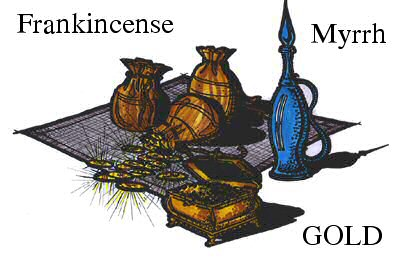
When the Magi came to Bethlehem in search of “he that is born King of the Jews” (Matt. 2:2), they brought with them three very rare and valuable gifts: gold, frankincense, and myrrh. They were not random gifts, but ones with specific political, spiritual, and practical importance; they were meant to recognize a literal, earthly, but also heavenly King.

gold frankincense and myrrhGold was a universally recognized precious metal, symbolic of all wealth. Frankincense was a substance primarily used as incense, but also mixed with other substances to create the holy anointing oil placed on high priests and kings. Myrrh was a substance used for things ranging all the way from cosmetics and antiseptics, to perfuming the living and embalming the dead.

According to Matthew 2:11, the Magi fell down before Jesus, which would have been an appropriate response when in the presence of royalty (and these men knew the difference). But the wise men did more than fall prostrate before royalty, they “worshiped him.”  This young king was more than just “King of the Jews,” but the long-promised Messiah, and they offered their gift to the Son of God.

Are You Wise?

As long as I can remember there have been sermons preached during and before Christmas entitled, “Wise Men Still Seek Him.” The sermons focus primarily on the seeking leading up to Christmas, but rarely, if ever, on the gifts given after the celebration is over. But today is different.

Today, I am going to ask you to consider three gifts we should give, now that the birthday celebration is over.

  • Gold. Gold represented wealth. In your worship of the King, will you give Him your wealth? In reality, God owns everything, including everything He loans unto you. But with your heart, are you willing to lay everything that is most valuable to you at His feet?
  • Frankincense. Frankincense represented worship. Would you be willing to fall down before Jesus, or do you hold back some of your Frankincense in reserve? Are there idols in your life – people or things – for which you reserve a little of that anointing oil, making those things lords of your life? Would you be willing to make Jesus Lord of all? Will you worship him without reservation?
  • Myrrh. Myrrh was symbolic of the beauty of life, from beginning to end. Would you give to Jesus everything that makes you happy? Everything that brings you hope? Everything that is sweet-smelling? Everything that hides your faults and failures, disguising your true self? Would you give Jesus your life? He can do more with it than you can do on your own.

Returns

For several days after Christmas people will stand in line to return and/or exchange unwanted gifts. Many will trade what others gave them for something they want more. Others will just ask for a refund or in-store credit.

Rest assured that when you give your gifts to Jesus, he will not return them, exchange them, or re-gift them next year. But will you, once you realize what you’ve given, want to take something back?

Don’t wait for a New Year’s resolution. Now that Christmas is over, be like the Magi and leave everything at Jesus’ feet, then “depart…another way.”

Once you give Jesus those three gifts, you’ll never be the same.

2 Comments

Filed under Christian Living, Christmas, God, Love of God, salvation, wisdom, worship

Questions You Should Ask Before Making a Resolution

Dear friends,

Every once in a while I find myself challenged by my own words, even convicted. The sermon I’m attaching below is a good example.

Back in 2014 I preached a sermon having to do with making resolutions, and as I listened to it today, my heart was broken; I’ve not accomplished my goals.

This sermon was recorded, as many of them were at that time, with my iPhone 4 sitting on the pulpit. Funny thing, some people actually thought I was reading my sermons from an app!

But I’ve done what I could to better the audio quality, and I would love for you to listen. This message is one that needs to be heard and heeded, for if Jesus set His face toward Calvary, there are some things we should set our faces “like a flint” towards.

Click on the link below, then after you listen to it, tell me if it challenged you like it does me.

God bless!

Questions to Ask Before Making a Resolution

“Eight Questions To Ask Before Making a Resolution”

  1. Do I need to make any resolutions?

There is nothing so fatal to character as half-finished tasks.” – David Lloyd George

  1. What has God called me to do? (John 6:38)
  2. Where will I be at this time next year if nothing changes?
  3. What should I do that I know is right, but will cause others to mock me?
  4. Will I be willing to be held accountable?
  5. Will my determination be visible?
  6. Will I rely on my own strength?
  7. To Whom will the glory go when I succeed?

“And whatsoever ye do, do it heartily, as to the Lord, and not unto men.” – Col. 3:23

2 Comments

Filed under Christian Living, Christian Maturity, Life Lessons, Preaching, the future

What Are You Worth?

What would you die for?

What is so valuable that you would risk or even sacrifice your own life? Have you ever stopped to think about that? You should.

The typical things in life that are considered so valuable, when put in perspective, aren’t really worth that much. Even the most “priceless” treasures are not worth your life – or are they? Would you fight a thief for your purse or car? If so, you are saying those things are more valuable than your life, for you are willing to risk your life to keep them. It is how people die every day in the pursuit of, and the keeping of earthly possessions. Pretty foolish.

What about non-concrete items, such as pride? Some people are willing to fight to the death, or kill others, when insulted or “dissed.” Perception is NOT reality, just as integrity is not determined by opinion; yet, some would rather risk death than be wrongly perceived.

Is family worth risking your life?

My wife, two of our daughters, and me.

Really, there is no argument against this one. But on the other hand, society has a difficult time determining the value of life; one life is not as valuable as another if convenience or personal pleasure is at stake.

I would risk my life to protect my family, and if you doubt it, try to hurt them – I carry more than a big stick.

Many, however, kill their own children before birth.  It seems to me that society values gold more consistently than life itself.

Are you willing to die for what you believe?

Now this, I know, could open up a whole can of worms; but that’s OK. Just stop and think about it for a moment. Do you believe in anything so much that it is worth more than your own life? When your life is on the line, knowing the difference between what you believe and what is only opinion is of key importance. A martyr is one who would rather die for what he believes than deny it.

Is your faith worth dying for?  If not, then how much do you really believe?

How much is YOUR life worth?

Value is determined by what someone is willing to give for it, right? That’s typically the way it goes. So, if nothing on earth is more valuable than your life, does that make your life valuable? Well, maybe to you.

Think about it, to someone else your life might not be as valuable as their own. Would you value the life of a total stranger so much that you would offer your own in exchange? I mean, really? Someone may even be willing to give all of the world’s riches in order to obtain your life, but are you worth it? Who would even have that kind of wealth? That leaves you with nothing more than your sense of value compared to another’s; your worth against theirs.

Value is relative to the thing for which the buyer will exchange.  That’s a disturbing thought, isn’t it?

On the other hand, what if the Creator of the universe offered to die for you?

But God demonstrates his own love for us in this: While we were still sinners, Christ died for us. – Rom 5:8 NIV

That would make your worth INCALCULABLE! The King of Heaven, the Son of God, gave His own life in exchange for yours, even accepting your guilt and failures as His own, and payed the death penalty for sin on your behalf.

For he hath made him [to be] sin for us, who knew no sin; that we might be made the righteousness of God in him. – 2Corinthians 5:21 KJV

That makes you valuable; Jesus unique. How many others have done what He did for you? Most of us would die for our children or spouse.  Some of us would die for a friend or maybe a good person.  But how many of us would give our own life to purchase the life of a stranger, much less a convict, drug dealer, murderer, etc?  Jesus did.

You see, at just the right time, when we were still powerless, Christ died for the ungodly. Very rarely will anyone die for a righteous man, though for a good man someone might possibly dare to die. But God demonstrates his own love for us in this: While we were still sinners, Christ died for us. – Rom 5:6-8 NIV

That’s the whole reason for Christmas, you know.  Jesus had to come to earth as a baby to grow into the Man that would willingly go to a cruel cross.  The gift of Christmas is the gift of life, purchased with the life of the Giver of Life. How ironic is that? How wonderful?

Let’s Review

  • Jesus Christ suffered the most excruciating death Rome could conceive, crucifixion…for you.
  • The Prince of Peace was shredded by a “cat of nine tails”…for you.
  • The King of Kings wore a crown of 4″ thorns…for you.
  • God became flesh so the world could know Him…including you.

Don’t believe the lies told to you by Satan, the culture, or your depressed emotions. Your life is of immeasurable worth because of the immeasurable price offered for it.

If you are worth that much, and if that kind of price was paid, don’t you think giving your life to Jesus is a fair exchange?

If you would like to know more about Jesus, and how he loves you and died for you, then call this number, 1-800-NEED-HIM. Or, if you would like to talk with me, just send me an email.  Your life is worth it.


This article was first posted 6/13/2014 and has since been updated.

1 Comment

Filed under Christian Living, General Observations, Love of God, salvation, self-worth, World View

Just Stomp Me. Selah.

“Let the enemy persecute my soul, and take [it]; yea, let him tread down my life upon the earth, and lay mine honour in the dust. Selah.” – Psalm 7:5

FullSizeRender (1)Selah. A musical notation calling us to pause, to rest for moment and consider what has just been said. In this verse David asks God to let his enemy “persecute” him and essentially pound him into the earth! Why? Let’s think about it.

Out of Context

Should we read this verse as a stand-alone statement, apart from the context in which it was written, David would appear to have some serious mental problems. Is that what he is telling us to think about?

In this one verse there are three separate actions for which David is asking God to allow.

  1. Let the enemy persecute and take my soul.
  2. Let the enemy tread down (walk all over and stomp on) my life.
  3. Let the enemy lay my honour in the dust.

Why would David ask God to allow these things? Was he crazy? Not hardly.

In Proper Context

When we examine the full context of Psalm 7,  what we see is David crying out to God for deliverance from another one of his enemies, Cush the Benjamite. Evidently Cush had made some serious accusations concerning David’s actions, accusing him of some very bad things.

“O LORD my God, if I have done this: If there is iniquity in my hands, If I have repaid evil to him who was at peace with me, Or have plundered my enemy without cause…” – Psalm 7:3-4 NKJV

Iniquity…doing evil to the one with whom he was at peace…plundering his enemy without cause… What in the world did Cush think David did? We may never know.

However, David was so confident that whatever Cush was accusing him of was a fabrication – a lie – that he was willing to suggest his own destruction should the accusation be true.

Making Application

Are you living in such a way that you could pray with confidence: “Lord, let my enemy destroy me, even drag my soul to hell, should I actually be guilty of whatever he’s accusing me of.”

If not, then maybe we should pray another prayer, one in which David asked God to show him anything that needed changing.

“Search me, O God, and know my heart: try me, and know my thoughts: And see if [there be any] wicked way in me, and lead me in the way everlasting.” – Psalm 139:23-24 KJV

I’d say it’s far better to let God do a work on us before our enemy does a number on us.


Leave a comment

Filed under Christian Living, God, Selah, Theology, worship

We’re All Sinners. Selah.

“Stand in awe, and sin not: commune with your own heart upon your bed, and be still. Selah.” – Psalm 4:4

FullSizeRender (1)Selah. A musical notation calling us to pause, to rest for a moment and consider what has just been said. In this verse, we are told to “commune” with our own hearts upon our beds. What about? Let’s think about it.

How Long?

Before, in the previous selah in Psalm 4:2, David was asking the question “How long?” How long would those whom he had once trusted betray him? How long would his former friends treat him like an enemy? How long would they promote lies over truth, and turn his “glory into shame?”

You and I may not be kings in exile, or have former commanders in our personal guard out for our head. However, there may be people who lie about you; spread untruths about you at work; misrepresent you to your children, or withhold that little bit of evidence just to win their case against you. How long will they get away with it?

You observe the culture. You watch the news and see the movies. You shake your head with disgust as you witness sin and shame, practically every deviancy known to man, promoted like it was the new gospel. You narrow your eyes and grit your teeth and whisper under your breath, “They should be glad I’m not God.” How long will God let them get away with it?

Awful Angry

Stand in awe, and sin not…” The Septuagint renders it “Be ye angry, and sin not…” The same is repeated by the Apostle Paul in Eph. 4:26 when he says, “Be ye angry, and sin not: let not the sun go down upon your wrath.” So why awe in one and angry in the other?

The word translated both as “awe” and “angry” is an interesting one. Consider Strong’s treatment of it:

רָגַז râgaz, raw-gaz’; a primitive root; to quiver (with any violent emotion, especially anger or fear):—be afraid, stand in awe, disquiet, fall out, fret, move, provoke, quake, rage, shake, tremble, trouble, be wroth.

So, when David is telling us to stand in “awe,” he is not telling us to do something like look up to the stars and go, “WOW!” No, David is giving us permission, as Paul did, to be angry; angry to the point of violently shaking, full of emotion and rage.

Just without sin.

Go to Bed?

So, just to make it clear, it’s OK to get angry, just as long as it’s a righteous anger (the last thing we want to be found guilty of is a lack of emotion when confronted with perversion and injustice; apathy is its own sin).  But in an apparent contrast with the later writing of Paul, what does King David suggest we do?

Go to bed and think about it? He said, “…commune with your own heart upon your bed, and be still. Selah.

But wait! I thought the Apostle Paul said we shouldn’t go to bed angry? What’s the difference?

The difference is GRACE, pure and simple. And hallelujah for that!

Humble Communion

Go ahead, get angry at the sin of the world. Go ahead, tremble with indignant anger at the way the glory of God is impugned on a day-to-day basis. Go ahead, quiver and shake with anger over the way people have been treating you – you have that right. But there’s something else you need to do: Remember the grace of God.

No, David is not telling us to go to bed angry and stew on it; he is encouraging us to remember that we are sinners, also.

To “commune with your own heart” means to reflect on yourself and your own condition. And when we add to that the words “be still” (דָּמַם [dā·mǎm]), which according to some* carries with it the idea of wailing and lamenting, along with being silent, what we have is the suggestion to be angry, but to remember we are sinners, too.

When David was treated horribly, he got angry, but he also remembered that if it wasn’t for God’s mercy he would suffer the same fate as the wicked. So, although we should get angry, at times, it is important for us to remember that although God is righteous, He is also gracious and good.

Thank Him for His mercy as you commune with your soul, and let Him handle those other people. Selah.


*William Lee Holladay and Ludwig Köhler, A Concise Hebrew and Aramaic Lexicon of the Old Testament (Leiden: Brill, 2000), 72.

*James Swanson, Dictionary of Biblical Languages with Semantic Domains: Hebrew (Old Testament) (Oak Harbor: Logos Research Systems, Inc., 1997).

3 Comments

Filed under Christian Living, God, Selah, Theology, worship

Barriers to Church Growth #7 (Self-honoring Giving)

A very revealing study was done, leading to a book detailing how 300 churches went from declining or dying, to growing. In Comeback Churches, written by Ed Stetzer and Mike Dodson, there is a list of 30 different barriers to church growth. Having received permission from the publisher (B&H Publishing Group), I would like to discuss a different barrier each week.

“People think of giving as being for their own honor.”

Therefore when thou doest thine alms, do not sound a trumpet before thee, as the hypocrites do in the synagogues and in the streets, that they may have glory of men. Verily I say unto you, They have their reward. But when thou doest alms, let not thy left hand know what thy right hand doeth: That thine alms may be in secret: and thy Father which seeth in secret himself shall reward thee openly.” – Matthew 6:2-4 KJV

I don’t have a problem with buildings, wings of buildings, rooms, sanctuaries, pews, or stained-glass windows being named in honor of people. It’s when those people give money in order have their names put on those things.

One of the most commonly used complaints against the church is, “They only want your money.” Just throw a rock into any crowd and the chances are high that you’ll hit a disgruntled, self-proclaimed atheist who thinks that way.

But even though most churches aren’t all about money (if they were, then why are so many struggling with tight budgets?), there are some folk within the church that like others to know how much money they have. These are the ones who pay the bills, and everybody knows it.

Jesus spoke of those who give just to be seen. I know people like that. They don’t give anonymously, heaven forbid. No, they hold a new conference and write an over-sized, four-foot-long check to the church, while posing for the camera.

These are the people who think they have more say-so in the congregation of believers. They think they have earned the right. Some even give in order to purchase titles, such as “prophet.” What’s worse, that very practice is applauded within a particular denomination. How sad.

What we need are more people who are willing to give because they love the Lord, not praise. I love the scene in Facing the Giants where a wealthy man gives the coach a new truck. Then he looks over at his son and says something like, “Don’t you say a word.” Now THAT’S what I’m talking about!

God gives to us so that we can give to Him. When it is money that we give, it is to be for His glory, not ours. So, if you want recognition, why not wait a little while for the kind that will come from your Heavenly Father?

The praise of men is worthless, if not simply envy in disguise. 

3 Comments

Filed under Christian Living, Christian Maturity, General Observations, Uncategorized

Praying for the President

Why can’t more Christians be like Pastor Brunson and pray for the President?

How many times do folks like myself have to remind fellow believers that even if you dislike the man, Donald Trump is the President of the United States, and we are therefore instructed to petition God on his behalf, to pray for him when he might not even recognize his needs, and to thank God for him.

Don’t believe me?

First of all, then, I urge that petitions, prayers, intercessions, and thanksgivings be made for everyone, for kings and all those who are in authority, so that we may lead a tranquil and quiet life in all godliness and dignity. This is good, and it pleases God our Savior, who wants everyone to be saved and to come to the knowledge of the truth. – 1 Timothy 2:1-4 CSB

Notice the “why’s” attached to the above commands:

  • So that we may lead a peaceful and quite life.
    Tell me, how in the world is throwing civility out the window helping things? Is our nation peaceful and tranquil? Heck, no! And why not? Could it be that many Christians are guilty of allowing Satan to use them as tools to stir up strife?
  • So that we lead a quite life of godliness and dignity.
    Oh, tell me, how much godliness is there in forcing people out of restaurants and threatening constant incivility? Where is the dignity in screaming at the sky and clawing at the doors of the Supreme Court?
  • It pleases the Lord.
    Newsflash: Rioting in the streets and burning police cars does not please the Lord. Sending hate mail does not please the Lord. Creating an atmosphere of chaos and incivility – even anarchy – does NOT please the Lord.
  • For the sake of the gospel!
    Yes, we are to pray for our leaders so that we might live peaceable, godly, and dignified lives in order that the good news of Christ might be shared with those for whom Jesus died, and that those for whom He died might be saved.

If that’s not enough, and you can’t think of anything good to say about President Trump, Jesus Himself leaves you with no excuse for the hatred and violence.

But I say unto you, Love your enemies, bless them that curse you, do good to them that hate you, and pray for them which despitefully use you, and persecute you; That ye may be the children of your Father which is in heaven: for he maketh his sun to rise on the evil and on the good, and sendeth rain on the just and on the unjust. – Matthew 5:44-45 KJV

Some of you can’t believe that any Christian would support Donald Trump. Frankly, I couldn’t believe that any Christian could support Barack Obama, the man more hostile to the Church than any other president in history.

But I can tell you this without blinking an eye: I prayed for President Obama.

We should be praying for President Trump, too.

30 Comments

Filed under America, Christian Living, Christian Unity, community, current events, ministry, Prayer

Hiding In Plain Sight

Back in 2010 (Sept. 14th, to be specific) I wrote a post that later became the basis for a story in my book, Life Lessons from the School Bus. If you don’t yet have a copy (you can order one), the following story, “Stop #13,” can be found on pages 45-46.

I am no longer a school bus driver, but the truth of this story remains the same: Sometimes bad things can hide in plain sight.

The Story

As you can see in the picture, a typical school bus has two mirrors immediately to the left of the driver window (besides the convex mirror below). With mirrors everywhere, driving is made much safer and easier, even in heavy traffic. What you don’t see is what is on the other side of the mirrors.

(This picture at the very spot an accident could have taken place.)

I was beginning to exit a gas station directly across the street from another station, and a Hardee’s. I looked in every direction and checked my mirrors. Then, as I started to pull out, an 18-wheeler appeared out of nowhere…directly in front of me! It had been hiding behind the mirrors.

Take a look at the picture. Right behind the top mirror sat a Peterbilt. I never saw it. What saved me was taking my time and being cautious. Had I rushed on forward I may have pulled right into the path of that big truck. Only going slow and expecting the unexpected made the difference.

The Lesson

So many tragedies in life could be avoided if only we would take the time to “consider our ways.”

“Now therefore thus saith the LORD of hosts; Consider your ways” (Haggai 1:5 KJV).

Do we stop to think about where we are going? Do we take the time to make sure there is nothing hidden behind the obvious? Sometimes our judgment can be clouded by the determination to move forward with our plans. Wisdom understands that the Enemy loves to capitalize on things hidden.

For example, how many people have fallen into financial ruin because they rushed into a business deal or bought something too expensive? Many times there are dangers lurking in the fine print or hidden in words we don’t take time to understand. Even though the path may look clear, it never hurts to take one more look before proceeding.

Ironically, big dangers can hide behind the very things meant to point them out.

Route Suggestions

The following are a few suggestions to help you navigate the route of life:

  • Never get too comfortable behind the wheel.
  • Never make quick assumptions based on past experiences.
  • Never let someone rush you into making an uninformed decision.
  • Read Psalm 119:105…”Thy word is a lamp unto my feet, and a light unto my path.” How important is it to have a light when driving down a dark and unfamiliar road? Where does this verse say we can find light for the road of life?

The road of life can be a dangerous place, dear reader. Why not follow the One who not only knows the way but IS the Way?

1 Comment

Filed under Christian Living, Christian Maturity, Life Lessons