Tag Archives: Jesus

“By” or “Through”: That’s the Question (An Examination of John 1:3)

This morning I was having coffee with a brother in Christ, and now I’m going to do some visiting. So, I typed in “coffee” to search older posts of mine and this one popped up. Interesting.

So, have a great Tuesday afternoon!


Introduction

Tuesday morning, after a cup of coffee with some great, godly men in our community, I was standing out in the parking lot of a local restaurant discussing the morning’s plans. It was during this short conversation that the subject matter briefly switched to that of Bible translations.

There we were, standing by the cab of a pickup truck when one of these men – a great friend to our family and church – said something akin to the following:

“The reason I will only use the King James Bible can be illustrated by the change in one word, and that word is found in the first chapter of John. There, the King James Version says, ‘all things were made by Jesus,’ but every other version – every single one – changes that word ‘by’ to ‘through.’ I have a problem with that. As I see it, there’s a big difference between ‘by’ and ‘through.’ Either everything was made by Jesus, or it wasn’t.” (Again, this was not an exact quote, but close.)

Therefore, it might take more than the average 500-word blog post to unpack, but I want to address this apparent conflict between “by” and “through” as found in John 1:3.

Doing the Research

You know, the last thing one should do when confronted with an unknown is say to the one making the assertion, “Nuh uh!” Right after my friend said what he did about every other translation of the Bible changing “by” to “through,” I pulled out my iPhone and pulled up BlueLetterBible.com.

Seeing what I was doing, the gentleman goaded me a little and said with a slight chuckle, “You gotta look that one up, don’t ya?” I grinned as I nodded…the subject changed back to hardware for about 30 seconds…then we went our separate ways.

But I did look it up. It wasn’t difficult to do, either. The Bible-study tools we have access to in an instant, even on our smartphones, are literally mind-blowing. At no other time in history have we had so much knowledge available so quickly right in the palms of our hands. Therefore, it didn’t take more than a few seconds to learn that my friend’s assertions were spot on… The KJV was actually the only one to render John 1:3 with a “by,” not a “through.”

For example:

  • John 1:3 (KJV) – All things were made by him; and without him was not any thing made that was made.
  • (NKJV) – All things were made through Him, and without Him nothing was made that was made.
  • (NIV) – Through him all things were made; without him nothing was made that has been made.
  • (ESV) – All things were made through him, and without him was not any thing made that was made.
  • (CSB) – All things were created through him, and apart from him not one thing was created that has been created.

Yes, I did my research, and what I found was that my friend’s assertion was true: every other translation of the Bible changed the word “by” to “through.” However, my research wasn’t complete; it was time to consult the original languages.

It’s All Greek

Like I said above, the study tools we have these days are amazing, and there’s really no good excuse for any Bible student to claim ignorance. For example, if all one had was access to one online tool such as BlueLetterBible.com, then what used to take hours of study could be done in mere moments. Then if you add to that all the other free websites available, including what’s available from online libraries, and then throw in some relatively inexpensive (but voluminous) programs like Logos, oh… my… goodness! It’s hard to comprehend how blessed we are!

So, when it became obvious that “by” had been replaced by “through,” I decided to take the next logical step and look up the source of the translations in question: the original Greek word, διά (dē-ä’).

It may sound unbelievable to you, but there are still people out there who think Jesus spoke Elizabethan English. However, the Bible was not originally written in the language of Shakespeare. In actuality, John 1:3 was written in Greek, so “by” and “through” are only translations of the Greek word διά (Strong’s G1223).

The next question should then be: “What does dia mean?”

Grab Your Concordance

Well, every Bible student should have a Strong’s Concordance in his personal library, even if his library only consisted of a Bible and one other book. Therefore, let’s take a look at Strong’s and see what we find.

G1223: διά diá, dee-ah’; a primary preposition denoting the channel of an act; through (in very wide applications, local, causal, or occasional):—after, always, among, at, to avoid, because of (that), briefly, by, for (cause) … fore, from, in, by occasion of, of, by reason of, for sake, that, thereby, therefore, × though, through(-out), to, wherefore, with (-in).

According to Strong’s Concordance, dia is a word that denotes “the channel of an act; through…” Therefore, is it really an act of theological sabotage to translate John 1:3 with through instead of by?

Is it possible that Jesus was the One through whom God the Father made all things?

You see, it is not heresy to say that the Father made all that is through Jesus, the Word of God. No, it is actually MORE theologically sound and true to Jesus’ own words to say that He was the agency or “channel” of creation, rather than the one acting unilaterally in creation. Why do I say this? Consider the actual words of Jesus as recorded by John…

  • John 4:34 (KJV) – Jesus saith unto them, My meat is to do the will of him that sent me, and to finish his work.
  • John 5:19 (KJV) – Then answered Jesus and said unto them, Verily, verily, I say unto you, The Son can do nothing of himself, but what he seeth the Father do: for what things soever he doeth, these also doeth the Son likewise.
  • John 6:38 (KJV) – For I came down from heaven, not to do mine own will, but the will of him that sent me.

If Jesus had acted alone and created all things by Himself, then His own words would expose a critical inconsistency. The fact seems to be that even though Jesus was and is God, the Second Person of the Trinity, He still had to act in accordance with the will of the Father, and therefore saying “all things were created through Him” is more theologically consistent with the nature of the Trinitarian understanding of the Godhead.

A Dose of Commentary

I learned a long time ago that commentaries can be very useful if used properly; I go to them after I have already read the Scripture and done all the exegesis I can do with the study tools at hand. Therefore, it was only after I did the above study that I consulted several scholarly commentaries. For the benefit of this discussion and for your edification, allow me to share the following directly from the sources.

The New American Commentary: John 1-11

The preposition dia (“through”), used in connection with creation here, should not be taken to mean that the Logos is essentially inferior to God, as the Arians argued. But the early Christians, in attempting to discuss simultaneously the work of both the Father and the Son in creation, sometimes tried to hold both together through the use of two prepositions. The Father’s activity was linked with the preposition ek, which carries the sense of “origin,” and the Son’s activity was linked with the preposition dia, which carries the sense of “mediation” (e.g., the early Christian creedal statement in 1 Cor 8:6; also see Heb 1:2 for the use of dia).

The Pulpit Commentary: St. John (Vol. 1)

In asserting that the Logos is he or that through whom all things were made, the writer does not lower the dignity of the Logos by regarding him merely as the οργανον of the Father, because the same preposition is used of the relation of the Father to the world or to his servants (Rom. 11:36; Gal. 1:1; Heb. 2:10). Elsewhere St. Paul powerfully affirms the same application of διά (1 Cor. 8:6) to Christ’s part in the Creation, reserving for the One God, the Father, the preposition ἐκ. From God and by or through God are all things, still “all things” derive their existence “through” the activity, the will, the thought, of the Logos.

Word Studies in the New Testament (Marvin R. Vincent)

By Him (διʼ αὐτοῦ). Lit., through him. The preposition dia is generally used to denote the working of God through some secondary agency, as διὰ τοῦ προφήτου, through the prophet (Matt. 1:22, on which see note).* It is the preposition by which the relation of Christ to creation is usually expressed (see 1 Cor. 8:6; Col. 1:16; Heb. 1:2), though it is occasionally used of the Father (Heb. 2:10; Rom. 11:36, and Gal. 1:1, where it is used of both). Hence, as Godet remarks, it “does not lower the Word to the rank of a simple instrument,” but merely implies a different relation to creation on the part of the Father and the Son.

Again, it would seem to me that it is more theologically sound to translate John 1:3 the way all the other translations do it as opposed to the KJV.

Right or Wrong?

But after all that has been said, was the King James Version’s translators wrong in their use of the word by instead of through? Actually, no.

You see, the whole reason we have newer translations of the Bible is because the English language changes over time. Some words have different meanings today than they used to, and that is why we rarely speak of wearing our “gay clothing” to church, or “fetch[ing] a compass” as we travel (Num. 34:5).

At the time the KJV translators did their work, the meaning of “by” was probably more nuanced than today and would have been understood by the reader of the day to have the same depth of meaning as “through.” However, for the modern reader, by implies more of a literal meaning. For example, if my daughter made a wooden elephant figurine, and if you asked who made it, I could answer, “It was made BY Haley.” If we applied the same meaning to the “by” in John 1:3, then we would literally be on the road to heresy, for Jesus did not act unilaterally (own His own), but by the will of the Father (John 5:19).

So, by may have been the best word for the verse in the 17th-19th centuries, but through better conveys the Truth to those in the 21st.

Conclusion

Without a doubt, the translators of the 1611 King James Version of the Bible were men of superior capability. I dare say that finding modern scholars and intellects with similar credentials would be exceedingly difficult. Therefore, because they did such a great work, it would be wise to consider their words when debating the heart of this discussion.

Translation it is that openeth the window, to let in the light; that breaketh the shell, that we may eat the kernel; that putteth aside the curtain, that we may look into the most Holy place … Indeed without translation into the vulgar tongue (the modern, common way of speaking), the unlearned are but like children at Jacob’s well (which was deep) [John 4:11] without a bucket or something to draw with…”

“For is the kingdom of God become words or syllables? why should we be in bondage to them if we may be free…?”

 – from: “The Translators to the Reader,” a prefix attached to the original 1611 edition.

It really boils down to this: What does the Bible really say? Sometimes we have to set aside our preconceived notions in order to honestly exegete Scripture. The last thing we want to do is let a literary bias lend support to a faulty theology, even if our intentions are noble.

Ultimately, though, Jesus is the Door “through” whom we must enter; there is no other Way to the Father. If a translation can’t make that clear, then we have a problem.

So, let me say “Thanks” to my friend. Without his comment, I’d never walked down this rabbit trail 😉 

10 Comments

Filed under Bible Study, Theology, translations

Alone As Hell?

It was just after midnight, and I knew where my children were (if you’re old enough, you know what I’m talking about).

It was just after midnight, and I also knew where my wife was (thank heaven life isn’t a country song, right?).

It was just after midnight, and believe it or not, I pretty much knew where everybody I love was – and they were not here with me.

Just yesterday I drove from Georgia to South Carolina to pick up a cute little puppy (a chorkie -that’s a dog) that was a gift from our oldest daughter, Alicia. The little puppy was meant, among other things, to help alleviate the pain of the empty nest. But another reason was so that when my wife is out of town there’d be some sort of living being at home to welcome me when I came in the door (mice – and we don’t have any…anymore…don’t count).

You see, I hate being alone. I hate it that the people I love most in the world are not with me. Up until the end of July, the sound of “daddy” (or other versions of it) was a word I heard every day for the last 25 years. Not any more. And then, with everybody out of town last night, I had only 8 ounces of tea-cup cuteness to keep me company… and it wasn’t the same.

I was alone.

Praise the Lord for FaceTime! Can I get an “ amen!”?

But think with me for just a moment. When Jesus spoke words of comfort to a troubled Peter, what did He say to encourage him? Jesus told Peter that he would always have a place in His Father’s house, and most importantly, Jesus would be there with him!

The picture Jesus chose to describe heaven was an eternal home where one would never be alone.

So what is hell?

Hell is a place NOT prepared for us, but for Satan and his demons. It’s not a home; it’s a prison.

With hell there is no hope of Christ’s return or to be received into His welcome embrace. No, it is a place where one is sent, away from the presence of love, to be alone…forever.

No One to speak in our defense. No One to never leave us or forsake us. Only darkness, damnation, and desolation.

Sure, the fires of hell will torment, but how much worse when one is totally, mercilessly alone?

Even if there should be no flame, would not eternal, infinite loneliness qualify as hell?

Here on this earth I am never truly alone, for God is with me. I’m never alone.

But for those who don’t have Christ, no earthly loneliness could ever compare to a place where not even the Spirit of God convicts anymore.

Sure, I may be lonely right now, like I was a little before 1 a.m., but thank God I’m not alone as hell!

Jesus is here.

4 Comments

Filed under Family, General Observations, Jesus, Life Lessons, Parenting, Struggles and Trials

Things I Don’t Know

As a husband, father, pastor, author, and perpetual student, I am constantly reminded of how much I really don’t know.

What if I made a list of all the things I don’t know? Well, that would be impossible, especially when there are so many things that I don’t know I don’t know.

However…..

Here are some things I wish I knew more about or could better understand. If it were possible to master these subjects, my self-esteem might go through the roof! Some may even call me a “know-it-all” in a non-derogatory way!

Do you know the answers to the following questions?

  • How can only three knobs (valves) and two lips play an infinite number of musical notes?
  • How do people get clean in dirty bath water?
  • What are hot flashes, and why women hate them in the winter?
  • Why are things like Pi (things that have no answer) so dadgum important?
  • If animals in cartoons and movies can talk to each other in English, not to mention read, why don’t they just write a note to humans when someone is in danger?
  • Why do women wear “natural” makeup to look natural, when natural was what they were before they put on the makeup?
  • Greek grammar – enough said.
  • Who killed Kennedy?
  • Why can’t I just decide to increase my debt limit, instead of balancing my budget?
  • Why do dogs and cats hate each other?
  • Why I could never pick up a snake by the tail, but Steve Irwin could?
  • How did the first person decide drinking something fermented, breathing something on fire, eating something coagulated, or using the anal glands of a beaver for flavoring (castorium) was an appetizing idea?

Life is full of persistent, nagging questions. Some questions may never be answered. I may never truly be a know-it-all. However, when it all comes down to what’s most important, I am reminded of the words of a man who was blind from birth: “I was blind…but now I see.”

I may not know everything, but I know that I will be OK when I die. I know that this world is not all there is. I know that heaven awaits me when I die. How? It’s all written in the Word of God.

 These things have I written unto you that believe on the name of the Son of God; that ye may know that ye have eternal life, and that ye may believe on the name of the Son of God. – 1 John 5:13

Did you know that?

2 Comments

Filed under Life Lessons, World View

Life Lesson from the School Bus (#9) “Making a Way”

Trying to Merge

Have you ever tried to merge into traffic, only to find that everyone else is in a bigger hurry than you? Try convincing a bunch of motorists on their way home that your school bus needs to jump into the flow.

Every time people see my kid transporter attempting to enter traffic from a side street, they say to themselves, “Oh no! I can’t get stuck behind a bus!

So, without any compassion for me and my nerves, they pretend that they don’t see me. Better yet, they hold up a hand, wave slightly, and give me a look that says, “Sorry, but my schedule is too hectic to let you in front of me.” Jerks.

Making a Way

That’s when a school bus driver has to be proactive…he has to make a way into traffic. By being assertive with 35,ooo pounds of diesel-powered intimidation, one can MAKE motorist slow down and be polite. Making a way into traffic is possible because of a simple fact of life – getting put on the local news for hitting a school bus full of children is NOT in one’s best interest.

Life Lesson

God can make a way, when there seems to be no way.

Isaiah 43:16, 20 – [16] Thus saith the LORD, which maketh a way in the sea, and a path in the mighty waters; … [20] The beast of the field shall honour me, the dragons and the owls: because I give waters in the wilderness, [and] rivers in the desert, to give drink to my people, my chosen.

When God chooses to do something, nothing in heaven or on earth can stop Him. God can make a way. No decree of man or law of nature is an obstacle to the LORD of creation. If God has told you to go somewhere, do some work, or reach some person, even if the way seems impossible, He is God…He will MAKE a way.

Are you going through a valley? Are you on a stormy sea and can’t see past the waves? Do you think that there is no hope, no way out of it this time? Trust in Jesus – He can make a way, where there seems to be no way. He can give rivers of hope in the midst of your wilderness.

Hope you enjoy this short video of a beautiful song by Don Moen.


4 Comments

Filed under General Observations, Life Lessons, the future, Uncategorized

Salvation Is His Name. Selah.

“Salvation belongeth unto the LORD: thy blessing is upon thy people. Selah.” – Psalm 3:8

FullSizeRender (1)Selah. A word at the end of a verse that calls us to think… to ponder… to meditate on what has just been said. Let’s meditate for just a moment on our salvation.

They Said

They said there is no hope in God. In their arrogance they belittled David’s faith and tried to scare him. By the thousands they surrounded David, seeking his demise.

But David was not afraid. His confidence in God was such that he could sleep like a baby, cradled in the arms of his Deliverer.

They said God could not – that He would not – help David. But that’s what they said … and they had no clue what they were talking about.

He Didn’t Listen

David’s hope was not in man; it was in God. Who were these people to say God wouldn’t help? Did they have control over the Creator of the universe? Were they to tell God to whom mercy would be given?

David didn’t listen to the lies of his enemies, and neither should we. Salvation is not something we can get by bowing down and submitting to men. Salvation is of God! And if He choses to save us from danger, nothing can stop Him.

Prophetic Salvation

But if you don’t mind, there’s one more little thing to think about as we pause and reflect on God’s salvation. Think about the original Hebrew word for “salvation,” and then start putting two and two together.

  • The Hebrew word translated as “salvation” in Psalm 3:8 is יְשׁוּעָה (H3444) yĕshuw`ah – pronounced yesh·ü’·ä. It means “that which is delivered; deliverance.”
  • יְהוֹשׁוּעַ (H3091) is the Hebrew name “Joshua,” pronounced yeh·hō·shü’·ah. It means “Jehovah (Yahweh) is salvation.” 

  • “Jesus” is the way we spell the Greek name Ἰησοῦς (G2424), pronounced ē-ā-sü’s. “Jesus” is the Greek version of the name “Joshua.” Both mean “Jehovah (Yahweh) is salvation.

“But thanks [be] to God, which giveth us the victory through our Lord Jesus Christ.” – 1 Corinthians 15:57

“Blessed [be] the God and Father of our Lord Jesus Christ, who hath blessed us with all spiritual blessings in heavenly [places] in Christ:” – Ephesians 1:3

When the Enemy comes against you, find rest in the assurance that your Salvation is in Jesus Christ. He saved David, and He can save you!

1 Comment

Filed under Bible Study, Selah

Give Attention to Your Doctrine

Every once in a while I feel the need to do a little teaching. Keep in mind, many who read this blog do not go to a church, never hear a real pastor preach, nor even read a Bible. This might be the only path through which they choose to accept Biblical truth.

I just finished recording the audio for an upcoming radio broadcast. The text from which I preached was primarily the following:

Till I come, give attendance to reading, to exhortation, to doctrine. … Take heed unto thyself, and unto the doctrine; continue in them: for in doing this thou shalt both save thyself, and them that hear thee. – 1Ti 4:13, 16 KJV

One of the greatest challenges for the preacher is to make sure his doctrine is biblical, not based on human desires, such as the desire to only hear what we want to hear. I am reminded of the what Paul told Timothy in his second letter…

For the time will come when they will not endure sound doctrine; but after their own lusts shall they heap to themselves teachers, having itching ears; And they shall turn away [their] ears from the truth, and shall be turned unto fables. – 2Ti 4:3-4 KJV

How many people have literally “heaped to themselves” stacks of books, CD’s, cassette tapes, magazines, study guides, and DVD’s from televangelists, conference speakers, and popular authors who preach what scratches the itching ear? People want to hear what makes them feel good, more encouraged, and can lead to a more prosperous, fulfilled life. Therefore, hearing the Word of God is irrelevant, especially if it doesn’t scratch the itch

The challenge, then, is for the sincere man of God to give priority to what is true doctrine, not the doctrine of men. This takes serious study, a willingness to be led by the Holy Spirit, and an understanding that what is of the Lord might not be popular, or desired.

That’s when it’s important to be “instant in season and out of season.” God knows what we need to be spiritually healthy, so “taking heed” to our doctrine must also include the commitment to serve what what’s needed, not simply what we crave.


4 Comments

Filed under Christian Living, God, ministry, Preaching, Theology

Do You Have Hope Without Jesus?

In Acts 16:30 the Philippian jailer asked, “What must I do to be saved?

“Forgiven” by Thomas Blackshear

William MacDonald wrote the following comment in his commentary:

“This question must precede every genuine case of conversion. A man must know he is lost before he can be saved. It is premature to tell a man how to be saved until first he can say from his heart, I truly deserve to go to hell…Many people today seem to have difficulty knowing what it means to believe. However, when a sinner realizes he is lost, helpless, hopeless, hell-bound, and when he is told to believe on Christ as Lord and Savior, he knows exactly what it means. It is the only thing left that he can do!” (MacDonald, W & Farstad, A. Believer’s Bible Commentary: Thomas Nelson or Logos)

Do you have hope without Jesus? Then you’re without hope. Simply hopeless.

And that breaks my heart.

“Believe on the Lord Jesus Christ, and thou shalt be saved…” – Acts 16:31


If you would like to talk with someone, there is a phone line open 24 hours a day. Call 1-800-NEED-HIM (1-800-633-3446). Someone will be happy to show you how to be sure you have eternal life. Don’t wait.

2 Comments

Filed under Christianity, salvation

“One Man’s Sunset; Another Man’s Dawn”

Over a two-week period, just over 31 years ago, things started to get a little weird.

I can’t recall all of the moments that led up to me concluding something bad was going to happen, but a couple stand out above the rest.

The Revival Service

It was in June of 1991. The church that I attended was having a week-long series of meetings. My mother and father did not attend the same church as I did, but on the last night of the revival, which was a Friday, my dad came. The evangelist preached on heaven that night and said something that hit me like a brick. He said, “Heaven will never be real to you until there is someone there you want to go see.”

The Movie

In that very same week, my family went to see a movie. It was a new animated film called An American Tail: Fievel Goes West. In one particular scene, an old hound dog, the retiring sheriff, sat watching a sunset with the little mouse, Fievel. The legendary actor, Jimmy Stewart, speaking as Wylie Burp, said to Fievel,

“Just remember, Fievel – one man’s sunset is another man’s dawn. I don’t know what’s out there beyond those hills. But if you ride yonder… head up, eyes steady, heart open… I think one day you’ll find that you’re the hero you’ve been looking for.” – Wylie Burp

The moment he said, “one man’s sunset is another man’s dawn,” I felt a chill and a heaviness that took my breath. I knew my dawn was coming.

Sunset

Early on Monday morning, June 11, 1991, while working 3rd shift as a security guard in a high-security nuclear facility, my dad felt sick. He asked a cleaning person which bathroom was clean, then went in, took off his gun belt, bent over a sink, and died.

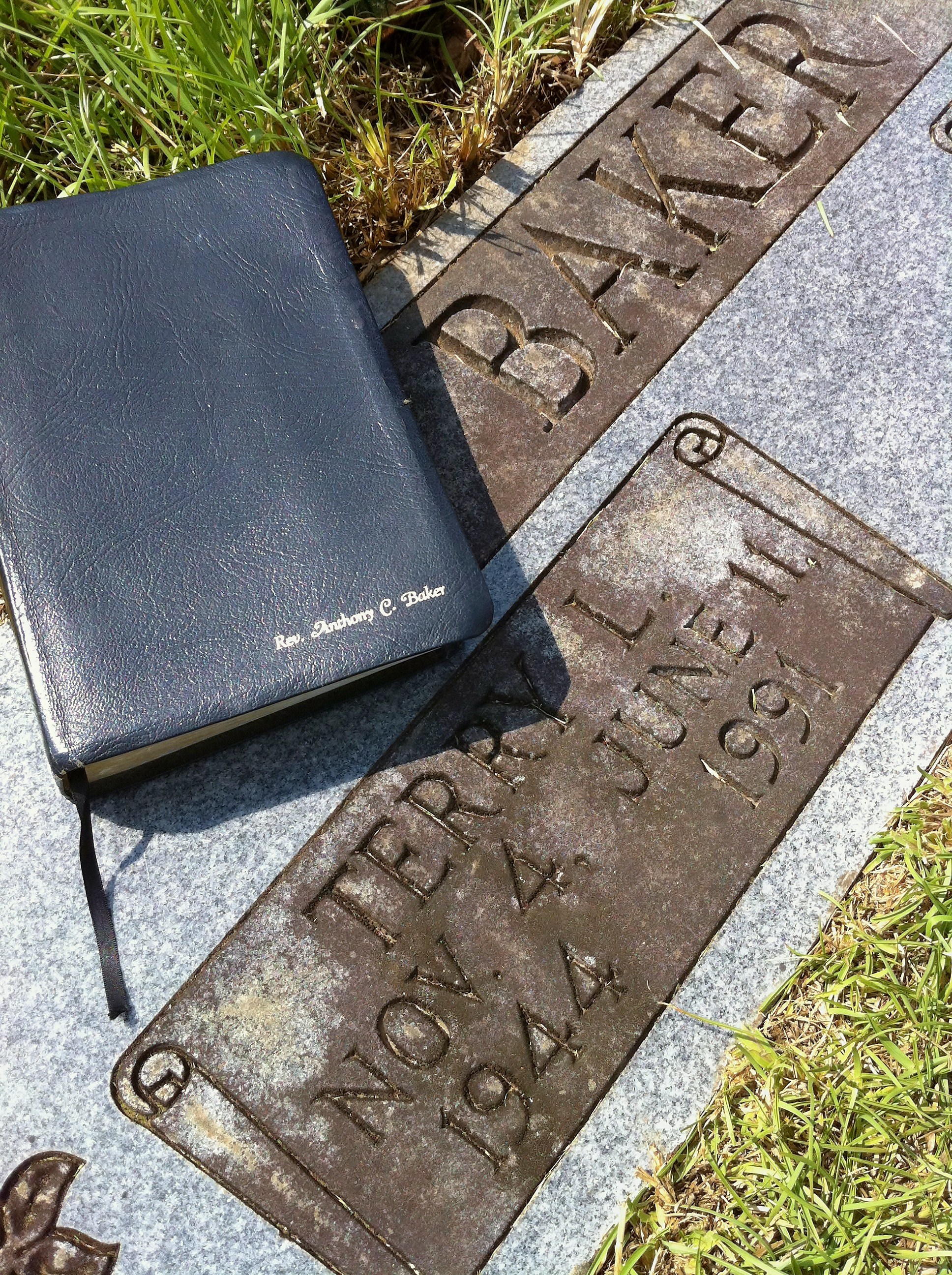
It had only been since Friday the 8th that I had heard that message about heaven. That Monday was when heaven became more real than I could have ever imagined. My dad, Terry L. Baker, went home to be with his Lord and Savior, Jesus Christ. He surrendered his badge, took off his gun belt, and laid down – literally.

Dawn

As the sun rose over the horizon, I sped my Datsun 280Z toward the hospital. When I got there, I asked for my dad, but was led to a room where my mother was sitting. In a sobbing cry, she looked up to me and held out a little plastic bag containing my father’s personal items. She said, “This is all I have left…” That was the exact moment when I found out. That was the exact moment it became dawn.

That’s my father and me on the front row. This was 1987 in Milan, Michigan.

It may have been my dawn, but it was one of the darkest moments in my life. My dad and I were terribly close. We worked together, played together, worshiped together, and preached together. In the week before my daddy died, I went up to him and told him that I really felt like something was going to happen. He told me that he would outlive my grandchildren. But in case he didn’t, I had to make sure of one thing – would I preach his funeral?

The Funeral

Some people could not understand how I did it, but I did preach my dad’s funeral. You see, I was 24, but I had accepted the call to preach when I was 16. My dad had been a pastor, a lay preacher for years. It may have been just guy talk at the time, but in a moment of male-bonding, my dad and I agreed that whoever died first, for whatever reason, the other would preach the funeral. That is why I asked my dad that question. I needed to be sure he was serious. His response was, “Of course. I wouldn’t have it any other way.” So, I did.

My dad presided over a lot of funerals, and he even carried in his Bible a sermon that he used more often than not. The title of the sermon was “The Times I Need Him Most.” So, from his own Bible, from his own outline, I preached his funeral. And unlike I usually do today, I even gave an altar call. Believe it or not, right there to my left, beside the casket, a friend of the family came down to the altar and asked Jesus to come into his life. Never once had my dad led a person to the Lord when he preached a funeral sermon, but this time was different.

The Family Car

There will always be those who think the following is crazy; only coincidence: but God showed up in the limousine as we went to the graveyard. As soon as I got into the car, I asked the driver, who was a Christian friend, to turn the radio on. I wanted to hear some encouraging music. When he did, the DJ on WAY FM out of Nashville played a song by Wayne Watson, The Ultimate Healing. Right after that, the DJ came on the air and said, “I know we usually have songs pre-planned according to a particular format, but I just really feel led by God to play this next song – I don’t know why.”  The song was Where There is Faith, by 4Him. The second verse goes like this:

There’s a man across the sea
Never heard the sound of freedom ring
Only in his dreams
There’s a lady dressed in black
In a motorcade of Cadillacs
Daddy’s not coming back
Our hearts begin to fall
And our stability grows weak
But Jesus meets our needs if only we believe

CHORUS
Where there is faith
There is a voice calling, keep walking
You’re not alone in this world
Where there is faith
There is a peace like a child sleeping
Hope everlasting in He who is able to
Bear every burden, to heal every hurt in my heart
It is a wonderful, powerful place
Where there is faith

Today

Today, my mother’s body is now resting beside my dad’s, but I am comforted with the knowledge that one day I will see both of them again (1 Thessalonians 4:13-18). In the meantime, I must carry on in the task that I have been called to do.

Several years ago, I went to the grave, and even though I knew my dad was not there, I read Proverbs 4 aloud. What better words could have been said in remembrance of a committed, consistent, caring, God-fearing, humble father? They were words that I wanted to say out loud because they were being fulfilled.

“He taught me also, and said unto me, Let thine heart retain my words: keep my commandments, and live. Get wisdom, get understanding: forget [it] not; neither decline from the words of my mouth.” – Prov. 4:4-5

“Hear, O my son, and receive my sayings; and the years of thy life shall be many. I have taught thee in the way of wisdom; I have led thee in right paths. … Enter not into the path of the wicked, and go not in the way of evil men. … My son, attend to my words; incline thine ear unto my sayings. Let them not depart from thine eyes; keep them in the midst of thine heart. … Let thine eyes look right on, and let thine eyelids look straight before thee. Ponder the path of thy feet, and let all thy ways be established. Turn not to the right hand nor to the left: remove thy foot from evil.” – Proverbs 4:10-11, 14, 20-21, 25-27

Dad (and Momma), I just want you to know that I am still in the fight. I haven’t given up and I haven’t compromised. I wasn’t a fly-by-night wannabe, but a real man of God. My Sword is still sharp. My aim is still true. I even have some “arrows” that used to be in my quiver; you will meet one day.

Don’t worry, even though I know you won’t. I will keep pressing on and fighting the good fight until the time of my own sunset. Then, when this life is over, I hope I can stand there beside you when Jesus says to you, “Well done.” You did good, Daddy. I’ll make you proud.

Tell Mom we all miss her, too.

Your loving son,

Rev. Dr. Anthony C. Baker

9 Comments

Filed under Family, Future, Life/Death, Preaching, Relationships and Family, salvation

7 Reasons Jesus Came To Die For You!

7 Reasons Jesus Came To Die For You!

7 Reasons Jesus Came To Die For You!


— Read on debrapedrow.com/2019/05/23/7-reasons-jesus-came-to-die-for-you/

Great post from Debra.

2 Comments

Filed under Apologetics, salvation, Uncategorized

The Humble God Brings Revival

A while back I preached a short message from Isaiah 57:15 entitled, “Three R’s and Revival.”

Later, I read through the chapter again on my iPhone, this time in the NET version:

“For this is what the high and exalted one says, the one who rules forever, whose name is holy: “I dwell in an exalted and holy place, but also with the discouraged and humiliated, in order to cheer up the humiliated and to encourage the discouraged.” – Isaiah 57:15 NET

My eyes filled up with tears! The Holy One is not too good to sit down with the humiliated and discouraged! Hallelujah!

News Flash! God is humble!

Of course He is! Just look at what He did! Jesus became flesh (John 1:14) and walked in our shoes. He allowed Himself to be humiliated and beaten, even crucified, although He had every reason to look down on us, being God (Phil. 2:6-7). The “High and Lofty One” became the “meek and lowly” (Matt. 11:29).

There is no pride in God!


The Three R’s

“For thus saith the high and lofty One that inhabiteth eternity, whose name is Holy; I dwell in the high and holy place, with him also that is of a contrite and humble spirit, to revive the spirit of the humble, and to revive the heart of the contrite ones.” – Isaiah 57:15 KJV

There are three “R’s” that I see in Isaiah 57:15… Reign, Realm, and Residence.

  1. I see the first one in the words “high and lofty.”
  2. The second one I see is found in the words “inhabiteth eternity.”
  3. The third “R” is located in the words “I dwell,”and “with him also.”

1. Reign

Earlier, in chapter 6, Isaiah said he “saw also the Lord sitting upon a throne, high and lifted up…” The “high and lofty” One is none other than a King. And not just any king, this is the King of Kings and Lord of Lords, Jesus Christ. The same description is found in Revelation 4. In verse 2, John saw a throne “set in heaven, and [one] sat on the throne.” Who was the One that sat on the the throne? Evidently the same Person who was seen by Isaiah, because in both accounts the angels were crying out “Holy, holy, holy...”

God is not a man-made idol or idea formed in the human mind – He is “high and lofty.” He is “exalted” above every other creature, whether in heaven or in earth. “Thine, O LORD, is the greatness, and the power, and the glory, and the victory, and the majesty: for all that is in the heaven and in the earth is thine; thine is the kingdom, O LORD, and thou art exalted as head above all” (1 Chronicles 29:11 KJV).

Because He is king, there remains only two options with regards to His reign: you are either His subject, or you are His enemy. God does not operate like earthly kings and nations. We have allies; but not God. His kingdom demands total loyalty (every knee shall bow). Serving another king is not a good thing at all, for it will only result in His judgment. No king is greater than He. To serve another is to live in rebellion.

2. Realm

God is the One that “inhabiteth (inhabits) eternity.” This is His realm. His influence reaches not only across all known and unknown areas of the universe, but across time immortal!

It was said that at one time the sun never set on the British realm. All over the world there were colonies under the control of the throne of England. But even more impressive than that, God’s realm isn’t limited to the present rising and setting of the sun, it is in ETERNITY.

It is important to note something here. I am not opposed to reading different translations, but a good example of when a new translation misses the mark is changing the word “inhabiteth” to “rules/lives forever.” Of course it is true that God lives and rules forever; however, there is more to it than that. The word “inhabit” touches upon His eternally sovereign omnipresence. God/Jesus is not just king over the here and now, or the future, but over the past, present, and future at the same time! He inhabits eternity! There is nothing in the realm of time, no matter where it is, that is out of His scope of authority.

Stop and think about this, folks. Think about the practical application of the above statement. Let’s just say you need $100 tomorrow to pay a bill. Or, it could be $1 million, a billion – doesn’t matter. You could go to an earthly king and ask for help, but the king would be limited to the time frame in which you needed the money, the amount that he had, and the limitations of his realm. Not God.

I have seen money come in for a need that was desperate. God provided what was needed. But, when you look at the sequence of events, God started answering that prayer long before it was ever prayed – decades before! God is not limited by time, space, or anything. His realm covers it all. When George Mueller prayed for milk (for his orphanage), do you not think that God had already put in place the neccessary sequence of events to make that milk wagon drop a wheel? It is not even out of line to think that He went back to when the tree was planted that provided the wood for the wagon.

3. Residence

God not only lives in the “holy place,” but He dwells with lowly man. His name is Emmanuel – God with us. But notice this, He only dwells with the humble, the contrite, the broken-hearted, the cast down, the weary, the needy (“God resisteth the proud, but giveth grace unto the humble.” – James 4:6). Even though He could choose to stay in His high and holy place, far above the heavens (as most men would do, given the opportunity), He makes His bed right on the floor with the lowliest, shivering beggar.

Of all people, God should be the one who looks down His nose at us. He is the “lofty” One upon the throne. We are the helpless sinners. How ironic is it that the only ones who will not open the door of their hearts are the prideful? Pride closes the door to the King.

and Revival

He said “I dwell” in order “to revive.” It is the presence of the God who cares; the God who understands where we are; the God who makes His home with the “discouraged” and the “humiliated” that brings revival. Oh, to live without hope, without compassion, without a tender touch from a caring hand, brings death. But to have a King step down from His lofty position in the heavenlies, from the eternal, to a lowly place in time – that revives the heart.

The gulf that separated me from Christ, my Lord 
It was so vast, the crossing I could never ford 
From where I was to His domain, it seemed so far 
I cried “Dear Lord, I cannot come to where You are” 

CHORUS 
He came to me, He came to me 
When I could not come to where He was, He came to me 
That’s why He died on Calvary 
When I could not come to where He was, He came to me 

He Came to Me – by Squire Parsons

Don’t let pride shut the door to your heart when the King of Kings seeks to dwell with you.

3 Comments

Filed under God, Preaching, salvation, translations, worship