Good morning, good afternoon, or good evening, dear reader! What a beautiful day to tackle a current story in the news!
Oh, and speaking of tackle, did you see the video of the USC (college football) punter who instead of punting threw a first down? Talk about faking out the competition! Instead of the player who WAS the punter, a third-string quarterback subbed in with the punter’s jersey and fooled everyone – until he rifled the football. Beautiful.
But speaking of beautiful, there’s the four-time bride Kim Davis, former county clerk in Kentucky. If you don’t remember who she is, back in 2015 she refused to sign the marriage certificates for same sex couples, even though the law had made it legal. After an emotionally-damaged gay couple from Rowan County sued Kim Davis for denying them a blissful union, the courts demanded that Ms. Davis pay the smartly dressed couple $360,000 in damages and attorney fees.
The current story is that Kim Davis is seeking to have the Supreme Court overturn her fine, and by extension, overturn Obergefell v. Hodges. What are her arguments for doing this? WHO CARES? She has no moral ground from which to appeal her case because . . . wait for it . . . she has been divorced.
That’s right, folks. Just because the ravishing Kim Davis found a way to seduce for different men into marrying her (and three to leave), she therefore must have no respect for the legitimacy of marriage and shouldn’t be lecturing others about it.
Riiiiiiiiiiiiiiiiiiiiiight.
So, let’s see if I am understanding this correctly. Let’s start with Kim Davis.
Kim Davis is a confessing Christian. She believes that God made men and women and only men and women should get married. She believes this so strongly that she chose to go to jail rather than go against her religious beliefs and put her signature on a same-sex county-issued marriage certificate.
“But Kim Davis has been divorced three times! She’s now married to her fourth husband!” you protest. Yes, that’s the truth. But does that mean she has no moral ground from which to launch an attack on gay marriage? Does her poor choice in men (or the poor vision and shortsightedness of these men) nullify her religious beliefs? Does her participation in the destruction of three marriages mean that, in actuality, she doesn’t believe what she preaches?
Some say, “Yes!” To those people, particularly those attacking Kim Davis in the media, let me ask YOU some questions.
Do you believe there should be speed limits in our neighborhoods? Then why to you speed in your car?
Do you believe it is wrong to lie? Did you say you never go over the speed limit?
Do you believe we should not objectify women? Then why do you change your appearance to that of a stereotypical caricature of 1950’s feminism?
Do you believe that marriage is just a construct of society, morals and values are relative to context, and sexual deviancy is nothing more than a than a term created by religious zealots? Then why do you judge another person’s moral standards and why is changing the definition of marriage such a big deal?
It’s only me thinking out loud, I suppose. I just don’t understand how one’s substandard living nullifies the standard by which one judges.
Ironically, one of the first evangelists, if I’m not mistaken, was a woman who was married five times and the man she was living with at the time was not her husband (so said Jesus).
As I write this, I am sitting in a familiar place. It’s a place I’ve been to many, many times.
It’s a funeral home.
To be honest, it’s not always been a place of sadness, at least not the kind I’m feeling today. No, many times it’s been quite the opposite, for “precious in the sight of the Lord are the death of His saints” (Ps. 116:15
But today is different.
Today I’m attending a “celebration of life” for a man I worked with. It’s a service of remembrance to celebrate the life and legacy of a well-loved individual. But nothing has ever been said about faith, not ever and not up until now.
So what about the next life?
The first song playing is “When I Get Where I’m Going.” It’s quite a sentimental piece that assures the listener that where the lost loved one is going will be wonderful. It’s got theological problems, but that a different issue.
But now there is a preacher speaking, and so far he’s speaking truth! That’s encouraging! What’s the outline? “Stand on the Truth That…”
God is Good
God Loves Us
God Will Help You
Amen, brother! That was certainly unexpected! A solid gospel message was delivered! I’m gonna find out who that preacher is and thank him for being so bold! (I did)
The last song now playing is “Go Rest High On the Mountain.” (Please, if you respect my wishes, threaten to hang anyone who suggests that song for my funeral.)
But where’s the real assurance that will happen? God only knows the heart of a man. The only guaranteed prescription for hope after this life is faith in the Person of Jesus Christ.
Was there faith? There could have been. Possibly. Nothing definite. No testimony to draw from and no mention of anything remotely religious in his life. Only God knows.
And that’s why there’s nothing for me to celebrate, only mourn. Not only is a decent man gone, but that’s it. Nothing else. No hope of eternity, only wishful thinking wrapped up in pseudo-religious country music.
As of this writing, there are only five days until Christmas. If I had only spoken out a few months ago, things might have been different today. But I didn’t say anything earlier because I didn’t want to hurt feelings or offend. I can only hope that by protesting now, something good can come of it.
You may recall that a few years ago I wrote a scathing critic of Dean Martin’s “Baby It’s Cold Outside.” I wasn’t the first to point out the song’s sexually abusive lyrics. Nevertheless, my article did get attention. This wasn’t surprising since the #metoo movement was going strong at the time.
But here we are in yet another Christmas season and what do we have? More offensive lyrics in Christmas songs. What makes it worse is that they are part of worship services. These services are meant to celebrate the birth of Jesus Christ, not a sexual conquest.
It seems that all one must do these days is include the word hallelujah in a song, no matter the context of the borrowed lyric or tune, and it’s sure to be a hit at your next Christmas cantata.
“Hallelujah”
Let me be clear. It is not my wish to trash Leonard Cohan’s famous, beloved and oft-covered “Hallelujah.” Why would I want to? My complaints would just fall on deaf ears. Since the 1984 release of Cohen’s “Hallelujah,” near universal praise has been given for its lyrical, poetic, and harmonic beauty. But I’m not a fan. I can’t stand the song – not because of the tune, but the message.
But as with many things, even though I’m not a fan, if it stays within the bounds of its intended secular audience, I’m content to let rotting dogs lie.
It’s only when the putrid scent of death begins to taint the fragrant incense of worship that I get offended. My gag reflexes tempt me to puke.
Unfortunately, as of late, I’ve had to keep a barf bag close by. It seems that more and more Christians have gone odor blind and cannot detect even the slightest stench. Everywhere I turn, Cohen’s agnostic and broken Hallelujah” is being incorporated into holy worship.
A Little Background
With just a little digging, I found that the first time “Hallelujah” became linked to Christmas was in 2010. Susan Boyle from Britain’s Got Talent included it on her Christmas album. It featured the original lyrics.
Then, early in December of 2012, Cloverton released the now popular Christmas version of “Hallelujah” which tells the story of Christ’s birth. Below is the first verse.
I’ve heard about this baby boy Who’s come to earth to bring us joy And I just want to sing this song to you It goes like this, the fourth, the fifth The minor fall, the major lift With every breath, I’m singing Hallelujah
In 2017 the group Anthem Lights released “Hallelujah Medley,” a mashup of two classic Christian songs with “Hallelujah” woven throughout. The other two songs were “Hallelujah, What a Savior” and Michael W. Smith’s “Agnus Dei.”
This year I heard both the Cloverton and the Anthem Lights versions in the same church Christmas cantata. However, as an instrumentalist in that church, I couldn’t bring myself to accompany either one.
Giving Grace
But I want to extend grace. I don’t want to disparage anyone who sings these covers or re-writes of “Hallelujah.” Their intention might be to glorify God. They may also encourage others to praise Him. Even Paul was hesitant to condemn those who, out of jealously, added to his suffering, for even then the Gospel was being preached (see Philippians 1:15-18). That was the main thing.
I’m compelled to show grace, too, because others may genuinely see things differently. They may consider what is being done with “Hallelujah” as an act of sanctification. They might argue that the tunes of some of the greatest and most beloved hymns were once big hits in the pubs and ale houses. Therefore, incorporating the tune or some of the lyrics into Christmas music is no different than how we sing “Amazing Grace” to the traditional tune of “New Britain.”
And, if nothing else, I must be careful to offer a lot of grace because I’m not perfect. I’ve had a bad cold, recently, and lots of things irritate me more when I feel sick.
What Are the Issues?
So, what is the issue (or issues)? What is there to complain about this time? What makes me cringe? What makes me nauseous?
Issue 1: The Lyrics
To begin with, it all goes back to Leonard Cohen’s original “Hallelujah” and its meaning. You see, I like music, but I also try to understand the lyrics. Just because a song has a happy tune, that doesn’t mean it’s worth listening to. I try to feed my soul with good stuff, not garbage.
Compared to many songs, though, “Hallelujah” is downright tame. It’s not a vulgar, pornographic jingle celebrating wet body parts (e.g., Cardi B). But it isn’t religious, nor is it wholesome for all ages, either. Actually, it is a song that draws loosely from the lives of biblical characters to describe dysfunctional, sexually-involved relationships that seek consolation through mutual brokenness.
But as a Christian, what bothers me most is the way Cohan distorts and contorts the word hallelujah. It offends me that such an intrinsically holy word (made up of two Hebrew words,hālal and yâ, which means “praise the Lord”) is used to describe a sexual release in the second verse.
Your faith was strong but you needed proof You saw her bathing on the roof Her beauty and the moonlight overthrew you She tied you to a kitchen chair She broke your throne, and she cut your hair And from your lips she drew the Hallelujah
It may seem petty, but it also irritates me how Cohan (born a Jew, but a practicing Buddhist) not only mixes the stories of King David and Samson, but does so in a self-justifying, slanderous way. David needed proof for his faith? Whose throne got broken?
But who really cares about the verses of this song, right? I mean, all that people really care about are the melody and the haunting chorus that repeats the word erroneously attributed to a “baffled” king.
Hallelujah is the real money maker, after all.
Issue 2: The Fusion of the Holy and the Unholy
The other big issue I have is not only the willingness, but the ambivalence toward fusing holy, Christian works with unholy, secular, even blasphemous works in an attempt to be creative.
Here’s the thing. I can’t sing “Amazing Grace” without including the accompanying tune once connected to bar songs. However, when I or any other person hears “Amazing Grace,” the words of “New Britain” never enter our minds. The older song is totally disassociated from Newton’s “Amazing Grace” and the author of “New Britain” never gets any credit.
But “Hallelujah” is a different thing entirely. Whenever either the tune or the lyrics of “Hallelujah” are used in either a lyrical remake or a mashup with other Christian songs, some sort of attribution must be given to Leonard Cohan.
Issue 3: Ignorance is Blessed
I asked my wife for her thoughts on the rendition of Cloverton’s version of “Hallelujah” that our praise band did last week. Like everyone else, she thought it was beautiful. And from a purely musical perspective, even a worshipful one, it was moving.
But on the other hand, on hearing “It goes like this, the fourth, the fifth, the minor falls, the major lifts,” when does one wonder: “Why are the words of an agnostic Jewish Buddhist being used out of their context to praise the God and Savior he doesn’t even believe in?”
But that’s just it. Most people don’t know.
Most people aren’t aware of the source material. For that matter, most people never parse the lyrics to any of the songs they sing, even in church, and are usually content remaining ignorant, but blessed. Honestly, I can’t blame them. It’s easier that way.
And frankly, at least in this case, what you don’t know probably won’t hurt you, so worship away.
But I do know. That’s why I just had to say something.
The ghoulish day is here, so time for a rerun of a favorite, timely post. 🙂
Halloween
This time of year gets on my nerves, and one of the biggest reasons is the proliferation of horror movies. Horror movies don’t scare me that much; they tick me off! They are always full of idiots walking into the dark asking, “Buffy, is that you?”
And what’s worse, so many of today’s horror flicks involve ghostly, demonic hauntings by creepy dead kids. HINT: if a soaking-wet dead girl crawls out of a well and starts climbing through your TV, change the channel (preferably to a Christian station).
The Undead
But what I really don’t understand are the “undead”…zombies… Michael Jackson’s dance partners. Can someone help me understand the logic behind their supposed capabilities and actions?
English: A participant of a Zombie walk, Asbury Park NJ, USA. (Photo credit: Wikipedia)
All I know is that the walking dead make absolutely no sense. Consider the following:
Health. Why is it that when I have the flu I feel as good as dead, yet when a zombie is dead he feels more alive than me? If I break a bone I can’t function, but a zombie can have all his bones broken and break into an armored car!
Why is it that zombies can have more energy once their skin has rotted than while they were still exfoliating?
Appetite. Why is it that the walking dead never seem to recognize that their fellow walkers are also human – and edible? And why are humans the only meat worth eating?
Why don’t the walking dead break into grocery stores, butcher shops, and kennels? Seriously, don’t the dead understand that there is far more meat and brains in a cow?! Why eat the farmer???
Blood. I’ve had too much experience in funeral homes to buy the idea that zombies coming out of graves have bright, red, flowing blood. Ever heard of embalming fluid?
Speed. Why can’t healthy people, including clumsy women in high heels, outrun people with muscles falling off the bone? Bones need muscles to function, especially when the function is running.
Even if one tripped over every blade of grass in an attempt to flee a rotting granny, how fast could granny be when her anterior muscles, such as the quadriceps femoris, iliopsoas, and sartorius (not to mention her hamstrings and gluteus maximus) are nothing more than brittle beef jerky?
It’s a matter of simple mechanics.
Minor Practicalities. Speaking of grannies, if old people become zombies do they have to keep their false teeth in order to chew their neighbor? I mean, if one did bite/gum you, would you still be infected if no teeth were involved? For crying out loud, how long does Fixodent last?
Theoretically, if the dentures of a zombie did come flying out after the first bite, could a non-zombie then use them as a zombie-creating weapon?
What is the life expectancy of something that is already dead?
Oh, and when a zombie eats a human, where does the ingested material go? Do zombies have functioning digestive tracts? If not, then how much could a zombie eat before becoming bloated, impacted, and for all intents and purposes worthless as a killing machine?
Do zombies poop?
The Real Undead
To be very honest, I am more afraid of my own stinking flesh than the “walking dead.” I cause myself more problems than any zombie can.
“O wretched man that I am! who shall deliver me from the body of this death?” (Romans 7:24)
I can’t outrun my old nature; I must crucify it on a daily basis! If I live in the power of my own zombie-like self, I will die. The only way I can survive is live in the life of Jesus Christ (Romans 13:14).
So, don’t worry about what’s already dead and buried; through the Spirit put to death the deeds of your own stinking flesh, and live (Romans 8:13).
Are you a fan of the gameshow Family Feud? Sure, there may be some haters out there, but most people enjoy watching it. And since YouTube has been around, what’s more fun that watching funny clips from the show?
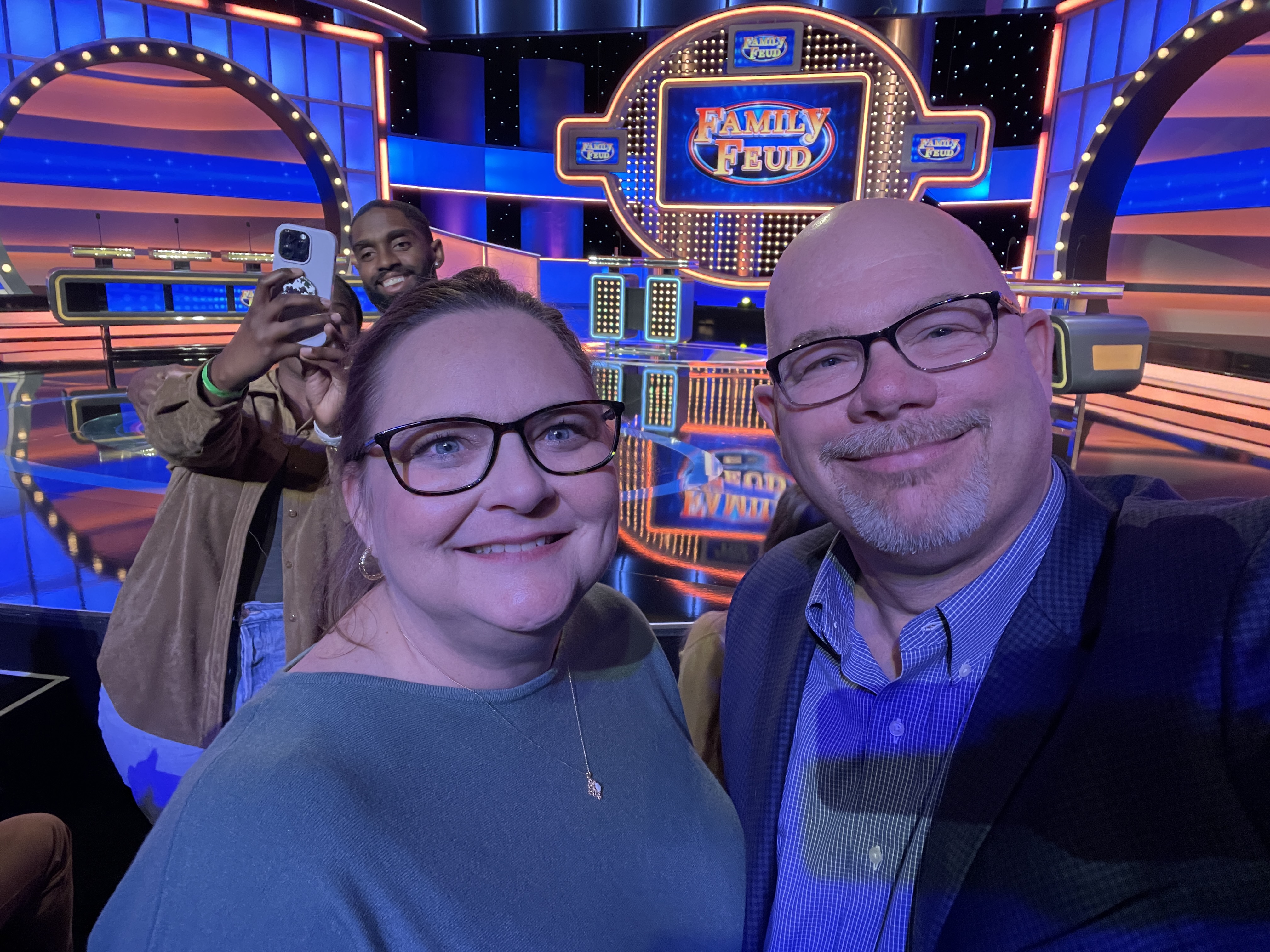
Well, recently my wife and I had the opportunity to attend the taping of two shows in Tyler Perry’s studios in Atlanta, GA. It was fun, I must admit – lots of fun. I’d even encourage you to attend a taping just once for no other reason than the experience.
But once the recording of the shows began, it became very clear how much editing must take place before an episode can be aired on syndicated television. Without a bunch of editing, the “family” version of Family Feud would have to receive an adult/parental-guidance-suggested rating.
Now, most people would not be shocked to hear that Steve Harvey, the host of the show, has the tendency to use adult language. However, even though blooper reels have hinted at language used off camera, the reality is that Mr. Harvey is a potty mouth.
For instance, you may have seen how that everyone always says, “Good answer!” whenever a family member gives any kind of answer to a question. They do this because they are supposed to. They do this even when they know the answer was not a good one. But in one case the answer was so bad, even Steve Harvey had to comment to the audience.
Mr. Harvey walked away from the family and toward the edge of the stage, faced the audience, then said, “I wish you could have seen the looks on your faces…it was like, ‘What the h***?'” He then agreed with the audience that the answer was a horrible one, but then stated that “there is no f****** way that sh** will be on the board!”
That was pretty much the pattern. Whenever things got slow, or whenever something crazy was said, Harvey would walk past a line on the stage and engage the audience, often with vulgar language. It started to feel uncomfortable.
Of course, it wasn’t only Steve Harvey; the family members on stage had their moments, too. Some answers and some things talked about will NEVER be put on family television.
However, it was not just the language and the inuendo so prevalent that evening that caused me the greatest concern. To be honest, I kinda expected it. No, what was most disturbing was the final few moments of the evening when Steve Harvey spoke to the audience.
Harvey has a huge, huge following. Many people watch and listen to him and are influenced by his advice (which isn’t all bad). And if there is one thing about him that I admire, it’s his boldness to talk about his faith in God. I mean, that night was not the time to be an atheist, not unless you wanted to be called out as an idiot by the TV host.
However, even though Mr. Harvey was quick to point out things like he was nothing without God; his efforts at evangelism missed a huge mark: that Jesus is the ONLY way to God. As a matter of fact, at one point, even though Harvey was adamant one needs to believe in God, he stated it really didn’t matter who your god was, as long as you believed…. because FAITH is what’s important.
So, then, what you have is a foul-mouthed false teacher, really. Sad, especially considering the influence Steve Harvey has.
It’s been nearly 2 months since I last updated you about anything, and for that I apologize. However, today I want to introduce you to my new YouTube channel, Edify.
Below is a link to my latest episode (for Sept. 22). I hope you like what I’m doing.
As I begin to write this, I am looking up to where it says, “Add title.” But I’m not sure what it should be. I am going to have to wait till I write a little more, I guess.
Two things have brought me back to the old keyboard: my new friend’s question and my questioning of what’s next.
My New Friend’s Question
If you read my last post, you’ll know who I’m talking about. There’s a sharp young man where I work with whom I’ve had some conversations. It was he who, while standing beside me in the “micro market,” asked, “Are you OK?”
Now, it doesn’t happen very often, as you probably well know – someone actually asking if you’re OK. I mean, it’s totally common to have people casually ask how you’re doing and not really expect an honest answer. And they shouldn’t expect it, either.
You and I do the same thing, don’t we? In passing, like an amplified “hello,” we ask, “How’re you?” without really wanting to receive a detailed response. All we expect is an obligatory, “I’m fine, how are you?” To which we always intend to say, “Fine.”
But this morning was a little different. My new friend asked if I was OK. He actually wanted to know! How strange! In a place with 5,000 people on any given day just trying to make it through their shift, here you have a guy who actually cared! So how did I respond?
Well, I don’t remember my exact words (his were more memorable), but I said something like, “I’m not that great.”
That’s when he told me he had noticed my lack of on-line activity (writing here, that is). So, here I am.
Questioning What’s Next
That brings me to the second of the two reasons I am writing this: I don’t know what’s next!
Here’s the thing, folks… I’m worn out. I’m tired. Primarily physically, but also emotionally. Everything from my new job (the main reason) to uncontrollable events, all have drained me so much that I have nothing to squeeze out. It’s literally taking reserve energy to type this.
If you want to know how bad things are, consider this: I am probably (90% sure) going to back away from the whole watch thing. Why? Well, for several reasons:
I’m too tired to make videos. It would help to have a dedicated, undisturbed studio, but I don’t, and everything has to be set up fresh each time I record. Then comes all the editing.
It takes time and money, neither of which I have much extra.
Even though I enjoy new watches, my last new one sucked the wind out of my sails when it exposed that I really didn’t want what I thought I wanted as the ultimate watch.
The economic suffering my friends in Pakistan are enduring made thinking of a luxury watch feel sickening.
So, if not watches, what? Back to painting? I wish – and hope! But again, with no dedicated place to set things up and leave them, it takes too much energy out of me to even get started.
And then there’s that whole “energy” thing. Did I mention that I worn out, tired, exhausted?
I don’t even want to study, which is the most tragic thing of all. Even though I have the opportunity to schedule speaking engagements, the thought of picking up a phone tires me, not to mention the mental fatigue that accompanies preparation.
Lastly, because this is already too long, I’m spiritually drained and feel like I can’t refill. My faith is under attack from several fronts and the battles are taking their toll. I’m not losing my faith, per say, but I do find myself wondering if I’m fighting the right battles.
If I could get more sleep, I would. But that’s a subject of its own.
But I’ll tell you this, at least some dadgum Volkswagen Atlas SUVs are getting built!
I had a couple of good conversations with a new friend this week. It all started with me being bored out of my mind and trying not to fall asleep at work. Having worked with him a little before, and sort of expecting a little of what was to come, I decided to walk over to where I saw him standing and ask him a very, VERY open-ended question.
To paraphrase, I asked, “So, tell me something philosophical.” It was like opening a faucet, LOL! What I was not expecting was the volume of conversation. Obviously, I struck a nerve!
A Second Conversation
So, it was the next day – in the only down time I had (coincidence?) – that this young man walked over to me and started a conversation. If nothing else, he would have made my day by the way he started . . . “Based on yesterday’s conversation, I’m assuming you’re a Christian?” Let me tell you, that alone was a shot in the arm that I needed that very moment!
It was too fast-paced and in-depth to recount what was talked about, but there was one thing my new friend said that made me smile. He prefaced a statement he was about to make with, “I don’t want to offend you…“
You Won’t Offend Me, Honestly
It’s not the first time I’ve been told that. Actually, it was just a couple of months ago that an older man who hired on the same time as I did asked what I had done for a living before coming to work at Volkswagen. When I answered that I had been a full-time pastor, he immediately returned with, “Well, I don’t want to offend you, but I don’t believe what you believe.“
How is this supposed to offend me? Why would I be offended by someone telling me he doesn’t believe the same things as me? It’s possibly because when he’s mentioned it to other believers they’ve gasped with indignation and shock. Sort of like, “Whaaat? How is that possible? You must be a bad, bad person!“
But seriously, it doesn’t offend me when someone tells me he doesn’t believe what I believe. All it does it open the door for the kind of conversation I live for!
Beware the Crack
So, to all my new and old friends out there, “offend” away! Go ahead, tell me what you believe that differs from what I believe. Seriously, I’d love to hear it! All I ask is that YOU return the favor and not get offended when I ask you questions about how you came to your conclusion.
Let me give you a little advice, however. If you want to continue being an atheist or agnostic, or whatever it is that leads you to believe I might be offended by your words, beware of the cracks that may develop in your philosophical foundation. As soon as you begin to open up to honest conversation, you risk hearing a perspective that might change YOUR mind. You risk developing a crack of doubt in your own presuppositional opinions, a crack that may allow a tiny seed of faith to sneak in and take root.
So, no, you won’t offend me; you will encourage me! All you can do is convince me that I’m in the right place at the right time, just as God ordained.
The thing about foundation cracks is that they rarely close back up; they just go deeper and wider.
I know that what I am about to write, and you are possibly about to read is a tad disturbing and possibly a bummer. However, stick with me for a few minutes and try to follow my still developing thought.
On this day 32 years ago, my father passed away at work. He was 46 years old; I was 24. He died from a massive heart attack while working third-shift security.
This morning before Bible study began at church, several of the men and I were talking about our ages. One of the guys told me with a grin, “I can guarantee I am older than you.” He was wrong – I was two years older than him. I was older than all four sitting at that table… and I also thought they were older than me!
Age is a funny thing, for our actual age and how we feel are more often nowhere close to each other. I still feel in my 20’s, like time stood still when my dad died. I don’t feel 55. Yet, here I am, older than my father was when he died, even older than his father, my grandfather, when he died (age 53). My dad was 24 when his father died, so I wonder if that was the age he felt when he died.
It has now been longer since my father died than I lived up until that day. That feels weird. It also feels weird that I always think of my dad as older than me, no matter how old I get. Time stood still for him as well as it seems it did for me.
That leads me to think about heaven. What will it be like when we see those who have gone before us when we were young, yet now we are adults? The Bible does briefly address some of the question in the last half of 1 Corinthians 15. There, Paul talks about there being a difference in the body we shall receive compared to what we have now. Earthly attained age will evidently have little to no relevance.
Therefore, in conclusion of this thought, at least one thing will be true when we see our loved ones again in Heaven (if we trust in Jesus Christ as our Savior): the saying that “time will be no more” will have as much to do with age as it does the clock.
How do you respond when people check up on you? Do you respond differently to different people? Do you give different answers, some more transparent than others, depending on whom you can trust?
Well, I trust you. Yes, I do. For one reason, you are actually reading this when so many others couldn’t care less. You care enough to get past the introduction.
So, how am I doing? Not well.
I think it was my wife (I can’t remember) who asked me the other day, “Are you having a mid-life crisis?” “Maybe I am,” I replied. I haven’t researched it, so I don’t know. However, I would bet that a definition would include a picture of someone that looks eerily like me.
For one thing, five decades worth of mistakes, miscalculations, stupid decisions, and squandered opportunities continually plague my memories. It’s not that I sit around and meditate on my past until I think of something depressing; they are triggered by ordinary things like a store at the mall, a movie, a song, a smell, an event, an expression, etc. I can drive down one road and be hit with 10 regrets in the span of a mile.
Secondly, there’s all the things I could have done and should have done. Have I accomplished anything? Of course. But when I am in a group of others who’ve accomplished anything similar, I feel like a fake, an imposter. I should be able to fit in, but now I never feel worthy.
I’m not a spiritual giant or anything. I’m not that great of a speaker. I have a very hard time praying. And, based on my cumulative experience, I’m a lousy pastor. Yet, that is all I’ve ever really wanted to be. I wanted to be “man of the Book,” a man with worn knees, a figure behind the pulpit my children would tell their children about.
But here I am, pushing 56 years old, a new employee in an automotive factory, with no savings, no home, a literal antique car to drive, and no real desire to pastor another church.
Simply put, I don’t know who I am anymore. For that matter, I’m not sure I ever did.
I don’t know where life is going to find me 5 or 10 years from now. However, even though I may never be a leader of anything, I can strive to be a good follower of Jesus.
Critique of ‘Hallelujah’ in Christmas Worship
As of this writing, there are only five days until Christmas. If I had only spoken out a few months ago, things might have been different today. But I didn’t say anything earlier because I didn’t want to hurt feelings or offend. I can only hope that by protesting now, something good can come of it.
You may recall that a few years ago I wrote a scathing critic of Dean Martin’s “Baby It’s Cold Outside.” I wasn’t the first to point out the song’s sexually abusive lyrics. Nevertheless, my article did get attention. This wasn’t surprising since the #metoo movement was going strong at the time.
But here we are in yet another Christmas season and what do we have? More offensive lyrics in Christmas songs. What makes it worse is that they are part of worship services. These services are meant to celebrate the birth of Jesus Christ, not a sexual conquest.
It seems that all one must do these days is include the word hallelujah in a song, no matter the context of the borrowed lyric or tune, and it’s sure to be a hit at your next Christmas cantata.
“Hallelujah”
Let me be clear. It is not my wish to trash Leonard Cohan’s famous, beloved and oft-covered “Hallelujah.” Why would I want to? My complaints would just fall on deaf ears. Since the 1984 release of Cohen’s “Hallelujah,” near universal praise has been given for its lyrical, poetic, and harmonic beauty. But I’m not a fan. I can’t stand the song – not because of the tune, but the message.
But as with many things, even though I’m not a fan, if it stays within the bounds of its intended secular audience, I’m content to let rotting dogs lie.
It’s only when the putrid scent of death begins to taint the fragrant incense of worship that I get offended. My gag reflexes tempt me to puke.
Unfortunately, as of late, I’ve had to keep a barf bag close by. It seems that more and more Christians have gone odor blind and cannot detect even the slightest stench. Everywhere I turn, Cohen’s agnostic and broken Hallelujah” is being incorporated into holy worship.
A Little Background
With just a little digging, I found that the first time “Hallelujah” became linked to Christmas was in 2010. Susan Boyle from Britain’s Got Talent included it on her Christmas album. It featured the original lyrics.
Then, early in December of 2012, Cloverton released the now popular Christmas version of “Hallelujah” which tells the story of Christ’s birth. Below is the first verse.
In 2017 the group Anthem Lights released “Hallelujah Medley,” a mashup of two classic Christian songs with “Hallelujah” woven throughout. The other two songs were “Hallelujah, What a Savior” and Michael W. Smith’s “Agnus Dei.”
This year I heard both the Cloverton and the Anthem Lights versions in the same church Christmas cantata. However, as an instrumentalist in that church, I couldn’t bring myself to accompany either one.
Giving Grace
But I want to extend grace. I don’t want to disparage anyone who sings these covers or re-writes of “Hallelujah.” Their intention might be to glorify God. They may also encourage others to praise Him. Even Paul was hesitant to condemn those who, out of jealously, added to his suffering, for even then the Gospel was being preached (see Philippians 1:15-18). That was the main thing.
I’m compelled to show grace, too, because others may genuinely see things differently. They may consider what is being done with “Hallelujah” as an act of sanctification. They might argue that the tunes of some of the greatest and most beloved hymns were once big hits in the pubs and ale houses. Therefore, incorporating the tune or some of the lyrics into Christmas music is no different than how we sing “Amazing Grace” to the traditional tune of “New Britain.”
And, if nothing else, I must be careful to offer a lot of grace because I’m not perfect. I’ve had a bad cold, recently, and lots of things irritate me more when I feel sick.
What Are the Issues?
So, what is the issue (or issues)? What is there to complain about this time? What makes me cringe? What makes me nauseous?
Issue 1: The Lyrics
To begin with, it all goes back to Leonard Cohen’s original “Hallelujah” and its meaning. You see, I like music, but I also try to understand the lyrics. Just because a song has a happy tune, that doesn’t mean it’s worth listening to. I try to feed my soul with good stuff, not garbage.
Compared to many songs, though, “Hallelujah” is downright tame. It’s not a vulgar, pornographic jingle celebrating wet body parts (e.g., Cardi B). But it isn’t religious, nor is it wholesome for all ages, either. Actually, it is a song that draws loosely from the lives of biblical characters to describe dysfunctional, sexually-involved relationships that seek consolation through mutual brokenness.
But as a Christian, what bothers me most is the way Cohan distorts and contorts the word hallelujah. It offends me that such an intrinsically holy word (made up of two Hebrew words, hālal and yâ, which means “praise the Lord”) is used to describe a sexual release in the second verse.
It may seem petty, but it also irritates me how Cohan (born a Jew, but a practicing Buddhist) not only mixes the stories of King David and Samson, but does so in a self-justifying, slanderous way. David needed proof for his faith? Whose throne got broken?
But who really cares about the verses of this song, right? I mean, all that people really care about are the melody and the haunting chorus that repeats the word erroneously attributed to a “baffled” king.
Hallelujah is the real money maker, after all.
Issue 2: The Fusion of the Holy and the Unholy
The other big issue I have is not only the willingness, but the ambivalence toward fusing holy, Christian works with unholy, secular, even blasphemous works in an attempt to be creative.
Here’s the thing. I can’t sing “Amazing Grace” without including the accompanying tune once connected to bar songs. However, when I or any other person hears “Amazing Grace,” the words of “New Britain” never enter our minds. The older song is totally disassociated from Newton’s “Amazing Grace” and the author of “New Britain” never gets any credit.
But “Hallelujah” is a different thing entirely. Whenever either the tune or the lyrics of “Hallelujah” are used in either a lyrical remake or a mashup with other Christian songs, some sort of attribution must be given to Leonard Cohan.
Issue 3: Ignorance is Blessed
I asked my wife for her thoughts on the rendition of Cloverton’s version of “Hallelujah” that our praise band did last week. Like everyone else, she thought it was beautiful. And from a purely musical perspective, even a worshipful one, it was moving.
But on the other hand, on hearing “It goes like this, the fourth, the fifth, the minor falls, the major lifts,” when does one wonder: “Why are the words of an agnostic Jewish Buddhist being used out of their context to praise the God and Savior he doesn’t even believe in?”
But that’s just it. Most people don’t know.
Most people aren’t aware of the source material. For that matter, most people never parse the lyrics to any of the songs they sing, even in church, and are usually content remaining ignorant, but blessed. Honestly, I can’t blame them. It’s easier that way.
And frankly, at least in this case, what you don’t know probably won’t hurt you, so worship away.
But I do know. That’s why I just had to say something.
Share this:
2 Comments
Filed under Christianity, Christmas, Church, music
Tagged as Christmas, Church music, commentary, critique, faith, God, Hallelujah, Jesus, Music, Theology