Happy Lord’s day(that’s Sunday, in case you wondered)!
This week we will be celebrating Thanksgiving in America, so today is a day when most Thanksgiving-related sermons will be preached.
Today at 5 pm (eastern), on a local a.m. radio station, I will be preaching once again, but you are going to have a chance to here the sermon first. How cool is that? If you so desire, you can click the link at the bottom of the page and hear a pre-recorded sermon which is scheduled to air later today.
Unlike what I regularly do, however, my radio messages are a little more unscripted (I rarely use an outline). Not that I “script” my regular sermons, but I usually don’t ad-lib. My radio recordings are a little more off-the-cuff, so to speak.
By the way, I am going to try to get a Monday Monkey episode ready for Monday (or maybe Tuesday). It has been a while since I last did one, and Mr. Monkey has been wanting to know why I have been avoiding him.
Also, I think I am going to create a new tab on my blog that will have links to all my previous Monday Monkey episodes. That way it will be much easier for you to access them, which is really a really good thing considering there are many of you who have no idea how many of them I have made (some better than others). I think I may label the tab “Monkey Archives.”
Please, just because I am from Tennessee, don’t mistake me for a big Vol fan. As a matter of fact, I am pretty much a non-fan, that is, I am not a real fan of any team. I’m just not a big sports guy.
Don’t be too shocked. It’s not that I dislike sports; it’s just that I have too little time to get into all the games and stats and money spent on dressing like an orange safety cone. However, when and if Tennessee ever again beats Alabama in football, you can bet I will be bouncing off the walls with unadulterated happiness.
But here’s the thing: I come from a long line of proud, patriotic, Tennessee volunteers – the kind that volunteer to serve.
We Tried
Many of my family served in the military, including one great uncle who was at Normandy in WWII. But for the last three generations on my father’s side, we were only volunteers, never veterans.
As I understand it, my grandfather, William D. Baker, volunteered at the beginning of World War 2, but was declared to be “4F” ( physically unfit for military duty). I don’t know what was wrong with him, but he was a tough man that looked like he could have whipped more than a few Nazi’s.
In the 1960’s, before the “Tet” offensive, my dad, Terry L. Baker, volunteered to go to Vietnam. Yes, before he could be drafted, he volunteered to fight. Yet, like his father, my dad was turned away from the army because he was “overweight.” Is that all? Really? My dad could bench 300 lbs., was the state heavyweight wrestling champion, competed in track and field, knew how to hunt, and was considered (along with his brother) two of the toughest, meanest boys on the river. He could have handled the Army, I’m sure.
Then, on January 17 of 1990, after two days of humiliating tests and physicals, I was turned down by the Army. Believe it or not, I volunteered for service, just like my dad and grandfather before me, but was turned away because it was believed I had glaucoma (an eye condition), which I never actually had.
Almost a Veteran
What I had no way of knowing was that exactly one year after I was turned away from the Army, one year after volunteering, Operation Desert Storm would begin. Had I been accepted, I could have been right in the middle of the conflict in Iraq. Knowing me, I probably would have been one of the few Americans killed.
Yes, I’m a true Tennessee volunteer, and that’s all I will ever be, unless America is ever invaded during my lifetime. So, I was almost a veteran, but not quite.
In the meantime, I will consider myself one those carrying on the legacy of the “Black Robed Brigade” of the American Revolution. I may never be called to take up arms against the enemies of freedom, but I can man the pulpit and let freedom ring!
God bless our veterans and the families that stayed behind waiting for their homecoming. Your sacrifices paid for the liberty we enjoy today.
The day is about over, and here I sit at the computer. I am tired, my feet hurt, my throat is sore, and I am brain-drained. On top of that, I am emotionally and spiritually spent.
It’s Sunday night, and I’m a pastor.
Others go to church, sometimes for both morning and evening services, but usually just for an hour a week.
I worked all week in a regular job, worked a few odd jobs, visited sick people in hospitals, answered late-night calls, prayed with the hurting, studied for three sermons and a Sunday school lesson, when I could squeeze in the time, and then put in more study on Saturday. Did I get a day of rest? Did I play golf? No.
I’ve been up since 5:30 a.m., it’s Sunday night, I’m tired, and I’m a bi-vocational pastor.
I did watch some TV (Duck Dynasty) with my family and four visitors who came over after church, had a late snack, and turned on the clothes dryer for my wife. So, it’s not like I haven’t done anything fun.
I’m about ready to go to bed in order to get up at 5:30 a.m. (again) in order to drive a school bus. I’m not complaining, however – at least I still have a job.
It’s Sunday night, I’m tired, and I’m a pastor.
Tomorrow, I will start my work week all over again. I will face the morning with hope and a joy unspeakable and full of glory. I’ll do my best, with the Lord’s help, but it will be Monday…(I hate Mondays).
So, if you see me tomorrow morning and I don’t offer you a “hallelujah,” give me a break. If I don’t look like Joel Osteen after a visit to a spa, cut me some slack. At least let me drink a cup or two of coffee before you start judging.
I hate it when someone tells me that they are listening to me, but then do other things while I am talking. For example, when I talk to my wife, I prefer that she put down the phone, the dishes, the laundry, and quit sending emails and texts when I have something important to tell her (notice I used the word “and,” not “or” in the list of things she does). Call me selfish, but it is important to me that I know someone is listening when she says she is.
The reasoning for this preference of mine became embarrassingly evident last night at Taco Bell. My wife said she was listening to me, but only partly so. I will now share with you how I know this to be true.
The Subject
Yesterday (Sunday) morning I preached a sermon drawn from John 3:16. It was a powerful message stressing the grace of a loving God who would give His One and Only Son, Jesus, as a ransom for our souls. It was a message that also stressed, among other things, the uniqueness of Jesus Christ. Therefore, part of the sermon dealt the Greek word monogenēs (translated “only begotten”).
So, last night, after church and choir practice, my family and a friend went to Taco Bell for a late night gut bomb. As we sat there in the restaurant, my wife asked me to go back over some of the things I shared regarding the King James word “only begotten.” As I began to do so, I noticed she was only half-listening as she tried to maintain another conversation with our two daughters sitting with us.
I shared how that it was unfortunate for so many KJV-only-ers to come down harshly on other translations that change “only begotten Son” to “One and Only Son.” Many claim that the change is an attempt to pervert Scripture; to deny the divinity of Jesus. Yet, what many don’t understand is that the word “begotten” is not the best word that could be chosen to support the very biblical doctrine of the Trinity.
“Only-Begotten”
The King James Study Bible’s notes on John 3:16 explain monogenēs (translated “only begotten”) in the following way (note the highlighted parts):
The Greek word monogenēs is used by John to convey only the unique relationship between God the Father and Jesus as the Son of the Father. It serves to distinguish Christ as the only Son of God, in contrast with the many children of God. The uniqueness of this relationship is further emphasized by the fact that we become the children of God whereas Jesus always was the Son of God.[1]
Note, nothing is said about why the word “begotten” was used in the first place, nor what the definition of monogenēs actually is. According to sources such as A Concise Greek-English Dictionary of the New Testament, the Louw-Nida Greek Lexicon, the LexhamAnalytical Lexicon to the Septuagint, and the Greek Lexicon of the Septuagint, the word translated “only-begotten” actually means “unique,” “only,” and “the only member of a kin, only-begotten, only (of children) Jgs 11,34; id. (of God) Od 14,13; alone in its kind, one only.”[2]
So, even though “only-begotten” can be used to translate monogenēs, it is obvious that the actual theological meaning implied is that Jesus is the One and Only, totally unique, never created, always God, Son of God – the Word made flesh. Therefore, in my opinion, it is unnecessary for KJV-onlyists to condemn the translating of monogenēs into language that more accurately reflects the theology they are actually trying to preserve.
I find the following selection from Eardmans Bible Dictionary very interesting…
The KJV translation of Gk. monogenḗs “only, unique, one of a kind,” used (following Vulg. Lat. unigenitus) with reference to both Jesus Christ (John 1:14, 18; 3:16, 18; 1 John 4:9) and Issac (Heb. 11:17). Most other translations consistently read “only,” while the NIV translates “the one and only” with regard to Jesus. In English “only begotten” implies a created being, an implication not conveyed by the Greek term (cf. Luke 7:12; 8:42; 9:38).[3]
As I explained to my wife and a friend, there is nothing wrong with changing a word to better reflect the actual meaning, especially when the modern understanding of the word being used tends to give credence to an un-biblical, heretical theology!! Consider the following section (especially the bolded parts) from Baker Encyclopedia of the Bible…
The phrase “only-begotten” is not an accurate translation and should not be used in any of the nine passages. This phrase is derived from the Latin Vulgate (a translation of the Bible from about the 5th century which has been quite influential on other translations) and reflects certain theological debates about the person of Christ. …Ultimately the phrase “begotten not made” leads to what theologians call the doctrine of the eternal generation of the Son. …“Only-begotten” is an incorrect translation. The idea being stressed is the uniqueness of Jesus’ relation to the Father.[4]
The irony is that I am the one who will be slammed and denigrated as a liberal “operative of Satan” who wants to change the Truth of Scripture. In the meantime, I am doing nothing but trying to “take heed unto…thy doctrine” (1 Timothy 4:16).
The Punchline
So, sitting in Taco Bell, I talked with my friend about monogenēs, at one point breaking down the word into its two parts, “mono” and “genes.” Unfortunately, sometime in the conversation I made a slip and mixed my words, saying “homogenes” (as in homogeneous). When I looked at my wife and asked, “Are you even listening?” She loudly, where everyone in the whole stinking place could hear her…
“HOMO! I got it! I GOT the HOMO!”
Here’s a lesson: if Greek bores you, keep silent about it in public places.
[1]King James Version Study Bible ., electronic ed. (Nashville: Thomas Nelson, 1997).
[2] Johan Lust, Erik Eynikel, and Katrin Hauspie, A Greek-English Lexicon of the Septuagint : Revised Edition (Deutsche Bibelgesellschaft: Stuttgart, 2003).
[3] Allen C. Myers, The Eerdmans Bible Dictionary (Grand Rapids, MI: Eerdmans, 1987), 782.
[4] Walter A. Elwell and Barry J. Beitzel, Baker Encyclopedia of the Bible (Grand Rapids, MI: Baker Book House, 1988), 1590.
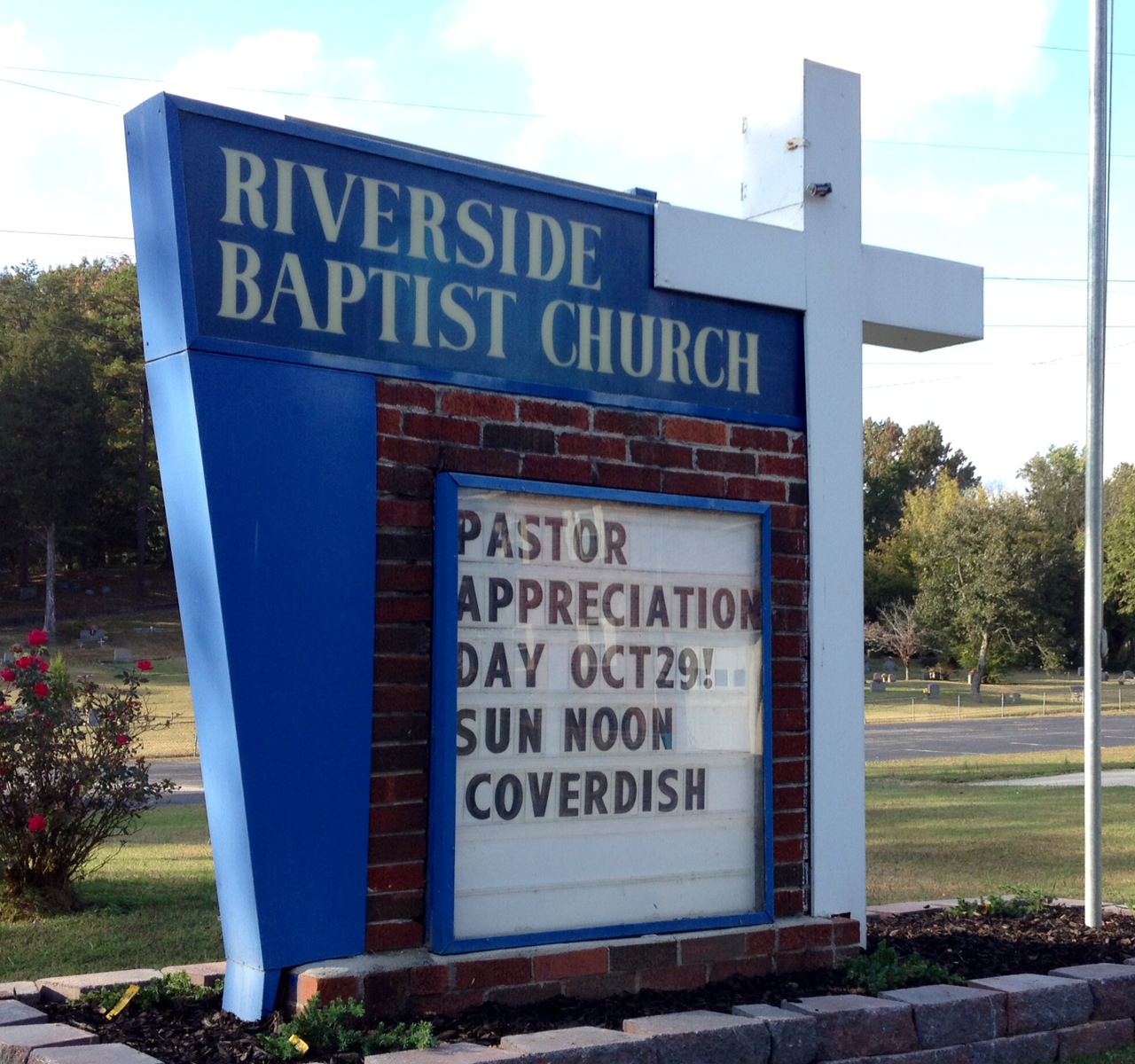
October is “Pastor Appreciation Month” here in America. Churches all over the place are planning different ways to show their pastors how much they care. Thankfully, Riverside (my church) is no exception: this Sunday, after the morning worship, a covered dish luncheon has been planned. Even though I don’t think anyone is planning on giving me the keys to a new Cadillac, Mexican cornbread would be nice.
The Reason for This Post. Because of all this ‘preecheeashun talk, I feel it is appropriate to address something rarely discussed: pastoral compensation.
In a recent edition (Aug. 16) of the Sword of the Lord newspaper, the editor ripped some comments historian David Barton made during an interview with Glenn Beck. The issue being debated was whether or not a pastor should receive an income from the church.
Should pastors be paid to be pastors? Should they earn their living elsewhere? What does the Bible say? Barton and the Sword of the Lord stand in opposition on this subject. I wonder where my opinion will fall?
Barton’s Belief
In June of 2013, ChristianPost.com discussed an interview historian David Barton had with conservative radio personality Glenn Beck. In that interview Barton spoke of the need for pastors to be more like Paul and become “bivocational.” Anything else he considered “church welfare.”
David Barton, Wallbuilders.com
“What they (pastors) believe is that they can’t survive without it. Now, I’m a big believer in the way Paul did it. Paul was bivocational. He had his own income so that he wasn’t dependent on a church…Right now what happens is so many ministers depend on their church, and I’m sorry, I often call it church welfare. These are guys that get their check from the church and they don’t want to mess with their check, don’t want to jeopardize that.”
“It’s time for more pastors to become bivocational so that nobody can tell them what to do with their money. They own their own money…If the church money dries up, great, they are still ministers and they can still preach because they’ve got an income. So I’m really into that mold. And until we get out of the church welfare mold, the church takes care of me and I can’t afford to lose my check from the church. It’s going to be really tough to get the guys in a different direction.” – from ChristianPost.com
Essentially, Barton believes that a pastor should get a job outside of ministry so that he (the pastor) can better perform the work of ministry. In other words, a self-funded pastor is better than a fully-funded pastor.
Note: someone should inform David Barton of the statistics…most pastors are already bivocational. The economy and declining church attendance has made sure of that.
The Sword’s Swipe
In response to David Barton, the Sword of the Lord editor, Dr. Shelton Smith, wrote the following:
Dr. Shelton Smith, editor of Sword of the Lord
“Barton is ill advised on this. First of all, it is totally scriptural for pastors to be paid and paid well (1 Tim. 5:17,18).
Secondly, if a pastor hesitates to “take a stand” because he is “taking a salary,” he needs to get a backbone and use it. If he can’t figure out something so simple as how to “take a stand and a salary” without flinching, then your church doesn’t need him as pastor.
Third, any church that would hold the salary over the pastor’s head in an attempt to throttle his voice is not a church where I want to be a member.
Fourth, pastors need to be fully funded so that they can invest themselves fully in prayer, preaching, teaching, soul winning, administering the work, and shepherding the flock. If a man does well with all his responsibilities as pastor, he won’t have a lot of time left to make his living elsewhere.”
Booyah! In your face, Mr. Barton! Seriously, this was a good response, but I do have some minor issues with it.
My Perspective
My study before I built my new book cases. I was making final notes before a Sunday service. Preparation time is more limited when you’re bivocational.
If you are still reading, I would like to make a few observations. If you are not still reading, then you won’t mind that this piece is a little longer than the average blog post.
First, just in case you don’t understand the difference, bivocational pastors are not necessarily “part-time” pastors; they do full-time work for part-time pay. “Part-time” is a misnomer. Bivocational guys need to have other sources of income because the congregations they serve cannot afford to “fully fund” them. The amount of responsibility is often the same.
Also, what we are talking about here are pastors of congregational-type churches, not ones who are paid regardless of where or how they perform the duties of their calling.
Second, I would love to be fully funded (“full time”), but the compensation my congregation can afford is not enough to provide for of a family of four (in this culture), especially when my wife cannot do any regular work. If I were able to walk away from my other jobs (driving a bus, etc.) to spend more time in study, prayer, and other aspects of ministry, that would be wonderful. However, I must deal with the cards I am dealt, and God holds the deck.
Third, regarding David Barton’s thoughts, it would be great if every preacher could be like Paul, but we are not. It is unwise to use Paul as the sole template for pastors, for even though Paul was a tent maker, he spoke several times about the appropriateness of meeting the temporal needs of ministers (1 Timothy 5:17; Romans 15:27; 1 Corinthians 9:9-14; Galatians 6:6).
Bivocational pastors praying for each other at a conference in Pigeon Forge, TN. Small churches; big men.
Fourth, I believe the Sword of the Lord comment is perpetuating a tendency to think of bivocational pastors as second-class ministers. The editor starts off his fourth point by saying “pastors need to be fully funded so that they can…” Can? Are we to understand that pastors who are not fully funded are not able to do what they are called to do? Intentional or not, the Sword is implying that if you want to find a good pastor, you must first look for ones who are paid well. Essentially, if the part-time guy was a better preacher he might have a bigger pay check.
Let me be clear about this. God is the one who ultimately chooses the fields in which His undershepherds are to minister.
“And I will give you pastors according to mine heart, which shall feed you with knowledge and understanding.” – Jeremiah 3:15
“And he gave some, apostles; and some, prophets; and some, evangelists; and some, pastors and teachers; For the perfecting of the saints, for the work of the ministry, for the edifying of the body of Christ:” – Ephesians 4:11-12
Many great men of God faithfully serve smaller congregations, while there are some real heathen leading churches running in the thousands. A man who has a jet is not automatically a man who spends more time in prayer and study. Where one serves should not be an automatic indication of ability.
Finally, it is true that a pastor should faithfully expound the Word without fear. However, without question there are those who fear saying anything to offend the one “holding the purse strings.” But on the other hand, knowing where one’s paycheck comes from can be a useful check on ones ego, brashness, and tendency to run off at the mouth without thinking. Nevertheless, a pastor who muzzles the Spirit for fear of losing his income is no worse than a pastor who’s in the ministry to get rich, and there are a lot of wealthy preachers who fit that bill.
“Preach the word of God. Be prepared, whether the time [or pay] is favorable or not. Patiently correct, rebuke, and encourage your people with good teaching [despite your income or other obligations]. For a time is coming when people will no longer listen to sound and wholesome teaching. They will follow their own desires and will look for teachers who will tell them whatever their itching ears want to hear. They will reject the truth and chase after myths. [So, at that point they’re gonna fire you, anyway.]” – 2 Timothy 4:2-4 NLT
To my fellow pastors, keep up the good work and finish well. Our reward is yet to come.
Today is Sunday, and many of you will be going to church somewhere. Many of you will not. So here is a question:
Does preaching have anything to do with your decision?
There are many opinions as to what constitutes “good” preaching. Some prefer a preacher who spits and hollers, bangs the pulpit, and makes that little “huh” sound between every amplified phrase. Others prefer the professor/preacher who reads from a manuscript in a mono-tone, non-offensive, Winnie the Pooh-like voice. Either way, what we are talking about is delivery, not substance.
Does delivery matter?
When Paul told Timothy to pay close attention to his doctrine (1 Timothy 4:16) and to “preach the word” (2 Timothy 4:2), content was the issue. However, if a sermon is poorly delivered, the efforts of the preacher could be nullified. If the hearer is distracted, bored, offended, lulled to sleep, or has his ear drums wounded, what is the point?
In my opinion, good preaching is preaching that contains solid, biblical content, but also keeps the audience engaged. One should never discount the importance of the power of the Spirit working through the weakness of men (1 Cor. 2:4; 2 Cor. 12:9). But, as ambassadors of the King (2 Cor. 5:20) who have been charged by our Sovereign to “compel” (persuade) hungry souls to come to His table (Luke 14:23), shouldn’t how we say what we say be important?
It is reported that Abraham Lincoln preferred listening to preachers who looked like they were swatting at a swarm of bees. In a similar vein, I think it was Charles Wesley who said that a preacher should “put some fire in his sermon, or put his sermon in the fire.”
On the other hand, Jonathan Edwards (1703-1758) is said to have read his sermon “Sinners in the Hands of an Angry God” with a steady, monotone voice, as the audience screamed in terror at the thought of falling into hell. So, delivery shouldn’t matter?
It would make sense that those entrusted with delivering sermons should do so in a manner befitting the “greatest story ever told,” but does delivery make a difference? After all, some of the greatest public speakers of all time were tyrants (Adolph Hitler). Should delivery be an issue, or should we simply focus on truth?
What about you?
What type of preaching style do you prefer? Has a particular style of sermon delivery ever caused you to tune out to what was being said?
Below is an example of me preaching. This sermon was delivered on a Sunday evening at Riverside Baptist (in the gym, while our auditorium was being remodeled). It was part of a series I did on the book of Ephesians and focused on the blessing of the Holy Spirit and the simple two word phrase, “but God.”
The following piece is meant to be informative, not critical, even though I may criticize a little, and I apologize in advance for the length. All in all, I hope that it will help lead people away from unhealthy, legalistic, and abusive churches by helping them recognize “red flags.”
Not all pastors are abusive megalomaniacs. The ones that are should be called out and held accountable, for their poor witness harms not only the Church, but the world to which we are called to be witnesses.
Hissy Fit
Several months ago a video was posted on YouTube. That video shows Dr. Jim Standridge, pastor of Immanuel Baptist Church in Skiatook, Oklahoma, publicly chastising members of his congregation.
Since its release, the video has gone viral with over 700,000 views, so far. I was made aware of this video a couple of months ago when friend on Facebook posted it to her wall and created a stir. It was originally posted on a website called Stuff Fundies Like.
Personally, I think it is a shame that something like this has been put out for all to see, for it damages the reputation of all who sincerely follow Christ. I even have problems with the website that originally made this widely available. But since it is out there and not going away, I feel it should be addressed.
Context
It is important to look at things in their proper contexts before we come to conclusions. That is why I wanted to find the video of Dr. Standridge’s entire sermon. I found it on Immanuel Baptist Church’s website and watched the entire thing, making plenty of notes.
Those commenting in defense of this video have said things like: “You shouldn’t judge a man based on this one video…we don’t know what led up to him talking this way.” In an interview with The Christian Post, even Dr. Standridge said, “…you can’t judge a man by one message.”
But is that entirely so? During the time it took to watch the hour-long sermon I noticed several “red flags” that told me this was probably not an isolated incident.
Full Sermon (see if you can spot the red flags)
NOTE: The video was taken down, so I’m glad I reviewed it when I did!
The term “red flag” is used to describe a warning sign. The following are some of the red flags I noticed while watching the full sermon preached by Dr. Standridge on May 19, 2013.
1) The need to express self-importance, along with possessiveness.
In less than two minutes into the sermon (1:13), Dr. Standridge first addresses the boy that was to fall asleep. He says: “Son, look at me – I’m the man, baby.” Later (39:23), he addresses the boy again and says: “I’m somebody…now you might do your English teacher thataway [sic], but I’m not teaching English…”
To the same boy he says, “I’m not some little hireling” (20:55). Then, at the 48:20 mark: “I don’t care…I do care, but I don’t care…It’s like that young boy right there, he don’t know who I am.”
In the infamous part where Dr. Standridge talks to Mr. Cox, the man in the video room, he says: “…you don’t care about what I want to do right…if you loved me, and you submitted to me, you’d know what my heart is and my message is…(43:00). Then, at the 47:25 mark he says: “You may be the best sound man…but that’s my sound room before it’s yours!”
Towards the end Dr. Standridge confronts a girl named Wendy (1:01:39) and plays the guilt card: “You count my life as something, well, very secondary, if anything.”
2) Belittling others.
In one hour Dr. Standridge manages to put down skateboards, comparing them to witch’s brooms (1:13; 4:39), texting (54:35-55:20), secular college education (1:01:39), the right of a mother to be upset (48:11), a woman’s needs (3:50), and a wife’s spirituality and intelligence (6:50-7:25).
3) Threats
In several places Dr. Standridge threatens to leave the church if the congregation doesn’t want to hear what he has to say. “Now if you don’t want me…”(40:50).
4) Publicly announcing church members’ faults.
What gets Dr. Standridge into so much trouble is where he calls out Mr. Cox in the sound/video room and the young couple about to get married (as seen in the YouTube clip). But where some want to say that was just an isolated incident, the reality is that he did this from the beginning to the end of the sermon!
The fact that he would say in front of the church that a young man was “one of the sorriest church members” and “not worth 15 cents” (39:50) was completely inexcusable. And, telling Angela, a young wife, that she should quit questioning her husband and start submitting to him (6:50-7:25) was completely out of line.
5) Following abuse with “You know I love you.“
It was really hard to keep track of how many times Dr. Standridge followed a stinging comment or snide remark with something like, “You know I love you, don’t you?” He said this to Mr. Cox and put him on the spot with a hug (39:50ff) right after telling him he wasn’t worth 15 cents! He even asked the poor skater boy: “Have I convinced you I love you? You better nod your head yes.” (39:23ff)
Even more, his love comments were commonly used as a justification to the congregation for his actions: “I love that boy right there” (1:13); “Now, let me tell everybody here how much I love these kids” (referring to Mr. Underwood and his bride to be). This is what abusive husbands do, not pastors.
Scripture
1 Timothy 5:20 says: “Them that sin rebuke before all, that others also may fear.” The only problem with using that verse to justify what Dr. Standridge did/does is that this verse was meant for elders…Pastors (vs. 18-19)! I cannot see any reason why it had to come to a point where the pastor of a church called out so many people for their supposed sins and inconsistencies.
Long before any of the people chastised by Dr. Standridge should have been publicly reprimanded, Jesus set the pattern for how to deal with church issues…privately, with one or two, then before the church.
“Moreover if your brother sins against you, go and tell him his fault between you and him alone. If he hears you, you have gained your brother. “But if he will not hear, take with you one or two more, that ‘by the mouth of two or three witnesses every word may be established.’ “And if he refuses to hear them, tell [it] to the church. But if he refuses even to hear the church, let him be to you like a heathen and a tax collector.” (Matthew 18:15-17 NKJV)
So much pain and embarrassment, both for the individuals involved and the church in general, could have been spared had Dr. Standridge heeded the wisdom of Solomon: “He who covers a transgression seeks love, But he who repeats a matter separates friends.” (Proverbs 17:9 NKJV)
Final Thoughts
As I see it, Dr. Standridge should have been asked to resign after this sermon, but as with any abused wife, the congregation defends what he said. When I spoke of it to my congregation, they agreed that if I had done anything similar I would be looking for a job.
Not all pastors are like Dr. Standridge, even on a bad day; those who are should be called to the carpet (1 Timothy 5:20). Sure, we make mistakes and say things we regret, but most of us aren’t arrogant and abusive. We love our flocks to the point of laying down our own lives (John 10:11). The last thing we want to do is embarrass and shame people; we want to see them restored, edified, and molded into the image of Christ (Romans 8:29).
Last week I received a note in the mail from one of my congregation. It was such an encouragement that I wanted to share it with all of you.
Dear Anthony,
You and our family are such a blessing to me.
Wednesday p.m. service was a comfort to me and I know from what three other people shared it was a comforting message they needed to hear, too.
I seems when you are most broken, weary, discouraged, Jesus and the Word pour through you in a powerful way, and we are touched.
Your prayer was like a shepherd interceding for his sheep.
Thank you for always being so sensitive to the Holy Spirit.
I am blessed to sit under a man of God who teaches and preaches the true Word of God.
You are continually in my prayers…
You see, there are times when we find ourselves wondering if we are even making a difference. But even though we may feel like we are useless at times, the truth of Scripture rings true…
And he said unto me, My grace is sufficient for thee: for my strength is made perfect in weakness. Most gladly therefore will I rather glory in my infirmities, that the power of Christ may rest upon me. – 2 Corinthians 12:9
Send your pastor a note of encouragement. I know he will appreciate it.
If you don’t go to church anywhere, you could listen to an edited message of mine that will air on local radio this evening (Sundays at 5 pm on WFLI, AM 1070).
I recently was impressed by a post that Chris Jordan did for Proverbial Thought (one of my other blogs); it really convicted me of my need to be stronger in the face of adversity. Chris commented on Proverbs 24:10, which says: “If thou faint in the day of adversity, thy strength is small.”
The next day, however, when I followed Chris’ post by commenting on Proverbs 24:11-12, I found a nugget of gold that was not lying on the surface; it had to be dug out of the mine. That little nugget became the basis for this sermon.
If you have a few minutes, take a listen. What you hear might just encourage you.
Recently, after having to look at other people’s resumés, I thought it would be a good idea to review my own. Even though I am not actively seeking another pastorate, information does change from time to time. So, after a quick glance, I noticed some areas needed tweaking.
For example, I earned my Masters, so that needed to be added. Also, puppets are no longer considered valid references, so Mr. Monkey’s name had to be deleted.
However, one part of my resumé did not need changing. When I read the “Ministry Objectives” section, my heart was convicted. Were my objectives being met? What am I doing to reach them?
Ministry Objectives
Some people take a sentence or two, or even a paragraph, to describe their ministry objectives. I decided to divide mine into five points and put them right up front for everyone, including myself, to read.
My desire is…
I. To bring glory to the name of Jesus Christ in all that I do (Ps 19:14) and go through (1Pet 1:7).
II. To “give attendance to reading, to exhortation, to doctrine” (1 Tim 4:13) and “to prayer, and to the ministry of the word” (Acts 6:4).
III. To be known as a humble and consistent husband and father whose household serves the Lord (Josh 24:15; 1 Cor 15:58); a forgiven sinner who understands grace (1 Tim 1:15); and a fearless soldier of the Cross (Mark 8:34) who never compromises the truth (1 Tim 4:16).
IV. To affect future generations yet to come as children are grounded, parents become responsible, singles are emboldened, and the aged get a second wind (Josh 4:21-24; Pro 22:6).
V. To promote the preaching and teaching of the Gospel in every part of the world (Acts 1:8).
Dear Heavenly Father, make them more than objectives… make them reality.









 The Recovering Legalist