Category Archives: Apologetics

Jesus Memes and the Comma-Challenged

imageIn a recent Facebook post a friend of a friend posted a meme created by John Fugelsang, the actor, Huffington Post contributor, and former co-host of America’s Funniest Home Videos (1998-99). The meme was posted in an effort to show how that Jesus Christ, if He were politically active in today’s America, would more likely be a liberal Democrat than a conservative Republican.

Mr. Fugelsang uses his meme (if he was actually the one who created it) to state ten assertions regarding who Jesus was and what He believed. For ease of reading and future commentary by me, I’ve listed them below (punctuation intact).

According to John Fugelsang (and, by extension, the friend of a friend on Facebook) Jesus was a:

  1. Radical nonviolent revolutionary
  2. Who hung around with lepers hookers and crooks;
  3. Wasn’t American and never spoke English;
  4. Was anti-wealth anti-death penalty anti-public prayer (M 6:5);
  5. But was never anti-gay, never mentioned abortion or birth control,
  6. Never called the poor lazy,
  7. Never justified torture,
  8. Never fought for tax cuts for the wealthiest Nazarenes,
  9. Never asked a leper for a copay;
  10. And was a long-haired brown-skinned homeless community-organizing anit-slut-shaming Middle Eastern Jew.

Before I go any further, I must address Mr. Fugelsang’s punctuation. You see, I am not a grammar Nazi, nor am I a punctuation prodigy, but sometimes a point can better be made if one would pay attention to the proper use of commas. For example, without commas it could be inferred that Jesus hung around with the hooks and crooks which belonged to lepers. As for “anti-gay anti-death penalty anti-public prayer,” that simply makes my head hurt.

Now, to the ten assertions…

Radical nonviolent revolutionary.  First, how many radical non-violent revolutionaries are there? I guess they exist here and there, but are they really that common? I mean, once you put radical and revolutionary together, specifically with the qualifier of “liberal,” how many are not violent? Jeez! However, that’s only based upon my own observations, so I’m happy to be proven wrong.

However, the question that ought to be asked first is: “Was Jesus really a revolutionary?”  I don’t believe He was. For one thing, most revolutionaries are focused on bringing about change within a political system – Jesus’ purpose in coming had nothing to do with any political system. Then secondly, it is clear from Jesus’ own words that He did not come to change or do away with anything, only to fulfill it.

“Think not that I am come to destroy the law, or the prophets: I am not come to destroy, but to fulfil.” – Matthew 5:17 KJV

[He] hung around with lepers, hookers, and crooks (punctuation added).  One of the biggest misconceptions about Jesus is that because He chose not to stone anyone for things like adultery (John 8:11) He must have had no problem with their actions. The problem with that assertion is that it totally avoids his command to “go and sin no more.” Yes, Jesus ate with the sinners, but that’s not to be construed that He “hung around” with them. Jesus came for a purpose, to “seek and to save the lost” (Luke 19:10), not to condone their lifestyles and avoid confrontation. No, Jesus ate with sinners so that they might be saved!

And when the scribes and Pharisees saw him eat with publicans and sinners, they said unto his disciples, How is it that he eateth and drinketh with publicans and sinners? When Jesus heard [it], he saith unto them, They that are whole have no need of the physician, but they that are sick: I came not to call the righteous, but sinners to repentance. – Mark 2:16-17 KJV

[He] wasn’t American and never spoke English.  Except for the most diehard KJV-only-ist, and one who might never have had even the most basic of history lessons, most would agree. This is pretty much a given. However, the assertion being made is that Jesus is thought of by conservatives as being pro-American and anti-everything else, and that is mostly untrue and unfair. Sure, there are some kooks who believe America is the New Jerusalem, but there are others out there, such as Louis Farrakhan, who believe aliens live in a spaceship and are circling Earth as we speak. Neither represents the majority, I hope.

Actually, the only think that we must be concerned with is whether or not our nation (whichever nation that is) is on the side of the Lord, for His Kingdom is not of this world.

When Joshua was near the town of Jericho, he looked up and saw a man standing in front of him with sword in hand. Joshua went up to him and demanded, “Are you friend or foe?” “Neither one,” he replied. “I am the commander of the LORD’s army.” At this, Joshua fell with his face to the ground in reverence. “I am at your command,” Joshua said. “What do you want your servant to do?” – Joshua 5:13-14 NLT

[He] was anti-wealth anti-death penalty anti-public prayer (M 6:5).  Oh boy. May I break this down into sub points? I mean, really, commas would have been helpful.

  1. Anti-wealth. I’d really like to know where Fugalsang got this. My guess is that he got it from passages like Luke 12:15 or Matthew 6:19-21. In the first Jesus warns us to guard against greed, while the second advises us to store up treasure in heaven, not down here where it can corrupt and/or be stolen. Even more, Fugalsang may be thinking of how Jesus is described as one having no place to lay His head (Luke 9:58), or that passage where Jesus says it’s easier for a camel than a rich man to pass through the eye of a needle (Mark 10:25).However, the fact is that it wasn’t wealth that Jesus had a problem with; it was greed, envy, selfishness, and faith in one’s own money and not in God.

    The reason Jesus spent more time with the poor than the wealthy was because the wealthy more often had hard hearts (much like today). The rich tend to put their faith in their possessions and positions more than in God, so why would they respect the One who divested Himself of the riches of heaven and humbled Himself, even to the death of the Cross (Philippians 2:8)?You see, Jesus wasn’t anti-wealth; He was concerned only with what men do with it (Matthew 25) and the condition of their hearts: “For what shall it profit a man, if he shall gain the whole world, and lose his own soul?” (Mark 8:36). For crying out loud, the Church is forever in debt to Christians who used their wealth (while remaining wealthy) to feed, clothe, house, and instruct the poor of the world. It was even a rich woman in Thyatira named Lydia who used her wealth to house the early Church in her town (Acts 16:14-40).

  2. Anti-death penalty. Again, this must be one of those derivations from John 8:11, the passage where Jesus rescued a woman caught in the act of adultery. The only problem is that this passage does not assert that Jesus disagreed with the law, but rather opposite. Jesus gave every opportunity for her accusers to carry out the death penalty which was prescribed by law, but none of them were able to stand without hypocrisy. Jesus knew they were trying to set Him up, not to mention the fact that there was an un-mentioned man involved. Jesus took the opportunity to take the Law beyond where it could go on its own and showed mercy and grace.
  3. Anti-public prayer (M 6:5). Seriously? First, you don’t abbreviate the book of Matthew with a capital “M”. I mean, there are other books in the Bible that start with “M,” such as Mark, Malachi, and Micah. I guess since we’re talking about Jesus we’re supposed to know the one to which he was referring.Secondly, to use Matthew 6:5 as a basis for condemning public prayer is to admit one has little understanding of context. The context in this passage of Scripture was one which dealt with pride and hypocrisy. Jesus was addressing those who did good deeds and prayed verbose prayers all for the purpose of being seen and praised by men. That is why He said of the hypocrites, “They have their reward.”

So, what is the assertion being made with this point? That people should not be allowed to pray in public? That freedom of speech should not include two Christian school football teams being allowed to use a public address system to say a prayer before a game? – Yes that just happened.

But was never anti-gay, never mentioned abortion or birth control.  The whole “anti-gay” thing has been argued over and over and much has been devoted to it, yet liberals will only hear what they want to hear; therefore, I will devote very little time to it in this essay. However, saying that because Jesus never mentioned abortion or birth control means these are non-issues and would have been no concern to Him is ludicrous. It would be just as easy to say that governments shouldn’t restrict unnecessary use of antibiotics because Jesus never mentioned Penicillin.

Let’s save some time and get straight to the big theological issue in the room: Jesus is the second Person of the Trinity, the Word of God made flesh, Emmanuel (“God with us” – Matt. 1:23). What was said about homosexuality in the Old Testament are actually the same position Jesus took, for He and the Father are One (John 1:1-2, 14; 17:11).  The only difference is that Jesus came to show that the strict requirements of the Law could only cause men to realize their own sinfulness in the light of Holy God, not save them. Jesus came to show God was merciful and wanted to graciously save men through putting their faith in Jesus. If you divest Jesus from His divinity then all you have is a crazy man who thought He was God and died for nothing.

As for birth control (speaking of contraception), there is no mention of it in the Bible, most likely because it was commonly understood that children were a gift from God (Gen. 4:1; 33:5) and the man with a “full quiver” was blessed (Psalm 127:5). With regard to abortion, it is God who gives life and considers us persons even before we are born (Psalm 139:13-14; Jeremiah 1:5), so I believe Jesus would have viewed elective abortion as murder. After all, it was Jesus’ own cousin, John the Baptist, who “leaped” in his mother’s womb when (Luke 1:41) when she greeted the pregnant Mary.

[He] never called the poor lazy. No, I don’t think He did. However, the Bible (the Word of God – See John 1) does say the following:

  • By the sweat of your face you shall eat bread, till you return to the ground, for out of it you were taken; for you are dust, and to dust you shall return.” – Genesis 3:19 ESV
  • For even when we were with you, this we commanded you, that if any would not work, neither should he eat. – 2 Thessalonians 3:10 KJV

[He] never justified torture. That’s probably true – can’t argue with that. Of course, Jesus wasn’t a military leader who’s task it was to protect the lives of millions of his fellow citizens, either. Actually, Jesus was the One who gave His life so that others might live. Yet, He also said to be “wise as serpents and harmless as doves” (Matt. 10:16). We will all have to answer to God for our actions.

[He] never fought for tax cuts for the wealthiest Nazarenes.  This is actually correct! Jesus never did fight for tax cuts for the wealthy. However, it is equally true that Jesus never fought to reduce taxes, either – even for the poor. In Matthew 22:17-21 Jesus made it perfectly clear that we are to pay taxes when taxes are due, and that even goes for the least of us. He said, “Give unto Caesar the things that are Caesar’s, and to God what is God’s.” Later, speaking to average Christians, the Apostle Paul wrote:

And for this reason you pay taxes, since the authorities are God’s public servants, continually attending to these tasks. Pay your obligations to everyone: taxes to those you owe taxes, tolls to those you owe tolls, respect to those you owe respect, and honor to those you owe honor.  – Romans 13:6-7 HCSB

[He] never asked a leper for a copay.  No, I don’t guess He ever did that, either; He just healed them. The last time I checked, neither Republicans nor Democrats are God (even though some think they are) and somebody has to pay somebody for adequate medical services (therefore, refer back to Romans 13:6-7…not just the rich should pay).

And finally, [Jesus] was a long-haired, brown-skinned, homeless, community-organizing, anti-slut-shaming middle eastern Jew.  Well, at least Mr. Fugelsang got the brown-skinned, homeless (technically speaking), anti-slut-shaming middle eastern Jew parts right. The rest, along with the usual lack of commas, he stereotypically got wrong.

Nazarenes (sometimes called Nazarites) were from Nazareth; Nazarites were those who took a vow not to cut their hair, drink wine, etc. Jesus never took a Nazarite vow. But, then again, Mr. Fugalsang is not a Bible scholar, only a political comedian who writes for the Huffpo and creates comma-challenged memes.


3 Comments

Filed under Abortion, America, Apologetics, Bible Study, Jesus, politics

Bumper Stickers

The following was first published in November of 2010. I do miss having my own “Ride.”

“The Ride”

My wife will not let me put a bumper sticker of any kind on her car.  Even if she was driving a rusty Chevy Vega which desperately needed the qualities of something with adhesive properties to keep her bumper stuck to her car…no bumper stickers.  Not so with my Ride.  I don’t need no stinkin’ sticky things!  Just staples and zip ties, thank you.  Really, what I mean to say is that “The Ride” is not too good to advertise TheRecoveringLegalist.com, even though my wife thinks her car is too special.  HA!

Bumper stickers are something akin to free advertisement…

…They promote whatever you want other people to know about you and what you think, or for that matter, how well your kids think.  Plastered to the back of a rolling billboard, they catch the eye of total strangers who have the random chance to find themselves behind you and I in traffic, or who catch a glimpse in a parking garage.  Some people, I have come to realize, are advertizing more than they know, for some bumper stickers betray a hidden (at least to the owner of the car) stupidity.

There are so many bumper stickers that scream “MORON!

Here is one that I saw.  What a profound question.  Why do we kill people that kill people?  Could it be that we don’t want them to killpeople again?  Could it be that they deserve to die for taking an innocent child’s life?  Could it be that there are those out there on parole who would love to shoot your stupid…..(calm yourself, Anthony)…..well, they would love to steal your car and leave you beside the road in a ditch, then drive away with your false advertisement on THEIR bumper.

The one that I would have to say gets me the most, maybe because I see it the most, is COEXIST.  I just love all the little symbols that are used to make up the happy little plea for love and harmony.  Too bad what it tells me is that the owner of the car is a blooming idiot, at the very least, or somehow an ostrich has learned how to drive with his head in the sand.  The message behind the little sticker is really, “Hey you Christians!  Can you quit being so narrow-minded and hateful?  Don’t you know that we all just want to get along, but you keep screwing it up?”  All religions are the same, you know, or that’s the idea.  We are all worshipping the same god, just by a different name.  All paths lead to heaven, it’s just that some choose to take a shortcut by blowing themselves to Allah in the name of Jihad…is that so wrong?

Tell that to the “C”

I like the following verse. Psalm 107:2 says, “Let the redeemed of the LORD say so, whom he hath redeemed from the hand of the enemy…”  As Christians, we should be speaking out about the goodness and mercy of our God, not trying to seek favor with false gods by “COEXISTing” in perfect joy and mutual admiration.  People in this country have the right to free speech and to freedom of religion, but if you haven’t noticed, we are in a real religious war.  The “C” doesn’t like the “T” in that bumper sticker.  If you’re going to put something on your bumper, make it something that points people down the narrow road, not the wide one that leads to destruction.  Show your intelligence and advertize your faith…just don’t be tacky and weird about it…or then we get back into the looking-like-a-moron thing that my wife so desperately wants to avoid.

Now here’s an idea for the “perfect” bumper sticker!

5 Comments

Filed under America, Apologetics, Christian Living, Christian Unity, General Observations, Uncategorized, World View

The Real Problem with the Problem of Evil

One of the most common reasons for denying the existence of God is the problem of evil in the world. Just ask any group of atheists to give their top ten reasons for unbelief and surely one will claim as number one, “If there is a God, then why is there so much evil in the world?” For many, this is the pièce de résistance of rebuttals. How could a good God be real and allow all the suffering in the world to continue unabated – assuming He is even good? The eighteenth century philosopher, David Hume described the problem this way in Dialouges concerning Natural Religion, 1779:

“Is God willing to prevent evil, but not able? then he is impotent. Is he able, but not willing? then is he malevolent. Is he both able and willing? whence then is evil?” (Stackhouse 1998, 11)

So, the “problem of evil,” and its source, has been an issue of philosophical debate for centuries.  The existence of evil in the world, along with unanswered questions, has even become evidence enough for some to even embrace atheism.  Therefore, because so many philosophers and theologians have tried for ages to reconcile the existence of God with the existence of evil, I dare say that nothing I write will be new.  But, if anyone were to challenge my belief in God, along with my faith in Jesus Christ, with the argument that the problem of evil constitutes proof God does not exist, then I would possibly respond with arguments based on the following thought: without the existence of God, there should be no evil to be a problem, and that’s the real problem with “the Problem of Evil’

What exactly is “evil?” Now, that may sound like an absurd kind of question to ask, but if the existence of evil is the evidence that is supposed to expose my faith as a fraud, at best, or even a lie, then what is it?  Is it something tangible? Is it metaphysical? Is ittheoretical? What is it, exactly? Does it have any particular form? How can it be distinguished from what is called good? On what do the atheists and agnostics base their definition of this thing called “evil?” Amazingly, the answers are not all the same, nor in some cases even grounded in reality. However, it is imperative to understand that we must define this God-killer, because its definition will determine our conclusions and help to clarify our assumptions. When C. S. Lewis was an atheist, for example, his “argument against God was that the universe seemed so cruel and unjust.” (Lewis 1989) There he had it, or so he thought. God could not exist because so much evil exists. But how did he arrive at “this idea of just and unjust?” Lewis said, “A man does not call a line crooked unless he has some idea of a straight line.” (Lewis 1989) “Tell me,” I would say, “what is evil, and how do you recognize it when you see it?

To start, evil must be understood to be an adjective. Evil is a description of something that is not good. Evil is not a thing. The word “evil” only describes the thing, the thought, and the action. Technically, “evil” does not exist, only what it describes. Some people say that they cannot believe in God because why or how could a good God, if He was perfect, create evil? They think of evil as something that must have not existed until God made it. But evil “isn’t a kind of molecule or a virus…infecting or affecting everything it encounters.  There was no time when God said, ‘Let there be evil,’ and there was evil.” (Stackhouse 1998)  As John G. Stackhouse put it, “evil becomes a noun only in the abstract.” Additionally, in his book Can God Be Trusted, Stackhouse says of evil:

“An action can be evil, or an event can be evil, or a quality can be evil, or a being can be evil. And we can lump all these particular evils together in our minds and come up with a category ‘evil.’ We can even go on to discuss it as if it were a particular thing, so long as we do not forget that we are always dealing with a category or group of particular evil things, not a thing itself.” (Stackhouse 1998, 31)

So then, if evil is a description, how is it that we come to use the adjective, or as Lewis put it, the “crooked line,” without first having some idea of what is a “straight” one?  Defining what is good is as important as defining evil. To know what is evil, we must first have some assumption as to what is not evil. The crazy thing is that if God does not exist, and man is nothing more than a collection of random matter, both good and evil are purely relative – their existence is based purely on one’s perspective.  So, in other words, the one who says that there is no God, based on the existence of evil, is literally basing his belief on pure opinion, not on anything objective; therefore, in order to bring an accusation against the goodness of God, one must have a base line. What is the standard by which we determine what is good and what is evil?

Some use Man as the baseline. They compare God to the standard set by what is thought to be good behavior in this world. They rationalize that if God is real, at least according to monotheistic dogma, He must be all-powerful, perfectly good, and the supreme example of love, kindness, and providential care. Because it is preached that God is a better Father than earthly fathers, Mark Twain took it upon himself to write:

The best minds will tell you that when a man has begotten a child he is morally bound to tenderly care for it…[yet], God’s treatment of his earthly children, every day and every night, is the exact opposite of that, yet those minds warmly justify those crimes…when he commits them.” (Tonie Doe Media 2007)

So then, according to Twain, God could not exist because if He did, He would act consistent with our understanding of what a good and loving earthly father would do.  In other words, if God cannot, in all His perfection, behave better toward His children than the most common man, His credentials are therefore revoked, and He must cease to exist.  However, this is so illogical. Who are we to say that God, if He is perfect, and we are imperfect, ever treats His children poorly? Do the protesting cries of a toddler who has had poison taken from his grasp carry more weight than the decision of the earthly father to take it away? How, then, are we to automatically assume that the infantile tendencies of finite man are wiser than the infinitely Mature?  Using Man as a baseline for what is good and evil is pure arrogance.

In reality, the problem of evil is really a problem for the atheist. He, who denies the existence of a Creator and accepts only the realities of evil in the world, essentially has nothing about which to complain.  Everything should be just fine and dandy, but it’s not.  The atheist knows that evil things happen to good people, as well as bad.  He sees the hurt, feels the pain, and begs for justice. The reality of evil in the world causes men to cry out for justice; for things to be made right. This is a problem, though, because knowing that a crooked line is not straight hints at the fact that a Line-drawer exists.

Of course, there are others who take a different approach. They claim that God does not exist except in the evil intentions of his followers to control others through guilt. They claim that God is just a fabrication of priests to keep mankind from behaving “naturally.” They say that nature is good, and if anything, God is evil for trying to get man to behave contrary to the very way he was created to behave. One guru said, “It seems that for those who worship God, the opposite to God is not that which is ‘evil,’ but that which is natural.” He said of animals, comparing them to men, “They don’t worship God, they don’t go to church, they don’t have any theology.  They don’t have any feeling of guilt, they are simply natural.” (Osho 2009)  In other words, if there is evil in the world, it is because our belief in God has inflicted it.

But for the majority of the hurting world, pain is real, loss is real, and evil is manifested daily.  Many see the things that happen to innocent people, especially children, and wonder, “If there is a loving God, why doesn’t he do anything about this?”  These people, many of which hold on to hope as long as they can, finally succumb to their doubts and conclude that the only way to explain away the pain is to admit that it is just part of life, part of the natural world, part of what makes us human; alone, in our quest to make life easier, free of pain, free from evil; alone, without God. These are the ones, I believe, that lure more away from the faith than any Darwinist.  They are the ones who have seen evil face-to-face and cannot fathom a God who would allow it to continue.  And because their experiences are so painful and tragic, the devout are left speechless and without explanation. Ellie Wiesel is a good example.

Wiesel was a teenager when he saw his family murdered in the Nazi death camps.  But it was only after witnessing one particular act of horror – the slow, hanging death of a young boy – that he turned away from his faith in God. In the book Night, his Nobel prize-winning autobiography, Wiesel said he heard a man behind him ask, “Where is God now?” As he stood there, being forced to stare into a pitiful, wide-eyed, swollen face of a dying child, a voice within replied, “Where is He? Here He is – He is hanging here on the gallows…” (Wiesel 1982) Because there was no justification, even in the big scheme of things, Ellie Wiesel’s God died with the executed boy.  But as sad as it is, without God, who can say what happened to that boy was any worst than the slaughter of an animal?  Are we not all just animals – some more evolved than others?

To me, the problem of evil is not a problem for the believer, but for the non-believer.  Aside from the theological arguments about the character of God, without God, to turn Hume’s question around, “whence then is evil?” Without God, evil is relative to one’s desires and personal pleasure.  Does it really even matter whether or not God could do anything about evil in the world when the whole question is moot if He didn’t exist?  With God, evil is defined as that which is against His law, that which stands opposed to His standards, and that which describes all who take pleasure in such rebellion. Without God, evil is just a matter of opinion. That is the real problem of evil.


Works Cited

Lewis, C. S. “Atheism.” In The Quotable Lewis, by C. S. Lewis, 59. Wheaton: Tyndale House Publishers, Inc., 1989.

Osho. The God Conspiracy: the path from superstition to superconsciousness. New York: Osho Media International, 2009.

Stackhouse, John G. Can God Be Trusted. New York: Oxford University Press, 1998.

Tonie Doe Media. In The Atheist’s Bible, 129. New York: Harper Collins, 2007.

Wiesel, Ellie. Night. New York: Bantam Books, 1982.

41 Comments

Filed under Apologetics, Culture Wars, Faith, General Observations, Life/Death, Struggles and Trials

A Book Title Poem

About the Books

About three years ago I received a rather large addition to my personal library. In addition to the over a thousand books in my office, nineteen banker’s boxes full of books was given to me by a former seminary professor.

This professor of theology, a graduate of New Orleans Baptist Seminary and a contemporary of David Platt, was from Canada. When his work permit in America expired he found himself unable to ship his library back home – the cost was prohibitive. Therefore, he offered them to me to keep and use in his absence. He said, “If I don’t come back in a couple of years, just consider them yours to keep.”

It’s now been three years, and I’m just now starting to unwrap the “gift.” I hope he forgot me.

The Box

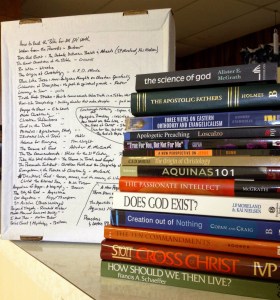
FullSizeRender (4)I’ve seen how people have been writing poems by using the titles of books. Linda Kruschke is a good example (click HERE to read her latest poem, My Soul Feels Peace).

So, what I did was open up one of the boxes of books (one of which I’d already written the contents on the lid), reached down inside and pulled out a decent stack, and then arranged the stack into a pyramid…largest book on the bottom, smallest on the top.

The poem that I proceeded to write was based on the titles of the books from top to bottom.

The Poem

The Science Question

The Science of God is the study of God

It’s something we call Theology.

The Apostolic Fathers taught it well,

Setting the standards for what would be.

The science would produce Three Views on Eastern

Orthodoxy and Evangelicalism

But Apologetic Preaching would come along

To combat what we’d come to call pluralism.

What’s True for You, but Not for Me

May give you A New Perspective on Jesus,

But be mindful of The Origin of Christology

And don’t neglect to peruse some Aquinas.

There’s something about The Passionate Intellect

That leads some to question, “Does God Exist?

But the wise understand Creation Out of Nothing

Was breathed by the God of The Ten Commandments.

And now that the Fathers are long past gone

The Cross of Christ is the message they give.

This new generations of scientific theologians

Who preach as they ask, “How Should We Then Live?


1 Comment

Filed under Apologetics, Christian Living, poetry, Theology

De-Grandeurization of God

Proud Doubter

Last night I was scrolling through the Facebook posts of a friend. Actually, I wouldn’t exactly call the person a “friend” as much as a former acquaintance. The person I used to know as a young, vibrant Christian student, one who boldly proclaimed his faith, has now become proud doubter.

Look, let me be the first to say that moments of doubt are not uncommon, and far be it from me to cast judgment on those who do. I have had my moments of doubt, and there have been many times when I’ve had to pray, “Lord, help my unbelief.” But one thing I’ve never done is boast about my doubting. G0d forbid!

Yet, as I scrolled through the posts and the comments of my young friend of years gone by, what I saw was one who was proud of the fact that he felt free enough to doubt, even to allow his doubts to affect what he believed about God.

A Blown Mind

Come to find out, my young friend has been doing some study. He has become fascinated with astronomy, specifically the “Big Bang.” As many have done, he has proudly ditched the supposed illiterate belief in a Young Earth creation and taken off full bore down the road of “true” science. He has been blown away by the scientific “evidence” that led him not only to doubt his earlier beliefs, but to look forward to other areas in which his understanding of God may be changed.

In other words, because of what my young friend has now learned, he is looking forward to the de-grandeurization of his God.

Did God?

If you will remember, it was Satan, in the Garden of Eden, who posed the first doubt-inducing question, “Did God…?” This led to Eve questioning the motives of her Creator.

Unfortunately, developments in modern science have been used in the very same way to create doubt, to cause believers to question the abilities of their Creator. They look at the marvelous works of creation and ultimately conclude that it was natural forces which created what we now see, not God. By doing so, they unwittingly fall prey to the gradual undermining of their faith, going from one “enlightening” conclusion to another, saying: “Well, if what I believed there is not true, then what else about God is not true?”

They proudly march forward with a presupposition of doubt leading the way, redefining God and His creation.

The Declaration 

Most detailed image of the Crab Nebula

Credit: NASA, ESA and Allison Loll/Jeff Hester (Arizona State University). Acknowledgement: Davide De Martin (ESA/Hubble)

But here’s the thing: Psalm 19:1 says that “The heavens declare the glory of God; and the firmament sheweth his handywork.” Even more, Psalm 97:6 says, “The heavens declare his righteousness, and all the people see his glory.”

Is the universe expanding? Yes, it is. But what does that necessarily mean about God? The universe is expanding, and men are made up of the same elements found in stars. Does this mean that believing God created the heavens, including man, “as is” is out of the realm of possibility?

The God I serve is so big, so powerful, so awesome, so grand that when He said, “Let there be…” it was. There’s no reason to doubt, even if it doesn’t all make sense.

After all, the grandeur of creation was created out of nothing. If God could do that, then nothing is impossible for Him. Science doesn’t have to disprove anything; it should be declaring.

I’m a proud believer.

1 Comment

Filed under Apologetics, Faith, God, World View

Prayer for My Wife

This [is] the day [which] the LORD hath made; we will rejoice and be glad in it. – Psalm 118:24

It is a good day, and it doesn’t matter what is going on – God made this day! And, for that matter, He makes every day, and what He makes is good.

How, then, can one reconcile the truth of Psalm 118:24 with the fact that my wife is in the hospital and doctors can’t figure out what is wrong with her? God is Sovereign, Holy, and by nature He is Good; therefore, I will trust Him.

photo (28)Nevertheless, I would ask that you intercede for my wife, Valerie, with prayer. Lift her up before the throne of God. Petition our Father for her healing, if it be within His will. Pray that God enlighten the doctors’ understanding so that that they may be able to diagnose her pain. But whatever the case, make sure you pray that through all our struggles and unanswered questions Jesus Christ receives the glory!



Remember, because many within the hospital community never go to church, sometimes God has to put the church in the hospital.

Thank you!

Update: Dear friends and subscribers, your prayers and encouragement have meant a lot. Thank you so much for your caring kindness. 

Valerie was discharged from the hospital this evening (2/22) with instructions to follow up with her regular doctor and a cardiologist. Unfortunately, while at the hospital, they were unable to find the reason for her pain. What also became obvious was her inability to stay awake for any length of time, actually falling asleep after only 30 seconds on the telephone (she does take meds to stay awake, but without them she is useless – she wasn’t able to take them while in the hospital – and they can’t determine the cause).

Valerie is no longer in pain (it was severe) except when she tries to lie down – when she does she suffers from crushing pain and the inability to breath. With some fluid around her heart, one would think there are heart problems. However, multiple tests were done and the doctors concluded her heart was in good condition and there had been no heart attack, no blockages, or anything. So, what the heck could it be???

Un-diagnosed illnesses can cause a strain on family and relationships, not to mention work and family routines. The stress has a tendency to stretch our abilities to cope. What we need more than anything right now is prayer for our spiritual hearts – especially mine – that we will remain compassionate, caring, and hopeful, not cynical or accusatory. Frankly, when we’re tired and worn is when the Devil tries to flank us, to cut us off from our Supply. That’s why we need you interceding for us.

So, right now Valerie is in good spirits and not in much pain, unless she tries to lie down. Please pray that future visits to specialists will provide answers. In the meantime we will do our best, in God’s strength, to give thanks in all things, for He is worth of our praise.

17 Comments

Filed under Apologetics, Defining Marriage, Marriage, Relationships and Family, Struggles and Trials, worship

Water on Mars – a Response

OH NO! What Will We Do?

Recent word from NASA is that there is water on Mars, and that life on Earth probably came from there a long, long time ago – at least that’s the idea. I mean, it’s just too crazy to believe in a Creator, but life coming from non-life and then traveling through space in order to form a more perfect union, establish justice, and secure domestic tranquility is perfectly plausible.

Just watch as Shepherd Smith on FOX News gets giggly as he and Corey Powell (Discover Magazine) mull over the thought that we all might be Martians.


Unfortunately, what is worrying some Christians (and getting atheists excited) is the idea that if life is found on Mars, then the veracity of the Bible will be called into question. In other words, why put your faith in Jesus Christ if the scientific community can find communities of little green men (or bacteria) alive on places other than Earth?

Don’t worry, dear believers, everything will be OK; nothing has changed.

Keeping the Rumor Mill Going

My response to the whole “water on Mars” thing is a post I published five years ago. The title – Dinosaur Bones Found On the Moon – was provocative enough that it’s still one of the most popular Google searches that leads people to my blog!

So, without any further ado, let’s go back to 2010 for a little perspective.

“Dinosaur Bones Found On the Moon”

What would be the impact on our philosophical, religious, and even evolutionary theories if bones from large reptiles were found on the moon?

bones on moonWho would be most shaken up?  Would you lose your faith in God? Would you have to rethink your science?  What would it do to you? The fact is that if it would change your core beliefs, then maybe you should re-examine them right now.  You don’t know what may happen just around the corner that could turn your world upside down.

Well, to be honest, this was originally just a test to see what kind of headline really catches people’s attention.  Did it yours?  If so, then why?

Even if dinosaur bones were found on the moon, or even if alien people landed on the White House lawn (really, could they even do that without getting pegged by surface-to-air missiles?), Christianity could stand the test.  As a friend of mine (Steve Castlen) put it:

No it wouldn’t shake my faith because:
1. The creation itself still needs a “Creator”.
2. The fine-tuning of the physical laws still needs a “Tuner”.
3. Moral laws still need a “Law Giver”.
4. The historical evidence for Jesus’ resurrection still stands.
5. And all life, even alien life, can’t come from non-life.

So, what do you think?  There is coming a day when the Bible predicts that the lies from the Enemy would be so strong that “even the elect” would have a hard time not believing them:

For there shall arise false Christs, and false prophets, and shall shew great signs and wonders; insomuch that, if [it were] possible, they shall deceive the very elect. – Matthew 24:24

Give it some thought.

3 Comments

Filed under Apologetics, World View

The REAL Snow Man

Here is just another example of insight into the human psyche gained while driving a school bus. (From my book) Enjoy!

The Setting

This morning, after picking up several young children, one little boy – a kindergartner –  began to sing one of his most favorite songs…”Let It Go.

Another little boy who was sitting next to him, a second-grader, began pleading with him to stop, after which he begged me to intervene. I couldn’t help it – I had to……let it go, let it go!

The Conversation

The younger boy (Boy 1) was singing the theme song from Frozen, to which the older boy (Boy 2) responded with his own lyrics: “Shuh uht up! Shuh uht up! I don’t want you to sing anymo oh ore!

An illustration of mine from "Life Lessons from the School Bus"

An illustration of mine from “Life Lessons from the School Bus”

Me:  What’s wrong? Don’t you like Frozen?

Boy 2:  NO! It’s a stupid movie!

Me:  What, you don’t like singing snowmen? What about Frosty the Snowman?

Boy 2:  I like Frosty, but he was real! Somebody put a hat on him and he started moving.

Me:  So, you don’t like Olaf?

Boy 2:  I like him, OK, but he’s not real…not like Frosty.

Seriously, if I made this stuff up it wouldn’t be as funny.

Sorta Like…

You know, the above story is sort of like arguments adults have. One particular argument that comes to mind is the one about where life on earth came from (I know the analogy isn’t perfect, but I hope you get the point).

Man 1:  I love to sing about Creation! “Oh Lord my God, when I in awestruck wonder, consider all the worlds Thy hands have made!

Man 2:  Stop it! I don’t want to hear all that nonsense! Sing something else, or sing nothing at all.

Man 1:  But I wan’t to sing! “Then sings my soul, my Savior, God, to Thee. ‘How great thou Art! How great Thou art!

Man 2:  STOP IT! I don’t want to hear it! God is NOT great! God is NOT great! He doesn’t even exist!

Man 1:  Yes, He does! And because He created me and gave me life, I want to give Him praise.

Man 2:  Oh, give me a break! I love life as much as anyone, if not more, but I’m not going to praise your God for it!

Man 1:  Oh, really? You believe that human life evolved from something that came from nothing? Do you really want to sing praises to nothingness?

Man 2:  Don’t be silly! Haven’t you ever heard of panspermia?

Man 1:  Uh, no. Not really.

Man 2:  You simpleton! You naive worshipper of a mythical fairy-god! You’re nothing but a slave to a worthless, iron-age book of man-made fiction. Life on earth didn’t evolve from nothing; it was planted here by intelligent life from beyond, from outer space.

Man 1:  Right! You mean God?

Man 2:  No! You idiot! Aliens!

Man 1:  Huh? But…

Man 2:  Shut up! I don’t wan’t to hear any more of your foolishness! God is not real; aliens are!

(Video of Richard Dawkins defending the theory of panspermia: the theory that alien intelligent life, not a Creator God, placed life on this planet.)

Uhmm…OK…  Let it go! Let it go!

“Through faith we understand that the worlds were framed by the word of God, so that things which are seen were not made of things which do appear.” – Hebrews 11:3

1 Comment

Filed under Aliens, Apologetics, Humor

Do You Believe? YES!

Last night I was privileged to see the new Pure Flix movie Do You Believe, which will be released in theaters on March 20. Wow!

Yes, I got to see it before the rest of you because I am uber-special and have connections. No, seriously, because I’m a pastor, I was invited by email to a screening. The purpose, of course, was to see the movie ourselves before we start encouraging others to buy tickets and flood the theaters.

Buy tickets and flood the theaters. It’s that good.

Seriously, Do You Believe fires on all 8 cylinders (that’s non-hybrid car talk). It is dramatic, well-produced, and unwilling to pull punches. Look at it this way, if you liked God’s Not Dead, you’re gonna love Do You Believe. On the other hand, if you thought God’s Not Dead was Christian propaganda, you’re gonna have an aneurysm before this movie is half-over. Do You Believe is all about the Cross and faith in Jesus Christ – no apologies.

If I could explain this movie to you in another way, I’d say it must have been derived from the classic book In His Steps. If you remember, those who believed in Jesus were challenged to walk “in His steps,” to live as He would if walking in their shoes. In this movie, those who truly believe are challenged to “carry the cross,” regardless the cost.

When God’s Not Dead was over, people were taking out their cell phones and texting “God’s not dead!” to all their contacts. When you see this movie, which I hope you do, the first thing you’ll probably do is stand and sing along with music playing during the closing credits. If you’re like some people I saw, you’ll sing with hands raised as you praise God. Others, like me, will stand shivering with tears in your eyes, realizing you’ve just been kicked in the gut by the Holy Spirit. The next thing you’ll do is go out and “do something” with what you believe.

After the movie was over, we took a little girl whom we took with us to the movie as a guest back to her home. There, for the first time, we got to sit and talk with the girl’s mother about the Gospel, about God’s love for us manifested on the Cross. It was like we were still in the theater, ’cause I even found myself, a preacher, using some the lines I’d just heard in the movie. So, what does that tell you?

Go see Do You Believe, and take the unbelievers with you. I guarantee you this: some will believe.

2 Comments

Filed under Apologetics, current events, salvation, Witnessing

6 Ways You May be Raising Your Kids With an Oversimplified Faith (Re-blogged)

Important!

Every once in a while I lay aside my own thoughts and substitute them with the thoughts of those more brillianter than me, such as Natasha Crain at ChristianMomThoughts.com.

This morning I had planned to write about the new atheist churches (Sunday gatherings) popping up around the country. I was going to share some observations meant to encourage you to go to a real church, especially if you are a believer (if atheists believe gathering together in “community” is important to combat the effects of loneliness, why do Christians think they can “forsake the assembling” of themselves?).

But instead of writing a post about what was on my mind, I am going to share a post that  – well, the idea has been on my mind for a while, but this beautifully sums it up. This is a VERY IMPORTANT post!

Please, especially if you are a parent, pastor, or youth leader, READ THIS! (click on the picture)

oversimplifiedfaith


Now, after reading what Natasha Crain wrote, what are we going to do about it?

Leave a comment

Filed under Apologetics, blogging, Culture Wars, Faith, Parenting, Relationships and Family, Theology, World View