Tag Archives: Theology

Trusting Our God

“The God who we trust with the spiritual needs of our eternal souls should also be trusted with the temporal needs of this body. If we can’t trust Him to supply our needs and keep us from begging bread, then we need another god! After all, which is harder, purchasing our redemption or providing a roof?”  – A. Baker

“…Lord, I believe! Help thou mine unbelief.” – Mark 9:24

3 Comments

Filed under Christian Living, Christianity, Faith, God

“Why in the Church?”

As I Promised

This past Sunday afternoon (March 5, 2017) I promised those watching me on Facebook Live (“Sunday Morning Recap”) that I would post the outline/handout I used and shared Sunday morning in the church service at South Soddy Baptist.

Because I am new at South Soddy Baptist Church, and because we are essentially starting from the ground level, I thought it beneficial to do a Vince Lombardi-like sermon, something like “Gentleman, this is a football.”

The idea was to assume no one knew, or at least they had not recently thought about, some very basic features of the local church. Sort of like asking “What in the world?” I called this message “Why in the Church?”

I might take the points of this little handout and develop them further as individual posts here on the blog. Would that be beneficial or interesting to any of you?

Let me know your thoughts in the comments below.

The Outline

“Why in the Church?”

Church

  • Body of Christ (Ephesians 1:22-23 and 4:15-16; Rom. 8:9) See also Jesus’ conversation with Paul (Acts 9:4)
  • Ecclesia: defined as “an assembly” or “called-out ones.”
  • The Universal Church (1 Corinthians 12:13)
  • The Local Church (Galatians 1:1-2)

Building

  • We should not neglect gathering together (Hebrew 10:25).
  • Why not just a house, or “home church”?
    • See: Acts 2:46 and 20:20.
    • Accountable leadership (Titus 1:5-9; 1 Timothy 3).
  • What is to take place, wherever one meets: Acts 2:42; 1 Corinthians 16:2; 1 Timothy 4:13; 2 Timothy 4:2.

Singing

  • Enter into His presence with thanksgiving and praise (Psalm 100:4).
  • Songs should teach, admonish, and ultimately be directed to the Lord (Colossians 3:16-17)

Prayer

  • House of Prayer (See: Luke 19:46 and Isaiah 56:7. Also, Acts 2:42)

Pulpit

  • Bema – possible influence
  • “Pulpit of Ezra” (Nehemiah 8:4-5)
    • מִגְדָּל migdal (Strong’s H4026): a tower, or castle
      • Migdal-eder (mig·dal’·ā’·der) = “tower of the flock”
        • a shepherd’s watchtower near Bethlehem (Micah 4:8)

Altar

  • “Mourner’s bench,” 19th-20th century crusades
  • Place of Sacrifice – pride
  • Place of Commitment; when people ask (Joshua 4:6,21)

Invitation

  • Urgency – Today is the day (2 Corinthians 6:2 and Isaiah 49:8)
  • If you will confess me before men, I will confess you before my Father (Matthew 10:32)

Leave a comment

Filed under Uncategorized

Divine Irreconcilabilty

The doctrine of divine irreconcilability is the point where the sovereignty of God and the free will of man meet in the light of the glory of the Gospel.  – A. Baker

3 Comments

Filed under Christian Unity, God, Theology

Is It Enough to be God-Centered?

The Prayer

A while back I asked the Lord to make me a “characteristic example of a life centered on God.” But as soon as I prayed that prayer, another thought came into my mind…

Maybe being “God-centered” is not enough.

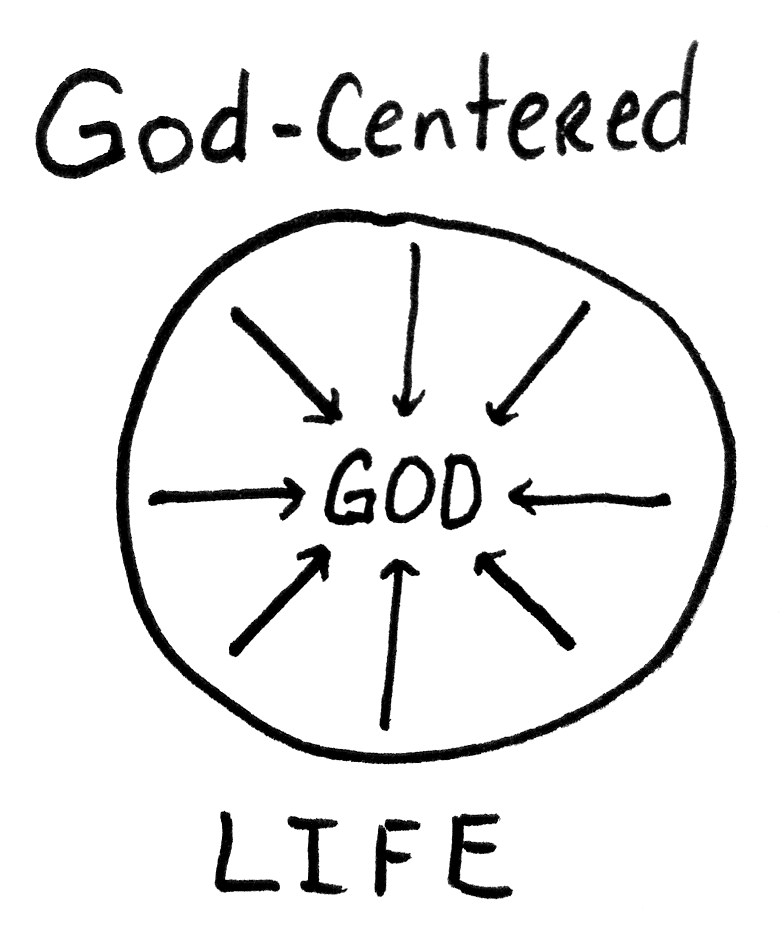
God-Centered Living

You may be asking, “What is wrong with that?” Well, there is nothing wrong with living a God-centered life, generally speaking. On the other hand, there is more to being a Christian than being “God-centered.”

“Outrageous!” “That’s blasphemy,” you say. Well, is it? Stop and think about it for just a moment. Start with thinking about what being “God-centered” actually means.

Does someone have to be a true Christian in order to live a God-centered life? You may think so, at first, but there may be a few church folk fooling themselves. Don’t believe me? Read what Paul wrote to the Church…

“Examine yourselves, whether ye be in the faith; prove your own selves. Know ye not your own selves, how that Jesus Christ is in you, except ye be reprobates?” – 2 Corinthians 13:5 KJV

Why would the Apostle tell church people to “examine” and “prove” whether or not they were in the faith? Could it be that there were some who were going through all the motions, but were never converted, never born anew? Could it have been possible that there were some doing all the right things, for the right reasons, but not right with God? He says that the answer to the test will be whether or not “Jesus Christ is in you.”

Can people live God-centered lives and still be lost? To help answer this question, consider the following people (names are fictitious). Do their actions guarantee salvation?

  • Bob goes to church every day the doors are open, including every other function on every other day
  • Henry gives 20% of his income and 10% of his time to the church. If there is a need, ask Henry for help.
  • Margaret goes to a Fundamental church, has the right translation of the Bible, and never wears pants – ever.
  • Mary would never say a dirty word, tell an off-color joke, or even permit foul language in her presence.
  • Sharon put aside marriage and gave her life to helping orphans on the streets of Mumbai, India.
  • Scott and Karen have Bible studies in their home, take the kids to Sunday School, and even have gold crosses in every room of their home, not to mention on their necks.
  • A rich young ruler keeps all the commandments (not just the Big 10) from his youth.

If these people were to examine themselves, as Paul asked, what might be missing? Colossians 3:23 says, “And whatsoever ye do, do [it] heartily, as to the Lord, and not unto men.” Is it not possible that someone could do everything for God’s glory (live a God-centered life), but still die without Christ?

What are your thoughts?

Have you “proven” whether you “be in the faith?”

Do you know of Scripture that supports a “God-centered” life being proof of salvation?

The Realization

When contemplated what I had asked of God (to make me characterized by a God-centered life), the mental picture of a wheel came to mind. It was the picture of a wheel with a center hub and spokes, much like a bicycle or wagon wheel. As I thought about this, however, something seemed wrong. Something seemed almost selfish.

You see, when you look at a wheel, especially the kind with spokes and a hub, it may not be obvious at first, but there are parts. In such a wheel I can distinguish the spokes from the hub, and the rim from the spokes. I can even see that there are spaces in between the spokes that are empty and not attatched or filled with anything – just empty. If God is supposed to be represented by the hub, the center of the wheel, then the wheel is not really all about the hub, but the wheel itself.

It’s about Jesus

The Apostle Paul told the Athenians (Acts 17:28) that in Jesus we “live, and move, and have our being.” In a letter to the Galatians he said “I am crucified with Christ: nevertheless I live; yet not I, but Christ liveth in me” (Galatians 2:20). It would seem to me that Jesus should be more than our “hub.” He should be our “ALL.”

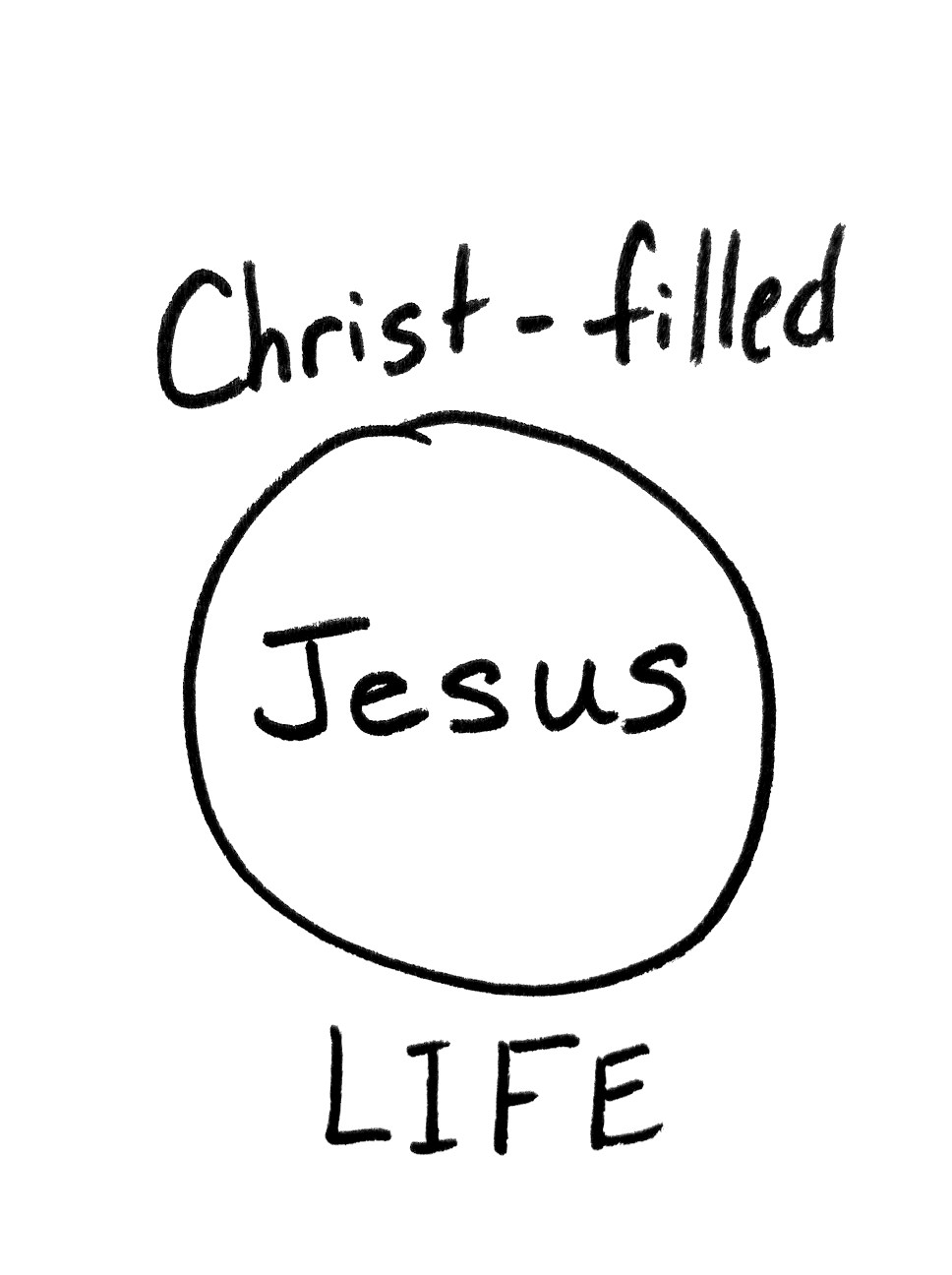
That is when I thought of a different picture. This time I imagined a solid circle – a disk. Unlike the other picture where God was the center of everything, yet separate, here was a picture of wholeness. In this picture, if my life is this type of wheel, people won’t notice anything about me, just Christ.

All of the spokes (my life, my dreams, my habits and hobbies, my talents, and my desires); the empty spaces (the areas of my life that seem irrelevant); and the rim (the total expanse of who I am – my identity, my sphere of influence); each part is now inseparable from the life and power of Christ who lives within me.

May they see Jesus

So, I no longer want to be characterized as a man with a God-centered life. I want to be a man characterized by the life of Christ. When people look at me, I don’t want them to say, “Hey, that guy really knows how to serve God,” or “Hey, that guy really loves the Lord.” Even though there is nothing wrong with those things, how much better would it be if they could say, “Hey, I met this guy… at first I thought he was that man they call Jesus.

Remember, it was to the Church at Corinth that Paul said, “Examine yourselves, whether ye be in the faith; prove your own selves.” There must have been some hearing this letter read who were deceived. Don’t be like them. Make sure your life is in Christ, and He is in you.

May your activities be “God-centered;” but your life “Christ-filled.” May the world see Jesus in you.

For Discussion:

Can you distinguish between a God-centered and a Christ-filled life? What characteristics would you expect to see?

Do you think someone could live a God-centered life and still be unsaved?

Your comments would be appreciated. 

2 Comments

Filed under Christian Living, Christianity, God, Jesus, Theology

A “Perfect” Role Model

Sermon Prep

Not long ago I was doing some research for a sermon on Jonah. In the process I came across a Muslim website that made an interesting observation (and I will paraphrase), “The Bible proves it is not true because God would not allow the prophets’ reputations to be smeared.”

It went on to say (paraphrasing, again), “What kind of role model would a prophet be if we read of him making mistakes?”

What kind of role model? That’s a good question! Was the Muslim author trying to say that role models had to be perfect in order to be real? Here’s a shocker – in one way or another, everybody is a role model.

If the defining characteristic of a role model is “perfection,” that would rule out King David, Solomon, Moses, Joshua, Abraham, Isaac, Jacob, Peter, Paul, Sarah, Mary (all of them), the woman who washed Jesus’ feet with her tears, and many, many others…

…especially Jonah.

Jonah

Now, Jonah wasn’t exactly the type of person after which I would want to pattern my life, but he was a prophet of God. He had some serious character flaws, though. He was angry, disobedient, and was a racist who constantly talked suicide. He even spouted off to the Lord for being too forgiving!

No, Jonah was not the type of person I would want to emulate. But hold the whale puke! I am more like him than I thought!

  • I have run from God.
  • I have harbored racism at times, as much as I am ashamed to admit.
  • I have been angry and disobedient.
  • I have wondered if life was worth living.
  • I have even wanted to see whole cities destroyed, innocent people and all, after September 11, 2001.

I have been more like Jonah more than I care to admit.

The Encouraging Part

The fact is that the Bible is not only full of role models, but models of the people we already are. Flawed, broken, and human. But here is the encouraging part: even when we are not perfect, God can still use us – and change us.

  • Jonah ran from God, but God pursued.
  • Jonah disobeyed God, but it didn’t derail God’s plan.
  • Jonah got angry with God, but God responded to him with the understanding kindness of a wise Father.
  • Jonah even wanted to die, but God never belittled him. He only focused Jonah’s attention on the bigger picture: 120,000 souls, not to mention animals, whose lives were spared (Jonah 4).

I thank God that the Bible doesn’t white-wash humanity. There are so many examples of how people, just like me, can find hope, even when we’re not perfect.

The Perfect One

It is not hard to come to the conclusion that there were some really dysfunctional people in the Bible. But you know what? That’s what adds to the authenticity of Scripture. There are no “perfect” role models in the Bible, except for one – Jesus.

“For to this you have been called, because Christ also suffered for you, leaving you an example, so that you might follow in his steps. He committed no sin, neither was deceit found in his mouth.” – 1 Peter 2:21-22 ESV

“For we do not have a high priest who is unable to empathize with our weaknesses, but we have one who has been tempted in every way, just as we are–yet he did not sin. Let us then approach God’s throne of grace with confidence, so that we may receive mercy and find grace to help us in our time of need.” – Hebrews 4:15-16 NIV

I want to be more like HIM!

2 Comments

Filed under Christian Living, General Observations, God, Life Lessons, Preaching, Struggles and Trials

Arguments for Eternal Security

My last post – the one about not having excuses not to go to church – certainly stirred up some comments, didn’t it? When you have the time, why not peruse them for some additional pondering material.

This post, being written as I am recovering from a 24+ hour stomach virus, may prove to be even more comment stimulating.

By the way, did you know one can lose 7 pounds in just 24 hours?

My Outline

bibleThe following is the outline I took to with me to the pulpit Sunday morning. It starts off with some arguments against the “once-saved-always-saved” position. The next part lists six basic arguments in favor of the eternal security of the believer.

Of course, this is only an outline, not the sermon. But just looking at the outline, what are your thoughts?

“Eternal Security” 

Arguments Against “Once Saved, Always Saved”

  1. Observational – How people live that believe it.
  2. Free Will – We are created with a will; we’re not slaves.
  3. Scriptural (Hebrews 6; 1 John 3:9; 5:18)

Arguments FOR “Eternal Security”

  1. Creational Argument: We are New Creations (2 Cor. 5:17)
    1. It took a supernatural act to change us
    2. We can’t act supernaturally to change us back
  2. New Birth Argument: We are Born Again (John 3:7,16)
    1. By the Spirit – Jn 3:6
    2. By the Word of God – 1 Peter 1:23
    3. We are not God, so we must remain “born again”
  3. Children of God Argument
    1. Born that way – 1 John 5:1; 1 Peter 1:23
    2. Adopted – Rom. 8:15; Gal. 4:5; Eph. 1:5
    3. Abba – Gal. 4:1-7
  4. The Possession Argument – We belong to Christ
    1. Purchased – 1 Cor. 6:19-20; 7:23 (Bought with a Price)
    2. Given by the Father – Jn. 6:37-40; 10:28-30
    3. Will never be separated – Rom. 8:35-39
    4. Romans 14:8 – For whether we live, we live unto the Lord; and whether we die, we die unto the Lord: whether we live therefore, or die, we are the Lord’s.
    5. He can keep what is His – 2 Tim. 1:12 “…for I know whom I have believed, and am persuaded that he is able to keep that which I have committed unto him against that day.” See also: 2 Timothy 4:18 And the Lord shall deliver me from every evil work, and will preserve [me] unto his heavenly kingdom: to whom [be] glory for ever and ever. Amen.
  5. The Marriage Argument
    1. Ephesians 5:25-28, 31-32 – Husbands, love your wives, even as Christ also loved the church…This is a great mystery: but I speak concerning Christ and the church.
    2. He is faithful, even when we are not.
      1. 2 Timothy 2:11-13 “…if we believe not, yet he abideth faithful…”
      2. He is God, not man! – Hosea 11:7-9
  6. It’s a Gift
    1. 2:8-9 Gift of God, by grace
    2. Romans 11:29 KJV – For the gifts and calling of God [are] without repentance (irrevocable)

Click on the link below to listen to the audio. As you might be able to tell by the opening remarks, I believe it was a sermon we needed, but the devil was opposing. Nevertheless, hearts were encouraged.

https://riversidesermons.sermon.net/main/main/20657994

9 Comments

Filed under Bible Study, Preaching, salvation

A Book Title Poem

About the Books

About three years ago I received a rather large addition to my personal library. In addition to the over a thousand books in my office, nineteen banker’s boxes full of books was given to me by a former seminary professor.

This professor of theology, a graduate of New Orleans Baptist Seminary and a contemporary of David Platt, was from Canada. When his work permit in America expired he found himself unable to ship his library back home – the cost was prohibitive. Therefore, he offered them to me to keep and use in his absence. He said, “If I don’t come back in a couple of years, just consider them yours to keep.”

It’s now been three years, and I’m just now starting to unwrap the “gift.” I hope he forgot me.

The Box

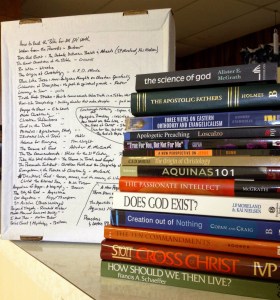
FullSizeRender (4)I’ve seen how people have been writing poems by using the titles of books. Linda Kruschke is a good example (click HERE to read her latest poem, My Soul Feels Peace).

So, what I did was open up one of the boxes of books (one of which I’d already written the contents on the lid), reached down inside and pulled out a decent stack, and then arranged the stack into a pyramid…largest book on the bottom, smallest on the top.

The poem that I proceeded to write was based on the titles of the books from top to bottom.

The Poem

The Science Question

The Science of God is the study of God

It’s something we call Theology.

The Apostolic Fathers taught it well,

Setting the standards for what would be.

The science would produce Three Views on Eastern

Orthodoxy and Evangelicalism

But Apologetic Preaching would come along

To combat what we’d come to call pluralism.

What’s True for You, but Not for Me

May give you A New Perspective on Jesus,

But be mindful of The Origin of Christology

And don’t neglect to peruse some Aquinas.

There’s something about The Passionate Intellect

That leads some to question, “Does God Exist?

But the wise understand Creation Out of Nothing

Was breathed by the God of The Ten Commandments.

And now that the Fathers are long past gone

The Cross of Christ is the message they give.

This new generations of scientific theologians

Who preach as they ask, “How Should We Then Live?


1 Comment

Filed under Apologetics, Christian Living, poetry, Theology

General Survey of Understanding and Belief

In the twentieth chapter of Acts, the Apostle Paul called for a meeting with the elders of the church at Ephesus. Knowing the dangers posed by “wolves” from the outside and perverse deceivers on the inside (vs 29-30), He warned them to pay close attention to the things he had taught them. After all, they were responsible for flocks purchased by God with his own blood (v28) – what a thought!

Paul said (v27), “For I have not shunned to declare unto you all the counsel of God.” Well, folks, I’ve been pastoring this little flock for nearly 8 years, and I’m afraid I might have left something out. Therefore, I thought this little survey (conducted anonymously) might help me determine some areas where I need to do some “declaring.” I don’t want to be guilty of shunning any of God’s counsel.

Glance over the following survey. How would you answer? (The “U” is for “unsure”)

2o16 General Survey of Understanding and Belief

  1. Jesus became God
    1. When born of a virgin
    2. When filled with the Holy Ghost
    3. When resurrected from the dead
    4. None of the above
  2. How many books in the Bible
    1. 55
    2. 66
    3. 100
  3. There are errors in the Bible because it was written by men. T / F / U
  4. God is
    1. One God, but with three names
    2. Three Gods with one Name.
    3. One God in three Persons.
  5. Jeremiah fought the battle of
    1. Jericho
    2. Nineveh
    3. None of the above
  6. Because Jesus prayed to the Father, that made him less than the Father. T / F / U
  7. You have to be filled with the Holy Ghost to be saved. T / F / U
  8. Where does the Bible say, “Cleanliness is next to godliness”?
    1. Matthew 7:19
    2. Romans 12:1
    3. None of the above.
    4. Unsure
  9. Have you determined your own spiritual gifts? Y / N
  10. Do miracles still happen today? Y / N / U
  11. Christians and Muslims worship the same God, but by different names. T / F / U
  12. Jesus was the first “born again” Christian. T / F / U
  13. Adam and Eve were literal people. T / F / U
  14. Salvation can be lost because man has a free will. T / F / U
  15. We become angels when we die. T / F / U
  16. Everyone will eventually go to heaven, sooner or later. T / F / U
  17. Jesus didn’t physically rise from the dead; He was a spiritual being. T / F / U
  18. Those who have died are
    1. Asleep until the resurrection
    2. In heaven or hell right now
    3. No more – they ceased to exist
  19. The proper day to worship is the Sabbath, but it was changed to Sunday by the Catholic Church. T / F / U
  20. You must be baptized to be saved. T/ F/ U
  21. Abortion is OK until the baby can breathe on its own. T / F / U
  22. The only difference between the religions of the world is how we choose to worship God T / F / U
  23. It is a sin to drink or smoke. T / F / U
  24. The King James Version of the Bible is the only one given by God to the English-speaking world. T / F / U
  25. Modern translations of the Bible deny the Virgin birth and divinity of Christ. T / F / U
  26. God’s power on earth is limited when we don’t give Him permission to use us. T / F / U
  27. We should only pray to God the Father or Jesus, not the Holy Ghost. T / F / U
  28. I feel God is angry or disappointed with me most of the time. T / F / U
  29. It doesn’t matter how you live as long as you love God. T / F / U
  30. Preaching and teaching are pretty much the same thing. T / F / U
  31. There’s a difference between the God of the OT and the God of the NT. T / F / U
  32. I am sure of my salvation. T / F / U
  33. Things I’ve done in the past keep me from being used by God. T / F / U
  34. I feel confident I could show another person how to be saved. T / F / U
  35. People who answer surveys in Church are guaranteed a blessing. T

2 Comments

Filed under baptist, Christian Maturity, Christianity, Church, ministry, Preaching, Theology, translations

Blogging Withdrawal and Psalm 40

I have so much to do, but here I am, late at night, writing something on this blog – just to be doing it.

Have you ever had this feeling? Those of you who are fellow bloggers, have you ever just been so busy…so overwhelmed…so caught up with things that are more important…that you look at the tab on your computer that links you to WordPress with a sense of longing?

Pitiful, isn’t it?

Frankly, there are so many things I’d like to write about, but I’m too stinking tired to formulate my thoughts. I’d love to share what I think about politics, the Mayor in Houston, and Ebola, but there’s just too much – and my opinion wouldn’t make that much of a difference.

photo (31)But I did have an idea. Today I was reading from Psalm 40, a passage of Scripture I read to my congregation last Sunday morning. Remember how some others and myself went through the book of Proverbs one proverb at a time? I thought that it might be beneficial and interesting, at least to some, if I were to break down that chapter a verse or two at a time.

What if I pushed aside all the other distractions of this election cycle and spent some time expounding on Psalm 40? In my opinion, it’s a revival-focused psalm that we all could benefit from applying.

What do you think?

2 Comments

Filed under blogging

Re-Examining the Divorce Controversy

Recently, I have been asked about the issue of divorce and whether or not it ultimately disqualifies one from ministry, especially the pastorate. Even though I know there will be many of you who disagree with me on this, here are my thoughts on the subject. Please understand that I did not come by them lightly.

My Story

I will never forget the phone call I got from a church in Rome, GA about 16 years ago. Someone on the other end of the line was part of a search committee looking for a new pastor.  They had gotten my resume and were impressed enough to give me a call.  Everything was going well until they asked a very pointed question, “Bro. Anthony, does your wife have a spouse that is still living?”  I responded coldly, with squinted eyes and through clinched-teeth, “Yes, ME.”  Unfortunately, this would not be the last time something like that happened.

What I encountered on the telephone that day was not unusual, nor unexpected, but it stung, nevertheless. I had chosen to marry a woman who had been divorced and it cost me. But even though our (then) pastor told me marrying Valerie would “put the final nail in the coffin” of my ministry hopes, I was aware the scripture (1 Tim. 3:2) being used against me was lacking in exposition, and it was ultimately up to God whether or not I pastored a church.  So, after much study, I felt peace that what I was doing was right (but it didn’t hurt when the late Dr. Spiros Zodhiates gave us his approval).

But let me be clear about a few things…

wedding picture fourFirst,  I have never been divorced, so for me the whole argument of 1 Timothy 3:2 should be moot.  Second, my wife was left with no choice but to divorce; furthermore, it happened before she was a believer.  Third, my wife’s ex-husband remarried and divorced again before I even met her. By all accounts my wife was free to remarry, so both she and I were clear from any “adultery” issues.  

Also, I am “the husband of one wife,” and Scripture NEVER said a bishop “must be the husband of one wife who was the wife of only one husband, ever.” Just a minor observation.

So, what DOES the Bible say?
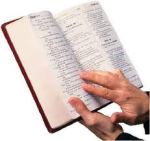
1 Timothy 3:2 says,  “A bishop then must be blameless, the husband of one wife...”  Also, verse 12 says, “Let the deacons be the husbands of one wife...”  The difficulty with these verses is not what is being said, but how it is interpreted.  

Is Paul telling Timothy that in order to be a pastor, deacon, or elder in a church, you must have only been married once?  Could it even be possible that Paul is saying that a man of God MUST have a wife, because being single would disqualify one from ministry?  These are things that have been debated for centuries.  

Some believe that a pastor, deacon, or elder should have never been divorced (or married to a divorcee) . Others believe that in order to be a proper leader, one must be married.  Still, many commentators believe that the proper rendering of the Greek is “one-woman man,” implying faithfulness and character over the number of wives.  In reality, what the Bible says is one thing, but as William D. Mounce put it, “The Greek gives us a range of possibilities, but our theology is going to determine our interpretation.” 

I think there’s another way to look at it…

Take a look at 1 Timothy 3 and read through verse 12.  The best I can figure is that there are between 16 and 17 qualifications for the bishop, and between 6 and 8 for the deacons.  All of these are preceded with a literal or an implied “must be,” as in “must be blameless,” or a “must have.”  How does this affect the argument that an elder “must have” only been married once, never remarried, or never divorced?    

Think of any great man of God you know that has stood behind the pulpit and faithfully proclaimed the Word of God.  Has he always been blameless?  Has he always been on his best behavior?  Did he ever get drunk, covet, lose his patience, or curse his wife or children in anger?  Was he ever a novice, a beginner subject to pride? If so, then according to the logic of some, he should never be able to preach or lead in God’s church, for just as a man “must be the husband of one wife,” so he also must be “blameless, vigilant, sober, well-behaved, given to hospitality, patient, never greedy, and always in control of his house and children.”  

Do you see it?  If your interpretation leads you to believe that the bishop must have only had one wife – ever – then the same hermeneutic (the study of the principles of interpretation) should apply to the other “must be’s.”  “Must be the husband of one wife” = never divorced.  “Not a novice” = never been a beginner in the faith. Doesn’t make sense, does it?

1 Timothy 3:1-12 is in the present infinitive tense (i.e., must be / dei einai).  The requirements listed are ones that describe a man of character and faithfulness, of sobriety and gravitas; not a beginner or one untried and unproven.  What I see is a list of requirements that may not have always been present in a man, but should be NOW, after God has done a verifiable work in his life.  In other words, the Bible says a bishop “must be,” not “must have always been,” or “must have never done.”  Paul said, “and such were some of you:  but ye were washed, but ye are sanctified, but ye are justified in the name of the Lord Jesus, and by the Spirit of our God.” – 1 Corinthians 6:11

Here’s my point…

I believe that there are plenty who are sitting back or hiding out because someone has convinced them that they are used up and un-usable.  For example, I can think of men right now who, for whatever reason, are divorced.  Yet, these men, now Christians, are sold-out, God-fearing, faithful, Spirit-filled fathers and husbands with proven testimonies and unimpeachable character.  Sadly, however, because of mistakes made when they were young, unsaved, and stupid, they cannot serve as deacons, much less as pastors.  

On the other hand, I can think of several pastors today who were once murderers, drug dealers, fornicators, extortioners, and abusers of mankind (do I need to explain that last one?). Yet, only because they don’t have “divorced” to add to the list of past sins, they are accepted and given full reign as leaders in the church. 

Sad.

It’s time the body of Christ re-examine this issue in the light of GRACE.

6 Comments

Filed under baptist, Divorce, General Observations, Independent Baptist, legalism, Relationships and Family, Uncategorized