Preaching Through Acts
This is my fourth time preaching/teaching through the book of Acts, and yes, I’m still learning things. Even though it’s all been over Facebook on Sunday evenings, it’s still been exciting (especially chapter 12 – I’ll included a link at the end – you should watch it).
But one person stands out to me, especially at this time in my ministry. How he is described is what I am lacking in my own life. When I read of him and preach about him, I am convicted. Wouldn’t it be nice if people thought my name was different than what it is?
Every pastor, to one degree or another, should be more like Barnabas. Yes, I want to be seen as a reflection of Jesus, but Barnabas was certainly that. So, if they every forget my name, Barnabas Baker would work.
Barnabas
Barnabas was a Levite from the country of Cyprus who became a follower of Christ. He was a generous man, a godly man, and one whose name fit his personality; he was the “son of consolation” (Acts 4:36-37).
Barnabas was the type of guy that truly cared about people and wanted to see them succeed. He was more than just a team player; he was a motivator, the kind of man who would step down from the pedestal so that someone else could shine. As a matter of fact, it was Barnabas who introduced Saul (Paul), the former persecutor of Christians, to the church at Jerusalem (talk about having someone’s back!).
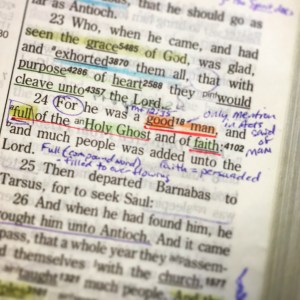 But in preaching through chapter 11 of Acts, I came across a description of Barnabas that left me very convicted. The way Barnabas was described should be how we are described: good people, full of the Holy Ghost, and full of faith (11:24).
A Good Man
The first thing said about Barnabas was that he was “a good man.” Now, a lot of people think they are good people, but not all are. As a matter of fact, there’s no other place in Acts where Luke describes a person as “good.” Only Barnabas gets that distinction.
Being described as “good” meant that he was a man with whom no one could find fault. He must have been a man of strong character, a man who kept his word, and a man who would do anything for anybody, including give the last coin to one in need. He was the kind of man Jesus was talking about when He said, “A good man out of the good treasure of his heart bringeth forth that which is good” (Luke 6:45). Barnabas was genuine, the “real deal.”
Full of the Holy Ghost
Barnabas was also “full of the Holy Ghost.” What does that mean? Well first off, let’s think about the description of “full.”
The Greek word translated as “full” is one that meant not only to be filled up but filled up to the point of overflowing. Barnabas was totally yielded and filled with the Spirit, so much so that His presence spilled over onto others. The “son of consolation” was an encourager, just like the Spirit controlling and empowering him.
Full of Faith
Barnabas was not only full of the Holy Ghost but also of faith. Simply put, Barnabas was fully convinced and persuaded with what he believed to be true. There was no doubting, no hesitation, no reluctance, no hiding, no timidity. Barnabas was sure in the gospel of Jesus Christ, and that is one reason he was sent by the church in Jerusalem to see what was going on in Antioch of Syria.
The Result
Now, let’s look at what happened because of Barnabas’ character, his spiritual power, and his sure faith.
“Who, when he came, and had seen the grace of God, was glad, and exhorted them all, that with purpose of heart they would cleave unto the Lord. For he was a good man, and full of the Holy Ghost and of faith: and much people was added unto the Lord.” – Acts 11:23-24
First, because he was a good man, he was not jealous of the good things happening in Antioch; he rejoiced that the grace of God had been poured out on the believers there!
Second, because he was full of the Holy Ghost, what was in his heart (as Jesus described) had to be shared, so he “exhorted” them and encouraged them in their faith.
Third, because Barnabas knew what temptations and trials could come, especially with the persecution following Stephen’s death fresh on his mind, he encouraged the new believers to be pro-active in their devotion to the Christ. He knew that the only way to have a strong faith is to purposefully “cleave unto the Lord.”
Fourth, many people were added unto the Lord! Because of the spirituality and faith and character of godly Barnabas, not only were new believers in Antioch strengthened, but many more people came to know Christ!
The Challenge
Here’s the thing. Why aren’t more people coming to a saving faith in Jesus? Why aren’t more of our churches encouraged? Why aren’t more Christians spiritually maturing in their faith? It’s because we don’t have enough men and women like Barnabas.
Be a good person! Seriously, be the type of man or woman that people can trust and rely on. Be the type of person that people can tell you care. Be generous, compassionate, trustworthy, and consistent. Be people of honor and character.
Be filled with the Spirit! Do you know what it means to be completely filled with the Holy Ghost of God? It means there are no little rooms, closets, or boxes in your heart where there is written a note to God which says, “Private! Hands off!” Every are of your life – every secret part – should be yielded to and controlled by the Spirit of God. Otherwise, you are self-controlled and rebellious, and thereby powerless.
Be full of faith! Grow your faith. Study God’s Word. Know why you believe what you believe. Don’t be a coward! If you are shy or feel intimidated to share your faith with others, ask yourself why that’s so!
Would you be afraid to warn your neighbor a murderer was crawling through his bedroom window? Would you be afraid to yell “fire!” if flames were engulfing the rooms of a hotel where people were sleeping? It’s only because you are NOT full of faith that you are not bold; you have doubts the fire is real and the murderer really means to harm.
You and I need to be more like Barnabas.

 As I look at this recent picture of my little George when he wasn’t feeling well, I can’t help but notice how at rest he is. Look at how little, yet how trusting. Just a tiny little guy, but he knows where he is loved, safe, and taken care of.






 The Recovering Legalist