Tag Archives: Christmas

Next Christmas, it’s One and Done

Too Early?

This morning, as I stood in the kitchen talking with my wife as she folded a few towels, I sat down my cup of coffee and asked, “Is it too early to talk about Christmas?”

Of course, just the fact that I brought up planning anything, much less Christmas, caught my wife’s attention. With raised eyebrows and a slight look of amazement she replied, “Sure! Why not? Go ahead!”

Then I said, “I know it’s only January, but I want to start now with an all-out push to change the way we do Christmas.” I explained that even if I have to say something every month until people are sick of hearing about it, it’s something I’m convinced needs to be discussed.

I am done with gift giving as usual. Now is the time to change.

First World Problems

I am sure you know what a “first world problem” is, don’t you? A first world problem is something like not finding your favorite brand of gourmet water at your local Whole Foods store when most of the world struggles to find the clean kind.

Well, maybe what I am about to describe is a problem only first-world folk have. It is highly unlikely that those in poorer countries (or even poorer communities) deal with giving too many gifts to their children. Many care more about how they will put food on the table, not how to afford the latest video game console or diamond ring.

But for those of you who are even now planning so that the trunk of next year’s Christmas tree will be hidden by boxes covered in shiny disposable paper and reusable bows, I say ENOUGH! Just STOP it, already!

The Purpose

If you know the meaning of Christmas has to do with celebrating the birth of Jesus Christ, not all things Santa, then you should understand what I’m about to say. On the other hand, if you think that Christmas is nothing more than the “season for giving,” then you’re going to hate me.

The ONLY reason we celebrate Christmas is because Jesus was God’s perfect Gift to mankind. While remembering the day (regardless of the date) that God became a baby and dwelt among us, we offer gifts to each other in memory of the unique Gift wrapped in swaddling clothes and laid in a manger.

Christmas is NOT supposed to be a season of commercial manipulation and debt-producing volume-minded influence peddling.

In reality, a Christmas gift should be nothing less than an homage to the greater Gift. The giving of gifts at Christmas should mimic the original. Even more, what is given should reflect the Gospel, not diminish or dilute it.

Value, not Volume

Again, it may only be a first-world problem, but how often have you been confronted with the issue of buying equally for multiple children or family members? For example, we have three daughters and three granddaughters. My wife gets so stressed over the number of gifts each one receives. She wants her giving to be and appear fair.

But then look at the way the number of gifts becomes more important than the value of each gift. Especially for the little children, all they can see is the number of wrapped gifts, not the value, especially not the heart. Thus, theoretically, one kid could get 5 gifts while another could get 10 gifts. Yet, because of the value of numbers, the one receiving 5 gifts might feel cheated, even if the inherent value of the 5 is equal to or more than the 10!

Do you see? By focusing on volume instead of value, the number of gifts becomes more important than the value of the gift. When the value of the heart is determined by the number of the sacrifices, the value of the individual sacrifice is diminished.

One and Done

Let’s face it, Jesus was the ultimate “one and done” gift. God did not send multiple saviors; He sent his One and Only Son. The angel told the shepherds, “You shall find the babe…,” not multiple babies, one wrapped this way, the other one that.

What are we telling our children and each other when we have to make sure there are several gifts under the tree and at least a few items in each stocking? How does that mirror the Gospel? What does it say about Jesus?

Today I’m starting a movement to change the way we do this. Will you join me?
Leave a comment

Filed under Christianity, Christmas

Critique of ‘Hallelujah’ in Christmas Worship

As of this writing, there are only five days until Christmas. If I had only spoken out a few months ago, things might have been different today. But I didn’t say anything earlier because I didn’t want to hurt feelings or offend. I can only hope that by protesting now, something good can come of it.

You may recall that a few years ago I wrote a scathing critic of Dean Martin’s “Baby It’s Cold Outside.” I wasn’t the first to point out the song’s sexually abusive lyrics. Nevertheless, my article did get attention. This wasn’t surprising since the #metoo movement was going strong at the time.

But here we are in yet another Christmas season and what do we have? More offensive lyrics in Christmas songs. What makes it worse is that they are part of worship services. These services are meant to celebrate the birth of Jesus Christ, not a sexual conquest.

It seems that all one must do these days is include the word hallelujah in a song, no matter the context of the borrowed lyric or tune, and it’s sure to be a hit at your next Christmas cantata.

“Hallelujah”

Let me be clear. It is not my wish to trash Leonard Cohan’s famous, beloved and oft-covered “Hallelujah.” Why would I want to? My complaints would just fall on deaf ears. Since the 1984 release of Cohen’s “Hallelujah,” near universal praise has been given for its lyrical, poetic, and harmonic beauty. But I’m not a fan. I can’t stand the song – not because of the tune, but the message.

But as with many things, even though I’m not a fan, if it stays within the bounds of its intended secular audience, I’m content to let rotting dogs lie.

It’s only when the putrid scent of death begins to taint the fragrant incense of worship that I get offended. My gag reflexes tempt me to puke.

Unfortunately, as of late, I’ve had to keep a barf bag close by. It seems that more and more Christians have gone odor blind and cannot detect even the slightest stench. Everywhere I turn, Cohen’s agnostic and broken Hallelujah” is being incorporated into holy worship.  

A Little Background

With just a little digging, I found that the first time “Hallelujah” became linked to Christmas was in 2010. Susan Boyle from Britain’s Got Talent included it on her Christmas album. It featured the original lyrics.

Then, early in December of 2012, Cloverton released the now popular Christmas version of “Hallelujah” which tells the story of Christ’s birth. Below is the first verse.

I’ve heard about this baby boy
Who’s come to earth to bring us joy
And I just want to sing this song to you
It goes like this, the fourth, the fifth
The minor fall, the major lift
With every breath, I’m singing Hallelujah

In 2017 the group Anthem Lights released “Hallelujah Medley,” a mashup of two classic Christian songs with “Hallelujah” woven throughout. The other two songs were “Hallelujah, What a Savior” and Michael W. Smith’s “Agnus Dei.”

This year I heard both the Cloverton and the Anthem Lights versions in the same church Christmas cantata. However, as an instrumentalist in that church, I couldn’t bring myself to accompany either one.

Giving Grace

But I want to extend grace. I don’t want to disparage anyone who sings these covers or re-writes of “Hallelujah.” Their intention might be to glorify God. They may also encourage others to praise Him. Even Paul was hesitant to condemn those who, out of jealously, added to his suffering, for even then the Gospel was being preached (see Philippians 1:15-18). That was the main thing.

I’m compelled to show grace, too, because others may genuinely see things differently. They may consider what is being done with “Hallelujah” as an act of sanctification. They might argue that the tunes of some of the greatest and most beloved hymns were once big hits in the pubs and ale houses. Therefore, incorporating the tune or some of the lyrics into Christmas music is no different than how we sing “Amazing Grace” to the traditional tune of “New Britain.”

And, if nothing else, I must be careful to offer a lot of grace because I’m not perfect. I’ve had a bad cold, recently, and lots of things irritate me more when I feel sick.

What Are the Issues?

So, what is the issue (or issues)? What is there to complain about this time? What makes me cringe? What makes me nauseous?

Issue 1: The Lyrics

To begin with, it all goes back to Leonard Cohen’s original “Hallelujah” and its meaning. You see, I like music, but I also try to understand the lyrics. Just because a song has a happy tune, that doesn’t mean it’s worth listening to. I try to feed my soul with good stuff, not garbage.

Compared to many songs, though, “Hallelujah” is downright tame. It’s not a vulgar, pornographic jingle celebrating wet body parts (e.g., Cardi B). But it isn’t religious, nor is it wholesome for all ages, either. Actually, it is a song that draws loosely from the lives of biblical characters to describe dysfunctional, sexually-involved relationships that seek consolation through mutual brokenness.

But as a Christian, what bothers me most is the way Cohan distorts and contorts the word hallelujah. It offends me that such an intrinsically holy word (made up of two Hebrew words, hālal and yâ, which means “praise the Lord”) is used to describe a sexual release in the second verse.

Your faith was strong but you needed proof
You saw her bathing on the roof
Her beauty and the moonlight overthrew you
She tied you to a kitchen chair
She broke your throne, and she cut your hair
And from your lips she drew the Hallelujah

It may seem petty, but it also irritates me how Cohan (born a Jew, but a practicing Buddhist) not only mixes the stories of King David and Samson, but does so in a self-justifying, slanderous way. David needed proof for his faith? Whose throne got broken?

But who really cares about the verses of this song, right? I mean, all that people really care about are the melody and the haunting chorus that repeats the word erroneously attributed to a “baffled” king.

Hallelujah is the real money maker, after all.

Issue 2: The Fusion of the Holy and the Unholy

The other big issue I have is not only the willingness, but the ambivalence toward fusing holy, Christian works with unholy, secular, even blasphemous works in an attempt to be creative.

Here’s the thing. I can’t sing “Amazing Grace” without including the accompanying tune once connected to bar songs. However, when I or any other person hears “Amazing Grace,” the words of “New Britain” never enter our minds. The older song is totally disassociated from Newton’s “Amazing Grace” and the author of “New Britain” never gets any credit.

But “Hallelujah” is a different thing entirely. Whenever either the tune or the lyrics of “Hallelujah” are used in either a lyrical remake or a mashup with other Christian songs, some sort of attribution must be given to Leonard Cohan.

Issue 3: Ignorance is Blessed

I asked my wife for her thoughts on the rendition of Cloverton’s version of “Hallelujah” that our praise band did last week. Like everyone else, she thought it was beautiful. And from a purely musical perspective, even a worshipful one, it was moving.

But on the other hand, on hearing “It goes like this, the fourth, the fifth, the minor falls, the major lifts,” when does one wonder: “Why are the words of an agnostic Jewish Buddhist being used out of their context to praise the God and Savior he doesn’t even believe in?”

But that’s just it. Most people don’t know.

Most people aren’t aware of the source material. For that matter, most people never parse the lyrics to any of the songs they sing, even in church, and are usually content remaining ignorant, but blessed. Honestly, I can’t blame them. It’s easier that way.

And frankly, at least in this case, what you don’t know probably won’t hurt you, so worship away.

But I do know. That’s why I just had to say something.

2 Comments

Filed under Christianity, Christmas, Church, music

10 Reasons and 10 Videos why Jesus Is Better than Santa Claus!

Hello, everyone! It’s been a while since I’ve been in touch (I tend to like these long breaks, it seems).

However, I am making an HUGE effort to bring you guys up to date with links to ALL my videos from a recent series on YouTube.

If you remember, I mentioned a while back that I was going to take older posts and convert them into videos for my new Edify! channel on YouTube. I did that, but it didn’t work as well as I initially thought it would.

So, what I did this time was take a sermon outline and turn it into a whole series: 10 Reasons Why Jesus Is Better than Santa.

Funny thing, I have gotten VERY LITTLE response on YouTube, but a lot from viewers on TikTok. Therefore, if you would be so kind, would you check out these videos on YouTube and let me know what you think? It would be great if all my subscribers to this blog would subscribe to my channel! I might even get monetized 🙂

2 Comments

Filed under Uncategorized

The Day After Christmas Is Proof We Need to Be Redeemed

I know that the title was a little long, but don’t let it intimidate you. Yes, for some of you what you are about to read will be profound – it may even hurt your head.

Yet, despite how much you’ve endured this week, please take just a minute or two, read on, and consider the following thought:

The feelings we have after Christmas point to the fact that we have not been fully redeemed. Our bodies are still waiting for that final transformation.

[We] also groan within ourselves, eagerly waiting for adoption, the redemption of our bodies. – Romans 8:23b CSB

What I am saying, brothers and sisters, is this: Flesh and blood cannot inherit the kingdom of God, nor can corruption inherit incorruption. Listen, I am telling you a mystery: We will not all fall asleep, but we will all be changed, in a moment, in the twinkling of an eye, at the last trumpet. For the trumpet will sound, and the dead will be raised incorruptible, and we will be changed. For this corruptible body must be clothed with incorruptibility, and this mortal body must be clothed with immortality. – 1 Corinthians 15:50-53 CSB

What does this have to do with “after Christmas“?

Celebrating Christmas has completely worn me out. I’m tired of carols, smiles, joy, and jingle bells… even eggnog. I need a break.

So, just imagine how difficult it would be to survive heaven for more than a day or two?

Not only will we need new bodies that never grow old, get weak, or want to go to bed before sundown, but we will need to be set free from all the chains of this mortal flesh! In other words, everything that turns an elf into a Grinch around December 26th or 27th.

Last year I conducted a funeral service for the wife of a dear friend. I spoke of her death as a process we all must go through: a process of putting off this mortal, corruptible body and putting on an immortal one. I spoke of how we would either all have to die or be changed in the “twinkling of an eye,” but none of us are ready for heaven as is.

Our corruptible minds and bodies must be exchanged for that which is incorruptible, else we won’t be able to endure the celebration that is to come!

Without being changed, heaven would be full of worn-out billion-year-olds leaving the dirty dishes for the angels to deal with.

Heaven will be a celebration of the Redeemer by the redeemed.

If the corruptible got in, it wouldn’t be long before they felt like hell.

2 Comments

Filed under Apologetics, Christmas, clothing, salvation, the future, worship

How We Know Jesus Was a Gift from God

A Christmas Sermon Outline

Have you ever been given a gift, or seen one under the Christmas tree, that needed no card or tag informing you who sent it? Maybe the meticulous wrapping was a clue to who the wrapper was.

I know Christmas is still a few days away, but some of you might need something to preach or teach between now and then. Therefore, please accept as my gift of an outline I prepared, “How We Know Jesus Was a Gift from God.”

Please, feel free to use it 🙂

“How We Know Jesus Was a Gift from God”

I.  Because of When THIS Gift Was Given

·   Galatians 4:4 “When the fullness of time had come, God sent forth His son…”

II.  Because of How THIS Gift Was Wrapped

·   Luke 2:12 “And this shall be a sign unto you, you shall find the babe wrapped in swaddling clothes, lying in a manger.”

·   Philippians 2:7 “But made himself of no reputation, and took upon him the form of a servant, and was made in the likeness of men:”

·   Hebrews 4:15 KJV – “For we have not an high priest which cannot be touched with the feeling of our infirmities; but was in all points tempted like as [we are, yet] without sin.”

III.  Because THIS Gift Was Truly Free

·   John 3:16 “For God so loved the world that He GAVE…”

·   Ephesians 2:8-9 “For by grace…it is a GIFT of God, NOT of works…”

·   Romans 3:24 “Being justified FREELY by his grace through the redemption that is in Christ Jesus.”

IV.  Because THIS Gift Was Exactly What We Needed

A.  To Bring Us Life – Luke 2:11 “Unto you is born, in the city of David, a SAVIOR…”

B.  To Bring Us Joy – Lamentations 3:22-23 “His mercies are new every morning”

V.  Because of the Love that Went Into It.

·   1 John 4:9 “In this was manifested the love of God toward us, because that God sent his only begotten Son into the world, that we might live through him.”

VI.  Conclusion:

A.  Accept the Gift of Jesus

B.  Give Thanks! – 2 Cor. 9:15 “Thanks be to God for this unspeakable Gift!”

Leave a comment

Filed under Bible Study, Christmas, Jesus, Preaching

Last Year I Gave You My Heart, Now It’s For Sale In a Resale Shop

Back In 1984

I was a senior in high school; I was infatuated with Pheobe Cates and Susanna Hoffs; I drove a 1979 Pinto station wagon, and that Chrismas season the English pop duo Wham! released “Last Christmas.”

The year was 1984.

George Michael (the famous half of Wham!) wrote “Last Christmas,” and in the end donated all royalties toward the Ethiopian famine relief. However, it’s my belief that there was an alternative purpose for writing “Last Christmas.” Besides feeding the hungry, the idea was to create a song which every new and up-and-coming talentless pop star could record in lieu of composing something original.

It was December of 1984…the year the movie Dune came out. No wonder I hate this song.

It’s Now 2021

It is now December of 2021 and everyone from Ariana Grande to Ashley Tisdale have done a cover of “Last Christmas.” Just about every time I get in the car and turn on the radio, or walk into any store, restaurant, or torture chamber, “Last Christmas” can be heard degrading the airwaves.

You know, if mankind is supposed to be evolving, why doesn’t Gwen Stefani just do a cover of Handel’s “Messiah”? Oh, yeah, I forgot.

Why I Hate It

So what is my gripe about “Last Christmas”? I’m glad you asked.

It’s the chorus…the chorus that gets sung over, and over, and over, and over again.

“Last Christmas I gave you my heart / But the next day you gave it away /

This year / To save me from tears / I’ll give it to someone special.” – George Michael

Questions:

  • Was the person this song was written about not a special person when the singer’s heart was first given away?
  • If this year you’re going to give your heart to “someone special,” what does that say about the person to whom the song is being sung? Was she nothing more than some floozy you met at the ski lodge? Did she wake you up before she went went?
  • If you’re in the habit of flippantly giving your heart away to non-special people – people who think so little of your heart that they give it away the very next day – what makes you think this year’s “special” person won’t do the same on December 26th?
  • I can see how a person would receive a heart, like during a transplant, but how does one “give it away” the very next day? Does one say to a new lover, “Hey, baby, let me give you this heart – some other guy gave it to me yesterday for Christmas”?

The Answer

The other day my wife and I stopped by a charity to donate some items for resale. Before we unloaded the items we no longer needed, my wife asked, “Do you want to go inside and look around?” “Sure,” I replied. “Anything to make you happy.”

A few minutes into our exploring of used or discounted items, my wife saw this strange, yet interesting music box sitting on a shelf. She said, “Look…a music box…it’s different…I wonder how much they want for it?”

Valerie reached up and turned the music box up on its side, and then she asked me to look at what she saw. Immediately I was struck with the awkwardness of the message and realized there was a potential blog post waiting to be written.

“Now you cant give this away”

Here was the answer to at least one of my questions to George Michael and all of his subsequent knock-offs. Obviously, George was giving his special and non-special Christmas relationships tacky music boxes…

And they gave them away. 

Leave a comment

Filed under Christmas, Humor, music

The Day After Christmas Is Proof We Need to Be Redeemed

I know that the title was a little long, but don’t let it intimidate you. Yes, for some of you what you are about to read will be profound – it may even hurt your head.

Yet, despite how much you’ve endured this week, please take just a minute or two, read on, and consider the following thought:

The feelings we have after Christmas point to the fact that we have not been fully redeemed. Our bodies are still waiting for that final transformation.

[We] also groan within ourselves, eagerly waiting for adoption, the redemption of our bodies. – Romans 8:23b CSB

What I am saying, brothers and sisters, is this: Flesh and blood cannot inherit the kingdom of God, nor can corruption inherit incorruption. Listen, I am telling you a mystery: We will not all fall asleep, but we will all be changed, in a moment, in the twinkling of an eye, at the last trumpet. For the trumpet will sound, and the dead will be raised incorruptible, and we will be changed. For this corruptible body must be clothed with incorruptibility, and this mortal body must be clothed with immortality. – 1 Corinthians 15:50-53 CSB

What does this have to do with “after Christmas“?

Celebrating Christmas has completely worn me out. I’m tired of carols, smiles, joy, and jingle bells… even eggnog. I need a break.

So, just imagine how difficult it would be to survive heaven for more than a day or two?

Not only will we need new bodies that never grow old, get weak, or want to go to bed before sundown, but we will need to be set free from all the chains of this mortal flesh! In other words, everything that turns an elf into a Grinch around December 26th or 27th.

Last week I conducted a funeral service for the wife of a dear friend. I spoke of her death as a process we all must go through: a process of putting off this mortal, corruptible body and putting on an immortal one. I spoke of how we would either all have to die or be changed in the “twinkling of an eye,” but none of us are ready for heaven as is.

Our corruptible minds and bodies must be exchanged for that which is incorruptible, else we won’t be able to endure the celebration that is to come.

Without being changed, heaven would be full of worn-out billion-year-olds leaving the dirty dishes for the angels to deal with.

Heaven will be a celebration of the Redeemer by the redeemed.

If the corruptible got in, it wouldn’t be long before they felt like hell.

5 Comments

Filed under Apologetics, Christmas, clothing, salvation, the future, worship

Christmas IS the Gospel

This month will see a lot of Christmas sermons preached, and if you actually go to church somewhere, you might actually get to hear some 😉

But if you aren’t planning on attending any church services this December, or if you just can’t get enough of sermons on the subject of Christmas, I would encourage you to listen to the one I’m attaching below.

Several years ago (2012) while pastoring at another church, I delivered a sermon entitled “Christmas Is the Gospel.” It was recorded on my iPhone that was sitting on the pulpit, so don’t expect too high a quality of production.

Why did the angels tell the shepherds what they are about to hear was “good tidings”? Pick up a Bible and turn to the book of Luke, chapter two, and follow along.

Listen: Christmas IS the Gospel

And remember, “sharing” is caring 🙂

2 Comments

Filed under Christmas, God, Preaching, salvation

The Shepherds and the Sign

The following is a sermon.

Literally, I wrote out my entire sermon in preparation for a service in which I would be preaching to a congregation in Pakistan. I had to preach my first Sunday morning message at 1 a.m.! My interpreter said it would be easier to translate for me if I had my sermon, or at least my outline, printed out.

However, once I started preaching, it became obvious that what I wrote was both too much in length and too much in detail for a translator. Especially doing it over Facebook Live with a lag in the signal.

So, what I wanted to do was post the originally written sermon so that you, when you have the time, can read through it and be blessed this Christmas season.

We will be looking at Luke 2:8-20.

  1. The Typical Shepherd Story
    • There were poor shepherds watching their flocks at night when suddenly, without any warning, the angel of the Lord appeared unto them… looking like a young child dressed in a white sheet with a shiny belt, wings, and a halo.
    • The angel gave these poor, unwanted, unloved, outcasts – because people thought of shepherds as the lowest of society, except for those with disease or Gentiles – the announcement of the birth of the Savior of the world.
    • Then they were told to go to Bethlehem and knock on doors, ask all the people “have you seen a special baby anywhere? He’s supposed to be wrapped in swaddling cloth,” and look wherever they could until they found a baby in a manger.
    • When they did find him (and, of course, they brought sheep with them), they worshipped Him. …along with the Wise men. Except the wise men didn’t show up for at least another 2 years.

  2. The Non-Typical Story
    • Unlike what most people assume, it is very likely that the shepherds watching over their sheep at night were not normal shepherds, but Temple shepherds, priestly shepherds, Levitical shepherds.
    • Unlike what most people assume, these were not unlearned men, but men who had been taught in the Law of Moses and were very aware of the requirements for sacrificial lambs.
    • Unlike normal shepherds and normal sheep, these shepherds and these sheep were special. These sheep were meant to be sold to Jews who didn’t have their own spotless lambs for a sin sacrifice. These sheep were very, very valuable and had to be watched day and night. They were considered “the royal stock of David” (Gesenius’ Hebrew-Chaldee Lexicon). They were even guarded and watched over from towers made of stone.
    • Unlike what most people assume, it is very likely the sheep these shepherds watched over were the ones who would be born in special birthing rooms, almost like a baby sheep maternity ward, that were clean and stocked with all the things required to aid in the birth of the lamb and to protect it from being hurt as it took its first steps.
    • Unlike what most people think, these shepherds would have been looking forward to the angel’s appearance. No, they may not have thought it would be an angel and the heavenly host, but they would most likely be aware of the prophecy found in Micah 4:8. It reads: And thou, O tower of the flock, the stronghold of the daughter of Zion, unto thee shall it come, even the first dominion; the kingdom shall come to the daughter of Jerusalem.
      • What is so special about this prophecy? To begin, the “tower of the flock” is migdal `eder in the Hebrew language.
      • Migdal-`Eder is the name of a small village near Bethlehem (See Genesis 35:21) and hence associated with Bethlehem itself.
      • Therefore, these special shepherds watching over very special sheep must have dreamed, they must have hoped, that they would live to hear that announcement. However, I am sure they still would have been shocked and terrified by the angel of the Lord.
      • In case you miss it, the Bible says the shepherds were “sore afraid,” which means they were absolutely terrified beyond words! This was no child in a white robe; it was an angel who had come directly from the presence of God! His brightness would have been indescribable and unbearable. Also, angels are fearful beings, warriors, like the one who killed 185,000 Assyrians in ONE NIGHT!
    • Unlike what most people think, these shepherds knew exactly where to go find this baby wrapped in swaddling clothes lying in a manger, and in all likelihood, it wasn’t a dirty stable in someone’s basement or a dark and dreary cave. IT WAS BACK AT Migdal-`Eder!!
    • Notice, the first verse in our text reads, “And there were in the SAME COUNTRY shepherds abiding in the field…” The words translated as “the same country” mean in the general area, in the outer expanse around an area. In other words, the shepherds were out in the wide-open area around the protective towers called Migdal-`Eder.
    • The shepherds did not need to follow the star, nor ask directions; they said, “Let us now go unto Bethlehem and see this thing which is come to pass…” They knew exactly where to go and what to look for, and they went back to the birthing room where sacrificial lambs were born and wrapped – the Tower of the Flock!

  3. The Sign
    • When Luke says that the shepherds went to Bethlehem to “see this thing,” what did they go to see? The “sign.” The angel said, “This shall be a sign unto you, You shall find the babe wrapped in swaddling clothes, lying in a manger.”
    • Stop and think about what is happening here.
      • You have priestly shepherds, those who are very familiar with the sacrificial system and how a spotless lamb must be used for a sin offering.
      • Next, you have shepherds who have been expecting, generation after generation, hundreds of years, the announcement of the coming of their Messiah, the Son of David, the Lamb of God.
      • Then you have a message from an angel that the Savior of the world has come. How could they know it’s true? What would be the evidence that this babe born in Bethlehem was worthy to bring joy to the entire world? The evidence would be the “sign,” and that was:
        • You’d find the babe – which is the first confirmation that the word from the angel could be trusted.
        • The babe would be wrapped in swaddling cloth. It’s one thing to wrap up a newborn, but a specific kind of cloth strips (some say were made from the used garments of the priests) would have been very unusual.
        • Then, the babe would be lying in a manger (In the exact place you would expect the Lamb of God who would take away the sins of the world to be born – Migdal Edar!)
          • Languages are funny things. Sometimes I have to speak through an interpreter so that I can be understood. And sometimes the words in one language are very hard to translate into another language.
          • But the word the angel of the Lord used to tell of Jesus “lying” in the bed was critically important. And it was not an accident, nor was it a coincidence, the WAY the word used.
          • The word we translate as “lying” in English is the Greek word keimenon. But what makes this word so special is the case it is in. To be specific (and I know this may sound complicated – and it can be) this one word, a verb, “lying,” is in Present Middle or Passive Deponent Participle – Accusative Singular Neuter. Are you totally confused? Are you wondering what’s so exciting?
          • What I am going to tell you next should make you want to truly shout with Joy! That’s what the angel said, correct? Joy to the world, correct? A Savior is born, correct? This shall be a sign, correct?

            The accusative case refers to the case used for a noun or pronoun that is a direct object. In this case, Jesus – the babe – is the noun or the subject of the action in this verb.

            The Middle voice, however, is what’s so exciting. We don’t have a part of speech like this in the English language. That’s why it’s so hard to understand the full impact of the angel’s message. But what the Middle voice tells us is that the object… and who is that? Jesus, the babe… is the one lying in the manger, but … and here is the part you’ve been waiting for… in this case the object or subject of the verb is the one performing the action! Did you understand what I just said?

            What does Isaiah 7:14 say? It says, “Therefore the Lord himself shall give you a sign; Behold, a virgin shall conceive, and bear a son, and shall call his name Immanuel.”

            What did the angel Gabriel say to Joseph in Matthew 1:21-23? And she shall bring forth a son, and thou shalt call his name JESUS: for he shall save his people from their sins. Now all this was done, that it might be fulfilled which was spoken of the Lord by the prophet, saying, Behold, a virgin shall be with child, and shall bring forth a son, and they shall call his name Emmanuel, which being interpreted is, God with us.

            Dear Church, what the shepherds found in the Tower of the Flock, Migdal Edar, there in the birthing stall where sacrificial sheep were born and wrapped so they would not be marred so that they could be sacrificed as a sin offering, was a baby – Jesus – who wasn’t just a baby placed in a manger by his mother, but GOD WITH US! EMMANUEL!

            HE was the “subject performing the action!”

            HE was responsible for being in the manger!

            HE was responsible for being wrapped in swaddling clothes!

            HE – Jesus Christ – God in flesh – God with us – Emmanuel – “…thought it not robbery to be equal with God, but made himself of no reputation, and took upon him the form of a servant – the Suffering Servant of Isaiah 53 – and was made in the likeness of men: and being found in fashion as a man, he humbled himself, and became obedient unto death, even the death of the cross” (Philippians 2:6-8).

  4. The Shepherd’s Joy, Joy to the World!

    My dear brothers and sisters, it doesn’t matter if we live in America or England, India or Pakistan, Israel or Egypt, Russia or China… the TRUE meaning of Christmas is still the same – the Savior of the world has come!

    The shepherds had a sad job. They were responsible for raising precious, beautiful little lambs, making sure they were healthy. They protected those sheep with their very lives! They devoted their whole lives to the care and nurturing of those helpless, harmless lambs – all so they could be slaughtered, so their blood could be a temporary measure of forgiveness. How heartbreaking! How sad!

    Don’t you know that somewhere in the shepherd’s heart he longed for the day when the reality of what the sacrifice of lambs symbolized would finally take place? Did he ever think, “One day we will not have to do this ever again”?

    Well, over 2,000 years ago, in the little town of Bethlehem, or maybe just outside the town in a stone tower, the Promise of the ages was fulfilled! God took on humanity and dwelt among us! And where the shepherds found Him was the sign…and HOW the shepherds found Him was the sign…and when they saw it – when they met Him – they were never the same!

    Luke says that they “returned, glorifying and praising God for all that they had heard and seen…” And, oh, they had a lot to praise God for, don’t you think? How privileged they were to be the ones who got to hear the announcement that finally came! How thrilled they must have been to see the angel of the Lord and the heavenly host! No church choir would ever compare to that, I’m sure! But most of all, they got to see Jesus, God in flesh, the Great I Am, Messiah, the Savior of the world.

    And don’t miss that last little part of Luke 2:20…”as it was told unto them.”

    Aren’t you glad the promises of God and His Word are true? If so, you can rejoice! You can glorify God! You can praise Him for all the things that you have heard and seen! And you can tell others what Christmas means to you. You celebrate the birth of the Savior of the world, the Savior of your soul, and that God’s Word is true!

    And may this Christmas remind you that if the promise of the coming of the Messiah was true, then the promise of the coming again of our Lord and Savior, Jesus Christ, is also true. We may not have been able to see him with our own eyes in a manger, walking the shores of Galilee, feeding the 5,000, dying on the cruel cross, or after He rose from the grave and ate with the disciples. Today we rejoice in faith! We glorify God for the Spirit in our lives! We praise Him for saving us from our sin and delivering us from death unto life!

    But one day, maybe soon, we will hear a trumpet, be changed, and see Him face-to-face as He is! That is worth telling people about! But should that glorious day not come in our lifetimes, we still have this promise that to be absent from this body is to be present with the Lord! Amen? Hallelujah!

Remember the shepherds this Christmas, and give God the glory, for great things he has done!

Amen.


1 Comment

Filed under Apologetics, Bible Study, Christmas

Do You Have After-Christmas Gifts?

“And when they were come into the house, they saw the young child with Mary his mother, and fell down, and worshiped him: and when they had opened their treasures, they presented unto him gifts; gold, and frankincense, and myrrh.” – Matthew 2:11

Late-Comers

Part of the Christmas story can be found in the book of Matthew, the first book in the New Testament. There, in chapter two, we read of several wise men, Magi, who followed the star till it rested over the place where the young Jesus was living.

But what most people fail to notice is that only the shepherds came to visit Jesus while he was still a baby in a manger. The Magi came later, once they were living “in the house” and Jesus was a “young child.” And, based on Herod’s decree that all male children 2 years old and younger should be killed (Matt. 2:16), Jesus could have been a toddler up and walking.

Simply put, generally, every manger scene protested against by atheists is not a faithful representation of the Christmas story. How ironic is that? But I digress…

The Gifts

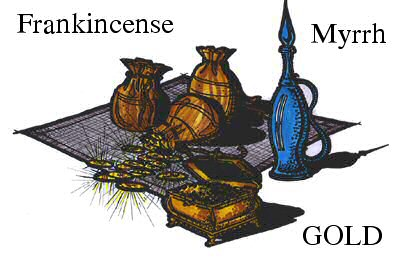
When the Magi came to Bethlehem in search of “he that is born King of the Jews” (Matt. 2:2), they brought with them three very rare and valuable gifts: gold, frankincense, and myrrh. They were not random gifts, but ones with specific political, spiritual, and practical importance; they were meant to recognize a literal, earthly, but also heavenly King.

gold frankincense and myrrhGold was a universally recognized precious metal, symbolic of all wealth. Frankincense was a substance primarily used as incense, but also mixed with other substances to create the holy anointing oil placed on high priests and kings. Myrrh was a substance used for things ranging all the way from cosmetics and antiseptics, to perfuming the living and embalming the dead.

According to Matthew 2:11, the Magi fell down before Jesus, which would have been an appropriate response when in the presence of royalty (and these men knew the difference). But the wise men did more than fall prostrate before royalty, they “worshiped him.”  This young king was more than just “King of the Jews,” but the long-promised Messiah, and they offered their gift to the Son of God.

Are You Wise?

As long as I can remember there have been sermons preached during and before Christmas entitled, “Wise Men Still Seek Him.” The sermons focus primarily on the seeking leading up to Christmas, but rarely, if ever, on the gifts given after the celebration is over. But today is different.

Today, I am going to ask you to consider three gifts we should give, now that the birthday celebration is over.

  • Gold. Gold represented wealth. In your worship of the King, will you give Him your wealth? In reality, God owns everything, including everything He loans unto you. But with your heart, are you willing to lay everything that is most valuable to you at His feet?
  • Frankincense. Frankincense represented worship. Would you be willing to fall down before Jesus, or do you hold back some of your Frankincense in reserve? Are there idols in your life – people or things – for which you reserve a little of that anointing oil, making those things lords of your life? Would you be willing to make Jesus Lord of all? Will you worship him without reservation?
  • Myrrh. Myrrh was symbolic of the beauty of life, from beginning to end. Would you give to Jesus everything that makes you happy? Everything that brings you hope? Everything that is sweet-smelling? Everything that hides your faults and failures, disguising your true self? Would you give Jesus your life? He can do more with it than you can do on your own.

Returns

For several days after Christmas people will stand in line to return and/or exchange unwanted gifts. Many will trade what others gave them for something they want more. Others will just ask for a refund or in-store credit.

Rest assured that when you give your gifts to Jesus, he will not return them, exchange them, or re-gift them next year. But will you, once you realize what you’ve given, want to take something back?

Don’t wait for a New Year’s resolution. Now that Christmas is over, be like the Magi and leave everything at Jesus’ feet, then “depart…another way.” Once you give Jesus those three gifts, you’ll never be the same.

2 Comments

Filed under Christian Living, Christmas, God, Love of God, salvation, wisdom, worship