Yesterday morning at Riverside I preached a sermon entitled “The Hands of God.” I would like to give the basic outline, along with an edited version of the recording sent to the radio. The recording was made before Sunday, but the message was essentially the same.
There are several things about the hands of God worth noting.
They Created Man (Gen. 2:7). As much as we would like to think that we are self-made, there is a Hand that formed us from the dust of the earth. We are not like the rest of creation which was simply spoken into existence; we were fashioned by the loving, artistic hand of the Creator, and His fingerprints are all over us.
They Contain the Believer (John 10:27-29). The believer should never worry about his salvation. He should never worry about being stolen away. Thank God that we are in His hand, and nothing, not even ourselves, can remove us from His omnipotent protection.
They Chastise the Child (Prov. 3:12; 13:24; 22:15; 19:18; Deut. 8:5; Rev. 3:19). God is not a Father who encourages “time outs;” He knows how to apply loving discipline to our seats of instruction. If more parents would worry less about the world’s wisdom and suggestions and follow the wise instruction of Scripture, we might not have as many entitlement-claiming, over-grown bratty children running the streets demanding their own way.
They Carry the Broken (Isa. 40:11). Praise the Lord for His mercy and love! As the gentle shepherd who must sometimes break the leg of the wandering lamb, God must discipline us. However, it is then that He carries us close to his bosom where we learn to love being in His presence.
They Catch the Stumbler (Psa. 37:23-24). There are times when we stumble, but because He is holding our hand, we will not “utterly” fall.
As Jonathan Edwards preached in 1741, it is a “fearful thing to fall into the hands of an angry God.” But as a child of God, there is no better place to be. David said, even after he had sinned, “Let me fall into the hand of the Lord…” (1 Chron. 21:13). He knew the truth that brought comfort, a comfort the world does not know, “The LORD will not cast off his people…” (Psa. 94:14).
One of the greatest hymns, at least one of my favorites, is “My Jesus, I Love Thee.” This past Sunday morning I preached a sermon based on the four verses from this song.
Below is a copy of the simple outline I took to the pulpit. I must admit, it got me a little wound up. (Can I get an “Amen!“)
“My Jesus I Love Thee”
My Jesus, I love Thee, I know Thou art mine; (Jn 21:15-17) For Thee all the follies of sin I resign; (2 Tim. 2:19) My gracious Redeemer, my Savior art Thou; (Ruth 2:10) If ever I loved Thee, my Jesus, ’tis now. (The Place of Regeneration)
I love Thee because Thou hast first loved me, (1 John 4:19) And purchased my pardon on Calvary’s tree; (1 Peter 1:18-19) I love Thee for wearing the thorns on Thy brow; (Mt 27, Mk 15, Jn 19:2) If ever I loved Thee, my Jesus, ’tis now. (The Place of Realization)
I’ll love Thee in life, I will love Thee in death, (Job 13:15) And praise Thee as long as Thou lendest me breath; (Job 33:4) And say when the death dew lies cold on my brow, (Ps. 116:15) If ever I loved Thee, my Jesus, ’tis now. (The Place of Resignation)
In mansions of glory and endless delight, (Jn 14:2) I’ll ever adore Thee in heaven so bright; (Rev 21:23) I’ll sing with the glittering crown on my brow, (2 Tim 4:8) If ever I loved Thee, my Jesus, ’tis now. (The Place of Revelation)
-William Ralph Featherstone (1864)
Regeneration. As I read the lyrics, I began to see a logical progression through the believer’s life. First, there was the love for Jesus that comes when one is born again – that moment of regeneration, when one is “saved.” The love we have for Christ is evident by our desire to repent of our sin and turn from its “follies.” Along with that there’s the humble heart that asks, as Ruth, “Why have I found grace in thine eyes, that thou shouldest take knowledge of me?”
Realization. The second verse describes a maturing love for our Lord that, over time, gains an appreciation for what Christ actually did to save us. Our love deepens when we begin to realize all those little sins, even the most petty, caused the sinless Son of God to have to endure unimaginable pain and humiliation, not out of obligation, but because of His love for us. His cross should have been mine, but He loved me first; therefore, I love Him.
Resignation. Thirdly, there’s that place in life when we must ultimately resign everything – our hopes, our dreams, our lives – to the One who ultimately lends us each breath. This deep, trusting love comes from a life that has witnessed the enduring faithfulness of our Savior, leading us to echo the words of Job, “though He slay me, yet will I trust Him.”
Revelation. Then, finally, there will be the place of revelation that will send our love for Christ soaring to infinite heights. We will know as we are known. We will have no more need of faith, for faith shall become sight. We will be eternally overwhelmed by the Love of the ages, forcing us to cry out, “If ever I loved thee, my Jesus tis now!”
On Sunday afternoon, just after church, our youth staged a spectacular Valentine’s Day banquet in our gym. It was essentially a fundraiser for an upcoming trip to Ridgecrest (North Carolina). All the youth worked as servers.
The program featured a meal, complete with dessert, live entertainment, and our twist on an old television game show; it was called TheOldywedGame.
The Oldywed Game
Here is a picture of the game in progress. Three couples from our church graciously accepted the offer to ruthlessly compete against each other, all for the satisfaction of winning a box of chocolates. The losers got three free appointments for marriage counselling.
Thankfully, the banquet/fundraiser was a huge success. However, for me the highlight was hosting the Oldywed game (oh, and I made the set they sat behind…yes, I’m talented). My comedic talents were brilliantly put to use, of course.
Old Standards
Now, there were a lot of people who worked feverishly to put the banquet together, but my youngest, Haley, must have stressed for months over the music selection. You see, she wanted to have standards from Bing Crosby, Dean Martin, Frank Sinatra, and others playing in the background. It took her a while, but she found more than enough, and all of it sounded great.
One song caught my attention. Dean Martin sang, “You’re nobody till somebody loves you, so find you somebody to love.” That’s when my mind flashed back to 1 Corinthians 13 (the love chapter).
“And though I have the gift of prophecy, and understand all mysteries and all knowledge, and though I have all faith, so that I could remove mountains, but have not love, I am nothing.” – 1 Corinthians 13:2 NKJV
Be Somebody
I don’t know if the songwriter knew of 1 Corinthians 13:2, but he hit on a profound truth: without love, we are nothing. As the apostle Paul made perfectly clear in this chapter, it doesn’t matter how much you know, how much you give, how spiritual you think you are, or how talented you may be; if you don’t have love for others, it’s all worthless – you’re a nobody.
There is an age-old truth most wise people know: if you want to be loved, show love. But it’s not just any ol’ love, you understand. As Christians, we are to love for Jesus’ sake, without expectation, just like He loved us. Because of His love, we love Him (1 John 4:19).
So, if you want to really be “somebody,” it would seem you need to love others. If you’re “nobody till somebody loves you,” then go find somebody to love. The world’s full of people in need of just that.
If hearing my Southern accent and pronouncification of words makes me sound illiterate or grates your nerves, then by all means skip the attached audio. On the other hand, if hearing my Southern accent reminds you of heavenly manna for the ear, click the link and be fed.
Seriously, I know what it’s like to listen to someones’s voice, someone whom you’ve read, only to be disappointed by hear. Reading my posts may have given you the idea that I sound like Charlton Heston, and if that’s the case, the you will certainly be disappointed. But if by reading my posts you have come to the conclusion I may sound like Pee Wee Herman, then you’ll be amazed – I actually sound more like Dave Ramsey (the financial guy).
Today, as I have done several times in the past, I am going to share with you the sermon that will air this Sunday on a local AM radio station. You get to hear it before everyone else does!
This recording was made in my study using a large diaphragm microphone and a digital Tascam 8-track recorder. I then edited it on my computer with Audacity, a free audio editing program. The process takes longer than recording on my iPhone, but the end product sounds better.
Also, on this recording I include a song from the Sonlife Quartet, a group I played bass with back in the late 90’s.
“And when they were come into the house, they saw the young child with Mary his mother, and fell down, and worshiped him: and when they had opened their treasures, they presented unto him gifts; gold, and frankincense, and myrrh.” – Matthew 2:11
Late-Comers
Part of the Christmas story can be found in the book of Matthew, the first book in the New Testament. There, in chapter two, we read of several wise men, Magi, who followed the star till it rested over the place where the young Jesus was living.
But what most people fail to notice is that only the shepherds came to visit Jesus while he was still a baby in a manger. The Magi came later, once they were living “in the house” and Jesus was a “young child.” And, based on Herod’s decree that all male children 2 years old and younger should be killed (Matt. 2:16), Jesus could have been a toddler up and walking.
Simply put, generally ever manger scene protested against by atheists is not a faithful representation of the Christmas story. How ironic is that? But I digress…
The Gifts
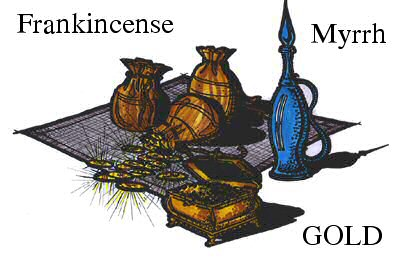
When the Magi came to Bethlehem in search of “he that is born King of the Jews” (Matt. 2:2), they brought with them three very rare and valuable gifts: gold, frankincense, and myrrh. They were not random gifts, but ones with specific political, spiritual, and practical importance; they were meant to recognize a literal, earthly, but also heavenly King.
Gold was a universally recognized precious metal, symbolic of all wealth. Frankincense was a substance primarily used as incense, but also mixed with other substances to create the holy anointing oil placed on high priests and kings. Myrrh was a substance used for things ranging all the way from cosmetics and antiseptics, to perfuming the living and embalming the dead.
According to Matthew 2:11, the Magi fell down before Jesus, which would have been an appropriate response when in the presence of royalty (and these men knew the difference). But the wise men did more than fall prostrate before royalty, they “worshiped him.” This young king was more than just “King of the Jews,” but the long-promised Messiah, and they offered their gift to the Son of God.
Are You Wise?
As long as I can remember there have been sermons preached during and before Christmas entitled, “Wise Men Still Seek Him.” The sermons focus primarily on the seeking leading up to Christmas, but rarely, if ever, on the gifts given after the celebration is over. But today is different.
Today, I am going to ask you to consider three gifts we should give, now that the birthday celebration is over.
Gold. Gold represented wealth. In your worship of the King, will you give Him your wealth? In reality, God owns everything, including everything He loans unto you. But with your heart, are you willing to lay everything that is most valuable to you at His feet?
Frankincense. Frankincense represented worship. Would you be willing to fall down before Jesus, or do you hold back some of your Frankincense in reserve? Are there idols in your life – people or things – for which you reserve a little of that anointing oil, making those things lords of your life? Would you be willing to make Jesus Lord of all? Will you worship him without reservation?
Myrrh. Myrrh was symbolic of the beauty of life, from beginning to end. Would you give to Jesus everything that makes you happy? Everything that brings you hope? Everything that is sweet-smelling? Everything that hides your faults and failures, disguising your true self? Would you give Jesus your life? He can do more with it than you can do on your own.
Returns
For several days after Christmas people will stand in line to return and/or exchange unwanted gifts. Many will trade what others gave them for something they want more. Others will just ask for a refund or in-store credit.
Rest assured that when you give your gifts to Jesus, he will not return them, exchange them, or re-gift them next year. But will you, once you realize what you’ve given, want to take something back?
Don’t wait for a New Year’s resolution. Now that Christmas is over, be like the Magi and leave everything at Jesus’ feet, then “depart…another way.” Once you give Jesus those three gifts, you’ll never be the same.
Dear Friends, I don’t want to burst any bubbles or shatter any Christmas ornaments, but Christmas, at least the meaning of Christmas, might not be what you think it is. At least I know this, it is not what the President of the United States’ speech at the 2013 lighting of the National Christmas Tree made it out to be.
Why do I make such a bold and controversial statement? I say it because the message of Christmas is too important to have pluralists, universalists, and atheists redefine it – even if they occupy the White House.
Below is an excerpt from President Obama’s December 6th speech at the lighting of the National Christmas Tree. Please read it, then my comments.
Each Christmas, we celebrate the birth of a child who came into the world with only a stable’s roof to shelter Him. But through a life of humility and the ultimate sacrifice, a life guided by faith and kindness towards others, Christ assumed a mighty voice, teaching us lessons of compassion and charity that have lasted more than two millennia. He ministered to the poor. He embraced the outcast. He healed the sick. And in Him we see a living example of scripture that we ought to love others not only through our words, but also through our deeds.
It’s a message both timeless and universal — no matter what God you pray to, or if you pray to none at all — we all have a responsibility to ourselves and to each other to make a difference that is real and lasting. We are our brother’s keeper. We are our sister’s keeper.
When I recently shared my thoughts about this on Facebook, a friend of mine responded with the following words: “[The] president is simply making an appeal to shared values– that even if you don’t believe in God, that you still have the responsibility to make a positive influence in the lives of others– which is exactly what Jesus did.” Oh, I completely understand the reason why a national leader would want to make a universal appeal to “shared values” and the “responsibility to make a positive influence.” However, just for comparison’s sake, listen to what former President Ronald Reagan had to say.
Why don’t we look at the things Obama said about Christmas? Let’s see if we can square what he said with Scripture and try to determine if the President clearly defined the TRUE meaning of Christ’s birth – the “message” of Christmas.
“Each Christmas, we celebrate the birth of a child…” I know this may sound like grasping at straws, but Christmas is not about celebrating “a” child’s birth; it is about celebrating the birth of THE child of whom the prophets foretold…God in flesh, Emmanuel (Matthew 1:23).
“For unto us a child is born, unto us a son is given: and the government shall be upon his shoulder: and his name shall be called Wonderful, Counsellor, The mighty God, The everlasting Father, The Prince of Peace.” – Isaiah 9:6 KJV
“Christ assumed a mighty voice…”Christ did more than “assume a mighty voice” as a result of his life of humility, sacrifice, and kindness; Jesus did what he did to prove he was not only the Voice, but the literal Word of God made flesh.
“And the Word was made flesh, and dwelt among us, (and we beheld his glory, the glory as of the only begotten of the Father,) full of grace and truth.” – John 1:14
“He ministered to the poor. He embraced the outcast. He healed the sick. And in Him we see a living example of scripture that we ought to love others not only through our words, but also through our deeds.” Yes, Virginia, there is a Jesus, and He did do all of these things. But why? A social gospel is wonderful, except when it leaves out the fact that Jesus did good works to fulfill Scripture (see Isaiah 61:1-2).
“The Spirit of the Lord is upon me, because he hath anointed me to preach the gospel to the poor; he hath sent me to heal the brokenhearted, to preach deliverance to the captives, and recovering of sight to the blind, to set at liberty them that are bruised, To preach the acceptable year of the Lord.” – Luke 4:18-19
“It’s a message both timeless and universal…” This is where we get into some serious, pluralistic territory. What, exactly, is the “message” that is “timeless and universal”? Obama said “It’s” a message. What’s a message? The birth and life of Christ? Christmas?
I will agree with Mr. Obama on this one thing, that is certainly our responsibility “to ourselves and to each other to make a difference that is real and lasting.” The fact that we are our brothers’ and sisters’ keepers is most certainly a “timeless and universal” message, regardless whether or not we are pagans or atheists. But is this the message of Christmas? Is caring for others the message of Christmas? Simply put, no. It’s so much more than that.
The reason we celebrate Christmas with generosity, usually expressed with the giving of gifts, is because on that morning of which the angels sang (Luke 2) the most extravagant gift ever bestowed upon mankind was delivered, wrapped in the same cloth used to coddle newly-born sacrificial lambs, and laid in a manger. It was the Gift of God to desperate souls. THIS is the reason why we should “love one another.”
“In this was manifested the love of God toward us, because that God sent his only begotten Son into the world, that we might live through him. Herein is love, not that we loved God, but that he loved us, and sent his Son to be the propitiation for our sins. Beloved, if God so loved us, we ought also to love one another.” – 1 John 4:9-11
In Luke 19:10 Jesus stated that the whole reason he came was not to set an example, be a good role model, or even start a religion…he came to save sinful men and women, boys and girls.
“And Jesus said unto him, This day is salvation come to this house, forsomuch as he also is a son of Abraham. For the Son of man is come to seek and to save that which was lost.” – Luke 19:9-10
Truly, the real message is meant for all, for God so loved the world (John 3:16). So, if President Obama wants to call that “universal,” then so be it. But the message of Christ coming to save the lost is NOT “one of many ways to God,” or one of many ways to unite the brotherhood of man. No, the message of Christmas is that Jesus came because there was no other way. The message of Christmas is exclusive to the core (which is the real reason why so many want all vestiges of it removed from public life).
“Jesus saith unto him, I am the way, the truth, and the life: no man cometh unto the Father, but by me.” – John 14:6
“Neither is there salvation in any other: for there is none other name under heaven given among men, whereby we must be saved.” – Acts 4:12
America is a nation that accepts people from all walks of life and from every religious background. With rare exception, Lady Liberty will turn no one away (the Department of Immigration is another story). So, the “spirit of Christmas,” that common feeling of generosity and good will we all enjoy this time of year, should be a blessing enjoyed by all. But let us be careful, Mr. President, when we define the Reason for the season as anything other than what the Scripture says.
The following is from a study I did for my other blog, Proverbial Thought. Going into this weekend, knowing some difficulties my family is going to have to face (a prayer for provision would be appreciated), I really needed to be reminded of the goodness of God. Maybe you do, too.
Also, I just finished re-preaching a sermon I preached last night for the radio. The title of the message is “Praying for Those with Disease.” I needed it…we all need it. I hope it can be blessing to you.
“Praying for Those with Disease”
“Blessings are upon the head of the just: but violence covereth the mouth of the wicked.” – Proverbs 10:6 KJV
Nothing Stays
Have you ever heard the old adage, “Like water off a duck’s back?” The reason for that saying comes from the fact that ducks never get “wet,” just in the water (now that will preach!). You see, because of the oil in a duck’s feathers, the duck can be in the water, have water poured over it, etc., but never actually get wet. The water doesn’t soak in, but runs off.
My head is similar to a duck’s back. There is nothing on my head to make anything stay put. Everything just runs off, down my neck, and under my shirt, especially when it rains. The upside is that I never have to dry my hair when I get out of the shower.
Except Blessings
But the awesome thing is that no matter how slick my bald head is, God is able to heap blessing after blessing on top of it. My glasses won’t stay put; hats get blown off; I cant wear flowers; but the Lord can pile blessings as high as He wants. How is that? Must be a God thing.
I don’t deserve blessings. I don’t deserve anything from God. If you only knew me like I know me, you’d wonder how any blessing would stay on my head. Yet, my Lord is merciful. He is able to do what man and water can’t.
The Wicked
The mouth of the wicked, on the other hand, is covered up with violence. What that means exactly is debatable, but the idea implied is that one usually gets what he deserves. The wicked can be compared to a swimmer in wool clothing and a wool coat. When he gets in the water, he’s sunk.
In General
Generally speaking, this proverb tells us that there are consequences for our actions. The way we live will come back either to bless or haunt us. Right living brings peace, while wicked living never ends well.
Do you want to be thought well of? Live justly. Do you want to reap the rewards of righteousness? Live right. Otherwise, even though there may be some temporary benefits to living like the Devil, the end result of wickedness will have you covering your mouth in shame.
A Prayer
Jesus, even though I am not worthy, thank you for your blessings. My righteousness is in you. I am only “just” because “the just shall live by faith.” Thank you for your mercy, for when I was yet wicked, you saved me, cleansed me, and put a crown on my head. You are my glory, and I will praise you for your immeasurable goodness to me.
I hate it when someone tells me that they are listening to me, but then do other things while I am talking. For example, when I talk to my wife, I prefer that she put down the phone, the dishes, the laundry, and quit sending emails and texts when I have something important to tell her (notice I used the word “and,” not “or” in the list of things she does). Call me selfish, but it is important to me that I know someone is listening when she says she is.
The reasoning for this preference of mine became embarrassingly evident last night at Taco Bell. My wife said she was listening to me, but only partly so. I will now share with you how I know this to be true.
The Subject
Yesterday (Sunday) morning I preached a sermon drawn from John 3:16. It was a powerful message stressing the grace of a loving God who would give His One and Only Son, Jesus, as a ransom for our souls. It was a message that also stressed, among other things, the uniqueness of Jesus Christ. Therefore, part of the sermon dealt the Greek word monogenēs (translated “only begotten”).
So, last night, after church and choir practice, my family and a friend went to Taco Bell for a late night gut bomb. As we sat there in the restaurant, my wife asked me to go back over some of the things I shared regarding the King James word “only begotten.” As I began to do so, I noticed she was only half-listening as she tried to maintain another conversation with our two daughters sitting with us.
I shared how that it was unfortunate for so many KJV-only-ers to come down harshly on other translations that change “only begotten Son” to “One and Only Son.” Many claim that the change is an attempt to pervert Scripture; to deny the divinity of Jesus. Yet, what many don’t understand is that the word “begotten” is not the best word that could be chosen to support the very biblical doctrine of the Trinity.
“Only-Begotten”
The King James Study Bible’s notes on John 3:16 explain monogenēs (translated “only begotten”) in the following way (note the highlighted parts):
The Greek word monogenēs is used by John to convey only the unique relationship between God the Father and Jesus as the Son of the Father. It serves to distinguish Christ as the only Son of God, in contrast with the many children of God. The uniqueness of this relationship is further emphasized by the fact that we become the children of God whereas Jesus always was the Son of God.[1]
Note, nothing is said about why the word “begotten” was used in the first place, nor what the definition of monogenēs actually is. According to sources such as A Concise Greek-English Dictionary of the New Testament, the Louw-Nida Greek Lexicon, the LexhamAnalytical Lexicon to the Septuagint, and the Greek Lexicon of the Septuagint, the word translated “only-begotten” actually means “unique,” “only,” and “the only member of a kin, only-begotten, only (of children) Jgs 11,34; id. (of God) Od 14,13; alone in its kind, one only.”[2]
So, even though “only-begotten” can be used to translate monogenēs, it is obvious that the actual theological meaning implied is that Jesus is the One and Only, totally unique, never created, always God, Son of God – the Word made flesh. Therefore, in my opinion, it is unnecessary for KJV-onlyists to condemn the translating of monogenēs into language that more accurately reflects the theology they are actually trying to preserve.
I find the following selection from Eardmans Bible Dictionary very interesting…
The KJV translation of Gk. monogenḗs “only, unique, one of a kind,” used (following Vulg. Lat. unigenitus) with reference to both Jesus Christ (John 1:14, 18; 3:16, 18; 1 John 4:9) and Issac (Heb. 11:17). Most other translations consistently read “only,” while the NIV translates “the one and only” with regard to Jesus. In English “only begotten” implies a created being, an implication not conveyed by the Greek term (cf. Luke 7:12; 8:42; 9:38).[3]
As I explained to my wife and a friend, there is nothing wrong with changing a word to better reflect the actual meaning, especially when the modern understanding of the word being used tends to give credence to an un-biblical, heretical theology!! Consider the following section (especially the bolded parts) from Baker Encyclopedia of the Bible…
The phrase “only-begotten” is not an accurate translation and should not be used in any of the nine passages. This phrase is derived from the Latin Vulgate (a translation of the Bible from about the 5th century which has been quite influential on other translations) and reflects certain theological debates about the person of Christ. …Ultimately the phrase “begotten not made” leads to what theologians call the doctrine of the eternal generation of the Son. …“Only-begotten” is an incorrect translation. The idea being stressed is the uniqueness of Jesus’ relation to the Father.[4]
The irony is that I am the one who will be slammed and denigrated as a liberal “operative of Satan” who wants to change the Truth of Scripture. In the meantime, I am doing nothing but trying to “take heed unto…thy doctrine” (1 Timothy 4:16).
The Punchline
So, sitting in Taco Bell, I talked with my friend about monogenēs, at one point breaking down the word into its two parts, “mono” and “genes.” Unfortunately, sometime in the conversation I made a slip and mixed my words, saying “homogenes” (as in homogeneous). When I looked at my wife and asked, “Are you even listening?” She loudly, where everyone in the whole stinking place could hear her…
“HOMO! I got it! I GOT the HOMO!”
Here’s a lesson: if Greek bores you, keep silent about it in public places.
[1]King James Version Study Bible ., electronic ed. (Nashville: Thomas Nelson, 1997).
[2] Johan Lust, Erik Eynikel, and Katrin Hauspie, A Greek-English Lexicon of the Septuagint : Revised Edition (Deutsche Bibelgesellschaft: Stuttgart, 2003).
[3] Allen C. Myers, The Eerdmans Bible Dictionary (Grand Rapids, MI: Eerdmans, 1987), 782.
[4] Walter A. Elwell and Barry J. Beitzel, Baker Encyclopedia of the Bible (Grand Rapids, MI: Baker Book House, 1988), 1590.
I know that the title may come as a shock to many of you, but don’t be too shocked, at least not yet. I have been talking about men and women flirting over the last couple of days, but as I told you, there was a method to my madness.
You might be saying, “And if you say God is a flirt, then you are truly mad, you crazy fool!” But please, hear me (or read me) out. “Flirting” might not be the best word, but what about “wooing”? If not a flirting God, surely He woos us all the time.
Background
Now, just in case you think I am crazy, let me share with you one of my favorite verses from one of my favorite books in the Bible, Hosea.
“I drew them with cords of a man, with bands of love: and I was to them as they that take off the yoke on their jaws, and I laid meat unto them.” – Hosea 11:4 KJV
With metaphor God explains to the prophet Hosea how He has gone the extra mile to win over His people’s love. That, after all, is the message portrayed by Hosea’s pursuit of Gomer (that’s his wife’s name) as she runs from lover to lover. God would much rather win our love than divorce (judge) us.
When I think of the first part of that verse, the words “cords of a man” become “heart strings.” In other words, in order to win our affections, God is doing everything He can to “pull our strings,” or at least the emotional strings of our hearts. Cool, huh?
Signs of Wooing
As with the last two posts, I’d like to consider some ways in which God might “flirt” with us. In other words, God might be wooing you if…
You wake up earlier than you wanted, but see the most beautiful sunrise of your life.
You decide to give up on life, only to have an email pop up showing someone worse off than you.
It seems that there is no meaning in life, but then you hear a baby cry, or your child says, “I wuv you.”
In the dark, late at night, you find yourself crying, but a warmth you can’t explain wraps around you, cradling you to sleep.
You find yourself feeling like a failure, worthless and dirty, then from out of nowhere comes a verse you learned in Sunday School: “For God so loved the world, that He gave his only begotten Son…”
Do I need to go on? Is He pulling the strings of your heart? Will you respond to His advances?
On Friday and Saturday many observed Yom Kippur (Day of Atonement). “For devout Jews,” said a Fox News article, “Yom Kippur is the most solemn day on the calendar where according to tradition, God weighs people’s deeds and decides their fate for the next year.” (italics added)
However, I am thankful that Jesus fulfilled Isaiah 53, bore the cross that should have been mine, and decided my fate for eternity.
“And, having made peace through the blood of his cross, by him to reconcile all things unto himself; by him, [I say], whether [they be] things in earth, or things in heaven. And you, that were sometime alienated and enemies in [your] mind by wicked works, yet now hath he reconciled In the body of his flesh through death, to present you holy and unblameable and unreproveable in his sight…” Colossians 1:20-22 KJV
A Missionary’s List
Many years ago Rosalind Goforth (1864-1942) was a missionary to China who battled feelings of guilt. Even though she faithfully served the Lord, along with her husband, Jonathan, she always “felt guilty and dirty, nursing an inward sense of spiritual failure.” That is when she compiled this list of seventeen truths: What God Does with Our Sins.
What God Does with Our Sins
1. He lays them on his Son—Jesus Christ. Isaiah 53:6
2. Christ takes them away. John 1:29
3. They are removed an immeasurable distance—as far as East is from West. Psalm 123:12
4. When sought for, they are not found. Jeremiah 50:20
5. The Lord forgives them. Ephesians 1:7
6. He cleanses them ALL away by the blood of his son. 1 John 1:7
7. He cleanses them as white as snow or wool. Isaiah 1:18; Psalm 51:7
8. He abundantly pardons them. Isaiah 55:7
9. He tramples them under foot. Micah 7:19 (RV)
10. He remembers them no more. Hebrews 10:17
11. He casts them behind his back. Isaiah 38:17
12. He casts them into the depths of the sea. Micah 7:19
13. He will not impute us with sins. Romans 4:8
14. He covers them. Romans 4:7
15. He blots them out. Isaiah 43:25
16. He blots them out as a thick cloud. Isaiah 44:22
17. He blots out even the proof against us, nailing it to His Son’s Cross. Colossians 2:14[1]
“What can wash away my sin? Nothing but the blood of Jesus!”
[1] Robert J. Morgan, Nelson’s Complete Book of Stories, Illustrations, and Quotes, electronic ed. (Nashville: Thomas Nelson Publishers, 2000), 364–365.

 Yesterday morning at Riverside I preached a sermon entitled “The Hands of God.” I would like to give the basic outline, along with an edited version of the recording sent to the radio. The recording was made before Sunday, but the message was essentially the same.






 The Recovering Legalist