
So, what are you REALLY saying, Blake?
So, what are you REALLY saying, Blake?
Filed under General Observations, Life/Death, music
Today, I watched a man die, and I’m happy.
At this point you’re thinking: “Who in his right mind would admit to being happy he saw a man die?” Well, without the proper context, only a sick man, that’s for sure!
But here’s the context: I was with a family from my church as a 51 year-old son, father, brother, and grandfather breathed his last breath, and I was able to rejoice with them in the hope of Jesus Christ.

Joey and his dog, Willie
Several months ago, I was able to talk with Joey Armor for the first time. He was sitting on the tailgate of his truck, taking a break from welding. As we got to talking, he apologized for not coming to church more often, but he appreciated that I was the new pastor, and he hoped to become more regular. He also told me how sick he was.
Joey had battled with a lot of health issues over the last few years, and at that point he was not doing bad enough to keep him in bed. As a matter of fact, he was the type of person that not only avoided pain medication as long as possible; he never wanted to stop being active doing something, even if only a little welding here and there. The day I first talked with him, he was having a hard time breathing, but he was happy to be doing something he enjoyed.
The next few times I saw Joey Armor was in the hospital. It seemed that his body all of a sudden decided to give up, even though he was not willing to. The doctors had hope that he would recover, and for a little while it looked like he would, but it wasn’t long before things began to look dire.
The last few times I saw Brother Joey was when he was at home, a couple of times sitting in his recliner, a couple of times in his bed. On one occasion, I felt compelled to lead Joey through the plan of salvation. Because I had never seen him make a profession of faith, and since I could tell he was nervous about dying, I had to make sure he had an opportunity to accept Christ as his Savior.
Come to find out, Joey had indeed put his faith in Jesus, but he had come to the point where he was scared of what was to come. He had made some mistakes, not been perfect, and now he was facing death head-on. He needed to be reassured God did indeed love him and was faithful, as He always is, even when we are not.
Another time I took a communion kit, and with a deacon from our church I shared with him the elements and together rejoiced in the goodness of our Savior! We talked about Christ’s body and His blood, how each was given for us, and how by taking part in communion we proclaim his death until he comes (1 Cor. 11:24). Even though he could barely swallow anything (he even had a feeding tube inserted into his abdomen), he took the little piece of matzoh and the tiny cup of grape juice and consumed them both. It was a special moment, indeed.
The last time I saw him before today, the Holy Spirit had placed in my heart the urgent desire to go talk with him about Heaven. Joey new he was going, and he knew it wouldn’t be that long. So, I wanted to go by and encourage him with the facts about the place he was about to see. He asked for his large-print Bible so he could read along with me.
First, I turned to John chapter fourteen:
“Let not your heart be troubled: ye believe in God, believe also in me. In my Father’s house are many mansions: if [it were] not [so], I would have told you. I go to prepare a place for you. And if I go and prepare a place for you, I will come again, and receive you unto myself; that where I am, [there] ye may be also.” – John 14:1-3
These verses deserved a little amplification, and I knew Joey would appreciate it. I focused on the words “mansions” and “place.” Jesus wasn’t telling Peter he would have a four-story house of gold in Heaven; Jesus was telling him not to worry, for even though he’d mess up by soon denying Him, there was already a place in His Father’s house prepared – a room of his own! Compared to here, that room might be a mansion. But how much more wonderful is the promise that God wants us to live in HIS house with HIM forever??
And when it came to the word “place” (τόπος tópos), heaven is more than spirits floating on clouds; it is more than a feeling; it is more than being absorbed into the infinite: Jesus said it is a PLACE! I said, “Just like Chicago or Atlanta, Heaven is a place just like any place on a map down here. It is a place, and you are going there!”
Next, I turned – we turned – to Revelation 21 and 22. There, within the verses of those chapters we read of a holy city, a heavenly city, that God has prepared for those whose name is written in the Lamb’s Book of Life. Joey listen as I read, awake, but with his eyes closed, resting.
I said, “Well, Joey, I guess it’s about time we get out of here and let you rest.” He nodded.
Then, with weak voice and a slight smile, Joey said,
“I’m looking forward to seeing what my Father has for me.”
Today, around 12 p.m., my brother in Christ, Joey Armor, exhaled one last time, only to inhale for the very first time the celestial air of his new home.
I am glad his family was able to be there. I’m glad I got to see him off.
He’s seeing what his Father has prepared for him, and even more importantly, he’s hugging Jesus.
“O death, where is thy sting? O grave, where is thy victory? The sting of death is sin; and the strength of sin is the law. But thanks be to God, which giveth us the victory through our Lord Jesus Christ.” – 1 Corinthians 15:55-57
Filed under Christianity, Faith, Family, General Observations, Life/Death, salvation
“Now the God of peace be with you all. Amen.” – Romans 15:33
Filed under Christianity, Faith, grace, iPosts, Life/Death, salvation
I can still see that green Datsun station wagon my dad used to drive. It was a beat up, light-metallic green B210, I believe. I don’t remember what year model. But it had tan cloth seat covers and a 5-speed, and you couldn’t kill it.
One day, when for whatever reason my own car wasn’t running, my dad got up early (or stayed up late – he worked 3rd shift) and waited in a gravel parking lot just outside of the building where I was attending a class at the University of Tennessee at Chattanooga. It was 1991.
I walked up to the car, opened the passenger-side door, and there was my dad … blue work pants, a light-colored shirt, jacket, and ball cap … sitting with the seat leaned slightly back, bill of his cap resting over his eyes, listening to someone on the radio (WGOW, 1150AM).
That person was Rush Limbaugh.
In June of 1991 my dad died of a heart attack at age 46. There were no goodbyes, see-you-laters, or even warnings; he was just gone. It’s a whole other story, but the last words I ever heard him speak to me, or anyone, were, “Boy! I don’t EVER want to see you do that again! (slight pause) But that was a good burnout.” I then pulled away in my blue ’77 280z and never saw him alive again.
Wow, this is painful to write.
Sometime later, maybe in June, maybe a little after, I was scrolling through stations on the radio (why on AM radio, I don’t know), and heard the voice of Rush Limbaugh once again. I wasn’t much into politics at that time, so the subject matter didn’t catch my attention. It was just the voice, the one my dad was listening to, that made me stop turning the dial.
From that day until now, some 29 years later, I’ve been a faithful listener (whenever I could) to Rush Limbaugh, the most influential conservative radio personality in history. What’s more, with my father no longer in my life, tuning in to Rush each week day from noon till 3 was like having my dad in the car beside me. In a way, Rush Limbaugh (flaws and all) became a surrogate father figure to me.
Here I am, sitting in my office at the church, struggling with some deep-seated emotions. My chest is heavy. I sorta feel a burning in my eyes, but no tears have swelled to cool them. A little while ago my wife called my on my cell phone and started off with the following words: “I don’t want to ruin your day, but…”
I have lived long enough to know that when my wife says something like that it usually has something to do with the kids or a bill that didn’t get paid. I literally had no way to be prepared for what she said next.
“Rush Limbaugh just announced that he has advanced lung cancer.”
That loneliness when my daddy died … that feeling that sucker punched me in the gut when my mother, tears in her eyes, greeted me at the hospital with a clear plastic baggie full of my father’s final effects and said, “This is all I have left” … yeah, that kind of feeling hit me all over again, except this time I’m a little more calloused, so it doesn’t hurt as bad.
I don’t know what you think about the man, but he needs your prayers. I’ve prayed for him for years, actually, hoping that one day there would be proof, some evidence of him becoming a follower of Christ. His brother, David Limbaugh, after all, is a solid and out-spoken Christian lawyer, apologist, and author. Maybe my prayers were answered, today.
This afternoon, in the last segment of the Rush Limbaugh Radio Program, Rush let everyone know what was going on. Thankfully, since I am not a premium subscriber to his website and not able to watch the video of the show, the video of the last hour of the show was made available on YouTube.
If you’ve never listened to Rush, take advantage of this and listen to the whole hour – you might be surprised at what you hear. But if you want to get straight to the announcement (including a cryptic admission of his personal faith), go to the 45:46 mark and start watching there.
God speed, Rush. I’m praying for you.
Filed under current events, Life/Death, politics, Prayer, Struggles and Trials
Have you ever heard of “hell, fire, and damnation preaching”? Or, maybe it should be spelled “hell-fire and damnation.” I don’t know. Either way, the meaning is pretty much the same: it’s hardcore, old-fashioned, pulpit-whacking, snot-slinging, hankey-waving, chandelier-swinging preaching that unleashes the fear of righteous judgment. Haaaymen!
 Well, that’s really not my style, for the most part. Believe me, I can do my fair share of pulpit banging, but I’m not the type to jump across the stage like the legendary evangelist Billy Sunday. I’m more like the picture of me in the sidebar of this blog; I usually keep both feet on the ground … usually.
That being said, what most people expect out of a Baptist preacher like me when preaching on the subject of Hell is the yelling, spitting, and pulpit banging associated with “hell, fire, and damnation,” not a heartfelt plea with a reasoned argument.
On the other hand, when pleading for the souls of those facing eternal damnation, shouldn’t a man have a right to get emotional?
Today (Sunday, 02/02/2020), I preached a sermon on Hell. The title of the sermon was “If Jesus Believed In Hell, So Should We.”
Many people refuse to accept Christianity because of the doctrine of hell. Just the thought of a place of eternal judgment has led some to walk away from the faith, even to judge God as immoral or evil. The thought of a literal Hell was so repugnant to Charles Darwin that he wrote the following:
“Beautiful as is the morality of the New Testament, it can be hardly denied that its perfection depends in part on the interpretation which we now put on metaphors and allegories.
But I was very unwilling to give up my belief… Thus disbelief crept over me at a very slow rate, but was at last complete. The rate was so slow that I felt no distress, and have never since doubted even for a single second that my conclusion was correct. I can indeed hardly see how anyone ought to wish Christianity to be true; for if so the plain language of the text seems to show that the men who do not believe, and this would include my Father, Brother and almost all of my friends, will be everlastingly punished.
And this is a damnable doctrine.”― Charles Darwin, The Autobiography of Charles Darwin, 1809–82
Then there was Bertrand Russell, the philosopher who could not accept Christianity, believe it or not, because of Jesus!
“There is one very serious defect to my mind in Christ’s moral character, and that is that He believed in hell. I do not myself feel that any person who is really profoundly humane can believe in everlasting punishment. Christ certainly as depicted in the Gospels did believe in everlasting punishment, and one does find repeatedly a vindictive fury against those people who would not listen to His preaching…” – Bertrand Russell, Why I am not a Christian, 1927
Yes, Jesus DID believe in a literal place where the condemned spend an eternity in torment. Shocking, isn’t it?
So, it only stands to reason that if Jesus – the Author and Finisher of our faith, the Word of God made flesh, the Way, the Truth, and the Life – believed and taught that there was a place called Hell, we should believe Him. Are you with me?
Therefore, even though I was in pain and taking meds for a broken and infected molar, and even though my tongue was hurting because I had severely bitten it on the same broken tooth, with all the passion and energy I could muster – but without jumping over anything – I preached what Jesus preached.
Hell is real, and you don’t want to go there.
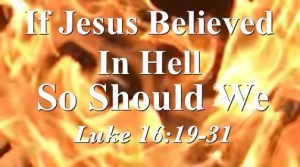
Click on the picture for a link to the sermon.
Feel free to share your thoughts.
Filed under Christianity, Future, Life/Death, Preaching, Theology
Just the other day I shared a post from Pastor Randy which generated a lot of response, some not so positive. Well, I guess I’m a sucker for punishment because I’m going to do it again.
I don’t want to give any spoilers, but I, too, have heard some seriously stupid answers to the question of “why?” when it comes to the death of children (I worked in a funeral home for several years). The “angel” and “He needed them” reasons were also sickening to me. Yet, some of my Calvinist friends have also attempted to give some pretty sad excuses (ask John Piper), but that’s another argument for another day.
Anyway, “be still and know that I am God” is in vinyl lettering (from Hobby Lobby) above the mantle in our dining room.

I thought this Tuesday Thoughts edition was going to take a while to figure out what to write. I was wrong. It comes out of something that happened last week: 4 year old Wyatt Spann died from cancer. And this reminded me of something that happened a few years ago–the death of another young child, Noah Crowe, from cancer. It’s not “MY” feelings about these tragedies, but the things “some” people say. To be more specific: What some who call themselves ‘Christians’ say to broken and grieving hearts. It’s not only at funeral homes where they speak these abominations, but being active in disaster response, I’ve heard some of the same poor, DEPLORABLE theology.
Below are some of the DESPICABLE, VILE, LOATHSOME AND WRETCHED things some people believe, and Dear Lord In Heaven, say to people in the worst moment of their lives:
View original post 381 more words
Filed under God, Life/Death, Struggles and Trials, Theology
Yesterday (Friday) was the opening night (aside from select showings on Christmas day) for the movie 1917. I had wanted to go see it Christmas evening, but it wasn’t showing any place near me.
So, I sent out a text invite to a bunch of guys, and two ended up going with me last night: a deacon from my church and a fellow preacher and combat veteran. We left the wives behind and had a guys’ night out.
On a side note, when men go to a movie together, it is not good for them to sit side-by-side if it’s only 2 of them. If you have more in the group, there’s no requirement to leave an empty seat between you.
 Let me just skip ahead to what you really want to know – it was a great movie. You should go see it, especially in a theater.
But what made the movie so good was not the acting, the action, the realistic combat scenes, or the plot; it was all of that mixed together with the most brilliant cinematography I’ve ever seen. From the very first scene, all the way to the last, it’s one continuous camera shot! I’d almost guarantee you’ve never seen anything like it.
The visuals, however, were as important as the story, in my opinion. In reality, the scenes from the silent, cratered fields over which the two main characters must bravely traverse in order to deliver a life-or-death message are a story in themselves. WW1 was a stupid, bloody, pointless massacre; yet, full credit should be given to the average soldier who heroically walked into the monster’s mouth whenever he heard the sound of a whistle.
1917 was a work of art. It wasn’t meant to be realistic in every detail, especially the size of the set on which the film was made; it was meant to tell a story, and that it did.
This morning, as I was drinking a cup of coffee and thinking about last night’s movie, it struck me that 1917 could be a metaphor for life. And just as soon as I thought that, something else crossed my mind: Is life a metaphor for war?
On the one side, life imitates war. The first moment of the movie opens up with a reluctant hero resting against a tree. The last scene mirrors the last: a worn-out hero finally resting against a tree. Is that not how life is? One battle after the next, brief rests, and then more struggles in which we’ve got little say and no choice but to fight?
But on the flip side, war evidently imitates life.
Or is it that life is a war on many fronts, and war is a part of life? That is, until the battle is won and the war is over.
And what, then, is more valuable and worth the valor? A piece of tin attached to a ribbon, or a crown of life and the words “Well done, my good and faithful servant”?
I know I’m a little different. Aren’t we all? But one thing that got me about this film is something that I have started feeling more often the more action films I see: the death of individuals.
Let us never forget that every dead soldier, our side or theirs, was somebody’s child. When I saw the decaying bodies half-buried in muddy craters, an image of a mother never knowing where here son went came to mind. Each one was a soul that went out into eternity. Each one lost was a tragedy.
Because I’ve been a police chaplain, it’s hard for me to watch movies where bad guys plow through town shooting cop after cop. If it were real life, each one of those who died would have been a dad, a son, or a brother who was just trying to make an honest living while serving his community. And yet, Hollywood shows that stuff all the time without any feeling for the widows and orphans of real-life heroes in blue.
So, whether war is a metaphor for life, or the other way around, or both, the fact is that whether it be 1,600 soldiers about to walk into an ambush, or a single private blown to bits in an artillery barrage, life is precious, and each one matters.
World War 1 should never be forgotten. Unfortunately, too many know nothing about it.
Hopefully, 1917 will help change that.
Filed under General Observations, Life/Death, Movie review
This morning I was looking on YouTube to find some background music to play while I studied. I usually select Christian piano instrumentals by Dan Mussleman (click here for his channel)
However, this time I saw a 5-hour video with background music; it was a Chronicles of Narnia snow-covered wood theme.
Now, I eventually went back to the piano music; the Narnia music got a little repetitive after an hour. But before I did, I read a comment in the comment section. It was a quote from the 15th chapter of “The Lion, The Witch, and the Wardrobe.”
“I hope no one who reads this book has been quite as miserable as Susan and Lucy were that night; but if you have been – if you’ve been up all night and cried till you have no more tears left in you – you will know that there comes in the end a sort of quietness. You feel as if nothing was ever going to happen again.” (15.8) – C. S. Lewis
When I read that quote and thought of what I was going to be doing in a little while, I realized it was a “God moment.”
I had been praying about what to share with a grieving widow. I know the Bible gives us hope and assures us that we will see our loved ones again, at least those who have put their faith in Christ. Yet, I wanted something that could specifically address the time in between…the time after the funeral…the time of adjusting…the time when things feel like they’re over, like nothing wonderful will ever happen again.
This was it! This was what I was looking for!
Susan and Lucy had just watched as Aslan has been humiliated, bound, and then stabbed to death by the White Witch. They had to listen to the rejoicing of their enemies as the beloved Lion breathed his last breath. Then, alone, they cried as time meaninglessly ticked by.
A loved one was dead. Was this the end of story? The end?
The stone table cracked! He broke the curse! Aslan was alive!

Now if we be dead with Christ, we believe that we shall also live with him: Knowing that Christ being raised from the dead dieth no more; death hath no more dominion over him. – Romans 6:8-9
Filed under Christianity, Faith, Future, Life/Death, music
Last week I got to see the reenactment of the occupation of Sandersville, Georgia. It was the 155th anniversary of the battle that left a few dead (not like the 10’s of thousands in other battles), a courthouse burned, and a citizenry who was thankful it didn’t turn out much worse.
In November of 1863, General William T. Sherman and the Union army marched into the Sandersville area, just 10 miles or so south of where I sit right now. A skirmish broke out between some of the advance Union cavalry and the Confederates under General Joseph Wheeler. This led to more fighting and a near-disastrous misunderstanding.
Below is a video I made of the reenactment in the Sandersville town square.
General Sherman (the “march to the sea” Sherman who’s tactics embodied the term “scorched earth”) thought it had been the citizens of the town who’d fired upon the Union troops, and he was furious. He didn’t know it was Confederate soldiers. Therefore, after entering the city, he intended to burn it to the ground.
That was when the Rev. James Anthony, a Methodist pastor, went to General Sherman to beg for the city to be spared.
Before I get back into the history of the battle and the main point I want to share, I must tell you about what I felt while videoing the reenactment.
If it had been 20 or 30 years ago, maybe even only 10, I would have watched this display of musketry and role playing as “totally cool!” I mean, you’re talking to a guy who “played army” all of his young years, up into his teens. Seeing all that action, especially that close, would have been awesome.
Yet, as I stood there on the curb letting my imagination get into the act, I was surprised by my sense of sorrow, of fear, and the tears that began swelling up in the bottom of my eyes. From the moment the two horsemen rode into town warning of the impending and unstoppable invasion, to the point where men and boys were point-blank shooting at each other right in front of me, my heart sank.
There was nothing “cool” about this at all; it was utterly sad.
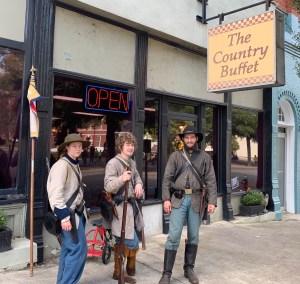
So “country” even the Confederates eat here 🙂
After it was all over, a deacon from our church saw me and invited me to have some tea (sweet, of course) in the little buffet right behind where I had been standing. Sitting there in the restaurant, the surreal scene of muskets lining the walls and “wounded” Confederates eating fried chicken, we talked about what we had seen.
He had felt the same way I did.
He had been standing down around the corner (where the video ended), and he said that when they came around and started shooting at “our boys,” he couldn’t help but shed a tear. He said, “This really happened.”
So, upon hearing that General Sherman was going to burn Sandersville, Rev. Anthony went to Sherman to beg for the town. He finally convinced him that it wasn’t the people who fired on the troops, but opposing forces that had already fled.
When Sherman heard that Rev. Anthony had also been kind to a wounded Union officer and kept him from being executed, he accepted the pastor’s request and spared all but the courthouse and other government buildings. Sandersville survived because of the brave actions of a pastor who put his own well-being on the line.
There’s a lot more to the story of Rev. James Anthony and his conversation with General Sherman. You can read about it by simply Googling his name. But as I stood there in the city square and heard the reenactment of the conversation between Sherman and Anthony, I could not escape the similarity between the Reverend’s name and mine.
I couldn’t escape the following passage that has been a “life verse” of mine for decades:
And I sought for a man among them, that should make up the hedge, and stand in the gap before me for the land, that I should not destroy it: but I found none. – Ezekiel 22:30
If only more pastors would stand in the gap!
If faced with an invading army, would I have the courage to risk everything, stand face-to-face with the conquering General, and beg for the lives of my people as Rev. James Anthony did?
Do I not have that opportunity even now?
But on my knees?
It’s war, and it’s really happening.
Filed under America, Church, General Observations, Life/Death, Prayer, Struggles and Trials
This evening at church we will be having an “Ask the Pastor” question-and-answer night. Am I nervous? A little. However, I’ve already warned the congregation that I may not have all the answers and some questions might get a simple, “I’ll have to get back to you on that.” We’ll see. I may even post the questions I get in an upcoming post! Hmmm?
But, because I have done a little writing on the “problem of evil,” I’ll re-post this article/paper in honor of tonight…and all the questions I still struggle with.
One of the most common reasons for denying the existence of God is the problem of evil in the world. Just ask any group of atheists to give their top ten reasons for unbelief and surely one will claim as number one, “If there is a God, then why is there so much evil in the world?” For many, this is the pièce de résistance of rebuttals. How could a good God be real and allow all the suffering in the world to continue unabated – assuming He is even good? The eighteenth century philosopher, David Hume described the problem this way in Dialogues concerning Natural Religion, 1779:
“Is God willing to prevent evil, but not able? then he is impotent. Is he able, but not willing? then is he malevolent. Is he both able and willing? whence then is evil?” (Stackhouse 1998, 11)
So, the “problem of evil,” and its source, has been an issue of philosophical debate for centuries. The existence of evil in the world, along with unanswered questions, has even become evidence enough for some to embrace atheism. Therefore, because so many philosophers and theologians have tried for ages to reconcile the existence of God with the existence of evil, I dare say that nothing I write will be new. But, if anyone were to challenge my belief in God, along with my faith in Jesus Christ, with the argument that the problem of evil constitutes proof God does not exist, then I would possibly respond with arguments based on the following thought:
Without the existence of God, there should be no evil to be a problem, and that’s the real problem with “the Problem of Evil.”

What exactly is “evil?” Now, that may sound like an absurd kind of question to ask, but if the existence of evil is the evidence that is supposed to expose my faith as a fraud, at best, or even a lie, then what is it? Is it something tangible? Is it metaphysical? Is it theoretical? What is it, exactly? Does it have any particular form? How can it be distinguished from what is called good? On what do the atheists and agnostics base their definition of this thing called “evil?”
Amazingly, the answers are not all the same, nor in some cases even grounded in reality. However, it is imperative to understand that we must define this God-killer, because its definition will determine our conclusions and help to clarify our assumptions.
When C. S. Lewis was an atheist, for example, his “argument against God was that the universe seemed so cruel and unjust.” (Lewis 1989) There he had it, or so he thought. God could not exist because so much evil exists. But how did he arrive at “this idea of just and unjust?” Lewis said, “A man does not call a line crooked unless he has some idea of a straight line.” (Lewis 1989) “Tell me,” I would say, “what is evil, and how do you recognize it when you see it?”
To start, evil must be understood to be an adjective. Evil is a description of something that is not good. Evil is not a thing. The word “evil” only describes the thing, the thought, and the action. Technically, “evil” does not exist, only what it describes.
Some people say that they cannot believe in God because why or how could a good God, if He was perfect, create evil? They think of evil as something that must have not existed until God made it. But evil “isn’t a kind of molecule or a virus…infecting or affecting everything it encounters. There was no time when God said, ‘Let there be evil,’ and there was evil.” (Stackhouse 1998) As John G. Stackhouse put it, “evil becomes a noun only in the abstract.” Additionally, in his book Can God Be Trusted, Stackhouse says of evil:
“An action can be evil, or an event can be evil, or a quality can be evil, or a being can be evil. And we can lump all these particular evils together in our minds and come up with a category ‘evil.’ We can even go on to discuss it as if it were a particular thing, so long as we do not forget that we are always dealing with a category or group of particular evil things, not a thing itself.” (Stackhouse 1998, 31)
So then, if evil is a description, how is it that we come to use the adjective, or as Lewis put it, the “crooked line,” without first having some idea of what is a “straight” one? Defining what is good is as important as defining evil. To know what is evil, we must first have some assumption as to what is not evil.
The crazy thing is that if God does not exist, and man is nothing more than a collection of random matter, both good and evil are purely relative – their existence is based purely on one’s perspective. So, in other words, the one who says that there is no God, based on the existence of evil, is literally basing his belief on pure opinion, not on anything objective. Therefore, in order to bring an accusation against the goodness of God, one must have a base line. What is the standard by which we determine what is good and what is evil?
 Some use Man as the baseline. They compare God to the standard set by what is thought to be good behavior in this world. They rationalize that if God is real, at least according to monotheistic dogma, He must be all-powerful, perfectly good, and the supreme example of love, kindness, and providential care. Because it is preached that God is a better Father than earthly fathers, Mark Twain took it upon himself to write:
The best minds will tell you that when a man has begotten a child he is morally bound to tenderly care for it…[yet], God’s treatment of his earthly children, every day and every night, is the exact opposite of that, yet those minds warmly justify those crimes…when he commits them.” (Tonie Doe Media 2007)
So then, according to Twain, God could not exist because if He did, He would act consistent with our understanding of what a good and loving earthly father would do. In other words, if God cannot, in all His perfection, behave better toward His children than the most common man, His credentials are therefore revoked, and He must cease to exist. However, this is so illogical.
Who are we to say that God, if He is perfect, and we are imperfect, ever treats His children poorly? Do the protesting cries of a toddler who has had poison taken from his grasp carry more weight than the decision of the earthly father to take it away? How, then, are we to automatically assume that the infantile tendencies of finite man are wiser than the infinitely Mature?
Using Man as a baseline for what is good and evil is pure arrogance.
In reality, the problem of evil is really a problem for the atheist. He, who denies the existence of a Creator and accepts only the realities of evil in the world, essentially has nothing about which to complain. Everything should be just fine and dandy, but it’s not. The atheist knows that evil things happen to both good and bad people.
He sees the hurt, feels the pain, and begs for justice. The reality of evil in the world causes men to cry out for justice; for things to be made right. This is a problem, though, because knowing that a crooked line is not straight hints at the fact that a Line-drawer exists.
Others take a different approach. They claim that God does not exist except in the evil intentions of his followers to control others through guilt. They claim that God is just a fabrication of priests to keep mankind from behaving “naturally.”
They say that nature is good, and if anything, God is evil for trying to get man to behave contrary to the very way he was created to behave. One guru said, “It seems that for those who worship God, the opposite to God is not that which is ‘evil,’ but that which is natural.” He said of animals, comparing them to men, “They don’t worship God, they don’t go to church, they don’t have any theology. They don’t have any feeling of guilt, they are simply natural.” (Osho 2009) In other words, if there is evil in the world, it is because our belief in God has inflicted it.
But for the majority of the hurting world, pain is real, loss is real, and evil is manifested daily. Many see the things that happen to innocent people, especially children, and wonder, “If there is a loving God, why doesn’t he do anything about this?”
These people, many of which hold on to hope as long as they can, finally succumb to their doubts and conclude that the only way to explain away the pain is to admit that it is just part of life, part of the natural world, part of what makes us human; alone, in our quest to make life easier, free of pain, free from evil; alone, without God.
These are the ones, I believe, that lure more away from the faith than any Darwinist. They are the ones who have seen evil face-to-face and cannot fathom a God who would allow it to continue. And because their experiences are so painful and tragic, the devout are left speechless and without explanation. Ellie Wiesel is a good example.

Wiesel was a teenager when he saw his family murdered in the Nazi death camps. But it was only after witnessing one particular act of horror – the slow, hanging death of a young boy – that he turned away from his faith in God.
In the book Night, his Nobel prize-winning autobiography, Wiesel said he heard a man behind him ask, “Where is God now?” As he stood there, being forced to stare into a pitiful, wide-eyed, swollen face of a dying child, a voice within replied, “Where is He? Here He is – He is hanging here on the gallows…” (Wiesel 1982) Because there was no justification, even in the big scheme of things, Ellie Wiesel’s God died with the executed boy.
But as sad as it is, without God, who can say what happened to that boy was any worse than the slaughter of an animal? Are we not all just animals – some more evolved than others?
To me, the problem of evil is not a problem for the believer to explain, but one for the non-believer. Aside from the theological arguments about the character of God, without God, to turn Hume’s question around, “whence then is evil?”
Without God, evil is relative to one’s desires and personal pleasure. Does it really even matter whether or not God could do anything about evil in the world when the whole question is moot if He didn’t exist?
With God, evil is defined as that which is against His law, that which stands opposed to His standards, and that which describes all who take pleasure in such rebellion. Without God, evil is just a matter of opinion.
That is the real “problem of evil.”
Works Cited
Lewis, C. S. “Atheism.” In The Quotable Lewis, by C. S. Lewis, 59. Wheaton: Tyndale House Publishers, Inc., 1989.
Osho. The God Conspiracy: the path from superstition to superconsciousness. New York: Osho Media International, 2009.
Stackhouse, John G. Can God Be Trusted. New York: Oxford University Press, 1998.
Tonie Doe Media. In The Atheist’s Bible, 129. New York: Harper Collins, 2007.
Wiesel, Ellie. Night. New York: Bantam Books, 1982.
Filed under Apologetics, Culture Wars, Faith, General Observations, Life/Death, Struggles and Trials



Click to Order




 The Recovering Legalist