Category Archives: legalism

legalism

What Kind of Friend Are You?

Do you consider yourself to be a good friend? What makes a good friend? More than that, what makes a real, true friend? I believe there is a difference.

A Good Friend

Good friends are the ones you have over to watch a ball game, but don’t worry if the house is messy. He’s the type of friend that you don’t mind bringing along to dinner with the family. She’s the one with whom you don’t mind sharing your gripes and complaints, like when your spouse ticks you off, or your co-worker make you jealous.

A good friend is one that remembers to invite you to a birthday party, a movie, or loans you a pick-up truck to move a piano (God bless’em). They’re the type of friends you get along with, even though you may have different tastes or opinions. You care about each other and say things like, “If you need anything, just let me know.”

Job had Good Friends

Job (as in the Bible, not to be confused with Steve) had some good friends. Really, they were not that bad. Just look at how they acted when they saw Job after the tragedies came about.

And when they raised their eyes from afar, and did not recognize him, they lifted their voices and wept; and each one tore his robe and sprinkled dust on his head toward heaven. So they sat down with him on the ground seven days and seven nights, and no one spoke a word to him, for they saw that his grief was very great.” – Job 2:12-13 NKJV

Obviously, his friends cared enough about him to break down into tears at the sight of his brokenness. They were good enough friends to even tear their clothes, sit down with him on the ground, and weep with him for seven days. They even cared enough to keep silent seven days so Job could pour his heart out in grief. They were good friends.

Superficial Friends

If the friends of Job had only been the partying type, do you think they would have come to see him after hearing of his loss? No, if they had only been superficial friends, they would have stayed far away from Job and his problems. They would have said, “Oh, that’s so sad…we should send him a Hallmark card…Honey, where are my keys?…I’m going to be late to the gym.”

Religious Friends

Anyone who goes to church has these. Religious friends are the ones who always have a smile and a warm handshake, but never really want to hear about your life. These type of people give a bad name to church folk. Have you ever met any? If you have, you know. They ask, “How are you doing today?” Then, just as you start to give a response they say, “Great, great…love your heart…well, I’ll be praying for you, honey, don’t you worry.” Riiight.

User Friends

This is not a scientific assessment of friendship types, but sometimes I think most friends are only users. When you stop and think about it, how many friends would you have if you had nothing to offer? At least Job’s friends weren’t users. They came around when Job had nothing to offer but tears. They came to offer him something – if only judgmental advice.

True Friends

This may only be my definition, but I think it is a good one:  A real, true friend is one who lets you cuss, spit, and even question God when times are tough. A real, true friend is one who will not only cry with you when you hurt, but stand there by your side as you kick the furniture, throw the dishes, slam the door, or even ask, “Why?!

The truest test of real friendship is how he/she responds when you say things you may regret. This is where Job’s friends fell behind.

Job came to the point where he “cursed the day he was born,” and asked God, “What have I done to you? Why have you made me a target?” Job literally became suicidal and terribly depressed as he struggled with trying to understand the reason for his troubles. But instead of keeping quite, or simply saying, “It will be OK, Job,” his friends started accusing him of wrongdoing. They blamed him for the trouble he was enduring, even though they had no proof. All they could do was pour salt on his wounds.

When Job cussed and spit, these friends said things like, “How long will you speak these things, and the words of your mouth be like a bunch of wind (Job 8:2)?” They called his painful rants “empty talk” and “vain words” which proved he deserved God’s judgment.

A real friend will let you expose your pain in ugly ways, with ugly words. Job’s friends should have understood that his words were spoken in grief. They should have understood that sometimes we say things we don’t mean when we are hurting, but need to say them, anyway. A real friend would have taken it, listened, and given only kind words of encouragement.

To him who is afflicted, kindness should be shown by his friend, Even though he forsakes the fear of the Almighty.” – Job 6:14 NKJV

If you know someone who is going through a tough time, don’t be judgmental – just love them. Even if they say things that are wrong, even vulgar, let God be the Judge – you just love them.

Job had to answer to God for the things he said, but the only ones who incurred the wrath of God were Eliphaz and his cohorts (42:7). As I see it, God understood Job, but He found no excuse for the response of his self-righteous friends.

Don’t just be a good friend – be a real friend. You may wish you had one, someday.

  • Friends (anotherchristianblog.org)

3 Comments

Filed under Christian Maturity, Christian Unity, Do not judge, legalism, Relationships and Family, Uncategorized

God-Centered, or Christ-Filled (Pt. 2)

Continuing from last time, let me conclude my thoughts on the difference between being God-centered and Christ-filled.

The Realization

When contemplated what I had asked of God (to make me characterized by a God-centered life), the mental picture of a wheel came to mind. It was the picture of a wheel with a center hub and spokes, much like a bicycle or wagon wheel. As I thought about this, however, something seemed wrong. Something seemed almost selfish.

You see, when you look at a wheel, especially the kind with spokes and a hub, it may not be obvious at first, but there are parts. In such a wheel I can distinguish the spokes from the hub, and the rim from the spokes. I can even see that there are spaces in between the spokes that are empty and not attatched or filled with anything – just empty. If God is supposed to be represented by the hub, the center of the wheel, then the wheel is not really all about the hub, but the wheel itself.

It’s about Jesus

The Apostle Paul told the Athenians (Acts 17:28) that in Jesus we “live, and move, and have our being.” In a letter to the Galatians he said “I am crucified with Christ: nevertheless I live; yet not I, but Christ liveth in me” (Galatians 2:20). It would seem to me that Jesus should be more than our “hub.” He should be our “ALL.”

That is when I thought of a different picture. This time I imagined a solid circle – a disk. Unlike the other picture where God was the center of everything, yet separate, here was a picture of wholeness. In this picture, if my life is this type of wheel, people won’t notice anything about me, just Christ.

All of the spokes (my life, my dreams, my habits and hobbies, my talents, and my desires); the empty spaces (the areas of my life that seem irrelevant); and the rim (the total expanse of who I am – my identity, my sphere of influence); each part is now inseparable from the life and power of Christ who lives within me.

May they see Jesus

So, I no longer want to be characterized as a man with a God-centered life. I want to be a man characterized by the life of Christ. When people look at me, I don’t want them to say, “Hey, that guy really knows how to serve God,” or “Hey, that guy really loves the Lord.” Even though there is nothing wrong with those things, how much better would it be if they could say, “Hey, I met this guy… at first I thought he was that man they call Jesus.

Remember, it was to the Church at Corinth that Paul said, “Examine yourselves, whether ye be in the faith; prove your own selves.” There must have been some hearing this letter read who were deceived. Don’t be like them. Make sure your life is in Christ, and He is in you.

May your activities be “God-centered;” but your life “Christ-filled.” May the world see Jesus in you.

For Discussion:

Can you distinguish between a God-centered and a Christ-filled life? What characteristics would you expect to see?

Do you think someone could live a God-centered life and still be unsaved?

Your comments would be appreciated. 

3 Comments

Filed under Christian Living, Christian Maturity, legalism, Uncategorized

God-Centered, or Christ-Filled? (Pt. 1)

The Prayer

Just the other morning I asked for the Lord to make me a “characteristic example of a life centered on God.” But as soon as I prayed that prayer, another thought came into my mind.

Maybe being “God-centered” is not enough.

God-Centered Living

You may be asking, “What is wrong with that?” Well, there is nothing wrong with living a God-centered life, generally speaking. On the other hand, there is more to being a Christian than being “God-centered.”

“Outrageous!” “That’s blasphemy,” you say. Well, is it? Stop and think about it for just a moment. Start with thinking about what being “God-centered” actually means.

Does someone have to be a true Christian in order to live a God-centered life? You may think so, at first, but there may be a few church folk fooling themselves. Don’t believe me? Read what Paul wrote to the Church…

“Examine yourselves, whether ye be in the faith; prove your own selves. Know ye not your own selves, how that Jesus Christ is in you, except ye be reprobates?” – 2 Corinthians 13:5 KJV

Why would the Apostle tell church people to “examine” and “prove” whether or not they were in the faith? Could it be that there were some who were going through all the motions, but were never converted, never born anew? Could it have been possible that there were some doing all the right things, for the right reasons, but not right with God? He says that the answer to the test will be whether or not “Jesus Christ is in you.”

Can people live God-centered lives and still be lost? To help answer this question, consider the following people (names are fictitious). Do their actions guarantee salvation?

  • Bob goes to church every day the doors are open, including every other function on every other day
  • Henry gives 20% of his income and 10% of his time to the church. If there is a need, ask Henry for help.
  • Margaret goes to a Fundamental church, has the right translation of the Bible, and never wears pants – ever.
  • Mary would never say a dirty word, tell an off-color joke, or even permit foul language in her presence.
  • Sharon put aside marriage and gave her life to helping orphans on the streets of Mumbai, India.
  • Scott and Karen have Bible studies in their home, take the kids to Sunday School, and even have gold crosses in every room of their home, not to mention on their necks.
  • A rich young ruler keeps all the commandments (not just the Big 10) from his youth.

If these people were to examine themselves, as Paul asked, what might be missing? Colossians 3:23 says, “And whatsoever ye do, do [it] heartily, as to the Lord, and not unto men.” Is it not possible that someone could do everything for God’s glory (live a God-centered life), but still die without Christ?

What are your thoughts?

Have you “proven” whether you “be in the faith?”

Do you know of Scripture that supports a “God-centered” life being proof of salvation?

4 Comments

Filed under Christian Living, legalism, salvation, Uncategorized

Barriers to Church Growth. #5 (Honoring Self)

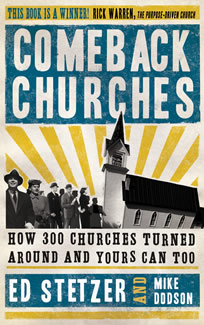
A very revealing study was done, leading to a book detailing how 300 churches went from declining or dying, to growing. In Comeback Churches, written by Ed Stetzer and Mike Dodson, there is a list of 30 different barriers to church growth. Having received permission from the publisher (B&H Publishing Group), I would like to discuss a different barrier each week.

“People do works for their own honor and not the glory of God (Matthew 5:16).”

“Let your light so shine before men, that they may see your good works, and glorify your Father which is in heaven.” – Matthew 5:16 KJV

Why do we do good works? Why do we feed the poor, shelter the homeless, tend to the elderly, etc. Do we do these things so that our Father will be glorified, or do we do them in order to get glory for ourselves?

To be Seen.

Some people do good works for the sole intention of being seen and considered especially spiritual. Jesus said that “Everything they do is for show” (Mt. 23:5 NLT). Jesus spoke of those who wanted to be seen as pious and holy by wearing boxes containing Scripture on their foreheads or arms. The bigger the box the better. All this was in an attempt to say, “I am keeping the law better than you!” (See Deuteronomy 6:5-9)

Then there are other people who do plenty of good deeds without even acknowledging God. For example,  go to any charity ball held by your local “high society” club. There you will find plenty of people who willingly give thousands to worthy causes, but smile as big as they can when the magazine photographers come around.

They may even be members of local churches and give large offerings to the building fund (as long as it’s named after them); buy the pastor a new car; or pay for a youth mission trip. “And they love to sit at the head table at banquets and in the seats of honor in the [congregation].” – Matthew 23:6 NLT

To be Accepted

Some people do good works in order to be accepted by God. They give away fortunes and spend their lives doing good deeds, but not to be seen of men. They want to be seen by God and thought of as worthy of His love. The only problem is that salvation is “not of works, lest any man should boast.” They work themselves to death in order prove their loyalty, thereby supposedly insuring a place in heaven. But the glory goes not to God, for attached to the works is an expectation of reward based on merit.

Soli Deo gloria

All glory should be to God alone. If our works are done in order to receive praise, then God is not getting the glory. If our works are meant to earn credit with God, then God is not getting the glory. If we work ourselves silly to meet the legalistic requirements placed on us by men, then God is not getting the glory. However, if out of a heart of love we do good works without expectation for reward, recognition, or acceptance, then God will receive the glory.

When all glory, honor, and praise is given to the Lord, He will draw all men unto Himself. Church growth will be unstoppable. Yet, if we expect credit for anything, then what should we expect but further decline? “For mine own sake, even for mine own sake, will I do it: for how should my name be polluted? and I will not give my glory unto another.” – Isaiah 48:11 KJV

We want others to see our good works, but not for our own glory. May they “glorify [our] Father which is in heaven.”

2 Comments

Filed under book review, God, legalism, Uncategorized

Barriers to Church Growth. #3

A very revealing study was done, leading to a book detailing how 300 churches went from declining or dying, to growing. In Comeback Churches, written by Ed Stetzer and Mike Dodson, there is a list of 30 different barriers to church growth. Having received permission from the publisher (B&H Publishing Group), I would like to discuss a different barrier each week.

“God withdraws Himself from the church because of sin. He hardens hearts and gives the people over to sin (Isa. 63: 15-19; Heb. 3:12-13).

“Take heed, brethren, lest there be in any of you an evil heart of unbelief, in departing from the living God. But exhort one another daily, while it is called To day; lest any of you be hardened through the deceitfulness of sin.” – Hebrews 3:12-13 KJV

Have you ever thought it possible for a church to be given over to sin? I am not talking about the “liberal” church down the street (every town has one, I suppose), but your church – my church. Is there no growth taking place? Maybe it is because of sin. Maybe it’s because of a hardened heart.

Do churches sin?

You know they do. Many times, however, the sin is not viewed as such. It is seen differently from something that smacks of unbelief. It is rarely seen as a departure from God. More often than not, the sin that churches commit is hidden or disguised with terms or labels meant to justify “an evil heart of unbelief.” Here are a few phrases you may have heard. If so, it might be time for a hard-heart check.

  • “We can’t do that.”
  • “We don’t have the funds for that.
  • “That area of town will never be receptive.”
  • “Maybe we should just pray about it, for now.”
  • “Why do we need to change? They need to change!”
  • “We’ve never done it that way before.”

Can churches have their hearts softened?

Absolutely! God is in the forgiving business, you know. All it would take is our churches turning away from the sins that so easily beset us, like legalism, traditionalism, racism, envy, and pride…not to mention fear that God will not provide for us the ability and means to accomplish His work.

“Let us search and try our ways, and turn again to the LORD.” – Lamentations 3:40

“Seek ye the LORD while he may be found, call ye upon him while he is near: Let the wicked forsake his way, and the unrighteous man his thoughts: and let him return unto the LORD, and he will have mercy upon him; and to our God, for he will abundantly pardon.” – Isaiah 55:6-7

7 Comments

Filed under book review, Christian Living, Christian Maturity, Christian Unity, General Observations, legalism, ministry, Uncategorized, worship

Legalistic Fasting

This is now the umpteenth time I have written several paragraphs, only to turn around and delete everything. Maybe I should just keep this very simple and to the point.

Don’t be legalistic about fasting.

There, I said it. It’s off my chest. I can sleep better, now.

You see, a lot of folks in the Christian community act no differently than the Muslim community during the month of Ramadan. They treat fasting as something necessary to gain favor with God. They think fasting is somehow required to be spiritual. I disagree.

Matthew 6:16 is a verse commonly used way out of context.  In that verse Jesus said, “when you fast.” It was not a command, but a prelude to a command. He said, “Moreover when ye fast, be not, as the hypocrites, of a sad countenance.” Jesus wasn’t commanding anyone to fast, only to not be like the hypocrites who make themselves look all pitiful.

When Jesus said “when,” He was speaking on the assumption that fasting was a common practice with those in the audience. However, we must be careful to take note that it was not a command to fast, nor one that gave instructions. All He said was that when you do fast, don’t be as one of those who seek attention from men.

Lest we forget, there is nothing that we can do to earn the favor of God. His grace is unmerited. His love is not based on the prerequisite of starving one’s self once a year, month, or week. There is nothing wrong with fasting, but there can be serious flaws with our intentions.

False Biblical Examples

It is evil to teach formulas for health, wealth, and happiness based on select passages of Scripture. A good example would be the Prayer of Jabez teaching that says, “Pray this prayer and you will be wealthy.” But examples of fasting in the Bible are also used for exploitation. The first one that comes to mind is the Daniel Fast.

If you remember, in the first chapter of the book of Daniel, Daniel “purposed in his heart that he would not defile himself with the portion of the king’s meat, nor with the wine which he drank.” Because of Daniel’s courageous stand, based on his faith in God and the dietary laws given to Moses, God chose to work a miracle and honor the Hebrew children, in turn bringing glory to Himself. Sadly, there are those who look at what Daniel did and say, “Hey, if I just eat vegetables and water (because meat and wine are obviously evil), then I will be guaranteed health, wealth, and favor.” This is a classic example of misapplication.

True Biblical Examples

When I read the Bible, there are 3 things that seem to be common with true fasting: 1) Desperation, 2) Mourning, and 3) God’s glory. Nowhere do I see it taught that it should be used as a way to become a better person, a more spiritual saint, or a healthier individual. Nowhere do I see it taught that if one did not regularly fast, then that person should be considered spiritually inferior.

What I DO see are examples of people who, when faced with insurmountable trials, impending defeat, or crushing repentance, found food to be the least of their concerns. I think of David when he was praying for his dying son (2 Samuel 12:16 & 17). I think of Nehemiah when he heard of the broken wall (Nehemiah 1:4, 6).  I think of Queen Ester faced with the annihilation of her people (Ester 4:3). I think of Ezra, who, fearing the name of the LORD would be tainted, called the people to a fast before God (Ezra 8:22). These are the common examples.

Too often we take something from Scripture and cheapen it to the point that it becomes a simple 4 or 5-point how-to bestseller. In our slightly inconvenienced world we resort to claiming the only thing truly desperate people had at their disposal. We say, “if you do this, then that will happen.” More often than not, when people in the Bible fasted, it was not because they wanted to – they couldn’t do anything else.

Modern Legalists

Then there are those who like to flaunt the fact that they are disciplined and spiritual – the modern “hypocrite.” They look with derision upon the one who has not fasted once a week. They proudly proclaim “I fast twice in the week, I give tithes of all that I possess” (Luke 18:12), when in reality their fasting is nothing more than a supposed means to a selfish end. Because of their judgmentalism, they force others to be like them. They create a law to which they hold all others accountable, while in the darkness the truly humble is beating his breast, saying, “God, be merciful to me a sinner.”

One Last Thing.

There is no denying that we probably do not fast enough. As a matter of fact, according to Jesus (Matthew 17:21), many a spiritual battle has been lost because of a lack of fasting and prayer. That is the key – prayer.

Fasting without prayer is nothing more than scheduled Anorexia. The whole point of fasting is to seek the face of God, laying all other allurements aside, such as food (even marital relations – 1 Cor. 7:5). It is not that we need to fast; we need God. If fasting is what it takes, then that is what we should do. But one thing is for sure, if we are hungry enough for God, then we won’t need anyone to tell us when or how to fast.

Let me know what you think. Do you fast? How long? Why? Results? 

7 Comments

Filed under Food, God, legalism, worship

“Don’t Be Skeerd” (My Own List)

This is a post about a post about a post.

After reading a post today on GrowUp! (click for link), I couldn’t help but respond with my own list of things that a Christian shouldn’t be scared of. Maybe the first one should be, “Don’t be skeerd to end a sentence with a preposition that you’re sick of.”

OK, so if you don’t get it, “skeerd” is “scared” spelled that way we say it sometimes in the South.

Here are 8 things of which a Christian should not be afraid….of:

Dracula, or any other vampire that stalks you through your window.

Just show them your cross. If that doesn’t work anymore, then quote Scripture. Of course, if you are a girl, then you’d be better off to just call 911, or better yet, shoot the idiot trying to act like a character from Twilight.

Disclaimer – DO be afraid of Vampire Bats. They have rabies. You may be alright when they bite you, but then again, you may be wishing your church family had something else to pray for…(I ended with a preposition, see?).

Atheists

If they prove that there is no God, no reason for faith, and no reason for forgiveness of sin, then you have nothing to worry about. They can’t prove there is no God, you know, but if they ever did, then you are free to whack them in the head with the biggest hardcover KJV you can find. If there’s no God, then there’s no absolutes or basis for morality outside of what makes you feel good. Make yourself feel better when they take away your hope by knocking the grin off their face…they should understand.

Women wearing pants, or men wearing dresses.

It may help some of you to know that even though most of the Christian world is more concerned with staying alive amidst persecution than with dress codes, some of our brethren and sistren still freek over this. For them let me just say, “Don’t be skeerd!” If Obama gets re-elected then we will probably end up wearing potato sacks, anyway. As we go back to the economic lifestyles of pre-electric days, no one will be able to afford any fancy stitching and things. Who knows, the toga may come back in style and everyone will wear a skirt.

Crazy worship styles and screens on walls.

No reason to fear these things, people. As long as the worship is from the heart and it IS true worship, not self-satisfying, self-glorifying entertainment, then God will be pleased. On the other hand, if church attendance continues to decline in this country, you won’t be able to afford the electricity needed to run the projectors and fancy sound equipment used by many praise bands. Where two or three are gathered together, there the non-electric bluegrass will be in the midst of them.

Disclaimer – For the record, I love bluegrass gospel. Sorry. Wait, I’m not sorry. Scratch that. I love bluegrass and want to see the words projected on screens in church for all to sing along….with.

Stray dogs that wander in through an open door and listen to the church service.

Had it happen. Didn’t mind. At least when the dog fell asleep he didn’t snore.

Week-long revival meetings.

Where have these things gone? All we see anymore are the 3-day kind, if not the weekend ones that include Sunday, but not Friday.

Just think, if we went back to longer revival meetings, then……wait…..does anybody have revival meetings anymore? We must be too skeerd of having to get dressed up each night; miss some TV we could easily DVR for later; miss a ball game or party; or hear something from God that might convict us. THAT should scare our socks off.

Visitation

What is there to be scared of? Why do we hate knocking on doors, prayer-walking streets, etc.? As long as we’re not trying to sell anything, then most people are happy to meet someone who cares about them. Sure, there are the few vampires that don’t want you coming around, but most folks are at least cordial, at least here in the South. Folks don’t like being banged over the head with your Bible, but they do appreciate being greeted kindly and invited to some place nice. Just invite them to the King’s house for a meet-and-greet (with a little sweet tea and love, they might just figure we’re not out to take their money).

Change

Somethings remain the same, and they have stones above their heads. Now, when those things come back from the dead, you DO have something to be skeerd….of (one more preposition misplacement). Of course, it all depends on Who raises the dead, too. Are they being raised to “walk in newness of life,” or to eat the flesh of screaming movie-goers? Either way, just invite them to a homecoming dinner on the ground and they’ll be alright.

5 Comments

Filed under Christian Living, Christian Maturity, Culture Wars, General Observations, legalism, Witnessing, worship

Which Is More Sinful?

Let’s get back to the basics, shall we?

For a quick exercise in recognizing legalistic thought, may I present for your consideration two pictures?

Which one of these pictures display something “sinful?” 

If these items were seen being consumed by a Christian, which would result in an immediate judgment of one’s spiritual health? Why?

Are either one of these items mentioned specifically in Scripture?

On what basis would the consumption of either be considered sinful?

Can we justify the consumption of one in moderation without doing the same for the other?

Both will do little immediate harm, but only one is consumed by children on Sundays. Which, then, creates the greater risk? How many Americans die each year from obesity and heart-related problems that could have been prevented by better food choices? How many children are allowed to smoke a cigar once a week? How many children are allowed to eat fast-food every day? Which will kill them first?

I am not attempting to justify or condemn either one of these items. All I want to do is make the point that we should be very careful when we judge another person based on what he/she consumes. Does the consumption of one or the other make a person more or less godly?

Keep in mind the words of the Apostle Paul as you think about this and respond for further discussion.

All things are lawful unto me, but all things are not expedient: all things are lawful for me, but I will not be brought under the power of any…For ye are bought with a price: therefore glorify God in your body, and in your spirit, which are God’s. – 1 Corinthians 6:12 & 20

—Oh, and by the way, that cheeseburger (from Hardees) contains over 1300 calories and 95 grams of fat, the equivalent of four (4) jelly-filled donuts.


3 Comments

Filed under Do not judge, fitness, Food, General Observations, legalism, Uncategorized

Beware the Boycott

I don’t want to take too much time addressing this issue, but it does need some clarity.

An Effective Boycott?

Recently, in a conversation that had the potential of causing irreparable damage to my reputation of being nice, I was accused, once again, of being, for lack of a better term, a “liberal.” Why was this accusation (although the term “liberal” was never used) thrown up to me? Simply because of the fact that I went to Disney World.

The History. Back around 1996, the American Family Association (decent group of people) called for a boycott of Disney World and all Disney products. On the heals of this decision, in 1997 Southern Baptists voted to boycott Disney. The reason for this was something called “Gay Days.”

For a couple of years I went along with the ban (which was overturned in 2005). We didn’t go to or buy Disney movies, nor did we go to the theme park in Florida. My wife and I felt that the boycott was justified because we wanted to send a message. We wanted Disney to know that many of their patrons (traditional families) were upset with their decision to have a special day set aside for, and promoting, homosexuality.

The only problem with this particular boycott is that it was unfounded. It was based on faulty information spurred on by indignation. Simply put, the Christians got the facts wrong. Sadly, too many are still refusing to face the facts – Disney does NOT now, nor did it ever, have a “Gay Day.”

What, then, is the true story? In 1991 the gay community in Orlando decided to band together and select a day in which they would all go to Disney world wearing red. What started out as a single day of solidarity turned into a week-long event that now makes up “Gay Days.” Totally apart from Disney, the LGBT community started this. Now, it is a big celebration that takes place all over Orlando. Disney has absolutely nothing to do with it. [Click here for a link to the “Gay Day’s” actual site.]

When it became clear that Disney did not set aside their parks for a day to promote the LGBT lifestyle, I was very happy to ride Mission: SPACE and eat at the Crystal Palace. I was free to purchase Disney DVD’s for Christmas. Finally, I could travel the World Showcase at EPCOT without feeling like I was supporting same-sex marriage. Getting the facts straight (pun intended?) was liberating, and it didn’t make me a “liberal.”

Get the Facts, NOT the Rumors.

1 Thessalonians 5:21 KJV – “Prove all things; hold fast that which is good.”

It is so embarrassing when Christian groups boycott something based on erroneous information. All it does is send a message that we don’t know what we are talking about – that we’re crazy – that we’re misinformed. When we can’t even do a little research into what is so obvious, what does that say to the unbelieving world about our theology? Have we really studied God’s Word, or are we just going on false assumptions based on the rants of a prejudiced preacher?

  • BTW, another business that is still being boycotted by Christians is Proctor & Gamble.  [For more info on the Proctor & Gamble story, click here.]

What to Do?

It is this simple: unless you never spend any money, you will never be able to keep all your dollars out of the hands of unbelievers who believe differently than you. In case you haven’t noticed, we live in a fallen world full of fallen people. So, what is the answer? There is no perfect answer for every individual. Just try to abide by the following suggestions…

Use good judgment.  If you feel like you are supporting something ungodly in a direct way with your patronage, then stop. Boycott it. On the other hand, if you are not sure, do your homework.

Don’t be unrealistic.  When you are driving across the country and you come to the last gas station for another 200 miles of sand, fill up your tank! It would not be a smart thing to keep driving in hopes that God would drop a fuel can beside a cactus, all because you don’t feel right about buying fuel at a place that sells alcohol. Get real!

Keep things in context.  What is most important? Sometimes we will put our personal crusades ahead of the welfare of our own families.

Want an example? Have you ever avoided the better product or medicine and selected a known inferior, therefore subjecting your children to the possibility of further infection and/or pain? I have. Why? I didn’t want the Devil to get a dollar. Never mind that my child might have died. Never mind that I drove to the other side of town on gas that funds the persecution of Christians in Saudi Arabia, thereby giving the Devil about 25 dollars, all in the hunt to find non-devil-supporting medicine.

Make it Clear.  In other words, make what you are doing clear to the one your boycotting AND the one you patronize. If you never let the business you’re boycotting know about it, what good is it? They need to know why you’re choosing to withhold your money.

Home Depot mascot at Chicago Gay Pride parade.

Recently, we had to make a major purchase involving building supplies.  I made it perfectly clear to the manager from which I did purchase the materials that I chose his place over another. I made it clear that until The Home Depot changed its activist-like policies supporting and promoting the LGBT agenda, I could no longer give them my money, a portion of which would be donated  to LGBT causes (click here for more info). The manager of the competition promptly gave me an additional 10% off.

Be gracious. You don’t have to be a self-righteous jerk to make a point or stand up for what you believe. If you feel there is Biblical support for your stand, make your stand in a biblical, Christ-like way. Don’t bring reproach to the name of Jesus and His church by acting hateful.

Keep This in Mind

If you feel like you must make a stand, do so with all your heart (Col. 3:23). Don’t let intimidation keep you from speaking out for what is right. On the other hand, keep in mind where you are. You are not in heaven, and this is not the Promised Land or the New Jerusalem. Don’t expect unbelievers to always act like saints. When you boycott a decent, secular business for not acting like the Church, you run the risk of alienating the very ones you’re called to reach. Consider the following words of Paul:

1 Corinthians 5:9-13 KJV – “I wrote unto you in an epistle not to company with fornicators: Yet not altogether with the fornicators of this world, or with the covetous, or extortioners, or with idolaters; for then must ye needs go out of the world. But now I have written unto you not to keep company, if any man that is called a brother be a fornicator, or covetous, or an idolater, or a railer, or a drunkard, or an extortioner; with such an one no not to eat. For what have I to do to judge them also that are without? do not ye judge them that are within? But them that are without God judgeth. Therefore put away from among yourselves that wicked person.”

Should we never go to the mall because the owner of the property is possibly an adulterer? Should we quit buying fuel because most providers are Muslim and hate Christians? Should we never buy clothing because the designer used half-naked models in a Paris show? Maybe, but where would it all end? Paul made it pretty clear in the above verses that there are times when it is necessary to “company with fornicators.”

The sad reality is that the very ones we should be boycotting may be IN the church, not outside. If we choose to boycott the world, it might be advisable to first determine if we are being hypocritical. Hypocrites make terrible evangelists and worthless boycotters.

15 Comments

Filed under Christian Living, Christian Maturity, Christian Unity, Defending Traditional Marriage, legalism, Southern Baptist, Witnessing, World View

I Ain’t Sinnin’; It’s Made of Veggies

Veggies and Fireworks

On Sunday night, July 3rd, after a wonderful evening service in which I preached on the love of God (for everyone), my family and I went to Collegedale, TN, to watch fireworks. We had a wonderful, patriotic evening, complete with fresh cotton candy, hamburgers, and hot dogs. Oh, my bad…cotton candy and veggies on bread.

There are few things more “American” than a Fourth of July celebration with hamburgers and hot dogs. On the other hand, if you plan to attend an event like this in a Seventh-Day Adventist utopia (such as Collegedale), don’t plan on eating the real thing (at least not at an outdoor event where most of the vendors are church-related). Many Adventists do not eat meat (at least the ones I’ve known), nor do they typically consume any beverages containing caffeine. So, while watching fireworks this year, I ate veggies on a bun, while drinking a Dr. Pepper with no ability to keep me awake while driving home. I could have died, you know.

Now, don’t get me wrong, I thought the burgers were very tasty, and the hot dog I had wasn’t bad. As a matter of fact, the burger was excellent, especially when I added a generous sprinkling of some spices they had sitting on the table. However, the whole idea of “veggie burgers” and “veggie dogs” got me to thinking. Unfortunately, that’s what gets me into trouble.

Why Not the Real Thing?

Why don’t vegetarians eat meat? Well, according to who you ask, the reason could be anything from wanting to be healthier, to not wanting to make a cow cry. Some feel that it is their religious obligation to not eat meat, while others are just animal lovers that would rather pet a critter than chew on its leg.

Are there any health benefits from not eating beef or pork? Sure, there are some. Are there any Biblical commands regarding meat that apply to us today? I don’t think so, but others have the right to their misinterpretation (said with a wink). Regardless, many choose not to eat meat because they think it is just plain wrong. A sin. An abomination. Well….

Then Why Fake It?

Surely I am not the only one who thinks that it is a little hypocritical to condemn eating meat, only to eat things that look and taste exactly like it. It seems like an attempt to have your righteousness, while eating your sin, too. Now, I’m not talking about the strictly health-conscious folk, but the ones that think eating ol’ Bessie is akin to eating Aunt Bessie.

I don’t understand. I don’t see the point. Isn’t eating something that looks and tastes as close to the real thing sorta like saying, “I know what sin tastes like, and this tastes like sin, but it’s OK, cause it’s fake.” Is it all about flavor? Or, is it that you want your sin, but can only stomach the appearance of it? If you were only concerned with the nutritional value of a veggie burger, then why make the taste, texture, and appearance identical to the real thing? Probably because a veggie burger that looked like an ear of corn or a turnip would not have the same appeal.

“Abstain from all appearance of evil.” – 1 Thessalonians 5:22

It only makes sense to me that if you are going call something evil, then you should not promote its pleasures. For instance, why would a Jew, someone who is fanatically opposed to eating pork, order several slices of imitation bacon for his bagel? Why would a Vegan, who was opposed to eating beef, order something that looks, smells, tastes, and feel exactly like a hamburger? It implies that their love for the look and taste of these foods is greater than their concern for what others may think.

“Wherefore, if meat make my brother to offend, I will eat no flesh while the world standeth, lest I make my brother to offend.” – 1 Corinthians 8:13

It seems to me that at the heart of the matter is a desire to try to satisfy the demands of the Law, while at the same time the desires of the flesh. The problem is that when we lust after what we can’t have, then we are guilty of the sin itself (Matt. 5:28).

This is an example of legalism at work. The legalist justifies his actions by boasting he is keeping the Law, but in his heart continues to desire the pleasures of unrighteousness; all the while, seeing himself as more right with God than his neighbor.

Deeper Application

As a believer, do you oppose adultery, fornication, idolatry, perversion, etc.? Do you oppose demonism and witchcraft? Do you oppose abuse, rape, murder, and lawlessness of all kinds? Or do you secretly desire these things, fulfilling your fantasies through illicit music, books, and movies? No, you wouldn’t do those things, would you? But do you get as close to the experience as you can without actually consuming the meat?

Just something to think about.

Note: The above article is meant to illustrate truth through honest questions and humor. In no way do I mean to presume that every Adventist is a legalist, or that every vegetarian is off his rocker. Please forgive me if you are offended by any over-simplification of one’s food preferences. However, if you are a legalist, well, what can I say?

15 Comments

Filed under America, Christian Living, Food, General Observations, legalism