Category Archives: General Observations

Just things I see that make me think.

Todal Anilation!

Photograph and Driving

First, I don’t know any better way to say it. The reason the above header says “photography and driving” is because “shooting and driving” sounds really, really bad. “Pic and driving” brings to mind images of one with one hand on the wheel, the other up a nose.

What im trying to say is that I took a picture while driving. I don’t know if doing so is illegal, like texting while driving is. All I know is that when I saw what I saw I had to take a picture to prove to it.

So, don’t text and drive… But if you’re taking pictures make sure they’re worth sharing.

A New Word

I learned a new word, today. I saw it on the back of a pest control truck. The word is anilate. 

imageI know this a new word because I can’t find a definition for it. As a matter of fact, when I did a definition search, not only did Google keep asking me, “Did you mean annihilate?”, but other helpful tools started popping up. For example, I didn’t know there was anything out there that searched word-game databases. However, the one I clicked on informed me that anilate was not accepted in ANY word game played in the English-speaking world.

What a bummer! I have proof anilate is a word, but I can’t use it to score points. Not fair! Somebody needs to tell Words With Friends.

Keeel ‘Em! 

Actually, I was driving down the road and had to take a picture of this pest control truck. I couldn’t help but laugh.

Now, should someone from the company read this post, I hope they forgive me. I mean, maybe they just came up with the word one day after they watched Achmed the Dead Terrorist say, “I’ll keeel you!” I hope so. If not, all I can imagine is a couple of guys sitting around dreaming up names for a new business venture.

“Bubba, I caint think of nuttin. It’s like all d’ good’ns are taken up!”

“Yeah, I know, Shorty. Well den, why don’t we just call it what we plan ta be do in’ wid all dis here poysuns?”

“Watchya got in mind, Bubba? Sump’n like Keeel’m Pest Control?”

“Naw, it’s gotta sound more perfeshional thun that. Weer gonna annihilate dem dang bugs, Shorty! Get it? Weer gonna uh-NYE-late ’em!”

“Yeah! How d’ya spell that?”

“A-N-I-L-A-T-E”

“Cool! I’ll call th’ sign comp’ny and get’r done!”

image

Now, if that’s NOT how it happened, I’ll be really disappointed. 😉


NOTE: This was meant in fun, so don’t give Anilate Pest Control a hard time. Heck, give them a call!  They just might be the ones to annihilate … er, ANILATE your bugs. You never know. Call (423) 432-8266.

6 Comments

Filed under General Observations, Humor

June 6th… Would We Do It Again?

d day

Seventy-two years have passed since the pride of the Allies, 156,000 strong, stepped out of landing craft and jumped out of airplanes into the mouth of a monster ready to eat them alive.

Seventy-two years have passed since young men from America, England, and Canada (and we must not forget Australia, Belgium, Czechoslovakia, France, Greece, the Netherlands, New Zealand, Norway and Poland) landed on beaches called Utah, Omaha, Gold, Juno, and Sword.

Seventy-two years ago, long before the fancy rock-climbing walls which are so popular in today’s health clubs and gyms,  the 2nd Ranger battalion “led the way” up the 100 ft. cliffs of Pointe du Hoc.

Seventy-two years ago, on the 6th of June, 2,499 American and 1,914 from the other Allied nations, a total of 4,413, gave their lives for the sake of freedom.

Seventy-two years ago men were stepping on the backs of their comrades as they sloshed through red water, breathed in the mist of war, and wondered if they would live to see the ground only yards (meters) in front of them.

On June 6, 1944, seventy-two years ago, it was said of those who landed:

They fight not for the lust of conquest. They fight to end conquest. They fight to liberate.” — President Franklin D. Roosevelt, radio broadcast, June 6, 1944

It is June 6, but are we a people with the stomach to liberate? If we were the ones living seventy-two years ago, where would we be today?

Ask those in pajamas talking on free smart phones. Ask the protesters who don’t even know why they protest. Ask those who are burning the American flag because “America was never great.”

image

It cost a lot to buy seventy-two years of freedom. Would we do it again?

2 Comments

Filed under America, Countries, Culture Wars, current events, General Observations, Life Lessons, Struggles and Trials, World View

Islands

The following is a guest post written by David Welford. The only islands I’ve ever been to are the Florida Keys. – Anthony Baker

I have a natural affinity for islands. I grew up on a small island called Guernsey, and moved to the rather larger island of Great Britain when I was eleven years old. Since then I have visited many islands, my preference being for the smaller variety.

Newfoundland, while interesting, was just too big. Guernsey, measuring just eight miles by five, was perfect. But then I am biased in favor of my childhood home.

There are smaller islands close to Guernsey that are wonderful for a day visit, but living permanently on a very small island poses certain challenges including food supplies, schooling, and social interaction.
P1110222

Last week I visited Madeira for the first time. Madeira is a Portuguese island that rises steeply from the Atlantic Ocean and has a population of roughly 280,000. To me that is a lot of people, but the island itself is small enough to get around.

Madeira is very rugged and very green. Everything seems to grow in abundance despite the gradients, and everywhere I went the land seemed to have been terraced to maximize the space available for crops.
IMG_2230

Accessibility to islands like Madeira is not always easy. There is an airport in Madeira but until the runway was extended a few years back the safety reputation of the airport was not good. There is a small harbor where cruise ships call, but there is no ferry service.

For some reason Madeira has an attraction for the elderly, and I was one of the youngest passengers on my flights to and from the island. I guess the young head to more exciting places.
Church

In some ways churches resemble islands. There are small and large churches, and there are churches that only seem to attract the elderly, while others appeal to the young.

A certain commitment is required to visit church, and significant journeys can be required because fewer churches seem to be inhabited these days.

In some churches there is evidence of abundant growth, but others resemble the desert islands that are visible from the south coast of Madeira where nothing grows.

Problems also occur when churches become exclusive – a bit like islands that fall into celebrity ownership, with Necker in the Caribbean being a prime example. The only way to visit Necker is as a guest or employee of a certain Sir Richard Branson.
washingtonpost

While certain types of island attract many visitors, it seems that few churches have much to offer to the world these days. I find myself increasingly drawn to the New Testament model of church where many small islands of faith appeared in an ocean of unbelief and opposition, and grew because friends and neighbors could see Jesus in the lives of their friends and neighbors.
IMG_2283 copy.JPG

I am aware that this post poses questions without providing answers, but as my thoughts travelled between islands and church I found myself challenged about church in general, the church I belong to, and the home group I attend once a fortnight.

I think the main challenge is to continue being challenged and asking questions, rather than trying to work out what type of island my church might be. But, if my church is not a place where Jesus can be found and disciples are being grown then it is no better than a desert island, regardless of how many inhabitants it might have.

All the believers devoted themselves to the apostles’ teaching, and to fellowship, and to sharing in meals (including the Lord’s Supper), and to prayer.
A deep sense of awe came over them all, and the apostles performed many miraculous signs and wonders. And all the believers met together in one place and shared everything they had. They sold their property and possessions and shared the money with those in need. They worshiped together at the Temple each day, met in homes for the Lord’s Supper, and shared their meals with great joy and generosity – all the while praising God and enjoying the goodwill of all the people. And each day the Lord added to their fellowship those who were being saved. (Acts 2:42-47 NLT)

2 Comments

Filed under Christianity, Countries, General Observations, Life Lessons, places, Vacation

Bug Spray Warning!

A Reasonable Idea

There is a suggestion floating around the internet on places like Facebook, Twitter, etc. The suggestion is to get yourself a big can of wasp & hornet spray (a pesticide) for protection – not from bug, but from criminals.

wasp sprayYou see, it is getting more and more difficult for honest, law-abiding citizens to own and carry firearms. On the other hand, criminals are becoming anything but more friendly. Therefore, some are suggesting that using a can of wasp spray is a good alternative to a gun. Here’s an example from a post on Facebook…

[Wasp spray] can shoot up to twenty feet away and is a lot more accurate [than pepper spray], while with the pepper spray, they have to get too close to you and could overpower you. The wasp spray temporarily blinds an attacker until they get to the hospital for an antidote. [A church secretary] keeps a can on her desk in the office and it doesn’t attract attention from people like a can of pepper spray would. She also keeps one nearby at home for home protection.

A Legal Problem

Having an inexpensive form of self-defense sounds all fine and dandy, especially if you are the type who either cannot or won’t own a firearm. The only problem with using a can of bug spray is that it would be illegal. Yes, illegal.

Now, you may be asking yourself, “Why would I worry about using a can of bug spray on an attacker trying to harm me or take my life?” In a normal universe, it would seem perfectly acceptable to use anything at your disposal to defend your life, correct? Well, we don’t live in a world ruled by common sense, but by lawyers.

If you were casually walking through your house one day, and a burglar broke in and chased you through the garage, and you picked up the first thing handy, a can of bug spray, and shot him in the face, you might be OK. On the other hand, if you have a can sitting on your desk, or beside your bed, or in your purse, then you could get in real trouble.

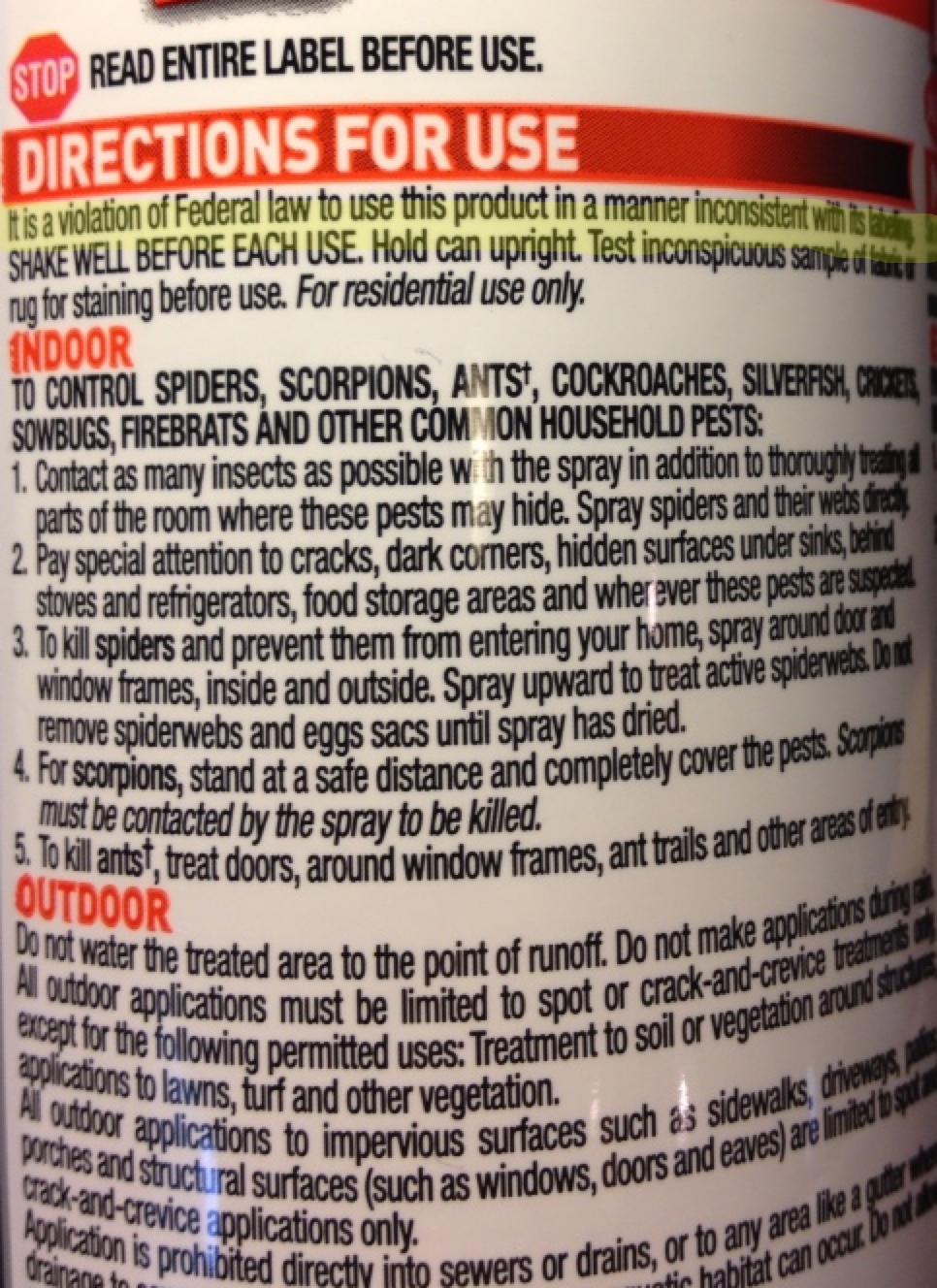
bug sprayTake a look at the highlighted portion of the picture. There you will read the following: It is a violation of Federal law to use this product in a manner inconsistent with its labeling.” As any trained pest control technician would tell you, the label is the law.”

So, if you are ever forced to use your bug spray on an attacker, bear this in mind: a good defense attorney will have your skin for the premeditated illegal use of a potentially deadly substance. If your attacker is harmed in any way, don’t think for a moment that a sleazeball lawyer won’t take advantage of you “violating Federal law.” Your attacker may even get off without jail time, all because you hurt his feelings with anything but a double-barrel shotgun.

Law and Grace

When the law is all there is, legalists will seize any opportunity. There will always be someone willing to twist the law to his (or his client’s) own advantage.

Paul told Timothy, “we know that the law [is] good, if a man use it lawfully” (1 Timothy 1:8). Unfortunately, in this day and age, there are those who don’t always use the law for good, but for gain. Therefore, be careful.

Thank God for grace.

My advice…get a Glock or shotgun.

7 Comments

Filed under America, General Observations, legalism

The Real Problem with the Problem of Evil

One of the most common reasons for denying the existence of God is the problem of evil in the world. Just ask any group of atheists to give their top ten reasons for unbelief and surely one will claim as number one, “If there is a God, then why is there so much evil in the world?” For many, this is the pièce de résistance of rebuttals. How could a good God be real and allow all the suffering in the world to continue unabated – assuming He is even good? The eighteenth century philosopher, David Hume described the problem this way in Dialouges concerning Natural Religion, 1779:

“Is God willing to prevent evil, but not able? then he is impotent. Is he able, but not willing? then is he malevolent. Is he both able and willing? whence then is evil?” (Stackhouse 1998, 11)

So, the “problem of evil,” and its source, has been an issue of philosophical debate for centuries.  The existence of evil in the world, along with unanswered questions, has even become evidence enough for some to even embrace atheism.  Therefore, because so many philosophers and theologians have tried for ages to reconcile the existence of God with the existence of evil, I dare say that nothing I write will be new.  But, if anyone were to challenge my belief in God, along with my faith in Jesus Christ, with the argument that the problem of evil constitutes proof God does not exist, then I would possibly respond with arguments based on the following thought: without the existence of God, there should be no evil to be a problem, and that’s the real problem with “the Problem of Evil’

What exactly is “evil?” Now, that may sound like an absurd kind of question to ask, but if the existence of evil is the evidence that is supposed to expose my faith as a fraud, at best, or even a lie, then what is it?  Is it something tangible? Is it metaphysical? Is ittheoretical? What is it, exactly? Does it have any particular form? How can it be distinguished from what is called good? On what do the atheists and agnostics base their definition of this thing called “evil?” Amazingly, the answers are not all the same, nor in some cases even grounded in reality. However, it is imperative to understand that we must define this God-killer, because its definition will determine our conclusions and help to clarify our assumptions. When C. S. Lewis was an atheist, for example, his “argument against God was that the universe seemed so cruel and unjust.” (Lewis 1989) There he had it, or so he thought. God could not exist because so much evil exists. But how did he arrive at “this idea of just and unjust?” Lewis said, “A man does not call a line crooked unless he has some idea of a straight line.” (Lewis 1989) “Tell me,” I would say, “what is evil, and how do you recognize it when you see it?

To start, evil must be understood to be an adjective. Evil is a description of something that is not good. Evil is not a thing. The word “evil” only describes the thing, the thought, and the action. Technically, “evil” does not exist, only what it describes. Some people say that they cannot believe in God because why or how could a good God, if He was perfect, create evil? They think of evil as something that must have not existed until God made it. But evil “isn’t a kind of molecule or a virus…infecting or affecting everything it encounters.  There was no time when God said, ‘Let there be evil,’ and there was evil.” (Stackhouse 1998)  As John G. Stackhouse put it, “evil becomes a noun only in the abstract.” Additionally, in his book Can God Be Trusted, Stackhouse says of evil:

“An action can be evil, or an event can be evil, or a quality can be evil, or a being can be evil. And we can lump all these particular evils together in our minds and come up with a category ‘evil.’ We can even go on to discuss it as if it were a particular thing, so long as we do not forget that we are always dealing with a category or group of particular evil things, not a thing itself.” (Stackhouse 1998, 31)

So then, if evil is a description, how is it that we come to use the adjective, or as Lewis put it, the “crooked line,” without first having some idea of what is a “straight” one?  Defining what is good is as important as defining evil. To know what is evil, we must first have some assumption as to what is not evil. The crazy thing is that if God does not exist, and man is nothing more than a collection of random matter, both good and evil are purely relative – their existence is based purely on one’s perspective.  So, in other words, the one who says that there is no God, based on the existence of evil, is literally basing his belief on pure opinion, not on anything objective; therefore, in order to bring an accusation against the goodness of God, one must have a base line. What is the standard by which we determine what is good and what is evil?

Some use Man as the baseline. They compare God to the standard set by what is thought to be good behavior in this world. They rationalize that if God is real, at least according to monotheistic dogma, He must be all-powerful, perfectly good, and the supreme example of love, kindness, and providential care. Because it is preached that God is a better Father than earthly fathers, Mark Twain took it upon himself to write:

The best minds will tell you that when a man has begotten a child he is morally bound to tenderly care for it…[yet], God’s treatment of his earthly children, every day and every night, is the exact opposite of that, yet those minds warmly justify those crimes…when he commits them.” (Tonie Doe Media 2007)

So then, according to Twain, God could not exist because if He did, He would act consistent with our understanding of what a good and loving earthly father would do.  In other words, if God cannot, in all His perfection, behave better toward His children than the most common man, His credentials are therefore revoked, and He must cease to exist.  However, this is so illogical. Who are we to say that God, if He is perfect, and we are imperfect, ever treats His children poorly? Do the protesting cries of a toddler who has had poison taken from his grasp carry more weight than the decision of the earthly father to take it away? How, then, are we to automatically assume that the infantile tendencies of finite man are wiser than the infinitely Mature?  Using Man as a baseline for what is good and evil is pure arrogance.

In reality, the problem of evil is really a problem for the atheist. He, who denies the existence of a Creator and accepts only the realities of evil in the world, essentially has nothing about which to complain.  Everything should be just fine and dandy, but it’s not.  The atheist knows that evil things happen to good people, as well as bad.  He sees the hurt, feels the pain, and begs for justice. The reality of evil in the world causes men to cry out for justice; for things to be made right. This is a problem, though, because knowing that a crooked line is not straight hints at the fact that a Line-drawer exists.

Of course, there are others who take a different approach. They claim that God does not exist except in the evil intentions of his followers to control others through guilt. They claim that God is just a fabrication of priests to keep mankind from behaving “naturally.” They say that nature is good, and if anything, God is evil for trying to get man to behave contrary to the very way he was created to behave. One guru said, “It seems that for those who worship God, the opposite to God is not that which is ‘evil,’ but that which is natural.” He said of animals, comparing them to men, “They don’t worship God, they don’t go to church, they don’t have any theology.  They don’t have any feeling of guilt, they are simply natural.” (Osho 2009)  In other words, if there is evil in the world, it is because our belief in God has inflicted it.

But for the majority of the hurting world, pain is real, loss is real, and evil is manifested daily.  Many see the things that happen to innocent people, especially children, and wonder, “If there is a loving God, why doesn’t he do anything about this?”  These people, many of which hold on to hope as long as they can, finally succumb to their doubts and conclude that the only way to explain away the pain is to admit that it is just part of life, part of the natural world, part of what makes us human; alone, in our quest to make life easier, free of pain, free from evil; alone, without God. These are the ones, I believe, that lure more away from the faith than any Darwinist.  They are the ones who have seen evil face-to-face and cannot fathom a God who would allow it to continue.  And because their experiences are so painful and tragic, the devout are left speechless and without explanation. Ellie Wiesel is a good example.

Wiesel was a teenager when he saw his family murdered in the Nazi death camps.  But it was only after witnessing one particular act of horror – the slow, hanging death of a young boy – that he turned away from his faith in God. In the book Night, his Nobel prize-winning autobiography, Wiesel said he heard a man behind him ask, “Where is God now?” As he stood there, being forced to stare into a pitiful, wide-eyed, swollen face of a dying child, a voice within replied, “Where is He? Here He is – He is hanging here on the gallows…” (Wiesel 1982) Because there was no justification, even in the big scheme of things, Ellie Wiesel’s God died with the executed boy.  But as sad as it is, without God, who can say what happened to that boy was any worst than the slaughter of an animal?  Are we not all just animals – some more evolved than others?

To me, the problem of evil is not a problem for the believer, but for the non-believer.  Aside from the theological arguments about the character of God, without God, to turn Hume’s question around, “whence then is evil?” Without God, evil is relative to one’s desires and personal pleasure.  Does it really even matter whether or not God could do anything about evil in the world when the whole question is moot if He didn’t exist?  With God, evil is defined as that which is against His law, that which stands opposed to His standards, and that which describes all who take pleasure in such rebellion. Without God, evil is just a matter of opinion. That is the real problem of evil.


Works Cited

Lewis, C. S. “Atheism.” In The Quotable Lewis, by C. S. Lewis, 59. Wheaton: Tyndale House Publishers, Inc., 1989.

Osho. The God Conspiracy: the path from superstition to superconsciousness. New York: Osho Media International, 2009.

Stackhouse, John G. Can God Be Trusted. New York: Oxford University Press, 1998.

Tonie Doe Media. In The Atheist’s Bible, 129. New York: Harper Collins, 2007.

Wiesel, Ellie. Night. New York: Bantam Books, 1982.

41 Comments

Filed under Apologetics, Culture Wars, Faith, General Observations, Life/Death, Struggles and Trials

Girl Logic 101

A Pedagogical Surmise

As most of you are aware, I drive a school bus, and on my school bus there are several young girls who love to make fun of their male counterparts. With regularity they repeat a little rhyme which is suppose to show that girls are not only smarter, but inherently more capable of seeking an education.

They claim: Girls go to college to get more knowledge. Boys go to Jupiter to get more stupider.

jupiter

Jupiter. Credit: HubbleSite.org

If that is so, then the following points are in order:

1. Don’t you think that it takes a little more knowledge to go to Jupiter than to college? One requires the use of a multi-billion-dollar space ship; the other your daddy’s car.

2. In order to have acquired the technical skills to travel to Jupiter, the boys must have already attended a fine engineering college or university, maybe even grad school? Then they must have been able to pass the extremely demanding requirements to be accepted into the space program. And what is it you’re studying in college?

3. If the boys now have the ability to travel to where NASA has yet to plan, and if the girls have yet to finish college, there is evidently a MASSIVE learning gap between the two. Therefore, should they get “stupider” while on Jupiter, and yet still (by implication) have the ability to navigate a return trip to earth, then they still will have retained a cognitive advantage over Buffy and Bambi, the bantering sorority sisters.

4. “Stupider” is not a word. Therefore, ladies, I would suggest you enroll in some remedial English classes before you dive into the full-blown college stuff. Knowledge is power!

So, girls, what’s your point?

Leave a comment

Filed under General Observations, Humor, politics

Decaffeinated Christianity

Like vs. Love

I like coffee, but I wouldn’t say I love it. My wife and kids, on the other hand, are worth dying for. I love them. I only like coffee. I’m not going to jump in front of a moving train to save an espresso.

But there are times when I like coffee more than I like my wife. Every once in a while I want a cup of coffee more than a kiss or a hug. I still love my wife, but she won’t fit into the French press.

Now, it must be said that I also like tea. Thanks to the influence of certain English folk, my tea consumption has increased a thousand fold! Yet, tea is not coffee. Sometimes I want coffee more than tea. Sometimes tea needs to leaf me alone. There’s a big difference between loose-leaf anything and some medium roast Jamaican Blue Mountain. That’s real coffee, and I really like it.

What is Real?

But wait! That raises a question. What is real coffee? What is the difference between freshly brewed coffee and let’s say, uh, freeze-dried instant? Both are real, aren’t they?

Fake coffee. Whoever still drinks that stuff on purpose should be psychologically evaluated. Coffee is only coffee if it comes about as the result of gently ground coffee beans being caressed by steaming hot water. Chicory is of the Devil.

Instant coffee. It comes packaged in a jar, but it is made from real coffee. It may not taste as good as fresh-brewed, but it’s real, nevertheless. The worst instant coffee is still better than dandelion tea, believe me.

Nasty coffee. Even the stuff you find in a gas station, an army mess tent, or a crazy relative’s thermos is still coffee. Coffee is coffee, even if it tastes like road tar.

“Unleaded.” What I don’t understand is decaffeinated coffee. Sure, it tastes the same to most people, but why would anyone want it? Without the caffeine coffee is…well…it’s just not coffee. It has the look and taste, but no umph, no kick, no power.

Powerless

Decaffeinated Christianity is the same way. It looks like the real thing. It smells like the real thing. It tastes like the real thing. For crying out loud, it even outsells full-strength, real Christianity 10 to 1! People love it! They wear t-shirts promoting their favorite brand. Yet, decaffeinated Christianity is no better than decaffeinated coffee without the Power.

You should know this, Timothy, that in the last days there will be very difficult times. For people will love only themselves and their money. They will be boastful and proud, scoffing at God, disobedient to their parents, and ungrateful. They will consider nothing sacred. They will be unloving and unforgiving; they will slander others and have no self-control. They will be cruel and hate what is good. They will betray their friends, be reckless, be puffed up with pride, and love pleasure rather than God. They will act religious, but they will reject the power that could make them godly. Stay away from people like that! – 2 Timothy 3:1-5 NLT

What are you drinking?

4 Comments

Filed under Christian Living, Christian Maturity, General Observations, Life Lessons, Uncategorized

A Small Observation

A version of this story can be found in my book, Life Lessons from the School Bus.

Politically Incorrect

OK, I will admit it, once you read what this is all about you will tell me that I am being politically incorrect, insensitive, or mean-spirited. You will say that the title of this post is inappropriate and beneath me (well, the beneath part is right). You may tell me that I should not make fun of those who are “vertically challenged.”

If you say these things because you think I am making fun of short, small, or otherwise non-tall people, then think again. I am only being humorous at their expense to make a point. Actually, it won’t be at their expense for long. I am going to pay the bill.

Children Can be Cruel

You know it’s true – children can be cruel, especially around people who are “different.” When driving around a bus load of elementary children, one can hear a lot of cruel comments come from their little, angelic, crumb-crunching mouths.

photo 2 (2)Little girls, as well as little boys, can get downright mean with the things that they say. However, they have no idea of the lasting consequences of their teasing. They have yet to sit through months or years of counseling.


Because kids can be cruel, even when they don’t mean to be, I try to steer them (literally) away from opportunity. But on one occasion, even though I did the best I could, the kids jumped at the chance to gawk and laugh. I will never forget what I saw.

Choosing Not to Hear

One day I was driving my school bus down a two-lane road when just ahead of me I spotted a dwarf…a short guy…a midget…walking by the curb. Immediately, I knew what was about to happen.

Right ahead of where this guy was walking was a place I had to make a stop. Sadly, I could not just speed on by, but had to slow down. When the first child saw this little man it didn’t take long for the 20+ others to shift over to that side of the bus to take a look. In an instant there was laughter.

But in all honesty, the laughter was not all that loud. My kids are aware that stuff like that makes me angry, so they try not to get caught. So, only if one had been really listening or paying attention could that person have heard the giggles and jokes. The little man on the road didn’t want to take any chances.

As soon as I started to pass by this 3ft-tall little bald guy with biker tattoos (wearing a tank top and little jeans), he did something that really broke my heart -he put his finger in his ear. He knew what was coming, and he didn’t want to hear.

That simple action said a whole lot. 

  • He had heard cruel laughter before
  • He expected to hear it again
  • He knew what kinds of things would be said
  • He did not have the will, nor the ability to defend himself
  • He decided to not listen, but to close his ears

Sadly, many are convinced what other people say about them is true.

The jeers and the laughter not only offend, but they cut deeply, causing irreparable scarring and pain. How many have given up? How many have quit defending themselves?

One of the characteristics of a true Christian should be that he defends the defenseless, the ones who can not speak up for themselves. Psalm 82:3 says that we should “defend the poor and fatherless: do justice to the afflicted and needy.” Couldn’t this also apply to standing up for those who are made fun of or mocked unjustly?

Consider the words of Jesus: “Thou shalt love thy neighbor as thyself” (Mark 12:31). What kind of person would want to be laughed at because of something he/she could not help?

Be Considerate

The next time you are tempted, consider what you are doing. The next time you are around someone, even a child, who makes fun of another person, stop and take the time to “defend” and “do justice.”

Don’t walk around with a finger in your ear.

1 Comment

Filed under Christian Maturity, Do not judge, General Observations, self-worth

Self-Deprication

1 Comment

by | April 8, 2016 · 10:20 am

Email Hacked? And You Clicked On It?

The Notification

“Anthony, your email has been hacked,” so said my wife when she called me. “Are you serious?” I replied in disgust. “Maybe you should reset your password,” she suggested.

yahoo_iconOh, I did…again! This wasn’t the first time I’ve received a notification that my email has been hacked (#*!%#@! Yahoo!). And, it’s not easy keeping up with new passwords, much less when you constantly have to change them after some boob has hacked your email! Dang it!!


(And in this case, when I say “dang it,” I really do mean what I can’t write.)

I might as well just give all of you my password right here and now. Why not? I mean, I’m going to have to change it tomorrow, anyway, right?

So, you get it… Some jerk (whether it be a person or a machine) found a way to send emails with my name attached. Somebody, posing as ME sent emails to my FRIENDS…as ME.

Why Would I?

But, honestly, all of this would be a non-issue if those people who get these hacked emails would just stop and think. I mean, seriously!

Why would I (the pastor, the preacher, the Christian author) send stuff like the following to people I know?

  • Anthony Baker     ………#1 way to boost your testosterone!
  • Anthony Baker     ………Hey hot stuff! Got plans for tonight?
  • Anthony Baker     ………Long time, long night! U R gonna LUV this!
  • Anthony Baker     ………Best DEAL EVER! Gotta check it out!
  • Anthony Baker     ………Happy w/ur job? Make Million$$ frm HOME!!

If you are stupid enough to click on any of the above emails supposedly from me, just unfriend me, don’t call me, and delete me from your contact list. If you seriously think I would send out trash like that…give me a break!

If nothing else, am I making millions from home? Hardly. So why would you take my advice? Or, you could be wanting to just see what kind of perversion I could be smeared with, right? Shame on you.

My Name

Seriously, folks, what bothers me most about this email fiasco is that some people would actually click on something vulgar, even with my name attached. Why?

When you see my name attached to an email, letter, tweet, Facebook message, or whatever, and it doesn’t fit my character, delete it!

“A good name is rather to be chosen than great riches, and loving favour rather than silver and gold.” – Proverbs 22:1
“A good name is better than precious ointment; and the day of death than the day of one’s birth.” – Ecclesiastes 7:1

My name and my reputation are important to me, and what I send out on the internet should be that which reflects a man of God. If it is trash, it’s not from me.

And, yes, I’m considering a new email provider.

2 Comments

Filed under current events, General Observations, Witnessing