Tag Archives: Christianity

A Mini Commentary (Pt. 2)

Welcome back to part 2 in this series of posts focusing on a particular section of the book of Ephesians, Paul’s letter to the Church at Ephesus.

Yesterday I shared with you the Introduction. Now, let’s jump right into it with the very first verse, Ephesians 4:1


4:1 “I therefore, the prisoner of the Lord, beseech you that ye walk worthy of the vocation wherewith ye are called,”

I therefore,

The first thing to consider in this verse are the words “I therefore.” As an old saying goes, whenever we see the word therefore, we need to ask what it is there for? Here, therefore is referring us back to the previous chapter, arguably to the very beginning of the letter.

the prisoner

Paul referred to himself as a “prisoner” (δέσμιος) five different times in his letters (Eph. 3:1; 4:1; Phm. 1:1 and 1:9; 2 Tim. 1:8). Interestingly, maybe even ironically, the idea of the word desmios is that of one who has actually committed a crime and is a “person who is under custody in prison—‘prisoner.’”[1] In any other situation, to be a guilty prisoner should expect judgment and condemnation, except the Lord (κύριος) to whom he is a prisoner is Jesus Christ, as seen in 3:1. Because of this, Paul doesn’t recoil from the idea of being a prisoner – he revels in the fact, for it is only THIS Lord who has paid Paul’s debt and imputed His own righteousness. Though a prisoner, he is free.

of the Lord,

The difference between using “Jesus Christ” and “Lord” in 3:1 and 4:1 can be seen in the differing contexts; one being the context of a Messiah for all, the other being the context of those answering to the Master for the task we have been given. Both aspects will contribute to the foundation of Paul’s later argument for unity. Jesus is not only the Messiah for the Jews, but also the Savior of the Gentiles. Yet, as implied in 4:1, Jesus is also our Master. The implication is that what Paul is about to address will be something for which we will be held accountable.

What about the preposition in relation to the prisoner? The KJV renders ἐν as “of,” but according to the Pulpit Commentary, Paul’s prisonership is more than one of association, but partnership: “Not merely “of the Lord,” but ἐν Κυρίῳ, the usual formula for vital communion with Christ, indicating that his captivity was the captivity of a part or member of the Lord.”[2] Here with this preposition we see a foundational stone in the building of Paul’s argument for unity in the Body of Christ, for we are all part of that Body.

beseech you

Speaking to all the Christians who would hear or read this letter, Paul showed concern and passion as he “beseech”-ed the Church to “walk worthy.” The word παρακαλέω (Strong’s G3870) was used by Paul fifty times in his letters and epistles. Sometimes the word was translated as “comforted” (1 Corinthians 14:31) or “exhort” (2 Corinthians 9:5). Yet, more often parakaleo was used with the meaning of “to ask for something earnestly and with propriety.”[3] However, it would be too simple to conclude that Paul’s beseeching was simply “begging” people to do something. The depth of parakaleo implies that Paul was speaking as a friend, a companion on the same journey, to those he called to his side to impart wisdom. One could almost sense that the Apostle couldn’t tell them everything he wanted to, but could only simply say “…please, I beg of you, for your own good…”

that ye walk worthy of the vocation wherewith ye are called,

            The Apostle Paul wrote to the Philippians, “Only let your conversation be as it becometh the gospel of Christ…” [4] Here in Ephesians 4:1 as also in Philippians 1:27, Paul uses the word ἀξίως (axios), which is an adverb modifying the verb “walk.” With the idea of one’s walk being his way of living and choice of conversation, his “walk” should be one that reflects positively on both the calling and the Christ who issued it. Paul goes on in the next verses to give examples of what a “worthy” walk would include.

  • Vocation

 The first thing that probably comes to mind when we see this word is one’s career or job. Some may be familiar with “vocational schools,” places where students learn skills which they will apply in their career, their vocation. When it comes to the Christian, all work should be considered sacred, and every “vocation” should be understood as a calling.

 Translated as “vocation,” κλῆσις (klēseōs Strong’s G2821) means more than one’s career choice, “but invitation to experience of special privilege and responsibility, call, calling, invitation.”[5] Used nine times by the Apostle Paul (Rom. 11:29; 1 Cor. 1:26, 7:20; Eph. 1:18, 4:1, 4:4; Phil. 3:14; 2 Thess. 1:11; 2 Tim. 1:9), once by the writer of Hebrews (Heb. 3:1), and once by the Apostle Peter (2 Pet. 1:10), it’s only in 4:1 that we see κλῆσις translated as “vocation”; every other time it is translated as “calling.” However, if we were to replace calling with vocation in several of these other verses, it might help shed light on the sanctity of work.

Romans 11:29 KJV – For the gifts and [vocation] of God are without repentance.

1 Corinthians 7:20 KJV – Let every man abide in the same [vocation] wherein he was called.

Philippians 3:14 KJV – I press toward the mark for the prize of the high [vocation] of God in Christ Jesus.

Those in ministry often refer to their vocation as a “calling,” i.e., they were “called” into the ministry of the Gospel. When we consider that vocation is another word for calling, every vocation is a calling from God to be a witness where He places us. However, in the context of this passage, part our job description is to “forebear one another” and “endeavor” to keep unity in the Body of Christ.”


[1] Johannes P. Louw and Eugene Albert Nida, Greek-English Lexicon of the New Testament: Based on Semantic Domains (New York: United Bible Societies, 1996), 485.

[2] H. D. M. Spence-Jones, ed., Ephesians, The Pulpit Commentary (London; New York: Funk & Wagnalls Company, 1909), 146.

[3] Johannes P. Louw and Eugene Albert Nida, Greek-English Lexicon of the New Testament: Based on Semantic Domains (New York: United Bible Societies, 1996), 407.

[4] The Holy Bible: King James Version, Electronic Edition of the 1900 Authorized Version. (Bellingham, WA: Logos Research Systems, Inc., 2009), Php 1:27.

[5] William Arndt et al., A Greek-English Lexicon of the New Testament and Other Early Christian Literature (Chicago: University of Chicago Press, 2000), 549.



Leave a comment

Filed under Bible Study

A Mini Commentary (Pt. 1)

Hello… Again!

A month or two ago I was happy to announce that I would be returning to the blogging community with new content and would be reading your stuff again. Well, it’s taken longer than I planned.

Have you ever noticed how life can get a little busy?

Anyway, today I want to start a short (maybe) series of posts based on some study I did in the 4th chapter of Ephesians. It was a short (mini) commentary that was, among other things, required for me to complete my Doctorate of Ministry (D. Min.).

So, without further ado, let’s begin with the beginning: the title and a short introduction.


“The Edification of the Body of Christ by the Gifts Given by Jesus to the Church”

(An exposition of Ephesians 4:1-16)

Introduction

Photo by Jeff Stapleton on Pexels.com

The following exposition focuses only on one small section of the Apostle Paul’s letter to the church at Ephesus. This section uses the metaphor of a human body to explain the truth that the Church is the Body of Christ. But even more, he delineates between the corporate truth and the individual truth: that the Body is being built up and matured, but that God is also concerned about the individual member’s development.

    This section is also where we find an explanation of the “grace” gifts to the Church Body and members in particular. These are the Apostles, Prophets, Evangelists, Pastors, and Teachers. As Paul explains, it is these gifts that are necessary for growth.

    Paul then details the progressive steps toward growing “up into Christ” as not only the supreme Example, but the very Framework and pre-determined Design for the Church and individual member alike.

    Ephesians 4:1-16 is the blueprint for a successful and healthy Church, where the rest of the chapter focuses on the individual member of the Body’s walk. Yet, these sixteen verses are full of encouragement and hope. No matter our station, no matter our abilities, we are all designed by God, equipped by God, placed by God, and are guaranteed to grow with the Body through the enabling power of the Holy Spirit.

But key to our success is the faithful application of the gifts He has given us. They cannot be ignored, kept to ourselves, or prohibited. In whatever measure we are given these gifts, the ultimate goal is not self-edification, however important in its own right; the ultimate objective is the edification – the building up into Christ – of the Church, the Body of Christ. Only by seeking to edify the Body can individual gifts find their greatest fulfilment.


Come back tomorrow for Part 2 in this series.

If any of it is a blessing or an encouragement, I’d love to hear about it.

God bless!

1 Comment

Filed under Bible Study

If You Have Honest Questions, Why Not Ask?

2 Comments

Filed under Apologetics, Bible Study, Christianity, Faith

America Was Established On God, But Then…

I admire this nation formed by God. I respect the brave men and women, motivated by God, who fought to establish this country. The precise structure …

America Was Established On God, But Then…

1 Comment

Filed under Abortion, America, Guest Posts, History

You Can Laugh, But I Believe

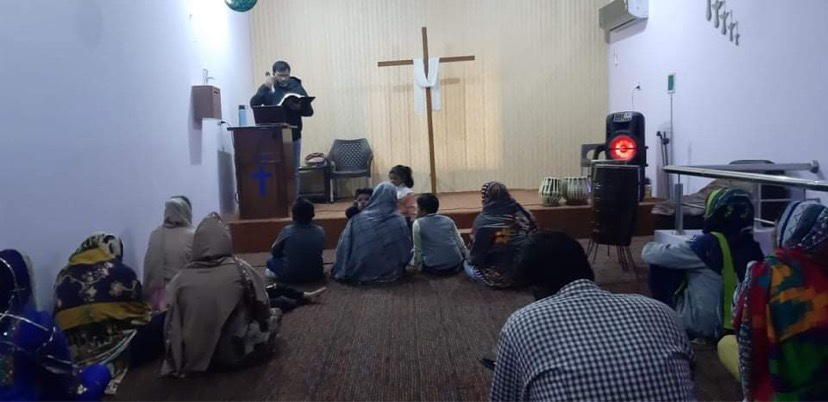
It is 1:27 in the morning, and I just finished preaching to the congregation in Pakistan. It was a sweet time of fellowship with brothers and sisters 10 time zones away.

This time I told Pastor Victor that I would provide to him a transcript from which I would preach so that he would be able to know exactly what I said. But that being said, having a transcript made things easier for me, too. As some of you may understand, it is not at all easy to preach through an interpreter.

So, doing the best I could with the little time I actually had – because a 10-minute sermon can take 15 minutes to translate – I preached a sermon on the Rapture. Honestly, it was a VERY SIMPLE sermon, one which was meant more to encourage the believer than convince the skeptic.

After all, how many unbelievers do you expect to show up to a Christian service in a 98% Muslim country?

I hope the following sermon transcript encourages you, too (even if you didn’t vote for Trump – LOL).


Good morning, brothers and sisters, I am so happy and honored to be worshipping with you today.

It is also my honor to have been asked by Bro Victor to preach to you each Sunday the rest of this month.

When Bro Victor asked me if I would preach each Sunday in February, I asked him what it was that he thought I should preach.

That is not something I normally do; I normally never ask another man what I should preach, only God.

But this time, because your pastor knows you better than I do, I wanted to hear what you needed or desired to hear from God’s Word.

So, today I am going to talk about something that should be an encouragement to all of us… to every Christian in every country… This morning I am going to talk to you about the Rapture of the Church.

I am going to ask Bro Victor to read to you my opening text…

1 Corinthians 15:51-53 – Behold, I shew you a mystery; We shall not all sleep, but we shall all be changed, In a moment, in the twinkling of an eye, at the last trump: for the trumpet shall sound, and the dead shall be raised incorruptible, and we shall be changed. For this corruptible must put on incorruption, and this mortal [must] put on immortality.

This year in America we had a very controversial election. According to the numbers reported, this year more people voted than ever before – the most for a Republican candidate, the most for a Democrat candidate.

Unfortunately, many Americans just like myself think something was not right.

We look at the crowds President Trump had at his campaign rallies, then compare them with the tiny crowds Joe Biden had, and it’s very hard to believe that more people voted for Biden than Trump.

So, when people ask me, “Anthony, do you think the election results were manipulated?” I say, “Yes, I do.”

Now, the problem is that anyone who thinks like I do these days is laughed at and mocked. It is now being said by some people that those who voted for Trump should be sent away to re-education camps!

They even say that Trump voters are as crazy as Christians – and as dangerous – for believing in a “fairytale,” a “myth,” even a “lie.”

This should come as no surprise to us, for Jesus said that His followers would be hated by the same people that hated Him. Those who mock the name of Jesus will mock Christians, too.

But what do people think of you and me when they ask if we believe in the Rapture of the Church? Should we be surprised if they laugh at us?

Just like those of us in America who think something went wrong with the election, they will laugh at us and say, “Show us the evidence!”

But this is nothing new, for they have been saying the same thing for 2,000 years! Saint Peter wrote about these people…

2 Peter 3:3-4 – Knowing this first, that there shall come in the last days scoffers, walking after their own lusts, And saying, Where is the promise of his coming? for since the fathers fell asleep, all things continue as [they were] from the beginning of the creation.

But let me tell you, dear church, that things have not always gone on the same from the day of creation. For one thing, everything changed when a Virgin gave birth to a Child and called His name Jesus!

The world went on like normal for thousands of years until the King of the Universe, the Living Word of God, became flesh!

John 1:1-2, 14 KJV – In the beginning was the Word, and the Word was with God, and the Word was God. The same was in the beginning with God. … And the Word was made flesh, and dwelt among us, (and we beheld his glory, the glory as of the only begotten of the Father,) full of grace and truth.

This was the First Coming of Jesus Christ! The fact that Jesus came to earth the first time is all the evidence I need that he will return again.

For you see, for thousands and thousands of years a Messiah was promised, even as far back as the Book of Genesis when Eve rejoiced at having a man child.

Throughout the Old Testament we read of One who would be our Kinsman Redeemer, our Great Shepherd, our Fountain in the wilderness, our Rock in the storm, and the Servant who would suffer for the sins of mankind (Isaiah 53).

The Messiah was promised, His birth, His life, and His death… especially His resurrection… were all prophesied, and it all happened just as we were told it would!

Acts 1:9-11 KJV – And when he had spoken these things, while they beheld, he was taken up; and a cloud received him out of their sight. And while they looked stedfastly toward heaven as he went up, behold, two men stood by them in white apparel; Which also said, Ye men of Galilee, why stand ye gazing up into heaven? this same Jesus, which is taken up from you into heaven, shall so come in like manner as ye have seen him go into heaven.

Did you hear that last part? This SAME JESUS shall so come!

Jesus told us that He would return. Do I believe Him? Yes, I do!

As the Apostle Paul said, one day a trumpet will sound, the dead will be raised, and we who are living will be caught up! We will be snatched up, like pulling a fish out of the water! We will be taken out, like pulling a cork out of a bottle!

In the blink of an eye, when the trump of the Lord shall sound, we shall be “caught up,” raptured to be with Jesus!

IF I can do nothing else this morning, dear church I want to encourage you!

You live in a world that hates you for what you believe, for you believe in grace, not works.

You believe in freedom, not slavery.

You believe that all men and women, boys and girls, are made in the image of God.

You believe that God became flesh, that Jesus died for our sins, and that He rose again.

You believe in Jesus, yet you are mocked, you are laughed at, you are hated.

But you and I have a HOPE! Our HOPE is not in our good deeds.

Our HOPE is not in how many times we pray or in what direction we pray.

Our HOPE is in Jesus! Our HOPE IS Jesus!

And one day, whether we live or die, one day He will receive us unto Himself!

Listen to what the Apostle Paul wrote to encourage the church at Thessalonica:

1 Thessalonians 4:13 – But I would not have you to be ignorant, brethren, concerning them which are asleep, that ye sorrow not, even as others which have no hope.

Some people are full of sorrow and fear because they don’t know where they will go when they die, but you know! You have hope in Jesus!

1 Thessalonians 4:14-15 – For if we believe that Jesus died and rose again, even so them also which sleep in Jesus will God bring with him. For this we say unto you by the word of the Lord, that we which are alive [and] remain unto the coming of the Lord shall not prevent them which are asleep.

You see, Paul was trying to encourage the Church, for many thought that those who had already died would never see the return of Jesus. But Paul said that not even death would prevent the Christian from receiving a resurrected body!

1 Thessalonians 4:16-18 – For the Lord himself shall descend from heaven with a shout, with the voice of the archangel, and with the trump of God: and the dead in Christ shall rise first: Then we which are alive [and] remain shall be caught up together with them in the clouds, to meet the Lord in the air: and so shall we ever be with the Lord. Wherefore comfort one another with these words.

Did you hear that? Those are the words of COMFORT! That is TRULY encouraging! One day, we don’t know when, but one day a trumpet is going to sound…

Do you believe that?

One day the Lord Jesus is going to descend from heaven with a shout! Do you believe that?

One day we will be caught up, taken out of this world, and given a new body fit for eternity in heaven!! Do you believe that?

Then, church, be COMFORTED WITH THESE WORDS! HALLELUJAH!

Do I believe that Jesus is coming again? Yes, I do.

Do I believe that at any moment a trumpet could sound and I could be raptured out of this world to be with Jesus? Yes, I do!

And why do I believe that? Because God keeps His promises! If Jesus came the first time as promised, then I believe He will come again just as He promised.

The only thing is that none of us knows when, so we must always be ready to meet Him.

Are you ready to meet Jesus? Are you ready to meet God?

Please be sure you have accepted Jesus as your Savior, dear friend. For if the trumpet doesn’t sound, we are also promised something else, that it is appointed unto man once to die, and after that the judgement (Heb. 9:27).

You could die today, even before the rapture, and you want to know your soul is right with God.

Brother Victor, I will now give the service back to you.

1 Comment

Filed under Christianity, Church, ministry, Preaching

What is “Good Preaching”?

Today is Sunday, and many of you will be going to church somewhere (or watching online). So here is a question:

Does the “preaching” part of the service have anything to do with your decision?

There are many opinions as to what constitutes “good” preaching. Some prefer a preacher who spits and hollers, bangs the pulpit, and makes that little “huh” sound between every amplified phrase. Others prefer the professor/preacher who reads from a manuscript in a mono-tone, non-offensive, Winnie the Pooh-like voice.

Either way, what we are talking about is delivery, not substance.

Does delivery matter?

When Paul told Timothy to pay close attention to his doctrine (1 Timothy 4:16) and to “preach the word” (2 Timothy 4:2), content was the issue. However, if a sermon is poorly delivered, the efforts of the preacher could be nullified. If the hearer is distracted, bored, offended, lulled to sleep, or has his ear drums wounded, what is the point?

In my opinion, good preaching is preaching that contains solid, biblical content, but also keeps the audience engaged. One should never discount the importance of the power of the Spirit working through the weakness of men (1 Cor. 2:4; 2 Cor. 12:9). But, as ambassadors of the King (2 Cor. 5:20) who have been charged by our Sovereign to “compel” (persuade)  hungry souls to come to His table (Luke 14:23), shouldn’t how we say what we say be important?

It is reported that Abraham Lincoln preferred listening to preachers who looked like they were swatting at a swarm of bees. In a similar vein, I think it was Charles Wesley who said that a preacher should “put some fire in his sermon, or put his sermon in the fire.”

On the other hand, Jonathan Edwards (1703-1758) is said to have read his sermon “Sinners in the Hands of an Angry God” with a steady, monotone voice, as the audience screamed in terror at the thought of falling into hell. So, delivery shouldn’t matter?

It would make sense that those entrusted with delivering sermons should do so in a manner befitting the “greatest story ever told,” but does delivery make a difference? After all, some of the greatest public speakers of all time were tyrants (Adolph Hitler).

Should delivery be an issue? Should we simply focus on truth?

What about you?

  • What type of preaching style do you prefer?
  • Has a particular style of sermon delivery ever caused you to tune out to what was being said?
  • What suggestions would you like to offer to one just beginning public ministry?

Now, to be fair, below is a link to our church Facebook page and one of the last sermons I preached. It was Sunday morning, last week, on Sanctity of Human Life Sunday.

The preaching starts at around the 11-minute mark.

In your objective opinion, how would you describe my style in this sermon? Did my delivery enhance or distract from the subject of the sermon?

Ultimately, no sermon, no matter how well it’s delivered, can change hearts and minds and lives without the power of the Holy Spirit. Even the worst preacher, filled with God’s power, can be the most effective. In reality, one’s supreme goal should be for God to be heard and the preacher to be forgotten.

Yet, we are human, aren’t we? We should always want to strive to do better. Even Elijah presided over a “prophet’s school” (1 Samuel 19:18-24).*

 Click on the picture for link to sermon on Facebook.

*Just be careful when you talk about my bald head 😉

6 Comments

Filed under Abortion, Preaching

Speak With Authority, or Sit Down

It’s early on a Sunday morning, 15 minutes before 7 a.m., to be exact. I’m sitting here at the dining room table with my Bible and my laptop (graciously provided to me by our church), contemplating the Scripture I am going to be sharing a few hours from now.

What I am about to say is not for everyone, for not everyone has been given the responsibility to lead. Nevertheless, though not all of us will have the opportunity and calling to shepherd a congregation of believers, each and every one of us will at some point be responsible for communicating truth to those for whom we are one day going to give an account.

The verse from this morning’s text that has captured my attention is Titus 2:15.

“These things speak, and exhort, and rebuke with all authority. Let no man despise thee.”

That was the King James Version rendering. Now, let’s read the text as translated in another version.

You must teach these things and encourage the believers to do them. You have the authority to correct them when necessary, so don’t let anyone disregard what you say.

Titus 2:15 NLT

What I think we as pastors need to remember is that what we have to say needs to be taken seriously. If, however, we stand before our flocks as shepherds with no staff, not only are we “despised,” but so is the Word we are called to teach.

Those who know me the best know that I am a nice guy. Seriously, I hate confrontation so much that I will go to great lengths to avoid it. I want to be liked, even to a fault.

But when it comes to preaching and pastoring, we must take very seriously Paul’s admonition to Titus. As Paul left Titus in Crete to “set in order the things that are wanting,” so has God ordained us to set and keep things in order(1:5), speak those things which become sound doctrine (2:1), and remind believers of their obligations and responsibilities as representatives of God’s grace (3:1).

The problem we in leadership face is how to demand attention, to “let no one despise” us, without coming across as authoritarians or tyrants. Is a pastor to be a bully in the pulpit? Is he supposed to lord his authority over the sheep and force them to lie down in green pasture? Some think so.

However, it is Jesus who exemplified for us the model of servant leadership which draws attention. It is this same kind of example the apostles left us when we read of their boldness after Pentecost.

Our authority comes from the Word of God. Our boldness comes from the Holy Spirit. We are equally accountable as both heralds and subjects.

If we find ourselves timid, skiddish, reluctant, or intimidated behind the pulpit, we must ask ourselves some very point-blank questions. Who are we trying to please, God or man? Why are we called to be heralds? Just to be heard, or to proclaim the Message of the King?

Should we actually “speak the things that become sound doctrine,” then we are accountable to God for what we say, for we are to speak what He is saying. If we are tasked with heralding the Word, then God will hold us accountable for getting the message out to those who need to hear.

If we cower or hesitate in our duty, then we either doubt the authority of the Word, or we proclaim it in the power of our own strength. There is no excuse for the pastor, the shepherd, the man of God to stand behind the pulpit or on the neon-lit stage and waste time offering suggestions and scratching itching ears when we are plainly told, “These things speak…”

“Let no man despise thee” tells us there is a responsibility incumbent upon the preacher.

Therefore, unless you are going to mount the pulpit this morning with authority as one tasked with an urgent message from the King of the universe. . . unless you are going to “be strong in the Lord, and the power of His might” (Ephesian 6:10). . .

Sit down.

12 Comments

Filed under Bethlehem Baptist Church, Preaching

When my heart is overwhelmed

“from the end of the earth I call to you when my heart is faint. Lead me to the rock that is higher than I‭‭” Psalm 61:2 Over the past few days, …

When my heart is overwhelmed

1 Comment

Filed under Guest Posts, Love of God, Struggles and Trials

Preach What YOU Need to Hear

To begin, let me first apologize for the horribly weak audio of me speaking. The video I’m attaching was recorded, as usual, on my iPhone, but for some reason the corded external microphone attached to the pulpit didn’t work!

Ironically, you can hear everyone else clearly.

But beyond the audio issue, I’m attaching this video from Sunday night in order to encourage you. You see, even preachers need preaching to.

Did you know God loves you? He does.

If you have any questions or comments, I’d love to hear them. Either comment below or email me at pastoracbaker@yahoo.com.

Blessings!

3 Comments

Filed under baptist, Bethlehem Baptist Church, Bible Study, Christianity, Depression, Love of God, Preaching

Seeds and Harvest: the Hope of Christian Blogging

“High Cotton” by Anthony Baker

(Speaking to a friend about blogging, I said) We plant and water seeds of hope and love and joy and grace. We sow these seeds all over the world!

Rarely will we see a harvest, but the Holy Spirit knows how to take that divinely inspired “click” and turn it into new life.

It will be interesting, and wonderful, to one day see what God was able to do with the crazy medium of Christian blogging.

To HIM be the glory!

2 Comments

Filed under blogging, Christianity, hobbies, ministry, Uncategorized