Category Archives: Life/Death

No Time to Celebrate

As I write this, I am sitting in a familiar place. It’s a place I’ve been to many, many times.

It’s a funeral home.

To be honest, it’s not always been a place of sadness, at least not the kind I’m feeling today. No, many times it’s been quite the opposite, for “precious in the sight of the Lord are the death of His saints” (Ps. 116:15

But today is different.

Today I’m attending a “celebration of life” for a man I worked with. It’s a service of remembrance to celebrate the life and legacy of a well-loved individual. But nothing has ever been said about faith, not ever and not up until now.

So what about the next life?

The first song playing is “When I Get Where I’m Going.” It’s quite a sentimental piece that assures the listener that where the lost loved one is going will be wonderful. It’s got theological problems, but that a different issue.

But now there is a preacher speaking, and so far he’s speaking truth! That’s encouraging! What’s the outline? “Stand on the Truth That…”

  1. God is Good
  2. God Loves Us
  3. God Will Help You

Amen, brother! That was certainly unexpected! A solid gospel message was delivered! I’m gonna find out who that preacher is and thank him for being so bold! (I did)

The last song now playing is “Go Rest High On the Mountain.” (Please, if you respect my wishes, threaten to hang anyone who suggests that song for my funeral.)

But where’s the real assurance that will happen? God only knows the heart of a man. The only guaranteed prescription for hope after this life is faith in the Person of Jesus Christ.

Was there faith? There could have been. Possibly. Nothing definite. No testimony to draw from and no mention of anything remotely religious in his life. Only God knows.

And that’s why there’s nothing for me to celebrate, only mourn. Not only is a decent man gone, but that’s it. Nothing else. No hope of eternity, only wishful thinking wrapped up in pseudo-religious country music.

Leave a comment

Filed under Life/Death, Uncategorized

Postmortem Opinions of Those Who Unalive Themselves

This is going to sound wrong, but suicide is a fact of life. It’s not something that has to happen, but it does.

Odds are that each one of us knows a friend or relative who, by their own decision, exited life prematurely. I have known a couple.

But I want to know something. I want to know your thoughts. I want to know, if you knew someone, what you thought of that person after the thing was done.

One of the most common thoughts about those who commits suicide is that they were “cowards.” In other words, instead of facing their problems, they “took the easy way out.”

Was the person you knew a coward?

To be honest, for one thing, I think it takes a great amount of courage to put one’s theology to the ultimate test and risk eternal damnation. Then there’s the question of what method to use. Whatever the choice, does a coward take that fatal jump or pull the trigger without being forced?

What do you think of that person’s character? Obviously, taking one’s own life is not a good thing to do. So, do you now think of that person as bad or morally deficient? What about selfish? Prideful?

Did the person you knew abandon you or someone else?

What emotional attachment did you have? Did you love that person, or were you just an acquaintance? And what do you feel now, hate? Bitterness? Resentment?

Finally, did your opinion of the deceased change after their death? Did you at one point hold them in high regard? Did you lose all respect, or do you still recognize what had been their redeeming qualities?

If it is not too difficult, try to leave a comment below. Your input would be helpful.

Thank you.

3 Comments

Filed under Depression, Life/Death, Struggles and Trials

I’m Still Preaching

Today, June 11, is the anniversary of the death of a mighty man of God: a preacher, a pastor, my father. He died the week before Father’s day.

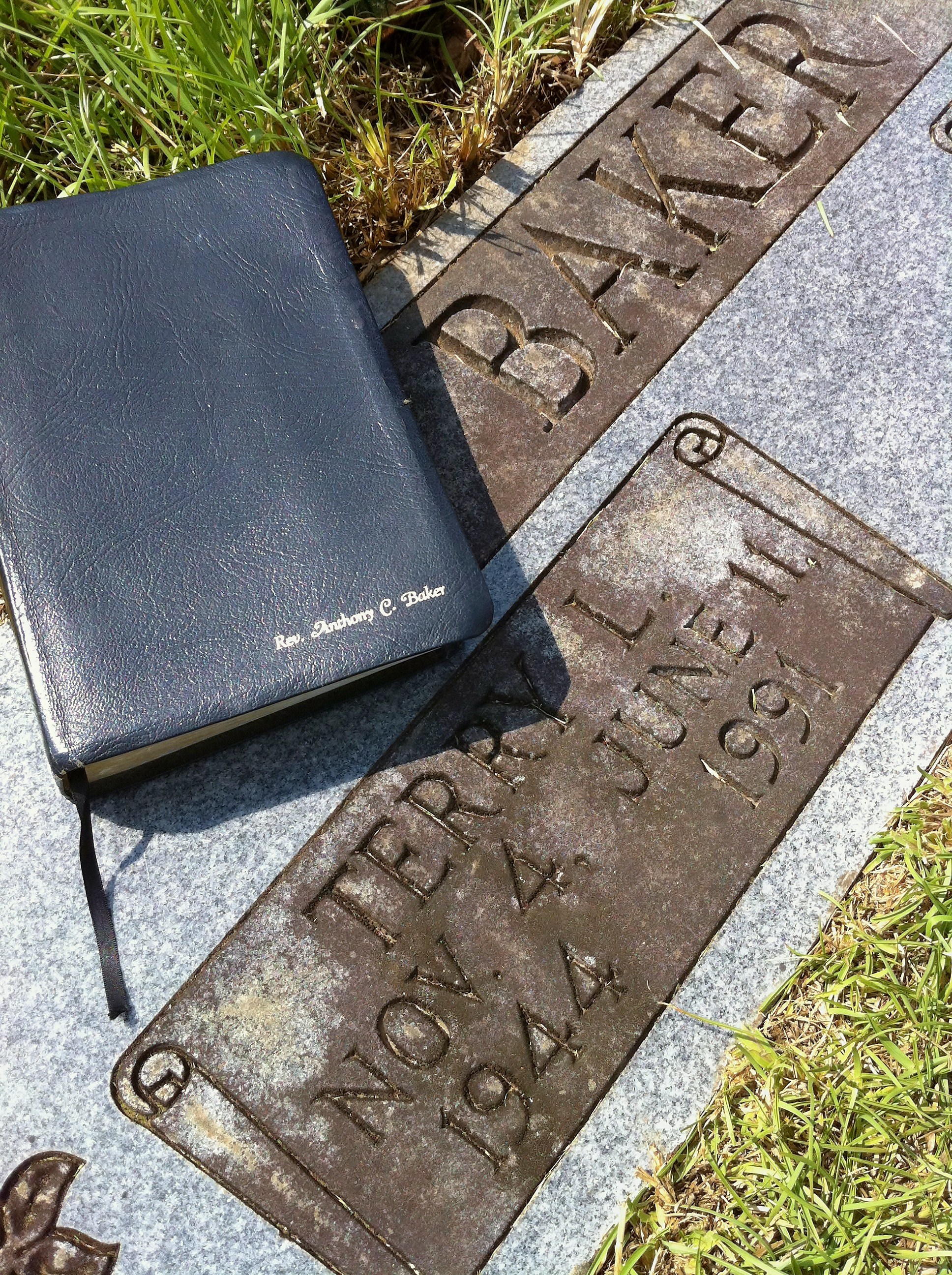
Several years ago I went to his grave and placed my Bible on his tombstone. There, glistening in the sun, were the gilded words “Rev. Anthony C. Baker.” It was a symbolic answer to a question I had received more than a few times. 

You Still Preaching?

I don’t hear it too much anymore, but I used to hear it rather frequently. Family members, old friends, former acquaintances, and the average person I never wanted to see again would come up to me and ask, “Hey, you still preaching?”

Maybe it’s the thing to do. Maybe it is customary to ask a person if they are still doing what they were doing the last time you saw them. I guess it makes sense.

But it’s when they ask if I’m still preaching that hurts on several different levels. Is it something I’d actually stop doing?

Some Statistics

In reality, it’s not that unreasonable to ask someone who once accepted the call to ministry if he is still preaching. Even though it sorta feels like an insult, I shouldn’t be surprised by other people’s shock. I mean, it has been 40 years since I made my calling public. I’ve known more than one who has walked away the first year.

If more people knew the statistics, few would ever enter the ministry. Stop and think about it, would you enter a career with the highest rate of heart attacks? Would you take out student loans for a degree that demands you work multiple jobs? Consider these sad facts…

  • 70% felt God called them to pastoral ministry before their ministry began, but after three years of ministry, only fifty percent still felt called.
  • 80% of pastors’ spouses wish their spouse would choose another profession.
  • 70% of pastors constantly fight depression.
  • 80% of adult children of pastors surveyed have had to seek professional help for depression.
  • 70% of pastors do not have a close friend, confidant, or mentor.
  • 80% of seminary and Bible school graduates who enter the ministry will leave the ministry within the first five years.

Still Preaching

Yet, even though I am longer in the pastorate, I’m still preaching. It may surprise people who haven’t seen me in a while, but I’m still doing the Lord’s work and still following the call I first heard when I was 16. It may sound strange, but I can’t help it.

“But if I say I’ll never mention the LORD or speak in his name, his word burns in my heart like a fire. It’s like a fire in my bones! I am worn out trying to hold it in! I can’t do it!” – Jeremiah 20:9 NLT

“For though I preach the gospel, I have nothing to glory of: for necessity is laid upon me; yea, woe is unto me, if I preach not the gospel!” – 1 Corinthians 9:16 KJV

photo (16)

That old Bible has a lot more wear on it since I took that picture years ago. But that’s OK, I’ve got a few cracks in my leather, too.

But Dad, two things remain true, despite all these years: that grave won’t always hold you, and I’ll keep preaching until we meet again. 

1 Comment

Filed under Christian Maturity, Church, Life/Death, ministry, Preaching, Relationships and Family

How Time Passes!?

I know that what I am about to write, and you are possibly about to read is a tad disturbing and possibly a bummer. However, stick with me for a few minutes and try to follow my still developing thought.

On this day 32 years ago, my father passed away at work. He was 46 years old; I was 24. He died from a massive heart attack while working third-shift security.

This morning before Bible study began at church, several of the men and I were talking about our ages. One of the guys told me with a grin, “I can guarantee I am older than you.” He was wrong – I was two years older than him. I was older than all four sitting at that table… and I also thought they were older than me!

Age is a funny thing, for our actual age and how we feel are more often nowhere close to each other. I still feel in my 20’s, like time stood still when my dad died. I don’t feel 55. Yet, here I am, older than my father was when he died, even older than his father, my grandfather, when he died (age 53). My dad was 24 when his father died, so I wonder if that was the age he felt when he died.

It has now been longer since my father died than I lived up until that day. That feels weird. It also feels weird that I always think of my dad as older than me, no matter how old I get. Time stood still for him as well as it seems it did for me.

That leads me to think about heaven. What will it be like when we see those who have gone before us when we were young, yet now we are adults? The Bible does briefly address some of the question in the last half of 1 Corinthians 15. There, Paul talks about there being a difference in the body we shall receive compared to what we have now. Earthly attained age will evidently have little to no relevance.

Therefore, in conclusion of this thought, at least one thing will be true when we see our loved ones again in Heaven (if we trust in Jesus Christ as our Savior): the saying that “time will be no more” will have as much to do with age as it does the clock.

Your thoughts?

Leave a comment

Filed under General Observations, Life/Death, old age, maturity

It Is Appointed…

If one wanted a career in which he would regularly be around dead or dying people, several choices would come to my mind.

  • Soldier
  • Doctor/Nurse
  • Hospice
  • Foreign Aid Worker
  • Cop in Chicago
  • Members of any Clinton campaign

Yet, I wonder how many would include “Pastor” in a list like that? They should.

Last week I presided over the funeral of an older lady, a sweet lady who had suffered with a lot of physical issues. This coming Monday the story will be repeated. Sad thing, it won’t be the last funeral I conduct.

How many sick and dying people do you see in a year? How many of them ask, “Why is this happening?” or “Will you pray for me?” How many times have you been there when someone breathed their last breath? How many times have you heard someone say, “Why won’t Jesus just take me home?”

If you think being a pastor is all about Sunday morning worship (whatever that may look like for you) and afternoons of golf, you need to stop listening to Hollywood or your disgruntled neighbor. Real pastors are just like shepherds – we are with the flock from birth to death.

Now, when you think of all the other people on the above list (and I’m sure we could add more), which ones do you think regularly tell the people with whom they interact, “You are going to die”?

The soldier? Probably not. And for that matter, far more soldiers never see combat, much less see someone die as a result of their pulling of the trigger.

The policeman? Some of you may think so, but no. More often than not, police involved shootings happen too quick to even think about telling someone he’s going to die. It’s over in seconds.

The doctors and nurses? Only if they are asked, or maybe if it takes saying that in order to convince a person to accept treatment. It’s certainly not good bed manners to tell patients they’re gonna die.

Hospice workers? Honestly, of all the hospice workers I’ve met, I don’t think they would say something like that. It’s pretty obvious since they are there. They just want to make things comfortable and peaceful.

But pastors? Let me tell you, if a pastor/preacher doesn’t regularly remind you of your mortality, that you are certainly going to die at some point, then I seriously doubt his calling.

So, if you’ve never been told, “it is appointed unto men once to die, but after this the judgment” (Hebrews 9:27).

In other words, YOU will one day be put in a box, an urn, turn into shark poop, or something, but YOU are going to die. It’s only a matter of time, and that time has already been appointed.

Every time you see one of those pretty boxes with flowers on top, think about where you will be spending eternity when your body is one.

If you don’t know the answer, I’d love to talk with you about it. Email me at Pastoracbaker@yahoo.com.

Leave a comment

Filed under Life/Death, Uncategorized

“One Man’s Sunset; Another Man’s Dawn”+31

Over a two-week period, just over 31 years ago, things started to get a little weird.

I can’t recall all of the moments that led up to me concluding something bad was going to happen, but a couple stand out above the rest.

The Revival Service

It was in June of 1991. The church that I attended was having a week-long series of meetings. My mother and father did not attend the same church as I did, but on the last night of the revival, which was a Friday, my dad came. The evangelist preached on heaven that night and said something that hit me like a brick. He said, “Heaven will never be real to you until there is someone there you want to go see.”

The Movie

In that very same week, my family went to see a movie. It was a new animated film called An American Tail: Fievel Goes West. In one particular scene, an old hound dog, the retiring sheriff, sat watching a sunset with the little mouse, Fievel. The legendary actor, Jimmy Stewart, speaking as Wylie Burp, said to Fievel,

“Just remember, Fievel – one man’s sunset is another man’s dawn. I don’t know what’s out there beyond those hills. But if you ride yonder… head up, eyes steady, heart open… I think one day you’ll find that you’re the hero you’ve been looking for.” – Wylie Burp

The moment he said, “one man’s sunset is another man’s dawn,” I felt a chill and a heaviness that took my breath. I knew my dawn was coming.

Sunset

Early on Monday morning, June 11, 1991, while working 3rd shift as a security guard in a high-security nuclear facility, my dad felt sick. He asked a cleaning person which bathroom was clean, then went in, took off his gun belt, bent over a sink, and died.

It had only been since Friday the 8th that I had heard that message about heaven. That Monday was when heaven became more real than I could have ever imagined. My dad, Terry L. Baker, went home to be with his Lord and Savior, Jesus Christ. He surrendered his badge, took off his gun belt, and laid down – literally.

Dawn

As the sun rose over the horizon, I sped my Datsun 280Z toward the hospital. When I got there, I asked for my dad, but was led to a room where my mother was sitting. In a sobbing cry, she looked up to me and held out a little plastic bag containing my father’s personal items. She said, “This is all I have left…” That was the exact moment when I found out. That was the exact moment it became dawn.

That’s my father and me on the front row. This was 1987 in Milan, Michigan.

It may have been my dawn, but it was one of the darkest moments in my life. My dad and I were terribly close. We worked together, played together, worshiped together, and preached together. In the week before my daddy died, I went up to him and told him that I really felt like something was going to happen. He told me that he would outlive my grandchildren. But in case he didn’t, I had to make sure of one thing – would I preach his funeral?

The Funeral

Some people could not understand how I did it, but I did preach my dad’s funeral. You see, I was 24, but I had accepted the call to preach when I was 16. My dad had been a pastor, a lay preacher for years. It may have been just guy talk at the time, but in a moment of male-bonding, my dad and I agreed that whoever died first, for whatever reason, the other would preach the funeral. That is why I asked my dad that question. I needed to be sure he was serious. His response was, “Of course. I wouldn’t have it any other way.” So, I did.

My dad presided over a lot of funerals, and he even carried in his Bible a sermon that he used more often than not. The title of the sermon was “The Times I Need Him Most.” So, from his own Bible, from his own outline, I preached his funeral. And unlike I usually do today, I even gave an altar call. Believe it or not, right there to my left, beside the casket, a friend of the family came down to the altar and asked Jesus to come into his life. Never once had my dad led a person to the Lord when he preached a funeral sermon, but this time was different.

The Family Car

There will always be those who think the following is crazy; only coincidence: but God showed up in the limousine as we went to the graveyard. As soon as I got into the car, I asked the driver, who was a Christian friend, to turn the radio on. I wanted to hear some encouraging music. When he did, the DJ on WAY FM out of Nashville played a song by Wayne Watson, The Ultimate Healing. Right after that, the DJ came on the air and said, “I know we usually have songs pre-planned according to a particular format, but I just really feel led by God to play this next song – I don’t know why.”  The song was Where There is Faith, by 4Him. The second verse goes like this:

There’s a man across the sea
Never heard the sound of freedom ring
Only in his dreams
There’s a lady dressed in black
In a motorcade of Cadillacs
Daddy’s not coming back
Our hearts begin to fall
And our stability grows weak
But Jesus meets our needs if only we believe

CHORUS
Where there is faith
There is a voice calling, keep walking
You’re not alone in this world
Where there is faith
There is a peace like a child sleeping
Hope everlasting in He who is able to
Bear every burden, to heal every hurt in my heart
It is a wonderful, powerful place
Where there is faith

Today

Today, my mother’s body is now resting beside my dad’s, but I am comforted with the knowledge that one day I will see both of them again (1 Thessalonians 4:13-18). In the meantime, I must carry on in the task that I have been called to do.

Several years ago, I went to the grave, and even though I knew my dad was not there, I read Proverbs 4 aloud. What better words could have been said in remembrance of a committed, consistent, caring, God-fearing, humble father? They were words that I wanted to say out loud because they were being fulfilled.

“He taught me also, and said unto me, Let thine heart retain my words: keep my commandments, and live. Get wisdom, get understanding: forget [it] not; neither decline from the words of my mouth.” – Prov. 4:4-5

“Hear, O my son, and receive my sayings; and the years of thy life shall be many. I have taught thee in the way of wisdom; I have led thee in right paths. … Enter not into the path of the wicked, and go not in the way of evil men. … My son, attend to my words; incline thine ear unto my sayings. Let them not depart from thine eyes; keep them in the midst of thine heart. … Let thine eyes look right on, and let thine eyelids look straight before thee. Ponder the path of thy feet, and let all thy ways be established. Turn not to the right hand nor to the left: remove thy foot from evil.” – Proverbs 4:10-11, 14, 20-21, 25-27

Dad (and Momma), I just want you to know that I am still in the fight. I haven’t given up and I haven’t compromised. I wasn’t a fly-by-night wannabe, but a real man of God. My Sword is still sharp. My aim is still true. I even have some “arrows” that used to be in my quiver; you will meet one day.

Don’t worry, even though I know you won’t. I will keep pressing on and fighting the good fight until the time of my own sunset. Then, when this life is over, I hope I can stand there beside you when Jesus says to you, “Well done.” You did good, Daddy. I’ll make you proud.

Tell Mom we all miss her, too.

Your loving son,

Rev. Dr. Anthony C. Baker

3 Comments

Filed under Family, Future, Life/Death, Preaching, Relationships and Family, salvation

The Real Problem with the Problem of Evil

An Old Debate

One of the most common reasons for denying the existence of God is the problem of evil in the world. Just ask any group of atheists to give their top ten reasons for unbelief and surely one will claim as number one, “If there is a God, then why is there so much evil in the world?” For many, this is the pièce de résistance of rebuttals. How could a good God be real and allow all the suffering in the world to continue unabated – assuming He is even good? The eighteenth century philosopher, David Hume described the problem this way in Dialogues concerning Natural Religion, 1779:

“Is God willing to prevent evil, but not able? then he is impotent. Is he able, but not willing? then is he malevolent. Is he both able and willing? whence then is evil?” (Stackhouse 1998, 11)

So, the “problem of evil,” and its source, has been an issue of philosophical debate for centuries.  The existence of evil in the world, along with unanswered questions, has even become evidence enough for some to embrace atheism.  Therefore, because so many philosophers and theologians have tried for ages to reconcile the existence of God with the existence of evil, I dare say that nothing I write will be new.  But, if anyone were to challenge my belief in God, along with my faith in Jesus Christ, with the argument that the problem of evil constitutes proof God does not exist, then I would possibly respond with arguments based on the following thought:

Without the existence of God, there should be no evil to be a problem, and that’s the real problem with “the Problem of Evil.”

Evil? What Is It?

What exactly is “evil?” Now, that may sound like an absurd kind of question to ask, but if the existence of evil is the evidence that is supposed to expose my faith as a fraud, at best, or even a lie, then what is it?  Is it something tangible? Is it metaphysical? Is it theoretical? What is it, exactly? Does it have any particular form? How can it be distinguished from what is called good? On what do the atheists and agnostics base their definition of this thing called “evil?”

Amazingly, the answers are not all the same, nor in some cases even grounded in reality. However, it is imperative to understand that we must define this God-killer, because its definition will determine our conclusions and help to clarify our assumptions.

When C. S. Lewis was an atheist, for example, his “argument against God was that the universe seemed so cruel and unjust.” (Lewis 1989) There he had it, or so he thought. God could not exist because so much evil exists. But how did he arrive at “this idea of just and unjust?” Lewis said, “A man does not call a line crooked unless he has some idea of a straight line.” (Lewis 1989) “Tell me,” I would say, “what is evil, and how do you recognize it when you see it?

The Adjective

To start, evil must be understood to be an adjective. Evil is a description of something that is not good. Evil is not a thing. The word “evil” only describes the thing, the thought, and the action. Technically, “evil” does not exist, only what it describes.

Some people say that they cannot believe in God because why or how could a good God, if He was perfect, create evil? They think of evil as something that must have not existed until God made it. But evil “isn’t a kind of molecule or a virus…infecting or affecting everything it encounters.  There was no time when God said, ‘Let there be evil,’ and there was evil.” (Stackhouse 1998)  As John G. Stackhouse put it, “evil becomes a noun only in the abstract.” Additionally, in his book Can God Be Trusted, Stackhouse says of evil:

“An action can be evil, or an event can be evil, or a quality can be evil, or a being can be evil. And we can lump all these particular evils together in our minds and come up with a category ‘evil.’ We can even go on to discuss it as if it were a particular thing, so long as we do not forget that we are always dealing with a category or group of particular evil things, not a thing itself.” (Stackhouse 1998, 31)

So then, if evil is a description, how is it that we come to use the adjective, or as Lewis put it, the “crooked line,” without first having some idea of what is a “straight” one?  Defining what is good is as important as defining evil. To know what is evil, we must first have some assumption as to what is not evil.

The crazy thing is that if God does not exist, and man is nothing more than a collection of random matter, both good and evil are purely relative – their existence is based purely on one’s perspective.  So, in other words, the one who says that there is no God, based on the existence of evil, is literally basing his belief on pure opinion, not on anything objective. Therefore, in order to bring an accusation against the goodness of God, one must have a base line. What is the standard by which we determine what is good and what is evil?

The Standard

Some use Man as the baseline. They compare God to the standard set by what is thought to be good behavior in this world. They rationalize that if God is real, at least according to monotheistic dogma, He must be all-powerful, perfectly good, and the supreme example of love, kindness, and providential care. Because it is preached that God is a better Father than earthly fathers, Mark Twain took it upon himself to write:

The best minds will tell you that when a man has begotten a child he is morally bound to tenderly care for it…[yet], God’s treatment of his earthly children, every day and every night, is the exact opposite of that, yet those minds warmly justify those crimes…when he commits them.” (Tonie Doe Media 2007)

So then, according to Twain, God could not exist because if He did, He would act consistent with our understanding of what a good and loving earthly father would do.  In other words, if God cannot, in all His perfection, behave better toward His children than the most common man, His credentials are therefore revoked, and He must cease to exist.  However, this is so illogical.

Who are we to say that God, if He is perfect, and we are imperfect, ever treats His children poorly? Do the protesting cries of a toddler who has had poison taken from his grasp carry more weight than the decision of the earthly father to take it away? How, then, are we to automatically assume that the infantile tendencies of finite man are wiser than the infinitely Mature?

Using Man as a baseline for what is good and evil is pure arrogance.

Whose Line Is It?

In reality, the problem of evil is really a problem for the atheist. He, who denies the existence of a Creator and accepts only the realities of evil in the world, essentially has nothing about which to complain.  Everything should be just fine and dandy, but it’s not.  The atheist knows that evil things happen to both good and bad people.

He sees the hurt, feels the pain, and begs for justice. The reality of evil in the world causes men to cry out for justice; for things to be made right. This is a problem, though, because knowing that a crooked line is not straight hints at the fact that a Line-drawer exists.

The Followers’ Fault

Others take a different approach. They claim that God does not exist except in the evil intentions of his followers to control others through guilt. They claim that God is just a fabrication of priests to keep mankind from behaving “naturally.”

They say that nature is good, and if anything, God is evil for trying to get man to behave contrary to the very way he was created to behave. One guru said, “It seems that for those who worship God, the opposite to God is not that which is ‘evil,’ but that which is natural.” He said of animals, comparing them to men, “They don’t worship God, they don’t go to church, they don’t have any theology.  They don’t have any feeling of guilt, they are simply natural.” (Osho 2009)  In other words, if there is evil in the world, it is because our belief in God has inflicted it.

The Majority Response

But for the majority of the hurting world, pain is real, loss is real, and evil is manifested daily.  Many see the things that happen to innocent people, especially children, and wonder, “If there is a loving God, why doesn’t he do anything about this?

These people, many of which hold on to hope as long as they can, finally succumb to their doubts and conclude that the only way to explain away the pain is to admit that it is just part of life, part of the natural world, part of what makes us human; alone, in our quest to make life easier, free of pain, free from evil; alone, without God.

These are the ones, I believe, that lure more away from the faith than any Darwinist.  They are the ones who have seen evil face-to-face and cannot fathom a God who would allow it to continue.  And because their experiences are so painful and tragic, the devout are left speechless and without explanation. Ellie Wiesel is a good example.

Wiesel’s Observation

Wiesel was a teenager when he saw his family murdered in the Nazi death camps.  But it was only after witnessing one particular act of horror – the slow, hanging death of a young boy – that he turned away from his faith in God.

In the book Night, his Nobel prize-winning autobiography, Wiesel said he heard a man behind him ask, “Where is God now?” As he stood there, being forced to stare into a pitiful, wide-eyed, swollen face of a dying child, a voice within replied, “Where is He? Here He is – He is hanging here on the gallows…” (Wiesel 1982) Because there was no justification, even in the big scheme of things, Ellie Wiesel’s God died with the executed boy.

But as sad as it is, without God, who can say what happened to that boy was any worse than the slaughter of an animal?  Are we not all just animals – some more evolved than others?

The Real Problem

To me, the problem of evil is not a problem for the believer to explain, but one for the non-believer.  Aside from the theological arguments about the character of God, without God, to turn Hume’s question around, “whence then is evil?

Without God, evil is relative to one’s desires and personal pleasure.  Does it really even matter whether or not God could do anything about evil in the world when the whole question is moot if He didn’t exist?

With God, evil is defined as that which is against His law, that which stands opposed to His standards, and that which describes all who take pleasure in such rebellion. Without God, evil is just a matter of opinion.

That is the real “problem of evil.”


Works Cited

Lewis, C. S. “Atheism.” In The Quotable Lewis, by C. S. Lewis, 59. Wheaton: Tyndale House Publishers, Inc., 1989.

Osho. The God Conspiracy: the path from superstition to superconsciousness. New York: Osho Media International, 2009.

Stackhouse, John G. Can God Be Trusted. New York: Oxford University Press, 1998.

Tonie Doe Media. In The Atheist’s Bible, 129. New York: Harper Collins, 2007.

Wiesel, Ellie. Night. New York: Bantam Books, 1982.

Leave a comment

Filed under Apologetics, Culture Wars, Faith, General Observations, Life/Death, Struggles and Trials

Heaven is a Personal, Permanent Place!

I preached on Heaven this morning. Want to watch the sermon (and me singing a song beforehand)? Well, to borrow from a funny guy, here’s your video.

(Oh, btw, please pardon the choppy internet service)

Click on the picture to watch the video. Thanks!

Leave a comment

Filed under Bethlehem Baptist Church, Bible Study, Church, Life/Death, Preaching

It’s Hard to Write when Your Friend Dies

It’s nearly 10pm on a Saturday night, and I’m a pastor who has no energy for anything right now, especially to write. But this afternoon a friend died, and I have to write something.

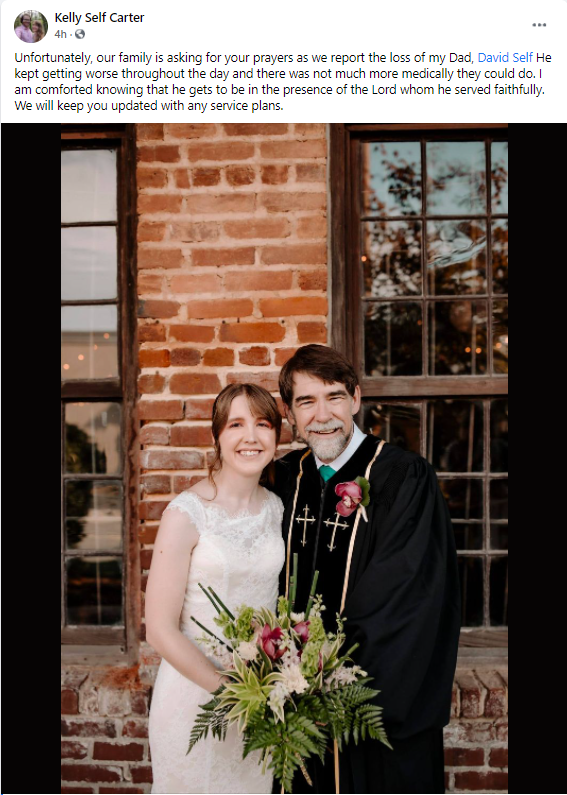
Dr. David Self, the Associational Missionary for the Washington Baptist Association (Georgia), knows now what his faith was for – he sees what has been made sight.

Honestly, I have known others who’ve died after contracting COVID, but David was the first one who was a personal friend. I’m having a difficult time with it.

Oh, there are so, so many more people in this part of Georgia that are far more devastated by this loss than me. My loss is nothing like that of his wife, Kathy, or the rest of his family. It sure shook my world when my own father died, and I saw how it affected my mother and sister. So, I know this is harder for them than for me.

But if one thing remains, it’s my faith. The same faith the David Self had. The same that his family has, as evidenced by the Facebook post from his daughter, Kelly Self Carter.

My favorite hymn is “The Solid Rock.” To paraphrase the lyrics, my hope is built on nothing less than Jesus’ blood and righteousness, not the recovery of health to those for which we desperately pray.

Before I learned of David’s passing, I had called for a gathering of folk to pray for him in the parking lot of our Associational Office. But before 10 minutes had passed after putting out the call on Facebook and over texts, I was told he died. He may have already been gone when I sent out the first message. But I went, anyway.

As I told another pastor, “Even if God didn’t heal David, He’s still worthy to be praised!” If it were not for the Lord, prayer would be useless and death would be inevitable. But it’s not! There is hope, and not only in this life, but when this life is over – because it will be, one day, COVID or not.

Consider the words of Job after he had lost everything but his life and his grieving wife…

Naked came I out of my mother’s womb, and naked shall I return thither: the LORD gave, and the LORD hath taken away; blessed be the name of the LORD.

Job 1:21

Would David had died anyway, despite our prayers? That’s not for me to say, but it was always right to pray. Just read what King David said after losing the first child he had with Bathsheba…

He answered, “While the baby was alive, I fasted and wept because I thought, ‘Who knows? The LORD may be gracious to me and let him live.'”

2 Samuel 12:22 CSB

We don’t know what God is doing, for His ways are higher than ours, and so are His thoughts (Isaiah 55:9). Therefore, being commanded to pray for each other, we pray – and we trust the One to whom we pray.

And what perfect timing! As if God wanted me to affirm the truthfulness of the previous sentence, I just got THIS from a friend on Facebook Messenger…

Please take a moment to thank your sweet church folks for all the prayers for my Cody when he was so sick from covid. He was able to come by our house for a little bit today and I was FINALLY able to hug my son!!! I thought I was possibly going to lose my boy… but sweet Christian people, who don’t even know us, prayed for God to intervene and heal him. Today I received the hug I wasn’t sure I ever would have again. ❤️

Rhonda Altum Barnette

We are all going to miss Dr. David Self. However, “we do not sorrow as those who have no hope,” for the hope that David had is the same that we have – that I have – and that’s in Jesus Christ. Our day will come, COVID or not, and on that day our faith will be made sight, as David Self is experiencing this moment.

Please go to church somewhere in the morning.

2 Comments

Filed under Faith, Life/Death

Is This the Beginning of the End?

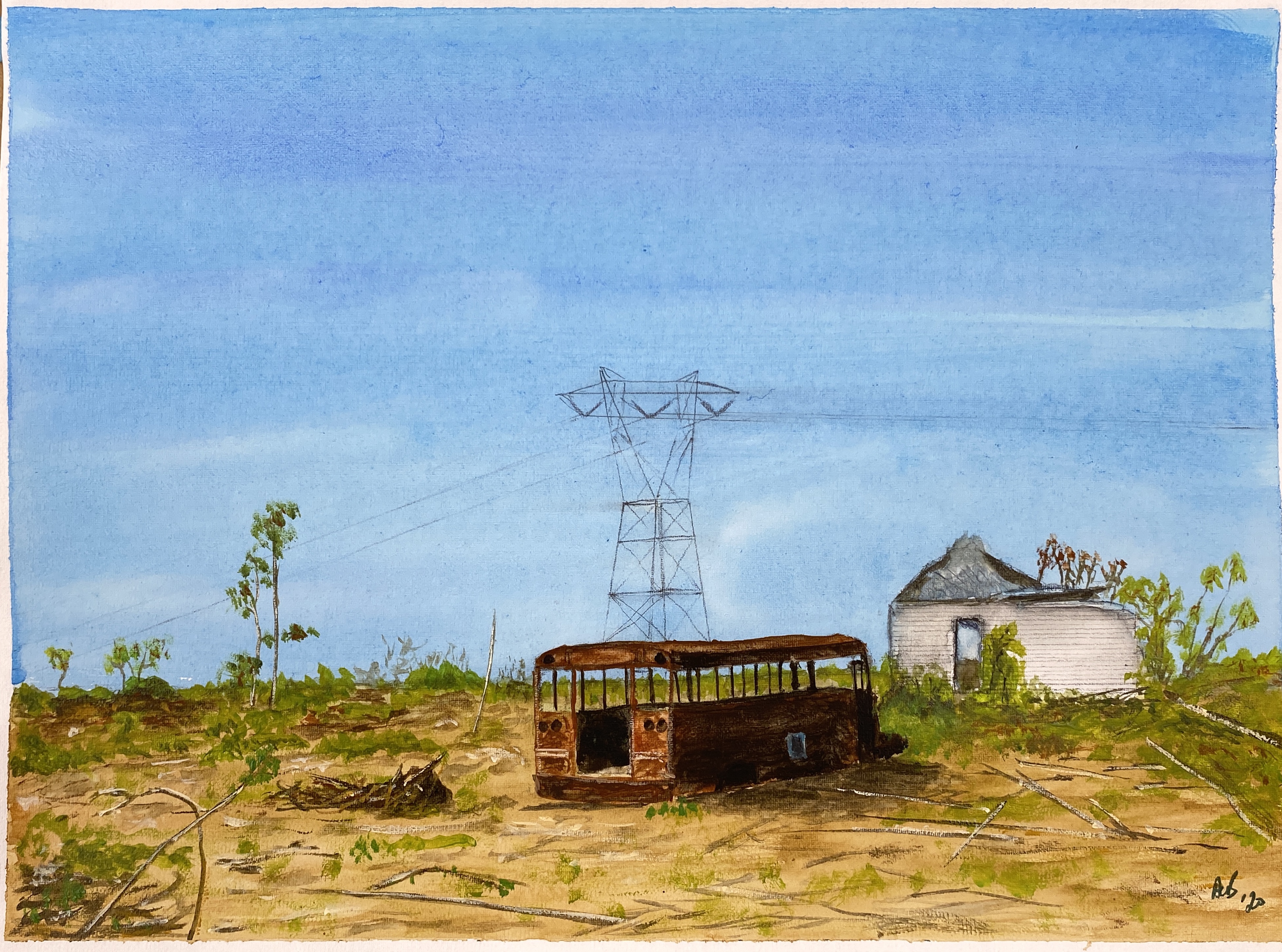
“After the Harvest” by Anthony Baker

At some point, when the preponderance of evidence leans so heavily in one direction, you’ve got to call it for what it is. So, as I look around at all that’s going on in this world, I think I’ve come to the conclusion this is the beginning of the end.

What do I mean by the end?

For as long as I can remember, at least as far back as the “turn or burn” movies of Estus Pirkle (d. 2005) and whole-Sunday-long prophecy services with Dr. Ed Vallowe (d. 2002), I’ve believed in the immanent return of Jesus Christ. To be more specific, I’ve always considered myself a pre-tribulationist and a pre-millennialist who believed, at least on paper, that the trumpet of the Lord could sound at any moment.

I’ve always believed that there would be a rapturing of the Church, a time of tribulation on Earth, and then the return of Jesus (the “second coming”) as King of Kings and Lord of Lords. And I still do.

The only difference is that before it was something I said I believed, but I didn’t REALLY believe it so much that I got excited about it or talked about it much. Why is that?

Well, a lot of people have gone to bat in the game of end-time signs. Every time they come out swinging, it’s because of some new earthquake, some war, some evil politician or evil law. It’s always been something, and usually it’s always been something that was a symptom of the natural moral decline in the United States. In other words, it’s always been something, but always something that should have never been thought of as anything other than ordinary.

For example, this once-great nation we know as America is rapidly chasing after its own demise. Many look at our country and its unbelievably insane social and legal affirmations of things not even possible in Sodom and Gomorrah and conclude, “The end must be near.” But was the end near when Rome fell? Was the end near when Germany fell sway to the anti-Christ-like Adolf Hitler?

We’re Doomed

Let’s be honest, folks. America is doomed. Marxists are already marching in lockstep down every hallway in Washington, D.C. For crying out loud, the only thing separating the Pelosi’s and the Cortez’s from red-flag-waving Bolsheviks are the perks and pensions they would lose in a full-on revolution.

The majority of our government, all of our media, every BLM-like terrorist group (yes, I said it), nearly every center of education, and probably a majority of Americans under the age of 20 want nothing less than to replace Western culture (including the USA) with a godless, socialist Utopia.

Granted, most of Americans DO NOT think this way, but they are too afraid or too tired to speak out anymore.

Like I said, America is doomed. All we are waiting for is either a miraculous healing or for somebody to flip off the the life support.

But is the decline of this country the sole predictor of the proximity of the “end time”? No!

Just like the fall of every other empire or nation did not mean the return of Jesus was just around the corner. America could fall and float away like dust in the wind (I bet you can even hear the tune, can’t you?), but the end could still be a hundred years away.

Except . . . . .

Have you heard the term “COVID Clench“? What about “Operation Pandemic Plunder“?

No?

Well, that’s probably because I just coined those terms. However, pause for a short moment and consider how that governments around the globe, from local to national, are clenching on to every bit of power they can obtain and are literally stealing liberty from every citizen.

Just the other day New York City Mayor Bill de Blasio unveiled the latest and greatest governmental twist of the arm, that proof of vaccination is “the key to NYC.” In other words, being vaccinated will be one’s “passport” to all the wonders available to them in the Big Apple. However, should one NOT be injected with the vaccine, there will be no access to restaurants, businesses, places of entertainment, public social events, etc.

Or, you could say that without the “mark” of a needle, there will be no buying or selling, etc., etc., etc. Sound familiar?

He required everyone–small and great, rich and poor, free and slave–to be given a mark on the right hand or on the forehead. And no one could buy or sell anything without that mark, which was either the name of the beast or the number representing his name.

Revelation 13:16-17 NLT

Is Mayor Bill de Blasio the Antichrist? No, of course not. That’s ridiculous. But what about that “mark”? Not so ridiculous of an idea as it might have seemed a few years ago, huh?

Isn’t this just another 1918?

102 years before COVID-19 was released upon the world, the flu killed millions of people around the globe. It came and went, and many people warned something like it would come again. It was just a matter of time.

2020 came along and with it came the Pandemic. So, just like nations rise and nations fall, diseases and viruses rise and fall. Therefore, this virus is no more of a reason to think the end is near than the flu of 1918.

Or is it?

What’s the difference between a naturally-occurring virus and one created in a lab? One eventually dies via herd immunity, while the other continually adapts and morphs into an ever-increasingly effective weapon that is always one step ahead of all defenses.

What nation can survive a destroyed economy? The inability to work, pay taxes, or feed oneself will destroy one’s faith in self, government, and even one’s god. Then, when no nation can support its infrastructure; when no nation can feed its people; when every nation cries out for effective leadership; when the world is desperate enough, one Leader will be able to take total control, especially if he’s gifted with the ability to literally bring healing.

Do you seriously think, just looking at how the new rounds of vaccine booster shots show no signs of ending, especially if the virus keeps mutating, that we are nearing an end to ever-increasing government control? That those with a blood-lust for power and control will let this pandemic go to waste?

And, do you think that those in charge are really capable of stopping something that was more than likely created as a weapon of gradual mass destruction?

It might not be tomorrow. It might not be next year. But if you want to know my opinion, I think it is entirely reasonable to assume, based on the preponderance of hard-to-explain-away coincidences and parallels with Biblical prophecy, that this is the beginning of the end.

What if I’m wrong? Does that make everything OK?

Umm, not really. There’s still a deadly virus out there that’s even killing fully-vaccinated individuals. That being said, the end of the world for YOU might be only one quarantine away.

Therefore, to paraphrase the prophet Amos, one way or another, prepare to meet thy God (Amos 4:12).

8 Comments

Filed under coronavirus, current events, Future, Life/Death, the future