As of this moment, alone in my quiet office, having just finished my preparations for Sunday morning’s sermon, I have only 15 days till I’ll be in Jamaica!
Yeah, for some of you that’s no big deal; you’ve probably been there multiple times. But for me, this is my first time going there, and I think I have a right to be excited. Don’t you think?
I will be flying out of Atlanta on the 20th, a Friday evening. Unfortunately, flying is the worst part – I have a love/hate relationship with it.
If you are curious, I will be preaching in a week of revival services at Leith Hall Baptist Church, along with ministering at several other locations throughout the week. Lord willing, I will also be speaking to the local police officers (please pray about that).
To my surprise I found a video on YouTube that shows the very street I will be traveling and the church in which I will be preaching! How cool is that?
I’m told this area of Jamaica is considered the poorest in the country. Those who do have jobs likely drive all the way to Kingston to work. For the rest, the unemployment rate is near 80%
Most of the children where I will be eat only one meal a day, and that’s their lunch at school.
As the days get closer, I’ll keep you guys updated.
Also, if you feel led to help support this trip, what I don’t use for personal items, food, fees, and all that junk, I will be leaving in the hands of those whom I can help. Simply click on the PayPal tab and designate what the funds are for.
It’s a pretty well-known idiom. It’s been credited to everyone from John Steinbeck to John Wayne. But who said it first? I have no idea. I’ve searched the internet – which is the fountain of all knowledge, correct? – and have found plenty of opinions, but no definitive answers.
What I do know for a fact is that my own father used to say, “A man’s gotta do what a man’s gotta do when a man’s gotta do it.” That’s where I first heard it. My dad was my source.
But you’ve gotta admit, it sounds like something John Wayne would say.
From the Pulpit
I think the reason the “A man’s gotta..” phrase sounds so much like John Wayne is that it’s a statement only a real man would make. It’s the kind of thing a tough man, a rugged man, the kind of man that takes responsibility for his actions would say.
It’s also the thing a preacher might say. Not the milk-toast, yellow-spined, liberal, crowd-pleasing hireling of a preacher or pastor; he wouldn’t dare ruffle a feather. No, it’s the thing a John Wayne, Sam Elliot, Jack Bauer, of a preacher would say. It’s the thing my dad would and did say. It’s what I’m saying.
And if you’re a preacher worth you’re salt, you’d better say it, too…or a least a variation of the theme.
“A man’s gotta preach what a man’s gotta preach when a man’s gotta preach it.”
The Burden
Real men do what they have to do. Real men do what’s necessary, even when it’s not pleasant. Real men look a challenge in the eye, grit their teeth, and plow forward. Real men do things others are not willing to do, even when it hurts – because it’s gotta get done.
The Prophet Malachi was a man who had to preach what needed to be preached, even though no one wanted to hear it. It was the “burden of the word of the LORD” that he had to deliver to a people who’s worship was tainted, second-rate, and offensive to God. But it wasn’t pleasant; it wasn’t nice; it was the least seeker-friendly thing a man could say.
“How I wish one of you would shut the Temple doors so that these worthless sacrifices could not be offered! I am not pleased with you,” says the LORD of Heaven’s Armies, “and I will not accept your offerings.” – Malachi 1:10 NLT
What??? What did he say??? Yes, he said it. With true grit the prophet essentially proclaimed, “It would be better that we close the church doors and go home than continue with the worthless stuff we’ve been doing – God ain’t happy!”
The Advice
Preaching the tough stuff isn’t for wimps. People may get mad at you. They may even try to shoot you – no joke. But if there was ever a John Wayne-like preacher, it was the Apostle Paul.
Imagine old Paul, dusty from a long cattle run, sitting on the ground and leaning back on his saddle, cleaning his Colt six-shooter. It’s late in the evening, the fire is crackling, beans are simmering, and Paul clears his throat.
“Timothy…” he begins, then after a pause, “Boy, let me give you some advice: ‘Preach the word; be instant in season, out of season; reprove, rebuke, exhort with all longsuffering and doctrine‘” (2 Timothy 4:2).
Timothy tilts his hat back a little to expose his forehead, then leans in and asks, “What will people think? It could get tough doing that all the time.”
“Yeah,” replies the old Apostle with a nod and a painful, grimaced look that came from years of experience, “But sometimes a man’s gotta do what a man’s gotta do.”
On the night of January 14 I was privileged to speak to a group of men, mostly older men, about social media and the ministry of Christian blogging. My first impression was that these guys had no clue what I was talking about.
I was correct about some of them.
But others got it. They knew how to use Facebook, understood the dangers of being online, and one had even thought about starting a blog.
Regardless, nearly every one was blown away by the world-wide impact that can be made from one’s laptop on the kitchen table, or even one’s smartphone.
However, as I pointed out, not everyone can write, especially for a blog. Nevertheless, God has placed us here for such a time as this, and whatever it is for which we have a talent or gift, God has a plan to reach the world, even if it’s only a small part of it.
Let me share four passages of Scripture with you, then I would encourage you to listen to the short message I gave to the 45 men here in Georgia.
Esther 4:14 – “For if thou altogether holdest thy peace at this time, [then] shall there enlargement and deliverance arise to the Jews from another place; but thou and thy father’s house shall be destroyed: and who knoweth whether thou art come to the kingdom for [such] a time as this?“
Philippians 1:27 – “Only let your conversation be as it becometh the gospel of Christ: that whether I come and see you, or else be absent, I may hear of your affairs, that ye stand fast in one spirit, with one mind striving together for the faith of the gospel;”
Colossians 4:2-4 – “Continue in prayer, and watch in the same with thanksgiving; (3) Withal praying also for us, that God would open unto us a door of utterance, to speak the mystery of Christ, for which I am also in bonds: (4) That I may make it manifest, as I ought to speak.”
Psalm 19:14 – “Let the words of my mouth, and the meditation of my heart, be acceptable in thy sight, O LORD, my strength, and my redeemer.“
Click the Picture
This photo is of my wife and me on our way to last week’s minister and wives retreat in Pigeon Forge, TN. The picture has nothing to do with the recording. I just wanted to use it 😉 If you click on it (or here) you can listen to the 21-minute sermon.
I just want to take a quick moment to blog. By that I mean that I want to do what blogging used to be meant for: a web log of thoughts; a diary of sorts.
What thoughts do I want to record and share with the world? Politics. Specifically, pastors and the subject of politics.
The reason I want to simply “blog” is because I have not done any research, sourcing, or anything like that in order to craft a professional opinion piece. This is not meant to be an article worth publishing in a news paper or magazine. I have no links to news stories or pictures to share.
No, all this is meant to be is me sharing my thoughts off the cuff, unprepared, and dangerous.
You see, I have political opinions. I have my opinions about our President. I have strong opinions about the government and the direction we should be going as a country. Yet, as a pastor, my thoughts on these issues are considered taboo, off limits, no matter if they are spoken from the pulpit or elsewhere (and I’m speaking generically, not specifically about my current congregation).
It’s a strange situation to be in, actually. I mean, here we are, pillars in the community, men tasked with preaching truth without compromise, yet if we mention anything about conservative policies we think might better the community, we’re in danger of alienating people and running the risk of splitting a congregation!
It’s pretty sad, isn’t it? Shouldn’t the gospel apply to every area of life? Shouldn’t the teachings of Jesus Christ and the Apostles find application in the voting booth? It would seem so. However, I could preach about anything, even against same-sex marriage, and aside from the vitriolic response I might get from friends of the rainbow, the average church member would support me in my pastoral, prophetic role. Yet, talk about anything political that might hint of my personal persuasions and I’d likely be censured.
Do you ever wonder why this is? Do you ever wonder why it is that a pastor cannot talk about politics that same way he can about adultery, lying, anger, murder, hate, hypocrisy, abuse, weighted scales, and bigotry?
Think about it… there are people in Christian media and print, along with nationally-known religious personalities, who are taking full advantage of their platforms to say anything negative about our President, even to the point of calling for his impeachment. Yet, if the average pastor stood behind the pulpit and said, “I think we ought to pray for Donald Trump, that he should succeed and become a great President, for our country and the world’s sake,” he’d likely be labeled a fascist, racist, evil Nazi sympathizer.
Oh, I forgot. It’s OK to admit you pray for the President, but only if you’re Nancy Pelosi and your ultimate goal is his imprisonment.
Here’s the thing, though. In every congregation of believers in Christ there are going to be people who are members of different political factions, and that goes for everywhere. Yet, when it comes to issues of right and wrong, good and evil, and how we should live out our faith in the public arena, which includes the voting booth, if God’s sufficient Word cannot find application that should guide the Christian, if there are areas in life that cannot be addressed by Scripture for fear that it might offend the Christian or bruise his personal sacred cow, then is the revealed Word of God really all it claims to be?
Prudence soaked in love; wisdom granted by the Spirit; and a keen contextual awareness are key when considering when, where, and how we should address these topics. However, fear should never be the motivating factor that intimidates us into silence when God has a Word to say.
I love my wife, and sometimes it’s not easy knowing all that she endures because of my position as Pastor. That’s why I found the following post from Keith Haney so encouraging. It shows that pastors aren’t the only ones who deal with the struggles of ministry.
God bless all the pastors’ wives!
When we talk about church worker wellness we often forget the spouses. This post is to alert you to a growing problem that often goes unnoticed and rarely addressed. Many pastors are lonely, and so are their wives and their children can become isolated. This account is not every minister’s history, but it is the tale…
I haven’t written much over the last week, especially since the weekend. The biggest reason is that I have been pretty busy with ministry and church-related stuff.
Now, when I say “stuff,” it could be interpreted as things that don’t matter much in the big scheme of things, things that just take up time and make us look busy. That kind of stuff is bad, for we should make the best use of what time we’ve been given.
However, the stuff I’ve been doing (at least from Sunday evening through Tuesday) was centered around our denomination in the state of Georgia. This week we attended the 198th Georgia Baptist Convention Annual Meeting.
Conventions
When hear the word convention, they often think about wild parties and lots of nonsense. The convention I went to for two and a half days was anything but parties and nonsense; it was where 1,300 delegates from Southern Baptist churches all over the state of Georgia came together to do business, worship, and be encouraged.
For those of you who don’t know, congregations within the Southern Baptist Convention are independent, autonomous, self-governing churches – the SBC doesn’t tell us what to do. However, what unites us is a common set of beliefs (Baptist Faith and Message 2000) and a desire to reach the nation and the world with the Gospel by participating in the Cooperative Program. State conventions operate in similar fashion, but deal more with regional needs.
Changes
This year is a big year for Georgia Baptists! The reason is that the whole convention was restructured to become more effective in serving the needs of our churches and pastors.
If you haven’t already, you can click on the link above (or here) and see exactly what’s going on. But if you are short on time and/or curiosity, let me sum things up with a few bullet points.
The Georgia Baptist Mission Board has been restructured into FIVE main ministry areas:
Georgia Baptist Women
Research and Development
Strategic Church Planting
Church Strengthening
Pastor Wellness
The Georgia Baptist Mission Board is now regionalized into six new areas. Each region will have a team of consultants that are serving our pastors, their families, and churches. Each region team includes consultants from:
Evangelism, Missions, Next Gen, Discipleship, & Worship and Music.
The Georgia Baptist Mission Board is committed to three guiding principles:
Pastors Are Our Heroes
Churches Are Our Priority
Georgia Is Our Mission Field
Why the Changes?
As stated in the video you can watch on the website, the main reason for all the changes in the structure and guiding principles of the convention is that there are over 7 million lost people in Georgia. We have to get “wiser, stronger, and more efficient in reaching them.”
There is a great need for discipleship. However, you can’t be a disciple of Jesus unless you are a follower of Jesus! We must get back to the primary mission of the Church, which was the primary mission of Jesus: “For the Son of man is come toseekandtosave that which was lost” (Luke 19:10).
I am proud to be a Georgia pastor. It is a great honor to be counted among those who will recommit to “making a big deal about Jesus” in the communities where we serve, and beyond.
Georgia pastors standing to be blessed with prayer.
Last week I got to see the reenactment of the occupation of Sandersville, Georgia. It was the 155th anniversary of the battle that left a few dead (not like the 10’s of thousands in other battles), a courthouse burned, and a citizenry who was thankful it didn’t turn out much worse.
In November of 1863, General William T. Sherman and the Union army marched into the Sandersville area, just 10 miles or so south of where I sit right now. A skirmish broke out between some of the advance Union cavalry and the Confederates under General Joseph Wheeler. This led to more fighting and a near-disastrous misunderstanding.
Below is a video I made of the reenactment in the Sandersville town square.
General Sherman (the “march to the sea” Sherman who’s tactics embodied the term “scorched earth”) thought it had been the citizens of the town who’d fired upon the Union troops, and he was furious. He didn’t know it was Confederate soldiers. Therefore, after entering the city, he intended to burn it to the ground.
That was when the Rev. James Anthony, a Methodist pastor, went to General Sherman to beg for the city to be spared.
Changed Feelings
Before I get back into the history of the battle and the main point I want to share, I must tell you about what I felt while videoing the reenactment.
If it had been 20 or 30 years ago, maybe even only 10, I would have watched this display of musketry and role playing as “totally cool!” I mean, you’re talking to a guy who “played army” all of his young years, up into his teens. Seeing all that action, especially that close, would have been awesome.
Yet, as I stood there on the curb letting my imagination get into the act, I was surprised by my sense of sorrow, of fear, and the tears that began swelling up in the bottom of my eyes. From the moment the two horsemen rode into town warning of the impending and unstoppable invasion, to the point where men and boys were point-blank shooting at each other right in front of me, my heart sank.
There was nothing “cool” about this at all; it was utterly sad.
So “country” even the Confederates eat here 🙂
After it was all over, a deacon from our church saw me and invited me to have some tea (sweet, of course) in the little buffet right behind where I had been standing. Sitting there in the restaurant, the surreal scene of muskets lining the walls and “wounded” Confederates eating fried chicken, we talked about what we had seen.
He had felt the same way I did.
He had been standing down around the corner (where the video ended), and he said that when they came around and started shooting at “our boys,” he couldn’t help but shed a tear. He said, “This really happened.”
Back to the Story
So, upon hearing that General Sherman was going to burn Sandersville, Rev. Anthony went to Sherman to beg for the town. He finally convinced him that it wasn’t the people who fired on the troops, but opposing forces that had already fled.
When Sherman heard that Rev. Anthony had also been kind to a wounded Union officer and kept him from being executed, he accepted the pastor’s request and spared all but the courthouse and other government buildings. Sandersville survived because of the brave actions of a pastor who put his own well-being on the line.
To the Point
There’s a lot more to the story of Rev. James Anthony and his conversation with General Sherman. You can read about it by simply Googling his name. But as I stood there in the city square and heard the reenactment of the conversation between Sherman and Anthony, I could not escape the similarity between the Reverend’s name and mine.
I couldn’t escape the following passage that has been a “life verse” of mine for decades:
And I sought for a man among them, that should make up the hedge, and stand in the gap before me for the land, that I should not destroy it: but I found none. – Ezekiel 22:30
If only more pastors would stand in the gap!
If faced with an invading army, would I have the courage to risk everything, stand face-to-face with the conquering General, and beg for the lives of my people as Rev. James Anthony did?
I’m going to be totally honest with you, OK? There was a post I published for just a few minutes this morning, but then I took it down and added it to the “draft” bin. Even as I was writing it, it seemed forced. So, no matter how I tried to edit it, it never seemed “right.”
So, what did I do? I decided I’d try to do a video blog ( a Vlog) post. I mean, hey, I’m a preacher, so why not just TELL my story? Yet, what happened? After multiple recordings, multiple edits, and multiple times trying to upload, only to see “Upload Failed,” I almost gave up.
Nothing was working!
YET, I still felt I needed to post something, almost like it was imperative that I do so. Why the pressure? Why the stress?
So, I decided to try one more thing – record straight to YouTube. No editing, not fancy camera work, no script…just raw, unedited video of me sharing what’s on my heart.
As I’m writing this, I’m waiting for the video to upload to YouTube (it’s taking awhile). If it uploads with no problem, you will see it below.
As I was sitting here in my study and reading a book that a church member gave me, I came across something I had to share…because I totally agree.
In his book Take the Dimness of My Soul Away, William A Ritter shares several sermons he delivered over the years following the suicide of his son. At the beginning of the third chapter entitled “Making It,” Ritter wrote something that mirrors my own philosophy of pastoral ministry.
When I read it just a couple of minutes ago, I knew I had to share it with you.
“We who follow Jesus need not hide our hurts. Not all wounds need covering. Even in the pulpit. Especially in the pulpit. People need to know that even preachers have been through some wars and accumulated some scars. But they also need to know where and how healing is taking place.” p. 38
I hope you’ve realized I’m not perfect.
I hope you’ve realized I have scars.
But please know that Jesus is the Hope through which healing and thriving is possible.

 What I do know for a fact is that my own father used to say, “A man’s gotta do what a man’s gotta do when a man’s gotta do it.” That’s where I first heard it. My dad was my source.
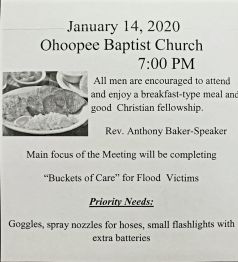 Tonight I am going to be speaking to a group of men…


 Now, when I say “stuff,” it could be interpreted as things that don’t matter much in the big scheme of things, things that just take up time and make us look busy. That kind of stuff is bad, for we should make the best use of what time we’ve been given.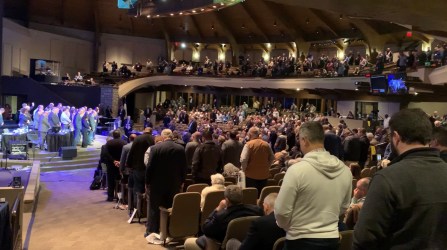






 The Recovering Legalist