Category Archives: worship

The Magnificent Fifty: Foundation of Faith (Pennsylvania)

Harrisburg, Pennsylvania (Artist: Susan Cassidy Wilhoit)

Constitution Preamble (1776)

We, the people of the Commonwealth of Pennsylvania, grateful to Almighty God for the blessings of civil and religious liberty, and humbly invoking His guidance.


Folks, is there no such thing as irony? The men and women of the Freedom from Religion Foundation (FFRF) make bold claims about a “godless” Constitution and the godlessness of our Founding Fathers, yet the words above seem to stand in stark contrast to their claims. Again, the “wall of separation” as defined by the modern “intellects” was nowhere to be found in 1776.

Leave a comment

Filed under America, Apologetics, Faith, God, politics, The Magnificent Fifty, worship

The Magnificent Fifty: Foundation of Faith (Kentucky)

Frankfort, Kentucky (Artist: Susan Cassidy Wilhoit)

Kentucky Latin Motto (2002)

Deo gratiam habeamus “Let us be grateful to God”

A group of Lexington homeschoolers with the help of the bill’s sponsor, Tom Riner (D-Louisville), wrote and were involved in the passing of HB 857.

Leave a comment

Filed under America, Apologetics, God, politics, The Magnificent Fifty, worship

8+ Reasons Why Smaller Churches Are Better

The Survey

In a recent study conducted by the survey pro’s at TheRecoveringLegalist.com, pastors from both large and small congregations shared why they thought a small church could be better than a big one.

The survey sample was made up of pastors from various denominations, from different parts of the country, and consisted of men from my personal contact list – and my wife. It was VERY scientific – sorta.

The Question

I had my own thoughts, but I wanted to know what others thought, so I asked a question. The question I posed to other pastors went something like this:

“I’m doing a quick, non-scientific survey for a blog post (no names will be mentioned). Can you give me 1 or 2 reasons why a small church could be better than a big church?”

Within moments I received multiple replies through text, email, and Messenger. It took them very little time to respond, like it was something they didn’t even have to think about, and the answers they gave were practically the same.

The Answers

If the answers from the pastors in the survey I conducted mean anything, it would seem that smaller churches are the place to be if you want to be:

  1. Known by name;
  2. Have intimate relationships with others;
  3. Have a pastor who misses you when you’re not there; and/or
  4. Experience more accountability.

Other answers suggested that in larger churches it is harder to keep track of what is being taught in “small groups,” while in smaller churches everyone is more on the same page. But overall, the most common reason given for smaller churches being better than bigger churches was knowing and being known by others in the congregation.

As a matter of fact, what the pastors in my survey said echoed the hopeful and encouraging words of Karl Vaters’ article “Why Small Churches Are the Next Big Thing.” Speaking of Millennials, he said:

“[There’s] growing evidence this new generation will bring the greatest opportunity for small church ministry in 2,000 years.

Why? Because, as the first generation with a majority born and raised outside traditional marriage, genuine relationships and intimate worshipwhat small churches do best—will matter more to them than it did to their parents.” [emphasis added]

So you see, even though larger churches offer a lot – unlimited numbers of ministries in which to get involved; professional-quality childcare; servant pastors for every niche; and the best technology money can buy – many people are coming to understand there’s something special about the community of a small, loving congregation.

But There’s MORE!

Should you surmise that intimate, supportive relationships, accountability, and being able to talk with your pastor without an appointment are the only qualities that make small churches better than bigger ones, think again. There’s more! Much more!

The following are 8 more reasons why small churches could actually be better than large ones, at least for some people:

  1. Parking Spaces. Why should one have to search ten minutes to find a parking place within walking distance to the trolley you must ride to get to the front door? Small churches have plenty of parking, usually no further than a hymnbook’s throw away.
  2. No Auditions Necessary. Forget having to try out for the choir, the praise team, the annual play, the children’s musical, or the worship orchestra. If you can sing, play an instrument, or read a line – or even if you can’t – there’s always a place for you in a small church, at least in the choir.
  3. No Training Necessary. So, you want to run sound? You want to operate the lights? You think you have a desire to operate the recording equipment? Well, you’d better have a resume and a list of references if you want to do any of that in a big church. Seriously, they can’t let just anyone with a desire operate a $25,000 camera or push the buttons that link to the network satellite feed. But in a small church? HA! There’s always a need for someone to flip the cassette or press “record.”
  4. The Best Seating Anywhere. If you come in late to a service at a big church, no kidding, you might need binoculars to see the holes in the pastor’s jeans. But in a small church, well, the back row might as well be in the reserved section! Compared to a mega-church, the back row in a small church is practically within spitting distance of the preacher.
  5. Genuinely-Experienced Childcare. Do you have small children? Do you care about them? Why let Buffy or Bianca watch your crumb cruncher while you worship? Why not trust them to the experienced, floppy-armed grannies who’ve raised more kids than a champion goat farmer? Who better to make sure you young’ns act right and learn about Jesus than a few ladies who’ve washed out more than a few mouths with Ivory soap? [Disclaimer: Washing out mouths with soap is no longer approved]
  6. Free Interactive Technology Museum. Bigger churches are all about the newest, most advanced technology. Smaller churches, on the other hand, rarely have the funds for regular upgrades to sound equipment, etc. Therefore, where else can you go to find working 1980’s (if not older) sound equipment still being used? Small churches are like free interactive technology museums where everyone can listen to both the preacher AND the local radio station at the same time!
  7. Food, Food, and More Food. Go to a large church and you’ll find plenty of opportunities to eat. They have Wednesday night meals, socials, finger foods, and all kinds of stuff before Sunday School (morning Bible study). Some large churches even have coffee bars and sit-down restaurants on campus! But seriously, how does any of that compare to what a bunch of ladies can whip up for a homecoming dinner on the ground? Believe me, when you’re sick at home and can’t fend for yourself, those small-church ladies can keep you well-maintained with cornbread, beans, fried chicken, and homemade stew.
  8. It’s Your Community. If nothing else, your typical small church is made up of people from your own community. Large churches – the ones with huge TV ministries and social programs – are made up of people from all over the place; small churches are filled with your neighbors. It’s in the small, hometown churches where people learn to shoulder up with each other through a community’s hard times. It’s in the small church where a pastor attends your daughter’s graduation, the funerals and weddings are no charge, and someone always notices when you’re not there.

Seriously, I have nothing against large churches – every pastor would love his church to be one. However, most churches average no more than 80 members, and they are where the majority of solid, faithful, salt-of-the-earth Christians still attend.

So, are small churches really better than big ones? Well, that all depends on where God wants you. But if you don’t want to get lost in the crowd – or in the parking lot – a small church just might be what you need.

Y’all are welcome any time! (11055 Dayton Pike, Soddy Daisy, TN)


13 Comments

Filed under baptist, Church, ministry, worship

Barriers to Church Growth #4 (Hold to God)

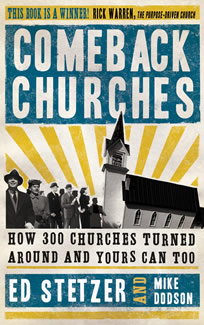
A very revealing study was done, leading to a book detailing how 300 churches went from declining or dying, to growing. In Comeback Churches, written by Ed Stetzer and Mike Dodson, there is a list of 30 different barriers to church growth. Having received permission from the publisher (B&H Publishing Group), I would like to discuss a few of them.

“People are unwilling to take hold of God (Isaiah 64:7).”

“And there is none that calleth upon thy name, that stirreth up himself to take hold of thee: for thou hast hid thy face from us, and hast consumed us, because of our iniquities.” – Isaiah 64:7 KJV

Every time we heard a gospel song that had words similar to “hold on to God,” or “hold to His hand,” my parents quickly reminded us that “we don’t hold God’s hand – He holds ours.” Understandably, what my parents were referring to was salvation. In that sense, we are held and He will never let go.

But that is not what this verse is talking about. Isaiah is saying that part of the problem his people were facing was the fact that none had the desire, nor even the desire to have a desire, to grab hold of God. If that is true today, then it may not only be a huge barrier to church growth, but to individual growth as well.

Take Hold of Thee

It is interesting and revealing when we look at this phrase and compare its usage to other places in Scripture. To begin with, the word chazaq (Strong’s H2388) essentially means “to tie fast, to bind bonds strongly” (Gesenius’s Lexicon). It is a verb that is translated into English as words such as strong, retain, urgent, and caught. Here are just a few examples.

“And the LORD said unto Moses, Put forth thine hand, and take it by the tail. And he put forth his hand, and caught[2388] it, and it became a rod in his hand:” – Exodus 4:4

“And the Egyptians were urgent[2388] upon the people, that they might send them out of the land in haste ; for they said , We be all dead men.” – Exodus 12:33

“Then said his wife unto him, Dost thou still retain[2388] thine integrity? curse God, and die .” – Job 2:9

Moses “caught.” Look at the first verse. Moses had been commanded by God to throw down his rod, after which it became a serpent. Then, against all logic, God told him to pick it up again, but this time by the tail (riiiiigghht!). I would have had to be seriously “stirred up” to pick up a deadly snake by the tail – it BITES! Yet, that’s what Moses did. He “caught it” by the tail.

The Egyptians were “urgent.” Next, after suffering under all the plagues, the Egyptians “were urgent” in there pushing the Israelites out of town. They had come to realize that their own lives were in jeopardy if the Jews stayed one day longer. It was imperative that they are pushed out as quickly as possible.

Job “still retained.” Now, look at poor Job. He had lost everything dear to him, including his health, and then came his wife telling him to curse God and die. She couldn’t believe that he could just sit there and hold on to his belief that God was worth serving. “After all this, are you still holding on to your integrity? What for? What’s the use? Quit putting yourself through this nonsense and just curse God and die!” Yet, he held on.

Making it Apply

When we view Isaiah 64:7 in the light of the verses above, what we have is astounding and convicting. Let’s see if we can work it all together:

1) Taking hold of God is something that we should take seriously, not flippantly. Don’t reach out for Him in a way that implies half-heartedness. Take hold like you mean it! Who do we think God is, a stick to be used by us in our own power to accomplish our own desires? NO! He is alive and dangerous. As Aslan in The Chronicles of Narnia, He is NOT tame. He is not here to be played with.

2) Do we not understand that without the power and presence of God we will die?In Him we live, move, and have our being” (Acts 17:28). There should be an urgency in our desire for Him, no less than the kind the Egyptians had to expel the Jews from their land. Do we want to live? We must urgently “take hold.”

3) We must hold on to God even when it seems insane to others. We must consider our relationship with our Heavenly Father so precious that even when Hell seems to be winning, faith tells us otherwise. Like Job of old, we should hold on to God even when we lie broken and wasted amid the ashes of seeming defeat. Our Redeemer LIVES!

The Barrier that Must Fall

If we are to see growth in our churches, not to mention our own lives, we must seek after God with urgency, intensity, and passion. He must be sought after and adhered to like no other treasure on earth. Anything less betrays our divided, adulterous hearts. God will bless and grow a people who “take hold.” No church will grow who only takes hold of God when it is convenient, fun, or fashionable.

Time is filled with swift transition
Not of earth or moon can stand
Build your hope on things eternal
Hold to God’s unchanging hand

Trust in Him who will not leave you
Whatsoever years may bring
When my earthly friends forsaken
Still more closely to Him cling

Hold to God’s unchanging hand
Build your hope on things eternal
Hold to God’s unchanging hand

We must cleave to Him. It IS a matter of life or death.

2 Comments

Filed under book review, Christian Maturity, God, Uncategorized, worship

If a Monkey Can Do It, Why Can’t We?

Free Movies

One of the great things about modern cable networks is the ability to watch free movies on demand. It’s a great thing, but I guess it’s also a bad thing, too. Free movies mean lots of wasted time in front of a television – because there’s always something to watch.

Well, sorta.

I mean, it’s precisely because I am NOT paying for these movies that the selection is a tad bit limited. When you get what you pay for, and you pay nothing, then you get what you pay for.

So, that’s why I found myself watching “Oz the Great and Wonderful” late Sunday night. I’d forgotten that I’d already seen it back in 2014.

Finley the Flying Monkey

Anyway, even though the movie was rather lame, there were a few well-acted scenes. I especially liked Mila Kunis as Theodora: the creepy, emotionally-ill, heartbroken witch that later became the wicked witch of Dorothy fame. She became the prime reason I will never trust an attractive woman dressed in red that just so happens to greet me in the middle of the woods.

But of all the scenes, one stood out immediately (at least this time around when it was free), and that was the following scene where Finley the monkey indebts himself to Oz.

https://youtu.be/DGJHdvNIGnQ

When I saw this Sunday night, I immediately thought of my Lord and Saviour, Jesus Christ.

I was once trapped and bound by sin. A lion that had been seeking me out to devour me was just about to pounce. I cried out to the only One who could save me, and he did – except in my case, He took the lion’s bite for me.

Why is it so hard to understand that I owe him my life? Oh, I know I do, but do I ever really go about it in the way that Finley the monkey did? Do you?

You do realize, don’t you, that without Jesus we would be dead – eternally so. The life we live is only because of the grace of God. The least we can do is echo the words of Finley and say, “You saved my life, oh Jesus. So, I hereby swear a life debt to you. From this moment on, I shall be your loyal and faithful servant until death.”

I am crucified with Christ: nevertheless I live; yet not I, but Christ liveth in me: and the life which I now live in the flesh I live by the faith of the Son of God, who loved me, and gave himself for me. – Galatians 2:20

If a monkey can do it, why can’t we?

1 Comment

Filed under animals, Christianity, grace, Movie review, salvation, worship

He Lives!

We celebrate many holidays in this world, but one stands out among the rest…

Easter.

Now, I know that some of the more legalistic among us will label all the celebrations “moot” because of certain “pagan” links, like that to Ishtar and fertility rites. The unbelievers will laugh off this day with arrogant disdain (especially with it being April Fool’s Day).

But for the majority of Christians around the world, this day is a day to rejoice in the Son of God’s victory over the grave.

We are prone to celebrate many things, like who won a game, that new promotion, or a birthday. We throw parties when political candidates squeak out a win, or when that big contract gets signed. Some will even fire thousands of AK-47 rounds into the air while shouting “Allah Akbar!” at the top of their lungs. But nothing is more worth celebrating than Jesus keeping His word and rising from the dead to secure eternal life for those who trust in Him.

Today, as I stand before a congregation, I will attempt, in the power of the Spirit, to stir the imagination, to take us back in time, to recreate a fraction of the excitement that must have been felt when those who were convinced of defeat were shocked by the greatest come-from-below victory of all time.

Today, before all those present, whether in flesh or spirit, I will celebrate victory over sin, death, and hell. The Enemy has been defeated, his tools are obsolete, for Jesus died and rose again.

He Lives!

Click on the link to listen to my favorite Resurrection Day song, “Gone!” (sung by Teddy Huffam).

Also, here’s a group that’s new to me singing a medley of Easter-related songs (none of them about a bunny).

3 Comments

Filed under Easter, Faith, God, Preaching, salvation, worship

Barriers to Church Growth #3

A very revealing study was done, leading to a book detailing how 300 churches went from declining or dying, to growing. In Comeback Churches, written by Ed Stetzer and Mike Dodson, there is a list of 30 different barriers to church growth. Having received permission from the publisher (B&H Publishing Group), I would like to discuss a few of them.

“God withdraws Himself from the church because of sin. He hardens hearts and gives the people over to sin (Isa. 63: 15-19; Heb. 3:12-13).”

“Take heed, brethren, lest there be in any of you an evil heart of unbelief, in departing from the living God. But exhort one another daily, while it is called To day; lest any of you be hardened through the deceitfulness of sin.” – Hebrews 3:12-13 KJV

Have you ever thought it possible for a church to be given over to sin? I am not talking about the “liberal” church down the street (every town has one, I suppose), but your church – my church. Is there no growth taking place? Maybe it is because of sin. Maybe it’s because of a hardened heart.

Do churches sin?

You know they do. Many times, however, the sin is not viewed as such. It is seen differently from something that smacks of unbelief. It is rarely seen as a departure from God. More often than not, the sin that churches commit is hidden or disguised with terms or labels meant to justify “an evil heart of unbelief.” Here are a few phrases you may have heard. If so, it might be time for a hard-heart check.

  • “We can’t do that.”
  • “We don’t have the funds for that.
  • “That area of town will never be receptive.”
  • “Maybe we should just pray about it, for now.”
  • “Why do we need to change? They need to change!”
  • “We’ve never done it that way before.”

Can churches have their hearts softened?

Absolutely! God is in the forgiving business, you know. All it would take is our churches turning away from the sins that so easily beset us, like legalism, traditionalism, racism, envy, and pride…not to mention the fear that God will not provide for us the ability and means to accomplish His work.

“Let us search and try our ways, and turn again to the LORD.” – Lamentations 3:40

“Seek ye the LORD while he may be found, call ye upon him while he is near: Let the wicked forsake his way, and the unrighteous man his thoughts: and let him return unto the LORD, and he will have mercy upon him; and to our God, for he will abundantly pardon.” – Isaiah 55:6-7

It is time for us to repent.

Leave a comment

Filed under book review, Christian Living, Christian Maturity, Christian Unity, General Observations, legalism, ministry, Uncategorized, worship

Barriers to Church Growth. #2

A very revealing study was done, leading to a book detailing how 300 churches went from declining or dying, to growing. In Comeback Churches, written by Ed Stetzer and Mike Dodson, there is a list of 30 different barriers to church growth. Having received permission from the publisher (B&H Publishing Group), I would like to discuss some of these barriers.

“Pastors are more concerned about self-interests than about God and His people (Philippians 2:21).”

 “For all seek their own, not the things which are Jesus Christ’s.” – Philippians 2:21

How sad is it to think that you can’t trust a man of God? Very! But, obviously, there are many men out there who care more about their own interests than for the church.

In the second chapter of Philippians, Paul was faced with this problem. According to the Apostle, Timothy was the only one he could trust with the care of this church, because all the others sought their own, “not the thing’s of Jesus Christ.” Imagine, there were others capable of doing the work, but only Timothy proved selfless.

What an indictment! What a troubling accusation to cast upon men of God! Shouldn’t the very fact that we are called and equipped for the task of shepherding sheep qualify us for the work? Not if the work is only a tool for self-gratification or gain.

Humility Needed

What kind of pastor was Paul looking for when he finally decided on Timothy? All one has to do is examine the previous verses and see that he was looking for a man with a heart and mind like that of the Savior. “Let this mind be in you, which was also in Christ Jesus: Who…made himself of no reputation, and took upon the form of a servant…humbled himself…unto death (2:5-8).”

Jesus was the highest example of a man who could have taken advantage of His position; yet, He was the one who washed others’ feet; wore the same clothes; never demanded special treatment; allowed Himself to be abused and mistreated; even went to a cross. How would modern pastors fare if asked to be more like Him?

The Man Paul Picked

Think about Timothy for a moment. When you do, what kind of mental picture comes to mind? Did he wear the nicest suit? Did he drive a new car? Did he publish a new book every week, or host 15 conferences listing his name on neon parchment?

Did Timothy get offended when not addressed by the correct title? Did Timothy have an “earned doctorate?” Would you have had to make an appointment to see him in his office? If you did, would you have felt intimidated by his presence and demeanor? I don’t get this picture when I think of Timothy, but I do about a lot of preachers.

Self-Examination

What kind of pastor am I? Am I a barrier to church growth? This is a question I have to ask myself, even though it may dig up some stuff of which I am ashamed.

You see, the church is more important than my ego. It is more important than what people think of me. The church was not put here for my benefit. I was sent to care for them. I was sent to feed and protect the sheep, not sell them off to make a profit. They don’t belong to me. They belong to Jesus Christ.

Do I look at every church as a stepping stone? Do I view people as objects, or worse, servants? Am I willing to sacrifice my pride, even my life, for the sake of those for whom Christ died? If not, then I don’t deserve this “good work” (1 Timothy 3:1). Unless I want to be like Christ, as modeled in the life of Paul and Timothy, then I desire the work for the wrong reasons, which would make me a “barrier to church growth.”

Dear friend in ministry, whatever your role, are you more concerned with self? Go back and read Philippians 2 and see how your intentions stack up. Like me, you may find some barriers that need to be torn down.

2 Comments

Filed under book review, Christian Maturity, God, ministry, Preaching, self-worth, worship

Barriers to Church Growth. #1

A very revealing study was done, leading to a book detailing how 300 churches went from declining or dying, to growing. In Comeback Churches, written by Ed Stetzer and Mike Dodson, there is a list of 30 different barriers to church growth. Having received permission from the publisher (B&H Publishing Group), I would like to discuss a few of this barriers.

“Churches aren’t concerned about God’s glory, believing the church is just for them (Isa. 42:8; 48:11).”

I [am] the LORD: that [is] my name: and my glory will I not give to another, neither my praise to graven images. – Isa. 42:8

For mine own sake, [even] for mine own sake, will I do [it]: for how should [my name] be polluted? and I will not give my glory unto another. – Isa. 48:11

When we read the above verses it should be very clear to us that God is not interested in sharing His glory. Yet, too many times we rob God of the glory that is due Him by seeking it for ourselves. We do this in many ways, including the reason many of us go to church.

Lest we forget, “it’s not about us.” However, if you polled the majority of church-goers, I believe you’d find that the reasons for attending congregational worship are more selfish than we’d like to admit. To many believers, church is about what one can get, as opposed to what one can give.

The Tale of the Hymns

Have you ever stopped to listen to the words of those old-time hymns many of us grew up with? You may have sung them all your life, but stop and think about the following: “This world is not MY home, I’m only passing through. / My treasures are laid up somewhere beyond the blue…;” “I’ll Fly Away;” “I’ve got a mansion just over the hilltop;” “All I Need.” What is the common denominator of these lyrics and titles? “Me, me, me.”

If the Church Hymnal (© 1951,1979) was used as a tool to determine what we think of church, stop and think about this: there are 80 hymns with a title that starts with the words, I, I’m, I’d, I’ll, I’ve, or My. In contrast, less than 10 contain the word glory. Those that do include “Glory Hallelujah In My Soul” and “I’ll Live in Glory.

I think it is pretty obvious that many of us come to church to get from God, not to give to God. He deserves our worship and our praise. He deserves all the glory because His is God, and not man (Hosea 11:9). We deserve nothing, yet His grace and mercy bestow upon us all the treasures we enjoy. Why do we come expecting anything?

Surely our churches would grow if God was glorified. Imagine a congregation of people who came together to lift up praise and adoration to Jesus for His glorious love. Imagine a group of folks who set aside all their own desires and petty differences in order to lift up holy hands unto the King of Glory. What did Jesus say? “If I be lifted up…I will draw all men unto me.”

So, what do you think? How could we do better in giving the glory to the One who truly deserves it?

Related Post: Un-“Christian” Ministry?

6 Comments

Filed under Christian Maturity, General Observations, God, Uncategorized, worship

Unashamed Of the Cross

Back in 2014, during the semifinals of The Voice, “Team Blake” member Craig Wayne Boyd cranked out a fantastic rendition of the classic hymn “The Old Rugged Cross.” Many people – including those who call themselves “Christian” – were shocked. Why did a singer choose to sing this hymn on a national stage – in a competition? I mean, the cross? Really? What was this guy thinking?

Maybe, just maybe, Craig Boyd was letting the world know where he’d lay that crown, should he win it.

You see, it was on the cross of Calvary that the “Dearest and Best” was slain. It was on this cross that the “ordinances against us” were nailed (Col. 2:14). It was on this cross that our Savior promised that if He be lifted up, He would draw all men unto himself. It was on this cross where Jesus said, “Father forgive them, for they know not what they do.”

Without the cross, grace would be a non-issue and the Law would still be my master. Without the cross, Easter would be irrelevant. Without the cross, we’d never been able to witness the most powerful manifestation of love (1 John 4:9-10)the world would ever see.

It was on that old, rugged, blood-stained cross that Jesus paid the penalty for my sin. It was the crossroad of judgment and mercy where the Lamb of God humbled Himself (Phil. 2:8) and purchased my reconciliation with God (Eph. 2:16).

So, why cherish the cross? Because it was and is proof positive that even before I knew Him, even when I was steeped in sin, God loved me enough to die in my stead.

It’s shame and reproach I’ll gladly bear.

2 Comments

Filed under Christianity, Easter, Faith, God, grace, Love of God, worship