
Category Archives: grace
Why Some People are Legalists
Filed under baptist, Christian Maturity, grace, Independent Baptist, legalism
“With” or “As,” That Is the Question
If you are old enough to have any memory of 1993, and if you were living anywhere in the Southeast at the time, “Storm of the Century” means something to you.
Like when Kennedy was shot, when Elvis died, or when the planes crashed into the Twin Towers, the Superstorm of 1993 was one that left people remembering where they were, who they were with, and how long they were cooped up.
For some of you, snow is no big deal. Heck, you’ve even got shoes to wear in it. But in the South, where an inch of snow can shut everything down, 19-21 inches of the white stuff practically cataclysmic! And that’s what we got when the “Storm of the Century” came through.
But wherever you get snow, especially if it’s just enough to cover everything with a blanket of white, for a little while everything is so pretty, isn’t it? Even the trashiest places in your neighborhood (like the guy’s yard with all the car parts strewn around the lawn, or the grimy streets of some major, liberal-run city) can momentarily appear sanitary and safe.
Unfortunately, what covers up something doesn’t necessarily make it better, fix the problems, or make it any safer than it was before.
Back in March of ’93, when the snow in my yard was 21 inches deep, we had a blast jumping and falling into it. We had no fear of falling backwards, forwards, or any direction because the snow was just so deep that we would never hit anything hard.
However, what we never considered was that as we did the same thing around the neighborhood the risk of injury was much greater. We never stopped to think that just under the surface of that soft blanket of white could lie a broken bottle, a board with a nail sticking through it, or a pitchfork.
In Psalm 52 we read King David’s sorrowful prayer of repentance following his adulterous affair with Bathsheba and the murder of her husband, Uriah. Throughout the psalm we sense how dirty he felt, begging God to “wash,” “cleanse,” and “purge” him. Then, in verse seven David mentions snow.
Purge me with hyssop, and I shall be clean: wash me, and I shall be whiter than snow.
Psalm 51:7
Notice, David was wanting his unrighteousness to be washed away so that he would be white AS snow, not covered with it.
The prophet Isaiah also mentioned snow in this context.
Come now, and let us reason together, saith the LORD: though your sins be as scarlet, they shall be as white as snow; though they be red like crimson, they shall be as wool.
Isaiah 1:18
Snow is the adjective, not the object. The desire is to be as clean and white as freshly fallen snow, not covered with it.
David knew the difference between works and grace. He knew there was nothing he could do to cleanse himself; only God could do that. Yet so many today simply try to cover up their sin with the snow of good deeds, appropriate associations, philanthropy, and religiosity. Sadly, all they really end up with are “whitewashed tombs” full of dead men’s bones.
Woe unto you, scribes and Pharisees, hypocrites! for ye are like unto whited sepulchers [tombs], which indeed appear beautiful outward, but are within full of dead men’s bones, and of all uncleanness.
Jesus – Matthew 23:27 (KJV)
Have you ever asked yourself why it is that a snow-blanketed landscape is so beautiful? What about it appeals to us, especially when underneath the white are myriads of color, even if only multiple shades of brown and gray? Could it be that within humanity is desire to be clean? To be free from guilt? To be forgiven? To be “white as snow.”
Could it be that the beauty of fallen snow is more innate than perceived? Could it be that there’s more to it than simple aesthetic beauty, but a spiritual longing?
What is your desire? Don’t try hiding your mess with the snow! May snow itself lie and wish to be as white as the soul redeemed with the atoning blood of Jesus Christ.
Filed under Christianity, grace, salvation
A Thought on Real Forgiveness: To Worship with the Predator
A while back, but less than 10 years, my family fell prey to a sexual predator. Some of you may know what that is like, what the roller coaster of emotions one must endure feels like, and how violated you feel when the one that did the harm was supposed to have been a friend.
I’m not going to share many details, but I am thankful for the fact that our loved one didn’t go missing or wasn’t found dead in a ditch. It could have been much worse.
Regardless, as a pastor, I learned some hard lessons about how sexual predators prey on children by infiltrating congregations while disguised as the best church members you could ever want. I also learned that forgiving a sexual predator does NOT translate into wiping the slate clean and “forgetting” in the same way God does our sin.
Initially, even though it’s hard to say with certainty because a man doesn’t truly know what he will do until he’s put in a situation, if given the opportunity I would have killed the man. As a matter of fact, there have been times when I doubted my manhood because I didn’t kill him. But that desire for vengeance has passed.
Do I want the man to be released from prison? Not any time soon. That’s because I don’t want him to have the chance to do more harm, to abuse more young girls. But do I want him to stay in prison forever? Honestly, not really. Actually, it’s not something I think about anymore.
Granted, if he showed up at my door unannounced, there would likely be bloodshed. Just saying. Why? Because I’ll never be able to trust him again. Period.
But do I hate him? No, I don’t. Have I forgiven him? Yes, I have. And I love him, too.
How is this possible? Well, to begin with, I gave him over to the authorities to deal with. They were the ones set up by God to carry out justice on this earth. Taking justice into my own hands would be contrary to God’s law, therefore a sin. I’m not seeking more punishment, for to do so would be seeking vengeance, not justice.
Next, my prayer is that one day this man would genuinely recognize the harm he has done and call out to God for mercy and forgiveness. I want him to feel remorse, but I also want him to bring God glory by calling out to Him in faith.
But this is how I know my heart is right, at least as right as can be considering the circumstances. I would love to see this predator in heaven one day. And do you know what I want to do when I see him there? I want to smile and say to him, “Isn’t God good!”
The greatest end to this tragic story would be to stand there with that sinner and recognize that my own sins would have damned me to hell just like him . . . if not for God’s grace, if not for Jesus!
Then, at that moment, the only right thing to do will be to turn toward the Throne and worship the One who saves to the uttermost!
What glory is there in seeing someone burn in hell for an eternity? God doesn’t want that, for He is “not willing that any should perish, but that all should come to repentance” (2 Peter 3:9). The glory comes when God is praised for his grace and mercy that is greater than all our sin! The glory comes when God is praised for eternity and His goodness and wisdom is displayed to all the principalities and powers in heavenly places!
"At the Cross"

Alas! and did my Savior bleed
And did my Sovereign die?
Would He devote that sacred head
For such a worm as I?

Was it for crimes that I had done
He groaned upon the tree?
Amazing pity! grace unknown!
And love beyond degree!

But drops of grief can ne’er repay
The debt of love I owe:
Here, Lord, I give my self away
’Tis all that I can do.

At the cross, at the cross where I first saw the light,
And the burden of my heart rolled away,
It was there by faith I received my sight,
And now I am happy all the day!

- Isaac Watts (1707)
Real forgiveness starts at the foot of the Cross.
Filed under abuse, Christianity, grace, Love of God, worship
A Mini Commentary, Pt 8 (Ephesians 4:7)
OK, so now it gets even better! Paul brings it down to the personal level.
4:7 “But unto every one of us is given grace according to the measure of the gift of Christ.”

But unto every one of us
After stressing unity in the Body, Paul now changes direction and tightens his focus onto the individual, including himself. In verses 1-6 Paul addresses the Church as a whole, the Preacher to the congregation. But now in verse seven we see Paul moving away from the plural “you”, using instead “every one” and “we.”
Christianity is about God’s love for the Church, the Bride of Christ, the Body of Christ, but it’s also about the individual member of the Body. The hope of the believer is not to be swallowed up into God as a Hindu might believe, but to be eternally loved by a personal God, one who has even reserved a special name on a white stone that only the Father and His child will know (Revelation 2:7). Yes, God loved the world so much that He gave His only begotten Son, but the offer of salvation is to “whosoever believeth” (John 3:16). The individual is uniquely important and particularly gifted for the work and the health and the unity of the Body.
It also should be noted that the “us” to whom Paul is speaking is the Church, the body of believers. This is an important observation to make because only those within the Body of Christ can experience being part of the Body of Christ.
is given grace
It is wonderful to read these words! It is much more wonderful know that it’s true! Who receives the gift of grace? It is the Church as a whole? Are those who are in the Church (i.e., baptized into the Roman Catholic Church) guaranteed a gift of grace from the Father? No, it is unto “every one of us” (v. 7a) that grace is given as a gift. The personal aspect of the relationship of the Father to His children should not be overlooked nor discounted.
Paul will go on to refer back to Psalm 68:18 in the next verse when he describes David’s description of Yahweh as a conquering King. But here what we have is the declaration that the gifts to be given are based not on our good works or position, but in the goodness and graciousness of God. The noun χάρις (charis) “is related to the verb χαρίζομαι (charizomai), which conveys the general concept of giving generously or forgiving a debt or a wrong.”[1] There are none who can say they deserve grace, for grace is “unmerited divine favor, arising in the mind of God and bestowed on his people.”[2] The idea that grace can be earned is contrary to the reality that the only thing earned by ungodly man is judgment.
There is also no maintaining of biblical unity without grace, for the natural man gives according to merit and expects to receive for the same reason. If God gave us grace according to measure of our good deeds, we would be doomed. But He gives grace to every man, not only to exhibit His mercy, but to manifest unto the greatest example of forgiveness and compassion which, if followed, will help the individuals within the Church to “keep the unity of the Spirit in the bond of peace” (v. 3).
according to the measure of the gift of Christ.
Here we find one of those lines in Scripture that seems simple enough, but upon deeper study, especially of the original languages, it is not simple in the least. As a matter of fact, “according to the measure of the gift of Christ” can be understood in different ways, leaving the context to be the only real determiner of the author’s meaning. For example, who is it that is to be giving the graces? Christ? God the Father on behalf of Christ? And what of the “measure” that is spoken? Is grace given to us based on a standard “measure,” that of the gift of Christ? Or is grace dispersed according to how Christ determines to mete (measure) it out? The best way to determine the meaning is to consider the context.
As has been mentioned earlier, verse seven shows us that God’s concern and work is not limited to the Church as a whole, but it also stretches to the individual and his place in the Body or Building. Not all bricks in a building are the same. And even if most of the bricks in a wall were made exactly alike, the positioning would be unique, for no two bricks could occupy the same space in the wall.
Unto “every one of us” is given grace (not saving grace, but special grace) according to the great architectural design of the Builder, Jesus Christ (“I will build my church” – Mark 16:18). As commentator Ernest Best explained, the giving is not random nor arbitrary, nor is it given in abundance for no reason; “he apportions gifts to believers”[3] in order to accomplish His architectural plan for the Church. Therefore, everyone is given special graces, such as will be touched upon in the next two verses, but they are not all the same, nor in the same amount.
[1] Joshua G. Mathews, “Blessing,” ed. Douglas Mangum et al., Lexham Theological Wordbook, Lexham Bible Reference Series (Bellingham, WA: Lexham Press, 2014).
[2] Gary S. Shogren, “Grace: New Testament,” ed. David Noel Freedman, The Anchor Yale Bible Dictionary (New York: Doubleday, 1992), 1086.
[3] Ernest Best, A Critical and Exegetical Commentary on Ephesians, International Critical Commentary (Edinburgh: T&T Clark International, 1998), 377.
Filed under Bible Study, grace
Just Return; He’s Looking for You!
This afternoon I did a live video on Facebook.
I normally do one, a short “Encouragement Time,” every weekday around 2pm.
The subject of today’s video was that of the prodigal son in Luke 15.
You know, I’m not perfect. Are you? Do you ever do things you’re ashamed of?
Do you ever sin? I do. I know perfectly well what it’s like to wonder whether God even wants to hear you confess and repent. I mean, really, hasn’t He heard it all before?

Image courtesy of https://www.gospelimages.com/
But the story Jesus tells of the Prodigal is one that displays the wondrous love, mercy, compassion, and forgiveness of the Father. Yes, the story is really more about Him than the wayward, muddy, starving son.
When the young man reached his lowest point, there in a hog lot, starving and alone, he remembered the goodness of his father.
When he came to his senses, he said, “How many of my father’s hired workers have more than enough food, and here I am dying of hunger! I’ll get up, go to my father, and say to him, ‘Father, I have sinned against heaven and in your sight. I’m no longer worthy to be called your son. Make me like one of your hired workers.'” – Luke 15:17-19 CSB
Because he had already spent his inheritance (he thought), and since he had treated his own father like he was dead, there was no reason to expect a “Welcome home!” However, he knew his father’s slaves had it better than what he had – which was nothing and no one. He’d have to take his chances.
So, when the broken and filthy young man returns, the reception he receives is more than he could have ever hoped for. Already looking for him, the father spots his son on the horizon and runs to him! No doubt expecting the worst, the son falls on his face and attempts to make the case for indentured servitude. Maybe this would keep his father from killing him outright.
Humble, prostrate in the dirt, not even looking up to see the tears in his father’s eyes, he expects – or rather hopes for – the customary foot upon his neck, the accepted symbol of becoming a slave. But, instead…
…the feeling of a bristly beard upon his ear…
…an arm on his back…
…a rough palm cradling the other side of his head…
…and tear-drenched kisses?? Not the sole of a sandal? KISSES! Yes, kisses on his neck!
More joyful to receive his son back home than determined to reclaim his honor, the exuberant father drowns out the pitiful son’s pleas and cries out, “My son has come home!”
Instead of putting his foot on the boy’s neck, the father had humbled himself and descended to the place where his lowly child lay in the dirt. Instead of justice, He showed mercy.
And then Amazing Grace called out for a party!
God is the Father. You and I are the Prodigal. No matter how far we’ve drifted or run, He is still looking and waiting.
Let’s go home.
Filed under Bible Study, Christianity, Family, God, grace, Love of God, Relationships and Family
Just Be Thankful You’re Alive!

Sunrise over Chattanooga
As I Was Reading…
As I was reading the book of Lamentations (not the happiest of reads), I read a verse I’d like to share with you.
Why should any living person complain, any man, because of the punishment for his sins? (Lamentations 3:39, CSB)
What does this verse mean?
Simply put, if you have been punished for your sins by a Holy God … and you’re still alive … you have nothing to complain about!
Seriously, so often we gripe about the circumstances we endure, yet those circumstances are often the result of our own sinful decisions.
But isn’t it a wonderful thing that we are so loved by our heavenly Father? Because he is rich in mercy, He does not pour out on us the punishment we deserve.
We are alive! We should be grateful!
Let us search and try our ways, and turn again to the LORD. Let us lift up our heart with our hands unto God in the heavens. – Lamentations 3:41-42
Did You See the Sunrise?
There are so many things in this world we could complain about. So often those who complain the most are the ones who have the most. But if there’s anything worth rejoicing about, it is the fact that we serve a God who is rich in mercy.
We don’t deserve anything good, no matter how small or insignificant; we deserve judgement.
However, if I just turn back one page in my Bible I can read verse 22, where it says, “Through the LORD’S mercies we are not consumed, because his compassions fail not.” And, thankfully, they are new every morning!
If you are reading this, then you are alive!
Why not take a moment and praise Him?
Filed under Bible Study, God, grace
God Did Not Create Another God
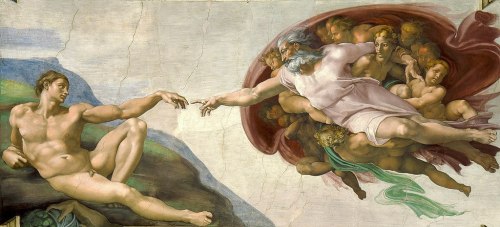
Would you take a moment and consider something?
When God created man, He didn’t create another God.
You might think that’s nothing new, but it is a very, very important truth – one that is rarely unpacked when discussing issues of sin and suffering.
There are people who wonder why God, if He exists and is so powerful and wise, created a free agent who could sin (break God’s law).
Others question why Scripture would suggest that Jesus was slain before the foundations of the world (1 Peter 1:19-20).
The answer to these questions and many more is that God did not create another God, only man.
God has certain characteristics that Man could never have simply because he was created. The most obvious are that he is not eternal, omnipotent, immutable, or omniscient. The most important is that Man, no matter how perfect he was at the moment of creation, was not holy as God is Holy.
If God were to create another like unto Himself, then God would not be God. If Man could be created, he couldn’t be eternal.
No matter what God created, His creation could never be Himself, and therefore not God.
God is eternally immutable, unchanging, therefore He cannot sin. On the other hand, Man is not eternal, nor immutable, so even from the beginning of creation, he had the potential, however remote, to sin. Therefore, even though God did not create sin, nor did He cause Adam to sin, sin was inevitable simply because God created a creature that was not Himself.
Why was it part of God’s plan that Jesus would be crucified, even before Adam even sinned? Because simply creating Man brought with it the inevitable possibility, the inevitable reality, that he would need to be redeemed – because he is Man, not God.
In this was manifested the love of God toward us, because that God sent his only begotten Son into the world, that we might live through him. Herein is love, not that we loved God, but that he loved us, and sent his Son to be the propitiation for our sins. – 1 John 4:9-10 KJV
Simply put, the only way sin could have been avoided would have been for God to never create any being capable of freely communing with Him. If he had created a robot, a machine, then sin would not have been inevitable. But since Adam was given the freedom to choose, a will, and since he was not God, the inevitable required an Emmanuel.
Filed under Christianity, God, grace, Jesus, salvation
Not Just a Magnificent Double Rainbow

Taken with my iPhone 11 on Tuesday, June 9, 2020 in Chattanooga, TN.
How many things are more impressive than a huge end-to-end double rainbow after a major downpour?
Can’t think of many.
But how many even know what a rainbow is? It’s not simply a beautiful phenomenon or the symbol of a social advocacy movement.
It’s a PROMISE!
Genesis 9:12-17 (NLT) 12 Then God said, “I am giving you a sign of my covenant with you and with all living creatures, for all generations to come. 13 I have placed my rainbow in the clouds. It is the sign of my covenant with you and with all the earth. 14 When I send clouds over the earth, the rainbow will appear in the clouds, 15 and I will remember my covenant with you and with all living creatures. Never again will the floodwaters destroy all life. 16 When I see the rainbow in the clouds, I will remember the eternal covenant between God and every living creature on earth.” 17 Then God said to Noah, “Yes, this rainbow is the sign of the covenant I am confirming with all the creatures on earth.”
What if it’s a double rainbow? My guess is God needed a little extra reminding today.
Filed under America, current events, grace, Love of God, nature
What Are the Five Solas, and Did Elvis Sing About Them?
‘O Sole Mio
When I am driving long distances, particularly when I’m alone (as far as I know), I sometimes sing aloud certain songs to keep me alert. Sometimes I sing songs I know well, and other times I make up lyrics to fill in the gaps for songs I know little of.
One particular song is “‘O Sole Mio,” or “It’s Now Or Never.” I will usually sing to myself and use the words interchangeably, adding in what I know of the chorus of “It’s Now Or Never,” then make up the rest from there. The whole idea is to sing loudly, operatically, in order to keep the blood and oxygen flowing, but sometimes my own lyrics crack me up, especially when I expand on the sexually predatory characteristics of Elvis’ version.
#/media/File:Elvis_presley_nowornever.jpg)
Credit: Wikipedia
Actually, the older (1898) Neapolitan song has nothing to do with the English-language hit recorded by Elvis Presley in 1960. ‘O sole mio actually translates into “my sunshine,” while It’s now or never translates into: “I’m so turned on by your looks that we should have a one-night-stand…I’m outa here come daylight.”
So why am I telling you this? I’m glad you asked.
Sole is the Italian word for “sun.” Luce del sole is Italian for “sunlight.” So, by way of a totally unrelated personal story, I want to segue into something that should be important to us all… I want to shine some luce del sole on the Solas 🙂
“It’s now or never . . .” (Elvis)
The Five Solas
Sola is the Latin word for “alone,” and for a practically 500 years non-Catholics (such as myself) have held five particular “solas” near and dear to our theological hearts.
1. Sola scriptura: “Scripture alone”
2. Sola fide: “faith alone”
3. Sola gratia: “grace alone”
4. Solo Christo: “Christ alone”
5. Soli Deo gloria: “to the glory of God alone”
What do they mean? Well, nothing Elvis Presley was singing about, that’s for sure. The following can be found on a great website whose link is already on my sidebar, GotQuestions.org.
Sola scriptura emphasizes the Bible alone as the source of authority for Christians. By saying, “Scripture alone,” the Reformers rejected both the divine authority of the Roman Catholic Pope and confidence in sacred tradition. Only the Bible was “inspired by God” (2 Peter 1:20-21) and “God-breathed” (2 Timothy 3:16-17). Anything taught by the Pope or in tradition that contradicted the Bible was to be rejected. Sola scriptura also fueled the translation of the Bible into German, French, English, and other languages, and prompted Bible teaching in the common languages of the day, rather than in Latin.
Sola fide emphasizes salvation as a free gift. The Roman Catholic Church of the time emphasized the use of indulgences (donating money) to buy status with God. Good works, including baptism, were seen as required for salvation. Sola fide stated that salvation is a free gift to all who accept it by faith (John 3:16). Salvation is not based on human effort or good deeds (Ephesians 2:9).
Sola gratia emphasizes grace as the reason for our salvation. In other words, salvation comes from what God has done rather than what we do. Ephesians 2:8-9 teaches, “For by grace you have been saved through faith. And this is not your own doing; it is the gift of God, not a result of works, so that no one may boast.”
Solo Christo (sometimes listed as Solus Christus, “through Christ alone”) emphasizes the role of Jesus in salvation. The Roman Catholic tradition had placed church leaders such as priests in the role of intercessor between the laity and God. Reformers emphasized Jesus’ role as our “high priest” who intercedes on our behalf before the Father. Hebrews 4:15 teaches, “For we do not have a high priest who is unable to sympathize with our weaknesses, but one who in every respect has been tempted as we are, yet without sin.” Jesus is the One who offers access to God, not a human spiritual leader.
Soli Deo gloria emphasizes the glory of God as the goal of life. Rather than striving to please church leaders, keep a list of rules, or guard our own interests, our goal is to glorify the Lord. The idea of soli Deo gloria is found in 1 Corinthians 10:31: “So, whether you eat or drink, or whatever you do, do all to the glory of God.”
The five solas of the Protestant Reformation offered a strong corrective to the faulty practices and beliefs of the time, and they remain relevant today. We are called to focus on Scripture, accept salvation by grace through faith, magnify Christ, and live for God’s glory. © Copyright 2002-2017 Got Questions Ministries
Never heard of the five solas of the Protestant Reformation before today? Well, I hope this shed some sunlight – luce del sole – on them for you 😉
Filed under Christianity, God, grace, Martin Luther, Theology
Bedtime Prayer of the Saved by Grace
“Now I lay me down to sleep.
I KNOW the Lord my soul will keep.
And if I should die before I wake,
Then, HALLELUJAH! That would take the cake!
Thank you Jesus! Amen! Praise God!”
“Now the God of peace be with you all. Amen.” – Romans 15:33
Filed under Christianity, Faith, grace, iPosts, Life/Death, salvation






 The Recovering Legalist