Author Archives: Anthony Baker

Anthony Baker's avatar

About Anthony Baker

Husband, dad, pastor, artist, and musician. Time Magazine's Person of the Year in 2006 (no joke!). Loves coffee (big time), good movies, and sarcastic humor. Holds a Doctorate in Ministry. Most importantly, a servant of the Lord Jesus Christ. All glory belongs to Him! Matthew 5:16

Sanctuary Sundown

Anthony Baker's avatari4 Daily

Don’t let the sun set on little churches like this!

Small congregations are just as important as large ones. However, sometimes it’s hard to find the finances to keep the doors open.

We’re not talking needing money for new jets or luxury homes; electricity, insurance, community ministry have costs.

South Soddy Baptist Church is one of those little churches that could use some help. If you would like to help in it’s time of need, go to SouthSoddyBaptist.org and click on the “Donate Online” tab.

Don’t let the sun set on this little church.

View original post

Leave a comment

Filed under Uncategorized

How Long? Selah.

“O ye sons of men, how long will ye turn my glory into shame? how long will ye love vanity, and seek after leasing? Selah.” – Psalm 4:2

FullSizeRender (1)Selah. A word that calls us to stop for just a moment and contemplate what we’ve just read. This morning pause and consider the glory of God.

“My glory”

It is important that we realize first that when David writes these words it is not only about himself. This is one of those verses which have a double meaning: one that is meant for the time it was written, and another that implies a bigger story. In this case, it’s about the glory of God.

In case you’ve ever wondered, the word glory carries with it the idea of a “heaviness” or a “burden.” It concerns one’s “reputation.”

“Sons of men…”

David was probably writing to men whom at one point were his trusted friends, but now they were trying to kill him. These were men who made up his inner circle of government, who acted in his name. Yet now, here they were in rebellion, turning the glory of David’s reign into shame.

Sons of men was something of a title of honor and dignity.

“Vanity” and “Leasing”

Vanity is that which is hollow and worthless. Vanity is that beauty that fades, the riches that decay. Yet, what does the world love? It chases after fleeting fame and false beauty. It’s constantly trying one-up God’s creation. Yet, men “love” it; literally, they “flirt” with it. Why not seek after things that last?

“Leasing” is another word for lying. David is asking why it is that men seek after lies? I guess the answer could be found in the modern context of news. Why do we keep going to the media for truth about the world when we know they rarely tell the truth?

From Glory to Shame

God is asking His creation – the ones who bear the fingerprint of their Creator – “Why do you turn MY glory into shame?” Why do men and women constantly seek after emptiness and lies, when the Truth is right in front of them?

Why did David’s men rebell against him, knowing he was God’s annointed King of Israel? Why do men rebel against Jesus, the eternal King of Glory? After all, we are who we are because of God; we are the jewel of His creation? Why do we love to devalue ourselves, turning His glory into shame?

Tragic, isn’t it? Nevertheless, the “how long” part of this verse hints at something very important: We can’t rob God’s glory and impune His name forever.

Just think about that for a while.

Leave a comment

Filed under Bible Study, God, Selah

Caption This :-)

I’m in the process of reawakening my creative side by reviving my old blog i4Daily.
I hope you get a kick out of the pictures 🙂

Anthony Baker's avatari4 Daily

While visiting a music store (Fiddlers Anonymous) to hear some bluegrass music, my daughter Katie was approached by the owner of the establishment’s dog.

The dog was in-your-face friendly!

But, you know, we Americans do like to maintain a little more space between noses, LOL!

View original post

2 Comments

Filed under Uncategorized

Proper Fear and Persuading Others

Not long ago I preached a sermon to my congregation, the following text being one of several that I used.

Knowing therefore the terror of the Lord, we persuade men…” – 2 Corinthians 5:11a

There is always talk about the fear of terrorism these days, yet very few talk about the fear of God. Why is that? After all, aren’t we commanded to fear the Lord? Isn’t it the wise thing to do?

The fear of the LORD is the beginning of wisdom: and the knowledge of the holy is understanding.” – Proverbs 9:10

The problem is that we get so distracted by the common, temporal fears of this world forget about the eternal. Some of us are terrified of what others may find in our closets, but forget that God knows all. Our minds are so cluttered with all the stresses of this life that we forget about what comes after.

Both of the previous verses also talk about “knowing” and  the “knowledge” of God. In the first passage (2 Cor. 5:11a) the Apostle Paul is essentially telling the Corinthians: “Hey, it’s because we know who God is and what He’s capable of, not to mention the fact that we must all stand before Him one day (5:10), that we do our dead-level best to tell it to you like it is!”

In the second passage, wise King Solomon is telling anyone who will listen, “The more you know God, the better you’ll understand how life works.” Knowing and understanding who God is will produce produce fear: terror in His enemies; reverential fear in those who love Him.

Jesus said: “And fear not them which kill the body, but are not able to kill the soul: but rather fear Him which is able to destroy both soul and body in hell” (Matthew 10:28). [emphasis added]

So, while ever-present bad news will tend to make us want to run and hide or take matters into our own hands, keep everything in its proper perspective. Those who serve the Living Savior; those who are reconciled to God by the atonement of the cross of Christ; those who were once strangers, but now have been made children of the Father, can find peace and rest in the fearfully omnipotent hand of our faithful Creator.

Wherefore let them that suffer according to the will of God commit the keeping of their souls to him in well doing, as unto a faithful Creator.” – 1 Peter 4:19 

The only ones who should be living in terror, in fear of what may come today or tomorrow, are those who have never known God, have forgotten God, or worse, mock Him (Romans 1:18-32).

When we persuade others to fear God in the proper way, they will come to know His love and love Him in return. Then, instead of living in terror, ironically, “perfect love casteth out fear” (1 John 4:18).

For ye have not received the spirit of bondage again to fear; but ye have received the Spirit of adoption, whereby we cry, Abba, Father.” – Romans 8:15 

Are you living in fear? Can you call God “Abba, Father” (Daddy)? A proper relationship will produce a proper fear; terror is the product of rebellion.

If you don’t fully understand what I’ve written, or if you’d like to know more about how to live in peace without terror, click on the Eternal Life tab at the top of the page and follow the instructions.

6 Comments

Filed under Bible Study, God, salvation, Struggles and Trials

Street of the Week Commercial

With the help of my daughter, Katie, I put together a new little commercial to promote our “Street of the Week” initiative.

We’ve been doing this for a while, so I know it’s really a blessing to people. Sure, we really want to grow the numbers in our little church, but there’s also a need for Christians to show love to their communities, and this is a non-confrontational way to do just that.

Now, when we go out and pray on a street of the week, we don’t just prayer walk – we try to meet people. But what they don’t expect is for use to give them a bag of homemade cookies and only ask if there’s something we can pray about.

It’s soft evangelism, in a way.

If we can show people we really do care, no strings attached, then maybe they will want to talk about eternal things. But that’s a door the Holy Spirit has to open.

Why don’t you give this a try in your hometown? If you want to know more about the specifics of what we do, I’d be happy to share them with you. Just email me or leave a message below.

Like I say at the end of this video, if you would like to make donations to help in this work (or any other that we are trying to do at South Soddy Baptist), you can go to the church website (SouthSoddyBaptist.org) and make a tax-deductible donation via the “Donate Online” link at the top of the main page.

Blessings!


4 Comments

Filed under Church, ministry, Prayer

Praying for the President

Why can’t more Christians be like Pastor Brunson and pray for the President?

How many times do folks like myself have to remind fellow believers that even if you dislike the man, Donald Trump is the President of the United States, and we are therefore instructed to petition God on his behalf, to pray for him when he might not even recognize his needs, and to thank God for him.

Don’t believe me?

First of all, then, I urge that petitions, prayers, intercessions, and thanksgivings be made for everyone, for kings and all those who are in authority, so that we may lead a tranquil and quiet life in all godliness and dignity. This is good, and it pleases God our Savior, who wants everyone to be saved and to come to the knowledge of the truth. – 1 Timothy 2:1-4 CSB

Notice the “why’s” attached to the above commands:

  • So that we may lead a peaceful and quite life.
    Tell me, how in the world is throwing civility out the window helping things? Is our nation peaceful and tranquil? Heck, no! And why not? Could it be that many Christians are guilty of allowing Satan to use them as tools to stir up strife?
  • So that we lead a quite life of godliness and dignity.
    Oh, tell me, how much godliness is there in forcing people out of restaurants and threatening constant incivility? Where is the dignity in screaming at the sky and clawing at the doors of the Supreme Court?
  • It pleases the Lord.
    Newsflash: Rioting in the streets and burning police cars does not please the Lord. Sending hate mail does not please the Lord. Creating an atmosphere of chaos and incivility – even anarchy – does NOT please the Lord.
  • For the sake of the gospel!
    Yes, we are to pray for our leaders so that we might live peaceable, godly, and dignified lives in order that the good news of Christ might be shared with those for whom Jesus died, and that those for whom He died might be saved.

If that’s not enough, and you can’t think of anything good to say about President Trump, Jesus Himself leaves you with no excuse for the hatred and violence.

But I say unto you, Love your enemies, bless them that curse you, do good to them that hate you, and pray for them which despitefully use you, and persecute you; That ye may be the children of your Father which is in heaven: for he maketh his sun to rise on the evil and on the good, and sendeth rain on the just and on the unjust. – Matthew 5:44-45 KJV

Some of you can’t believe that any Christian would support Donald Trump. Frankly, I couldn’t believe that any Christian could support Barack Obama, the man more hostile to the Church than any other president in history.

But I can tell you this without blinking an eye: I prayed for President Obama.

We should be praying for President Trump, too.

30 Comments

Filed under America, Christian Living, Christian Unity, community, current events, ministry, Prayer

I pray every one of you has a great day, today. Try to find a place to corporately worship with other believers. If you’re ever in Soddy Daisy, TN, I’d like to invite you to visit us at South Soddy Baptist. #southsoddybaptist

Anthony Baker's avatari4 Daily

“The true preacher, preaching with every drop of his lifeblood and with every spark of his understanding of the Word of God, has an unction from heaven itself. His feet may tremble but the rock upon which he stands shall abide forever.” W. A. Criswell

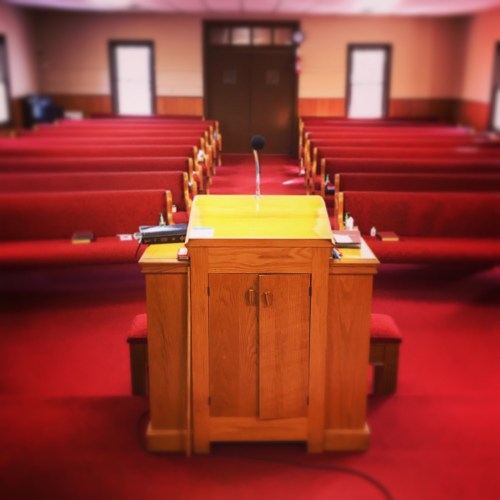
My pulpit at South Soddy Baptist

View original post

Leave a comment

Filed under Uncategorized

He Heard! Selah.

“I cried unto the LORD with my voice, and he heard me out of his holy hill. Selah.” – Psalm 3:4

FullSizeRender (1)Selah. It’s a musical notation meant to make us pause and reflect on what we’ve just read (or sung – the Psalms were songs). And what better to think about than the Lord of heaven hearing our cries?

I Cried

קָרָא qârâʼ (kä·rä’), translated as “cried,” could mean to recite, read, cry out, or proclaim. But in the context, and especially sense this word has also been used of animals crying out – and since the root of this word has to do with the sound a person makes when confronted unexpectedly, or accosted – I think the cry David made was more like a loud, desperate call for help . . . like the desperate plea from a fallen child.

Just think about that for a moment. Are you a parent? What does it do to you when your child cries out for help? What does that cry sound like to you? When your child is being chased by a dog, or when he falls and gets hurt, does he recite his proclamation of displeasure? You know the difference, don’t you?

So does God for His children when they cry out for Him.

He Heard Me

What an expression of hope! What an expression of joy! David was thrilled that God would actually hear him when he called.

He heard me from his holy hill” was an expression humility…of wonder…of amazement that the Holy One would be mindful of him (Psalm 8:4). But it was also a testimony to David’s enemies who had said previously that there was “no help for him in God” (Psalm 3:2).

Oh, God hears! David wrote this song as a testimony to that fact. He reminds us that heaven is not deaf, but attentive and listening. Our prayers are not worthless words read or recited to a spaghetti monster in the sky. No, there is a God, and He hears His own.

Pause and think about that for a while. 


Leave a comment

Filed under Bible Study, Selah, self-worth

Observant vs Oblivious

It’s been a long time since I regularly posted to i4Daily … it’s been a long time since I had an iPhone 4s, too. But, who knows, maybe it’s time to crank it up again. Let me know what you think.

Anthony Baker's avatari4 Daily

This is Jack and Mona (I’m not crazy about the “Mona” name, but that’s what my daughter named her).

Jack is a Chiweenie (sp?). Mona is supposedly a Chorkie. Jack has been going on Saturday-morning breakfast rides for years, but this was Mona’s first.

Notice how that Jack is sitting all proper and face-forward, while Mona is more interested in what I’m doing with my feet and hands as I drive.

Jack knows the destination, but Mona does not.

Sometimes, when the struggles of life want to drag us down, we need to be reminded that we have a purpose and a destination.

Prophetically speaking of the Messiah to come, Jesus, the prophet Isaiah wrote:

For the Lord GOD will help me; therefore shall I not be confounded: therefore have I set my face like a flint, and I know that I shall not be ashamed. – Isaiah 50:7

Looking…

View original post 200 more words

Leave a comment

Filed under Uncategorized

The Real Problem with the Problem of Evil

An Old Debate

One of the most common reasons for denying the existence of God is the problem of evil in the world. Just ask any group of atheists to give their top ten reasons for unbelief and surely one will claim as number one, “If there is a God, then why is there so much evil in the world?” For many, this is the pièce de résistance of rebuttals. How could a good God be real and allow all the suffering in the world to continue unabated – assuming He is even good? The eighteenth century philosopher, David Hume described the problem this way in Dialogues concerning Natural Religion, 1779:

“Is God willing to prevent evil, but not able? then he is impotent. Is he able, but not willing? then is he malevolent. Is he both able and willing? whence then is evil?” (Stackhouse 1998, 11)

So, the “problem of evil,” and its source, has been an issue of philosophical debate for centuries.  The existence of evil in the world, along with unanswered questions, has even become evidence enough for some to embrace atheism.  Therefore, because so many philosophers and theologians have tried for ages to reconcile the existence of God with the existence of evil, I dare say that nothing I write will be new.  But, if anyone were to challenge my belief in God, along with my faith in Jesus Christ, with the argument that the problem of evil constitutes proof God does not exist, then I would possibly respond with arguments based on the following thought:

Without the existence of God, there should be no evil to be a problem, and that’s the real problem with “the Problem of Evil.”

Evil? What Is It?

What exactly is “evil?” Now, that may sound like an absurd kind of question to ask, but if the existence of evil is the evidence that is supposed to expose my faith as a fraud, at best, or even a lie, then what is it?  Is it something tangible? Is it metaphysical? Is it theoretical? What is it, exactly? Does it have any particular form? How can it be distinguished from what is called good? On what do the atheists and agnostics base their definition of this thing called “evil?”

Amazingly, the answers are not all the same, nor in some cases even grounded in reality. However, it is imperative to understand that we must define this God-killer, because its definition will determine our conclusions and help to clarify our assumptions.

When C. S. Lewis was an atheist, for example, his “argument against God was that the universe seemed so cruel and unjust.” (Lewis 1989) There he had it, or so he thought. God could not exist because so much evil exists. But how did he arrive at “this idea of just and unjust?” Lewis said, “A man does not call a line crooked unless he has some idea of a straight line.” (Lewis 1989) “Tell me,” I would say, “what is evil, and how do you recognize it when you see it?

The Adjective

To start, evil must be understood to be an adjective. Evil is a description of something that is not good. Evil is not a thing. The word “evil” only describes the thing, the thought, and the action. Technically, “evil” does not exist, only what it describes.

Some people say that they cannot believe in God because why or how could a good God, if He was perfect, create evil? They think of evil as something that must have not existed until God made it. But evil “isn’t a kind of molecule or a virus…infecting or affecting everything it encounters.  There was no time when God said, ‘Let there be evil,’ and there was evil.” (Stackhouse 1998)  As John G. Stackhouse put it, “evil becomes a noun only in the abstract.” Additionally, in his book Can God Be Trusted, Stackhouse says of evil:

“An action can be evil, or an event can be evil, or a quality can be evil, or a being can be evil. And we can lump all these particular evils together in our minds and come up with a category ‘evil.’ We can even go on to discuss it as if it were a particular thing, so long as we do not forget that we are always dealing with a category or group of particular evil things, not a thing itself.” (Stackhouse 1998, 31)

So then, if evil is a description, how is it that we come to use the adjective, or as Lewis put it, the “crooked line,” without first having some idea of what is a “straight” one?  Defining what is good is as important as defining evil. To know what is evil, we must first have some assumption as to what is not evil.

The crazy thing is that if God does not exist, and man is nothing more than a collection of random matter, both good and evil are purely relative – their existence is based purely on one’s perspective.  So, in other words, the one who says that there is no God, based on the existence of evil, is literally basing his belief on pure opinion, not on anything objective. Therefore, in order to bring an accusation against the goodness of God, one must have a base line. What is the standard by which we determine what is good and what is evil?

The Standard

Some use Man as the baseline. They compare God to the standard set by what is thought to be good behavior in this world. They rationalize that if God is real, at least according to monotheistic dogma, He must be all-powerful, perfectly good, and the supreme example of love, kindness, and providential care. Because it is preached that God is a better Father than earthly fathers, Mark Twain took it upon himself to write:

The best minds will tell you that when a man has begotten a child he is morally bound to tenderly care for it…[yet], God’s treatment of his earthly children, every day and every night, is the exact opposite of that, yet those minds warmly justify those crimes…when he commits them.” (Tonie Doe Media 2007)

So then, according to Twain, God could not exist because if He did, He would act consistent with our understanding of what a good and loving earthly father would do.  In other words, if God cannot, in all His perfection, behave better toward His children than the most common man, His credentials are therefore revoked, and He must cease to exist.  However, this is so illogical.

Who are we to say that God, if He is perfect, and we are imperfect, ever treats His children poorly? Do the protesting cries of a toddler who has had poison taken from his grasp carry more weight than the decision of the earthly father to take it away? How, then, are we to automatically assume that the infantile tendencies of finite man are wiser than the infinitely Mature?

Using Man as a baseline for what is good and evil is pure arrogance.

Whose Line Is It?

In reality, the problem of evil is really a problem for the atheist. He, who denies the existence of a Creator and accepts only the realities of evil in the world, essentially has nothing about which to complain.  Everything should be just fine and dandy, but it’s not.  The atheist knows that evil things happen to both good and bad people.

He sees the hurt, feels the pain, and begs for justice. The reality of evil in the world causes men to cry out for justice; for things to be made right. This is a problem, though, because knowing that a crooked line is not straight hints at the fact that a Line-drawer exists.

The Followers’ Fault

Others take a different approach. They claim that God does not exist except in the evil intentions of his followers to control others through guilt. They claim that God is just a fabrication of priests to keep mankind from behaving “naturally.”

They say that nature is good, and if anything, God is evil for trying to get man to behave contrary to the very way he was created to behave. One guru said, “It seems that for those who worship God, the opposite to God is not that which is ‘evil,’ but that which is natural.” He said of animals, comparing them to men, “They don’t worship God, they don’t go to church, they don’t have any theology.  They don’t have any feeling of guilt, they are simply natural.” (Osho 2009)  In other words, if there is evil in the world, it is because our belief in God has inflicted it.

The Majority Response

But for the majority of the hurting world, pain is real, loss is real, and evil is manifested daily.  Many see the things that happen to innocent people, especially children, and wonder, “If there is a loving God, why doesn’t he do anything about this?

These people, many of which hold on to hope as long as they can, finally succumb to their doubts and conclude that the only way to explain away the pain is to admit that it is just part of life, part of the natural world, part of what makes us human; alone, in our quest to make life easier, free of pain, free from evil; alone, without God.

These are the ones, I believe, that lure more away from the faith than any Darwinist.  They are the ones who have seen evil face-to-face and cannot fathom a God who would allow it to continue.  And because their experiences are so painful and tragic, the devout are left speechless and without explanation. Ellie Wiesel is a good example.

Wiesel’s Observation

Wiesel was a teenager when he saw his family murdered in the Nazi death camps.  But it was only after witnessing one particular act of horror – the slow, hanging death of a young boy – that he turned away from his faith in God.

In the book Night, his Nobel prize-winning autobiography, Wiesel said he heard a man behind him ask, “Where is God now?” As he stood there, being forced to stare into a pitiful, wide-eyed, swollen face of a dying child, a voice within replied, “Where is He? Here He is – He is hanging here on the gallows…” (Wiesel 1982) Because there was no justification, even in the big scheme of things, Ellie Wiesel’s God died with the executed boy.

But as sad as it is, without God, who can say what happened to that boy was any worse than the slaughter of an animal?  Are we not all just animals – some more evolved than others?

The Real Problem

To me, the problem of evil is not a problem for the believer to explain, but one for the non-believer.  Aside from the theological arguments about the character of God, without God, to turn Hume’s question around, “whence then is evil?

Without God, evil is relative to one’s desires and personal pleasure.  Does it really even matter whether or not God could do anything about evil in the world when the whole question is moot if He didn’t exist?

With God, evil is defined as that which is against His law, that which stands opposed to His standards, and that which describes all who take pleasure in such rebellion. Without God, evil is just a matter of opinion.

That is the real “problem of evil.”


Works Cited

Lewis, C. S. “Atheism.” In The Quotable Lewis, by C. S. Lewis, 59. Wheaton: Tyndale House Publishers, Inc., 1989.

Osho. The God Conspiracy: the path from superstition to superconsciousness. New York: Osho Media International, 2009.

Stackhouse, John G. Can God Be Trusted. New York: Oxford University Press, 1998.

Tonie Doe Media. In The Atheist’s Bible, 129. New York: Harper Collins, 2007.

Wiesel, Ellie. Night. New York: Bantam Books, 1982.

9 Comments

Filed under Apologetics, Culture Wars, Faith, General Observations, Life/Death, Struggles and Trials