Tag Archives: Gospel of Matthew

Yokey Dokey

(Guest post by Nick Welford)

What do you think of most during a day? What thoughts capture your mind when you are otherwise unoccupied? Whatever it is there’s a good chance that is what you are yoked to, but we are getting ahead of ourselves.

Matthew 11: 28-30 ‘Come to me, all you who are weary and burdened, and I will give you rest. 29 Take my yoke upon you and learn from me, for I am gentle and humble in heart, and you will find rest for your souls. 30 For my yoke is easy and my burden is light.’

I love the imagery that Jesus conjures here. A yoke (as pictured) is a device that holds two or more oxen together while they pull their plough. The interesting thing is that an older more experienced Ox would be yoked to a young rookie. When the youngest got a bit carried away and tried to speed off and finish the job more quickly, the older Ox would pull him back in line, keeping the plough straight. When the young Ox got tired, the strength and experience of the old Ox would keep him on track. Why was this so important? Because one day the young Ox would become an old Ox himself, and on that day, when he’d learned all there was to know about ploughing a field, he would be yoked to a young rookie Ox.

In Jesus day a yoke was also another name of an interpretation of the scriptures. One Rabbi might read the Old Testament and conclude that sacrifice was the most important thing, his yoke would be sacrifice, another Rabbi might conclude love was the main message, and his yoke would be love. What is interesting is that Jesus claims His yoke is easy, but isn’t this the same Jesus that bids daily take up our crosses? That tells us to gain life we must lose ours? Hardly seems like the easiest of yokes does it? How can Jesus justify calling His yoke easy?

The key, I think, comes when we compare Jesus yoke to all the other yokes around Him. All the other yokes will let you down, none of the other yokes can cope with you! If you yoke yourself to a teaching or a theory what happens when you get headstrong? When you make a mistake? An ideal cannot forgive you, it cannot pick you up, dust you off and walk the road with you. In short words cannot teach you to plough. Yoke yourself to Jesus though, and he will teach you how to live.

In our day and age we may not yoke ourselves to Rabbi’s teachings, but the world provides plenty of other ideals to attract our devotion. Consumerism, individualism, money, sex, power. All of these and more bid for our loyalty, and yoke ourselves we do. But when we stumble and fall these things have no compassion, no pity. They cannot love us, or provide for us. All they can do is spit in our faces and laugh at us, and we take it all, thinking that is all there is to life. Yoke ourselves to Jesus though, and He will pick us up every time we fall, He will give us rest from the constant demands of the things we use to yoke ourselves to. Yoke ourselves to Jesus and He will teach us to be more like Him, so we can show others too.

 

8 Comments

Filed under Christian Living, Christian Maturity, Faith, God, Guest Posts, self-worth

Wouldn’t You Take Him Home?

Tear Jerkers

Frequently I see posts/pictures on Facebook that are really meant to make one cry. And many times the tears are supposed to make one want to do something, like give to a charity, hug a tree, or feed the hungry.

Now, look at the picture to the right. Here you have a grown dog sitting in the middle of a street getting soaked in the rain. I don’t know who took the picture, but the title of the Facebook post was something like, “Wouldn’t you take him home?”

That got me to thinking about some things. Can I share them with you?

  • Go ahead, go up to the dog. I bet it’ll snap your hand off at the wrist.
  • Have you ever wondered why a grown dog has chosen to just sit in the rain?
  • If the dog was smart enough to fetch your slippers, don’t you think it could have found something to hide under?
  • It the dog is so stupid that it can’t get out of the rain, then do you really want it in your home?
  • Is it possible that he simply wants to be left alone because his girlfriend left him for a Doberman? If that is true, refer back to the first point.

An Old Dog

Looking at this dog sitting in the rain also got me to thinking about some other things. For instance, why don’t we think about old men that way? Let’s just say that dog in the road is 5 or 6 years old – that would make him what, 30 or 40 in human years? Would you look at a drug addict lying in the rain and ask, “Wouldn’t you take him home?”

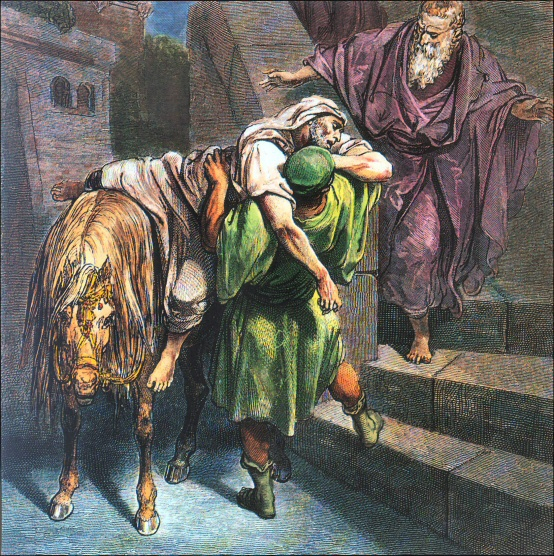
No, a grown man has made his choices, right? He should be left in the rain, or on the side of the road bleeding. It’s one thing to help a dirty dog, but a stranger? Get real, right? I mean, who does that kind of thing? A good Samaritan?

Isn’t that strange? Why is it that we would be more likely to cry a tear over an old dog than a man? A mother’s child?

What About These?

And then I remembered this picture. It is not of a dog in the rain, or a cat in a kennel, or a puppy in the pound; it’s just a bunch of orphans.

Back in 1992 I had the rare privilege to visit a Romanian orphanage. The children did not know why we were there, but they were excited. It wasn’t often that strangers were allowed in, especially after a 1990 news story on ABC’s 20/20.  They stood lined against a wall…waiting.

Wouldn’t you take one home? Don’t you know what happens to orphans in places like this, especially after they “graduate” at age 18?

Misplaced Sorrow

It is only my opinion, but I think we should worry less about animals in the rain and more about humans living in drains. I’ll never forget a story I saw about children living in the sewage drains of Kenyan cities. They would sniff glue at night, not for fun, but to keep from feeling the pain of hunger. That should make us cry.

“For I was hungry, and you fed me. I was thirsty, and you gave me a drink. I was a stranger, and you invited me into your home. I was naked, and you gave me clothing. I was sick, and you cared for me. I was in prison, and you visited me.’ “Then these righteous ones will reply, ‘Lord, when did we ever see you hungry and feed you? Or thirsty and give you something to drink? Or a stranger and show you hospitality? Or naked and give you clothing? When did we ever see you sick or in prison and visit you?’ “And the King will say, ‘I tell you the truth, when you did it to one of the least of these my brothers and sisters, you were doing it to me!'” – Matthew 25:35-40 NLT

11 Comments

Filed under animals, General Observations, Uncategorized, World View

Side Effects

Ask Your Doctor

Surely you have seen the commercials on television. They advertise different medications meant to do everything from grow hair to end hot flashes. And at the end of every commercial you hear, “Ask your doctor if ******** is right for you!”

Right for me? Ask my doctor? OK, maybe I will.

“Dr. Close (my general physician), can I ask you something? I saw an add for female hormone replacement medication. Is it right for me?”

A New Disease

I can’t tell you how many times I have watched a commercial and said to myself, “Where did that disease come from? Is it common? Could I be suffering from it? Will I get to wear a colored ribbon?”

Have you ever heard of Trihemamasticular Disease? I googled it – nothing came up. But that doesn’t mean there isn’t an advertisement in the works. At this very moment, there is probably a pill being made which promises to alleviate the symptoms of Trihemamasticular Disease. And if there is, rest assured it will be the best thing for you.

Just be aware of the side effects…

  • Common side effects may include the following: nausea, indigestion, coughing, dry mouth, ringing in the ears, and a runny nose.
  • Don’t be alarmed if you experience: watery eyes, hair loss, brittle teeth, a craving for oysters, bleeding gums, or stinky feet. These symptoms are usually temporary.
  • Stop using this medication if you begin to experience: a reddening of your ear lobes, tooth loss, finger loss, memory loss, or financial loss.
  • Avoid the following while taking this medication: leather, crayons, animal fat, peanut butter, aspirin, attitudes, children, loud noises, butterfly feces, clowns, and purified water.
  • Get medical attention immediately if you begin to experience: hives, swelling of the left knee, suicidal thoughts, thoughts of starting over, unknown tongues, a desire to star in a reality show, rapid breathing, breathing through a straw while submerged in a river, thoughts of voting Democrat, or a craving for pickles.

Warning Label

As crazy as it may sound, there should also be a warning label inside every Bible. They should make television commercials explaining the possible side effects of following Christ.

Side effects may include:

  • Being hated, ridiculed, made fun of, mocked, and parodied.
  • Being ostracized, avoided, shunned, passed over for promotions, and fired from a job.
  • Being accused of radicalism, racism, fanaticism, and narrow-mindedness.
  • A cross to bear.

Blessed are ye, when men shall revile you, and persecute you, and shall say all manner of evil against you falsely, for my sake.” – Matthew 5:11

Then shall they deliver you up to be afflicted, and shall kill you: and ye shall be hated of all nations for my name’s sake.” – Matthew 24:9

And he said to them all, If any man will come after me, let him deny himself, and take up his cross daily, and follow me.” – Luke 9:23

And whosoever doth not bear his cross, and come after me, cannot be my disciple.” – Luke 14:27

Is it right for you?

3 Comments

Filed under Christian Maturity, Humor, salvation, Witnessing, worship

Barriers to Church Growth. #5 (Honoring Self)

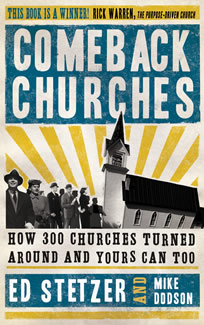
A very revealing study was done, leading to a book detailing how 300 churches went from declining or dying, to growing. In Comeback Churches, written by Ed Stetzer and Mike Dodson, there is a list of 30 different barriers to church growth. Having received permission from the publisher (B&H Publishing Group), I would like to discuss a different barrier each week.

“People do works for their own honor and not the glory of God (Matthew 5:16).”

“Let your light so shine before men, that they may see your good works, and glorify your Father which is in heaven.” – Matthew 5:16 KJV

Why do we do good works? Why do we feed the poor, shelter the homeless, tend to the elderly, etc. Do we do these things so that our Father will be glorified, or do we do them in order to get glory for ourselves?

To be Seen.

Some people do good works for the sole intention of being seen and considered especially spiritual. Jesus said that “Everything they do is for show” (Mt. 23:5 NLT). Jesus spoke of those who wanted to be seen as pious and holy by wearing boxes containing Scripture on their foreheads or arms. The bigger the box the better. All this was in an attempt to say, “I am keeping the law better than you!” (See Deuteronomy 6:5-9)

Then there are other people who do plenty of good deeds without even acknowledging God. For example,  go to any charity ball held by your local “high society” club. There you will find plenty of people who willingly give thousands to worthy causes, but smile as big as they can when the magazine photographers come around.

They may even be members of local churches and give large offerings to the building fund (as long as it’s named after them); buy the pastor a new car; or pay for a youth mission trip. “And they love to sit at the head table at banquets and in the seats of honor in the [congregation].” – Matthew 23:6 NLT

To be Accepted

Some people do good works in order to be accepted by God. They give away fortunes and spend their lives doing good deeds, but not to be seen of men. They want to be seen by God and thought of as worthy of His love. The only problem is that salvation is “not of works, lest any man should boast.” They work themselves to death in order prove their loyalty, thereby supposedly insuring a place in heaven. But the glory goes not to God, for attached to the works is an expectation of reward based on merit.

Soli Deo gloria

All glory should be to God alone. If our works are done in order to receive praise, then God is not getting the glory. If our works are meant to earn credit with God, then God is not getting the glory. If we work ourselves silly to meet the legalistic requirements placed on us by men, then God is not getting the glory. However, if out of a heart of love we do good works without expectation for reward, recognition, or acceptance, then God will receive the glory.

When all glory, honor, and praise is given to the Lord, He will draw all men unto Himself. Church growth will be unstoppable. Yet, if we expect credit for anything, then what should we expect but further decline? “For mine own sake, even for mine own sake, will I do it: for how should my name be polluted? and I will not give my glory unto another.” – Isaiah 48:11 KJV

We want others to see our good works, but not for our own glory. May they “glorify [our] Father which is in heaven.”

2 Comments

Filed under book review, God, legalism, Uncategorized

Legalistic Fasting

This is now the umpteenth time I have written several paragraphs, only to turn around and delete everything. Maybe I should just keep this very simple and to the point.

Don’t be legalistic about fasting.

There, I said it. It’s off my chest. I can sleep better, now.

You see, a lot of folks in the Christian community act no differently than the Muslim community during the month of Ramadan. They treat fasting as something necessary to gain favor with God. They think fasting is somehow required to be spiritual. I disagree.

Matthew 6:16 is a verse commonly used way out of context.  In that verse Jesus said, “when you fast.” It was not a command, but a prelude to a command. He said, “Moreover when ye fast, be not, as the hypocrites, of a sad countenance.” Jesus wasn’t commanding anyone to fast, only to not be like the hypocrites who make themselves look all pitiful.

When Jesus said “when,” He was speaking on the assumption that fasting was a common practice with those in the audience. However, we must be careful to take note that it was not a command to fast, nor one that gave instructions. All He said was that when you do fast, don’t be as one of those who seek attention from men.

Lest we forget, there is nothing that we can do to earn the favor of God. His grace is unmerited. His love is not based on the prerequisite of starving one’s self once a year, month, or week. There is nothing wrong with fasting, but there can be serious flaws with our intentions.

False Biblical Examples

It is evil to teach formulas for health, wealth, and happiness based on select passages of Scripture. A good example would be the Prayer of Jabez teaching that says, “Pray this prayer and you will be wealthy.” But examples of fasting in the Bible are also used for exploitation. The first one that comes to mind is the Daniel Fast.

If you remember, in the first chapter of the book of Daniel, Daniel “purposed in his heart that he would not defile himself with the portion of the king’s meat, nor with the wine which he drank.” Because of Daniel’s courageous stand, based on his faith in God and the dietary laws given to Moses, God chose to work a miracle and honor the Hebrew children, in turn bringing glory to Himself. Sadly, there are those who look at what Daniel did and say, “Hey, if I just eat vegetables and water (because meat and wine are obviously evil), then I will be guaranteed health, wealth, and favor.” This is a classic example of misapplication.

True Biblical Examples

When I read the Bible, there are 3 things that seem to be common with true fasting: 1) Desperation, 2) Mourning, and 3) God’s glory. Nowhere do I see it taught that it should be used as a way to become a better person, a more spiritual saint, or a healthier individual. Nowhere do I see it taught that if one did not regularly fast, then that person should be considered spiritually inferior.

What I DO see are examples of people who, when faced with insurmountable trials, impending defeat, or crushing repentance, found food to be the least of their concerns. I think of David when he was praying for his dying son (2 Samuel 12:16 & 17). I think of Nehemiah when he heard of the broken wall (Nehemiah 1:4, 6).  I think of Queen Ester faced with the annihilation of her people (Ester 4:3). I think of Ezra, who, fearing the name of the LORD would be tainted, called the people to a fast before God (Ezra 8:22). These are the common examples.

Too often we take something from Scripture and cheapen it to the point that it becomes a simple 4 or 5-point how-to bestseller. In our slightly inconvenienced world we resort to claiming the only thing truly desperate people had at their disposal. We say, “if you do this, then that will happen.” More often than not, when people in the Bible fasted, it was not because they wanted to – they couldn’t do anything else.

Modern Legalists

Then there are those who like to flaunt the fact that they are disciplined and spiritual – the modern “hypocrite.” They look with derision upon the one who has not fasted once a week. They proudly proclaim “I fast twice in the week, I give tithes of all that I possess” (Luke 18:12), when in reality their fasting is nothing more than a supposed means to a selfish end. Because of their judgmentalism, they force others to be like them. They create a law to which they hold all others accountable, while in the darkness the truly humble is beating his breast, saying, “God, be merciful to me a sinner.”

One Last Thing.

There is no denying that we probably do not fast enough. As a matter of fact, according to Jesus (Matthew 17:21), many a spiritual battle has been lost because of a lack of fasting and prayer. That is the key – prayer.

Fasting without prayer is nothing more than scheduled Anorexia. The whole point of fasting is to seek the face of God, laying all other allurements aside, such as food (even marital relations – 1 Cor. 7:5). It is not that we need to fast; we need God. If fasting is what it takes, then that is what we should do. But one thing is for sure, if we are hungry enough for God, then we won’t need anyone to tell us when or how to fast.

Let me know what you think. Do you fast? How long? Why? Results? 

7 Comments

Filed under Food, God, legalism, worship