

Denver, Colorado (Artist: Susan Cassidy Wilhoit)

Colorado State Motto (1861) and State Seal (1877)
Nil sine numine
“Nothing without the Deity”
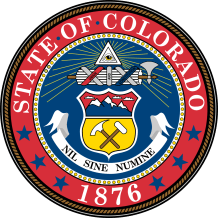
Image credit: Wikipedia
To read the introduction to this post, CLICK HERE.
Denver, Colorado (Artist: Susan Cassidy Wilhoit)
Image credit: Wikipedia
To read the introduction to this post, CLICK HERE.
Filed under America, Apologetics, community, Culture Wars, Faith, God, politics, The Magnificent Fifty

Sacramento, California (Artist: Susan Cassidy Wilhoit)

Devin Walker v. First Orthodox Presbyterian Church, 760-028.9
To read the “introduction” to this series, CLICK HERE.
Filed under America, community, Culture Wars, politics, The Magnificent Fifty
A very revealing study was done, leading to a book detailing how 300 churches went from declining or dying, to growing. In Comeback Churches, written by Ed Stetzer and Mike Dodson, there is a list of 30 different barriers to church growth. Having received permission from the publisher (B&H Publishing Group), I would like to discuss a few of this barriers.
“Churches aren’t concerned about God’s glory, believing the church is just for them (Isa. 42:8; 48:11).”
I [am] the LORD: that [is] my name: and my glory will I not give to another, neither my praise to graven images. – Isa. 42:8
For mine own sake, [even] for mine own sake, will I do [it]: for how should [my name] be polluted? and I will not give my glory unto another. – Isa. 48:11
When we read the above verses it should be very clear to us that God is not interested in sharing His glory. Yet, too many times we rob God of the glory that is due Him by seeking it for ourselves. We do this in many ways, including the reason many of us go to church.
Lest we forget, “it’s not about us.” However, if you polled the majority of church-goers, I believe you’d find that the reasons for attending congregational worship are more selfish than we’d like to admit. To many believers, church is about what one can get, as opposed to what one can give.
The Tale of the Hymns
Have you ever stopped to listen to the words of those old-time hymns many of us grew up with? You may have sung them all your life, but stop and think about the following: “This world is not MY home, I’m only passing through. / My treasures are laid up somewhere beyond the blue…;” “I’ll Fly Away;” “I’ve got a mansion just over the hilltop;” “All I Need.” What is the common denominator of these lyrics and titles? “Me, me, me.”
If the Church Hymnal (© 1951,1979) was used as a tool to determine what we think of church, stop and think about this: there are 80 hymns with a title that starts with the words, I, I’m, I’d, I’ll, I’ve, or My. In contrast, less than 10 contain the word glory. Those that do include “Glory Hallelujah In My Soul” and “I’ll Live in Glory.”
I think it is pretty obvious that many of us come to church to get from God, not to give to God. He deserves our worship and our praise. He deserves all the glory because His is God, and not man (Hosea 11:9). We deserve nothing, yet His grace and mercy bestow upon us all the treasures we enjoy. Why do we come expecting anything?
Surely our churches would grow if God was glorified. Imagine a congregation of people who came together to lift up praise and adoration to Jesus for His glorious love. Imagine a group of folks who set aside all their own desires and petty differences in order to lift up holy hands unto the King of Glory. What did Jesus say? “If I be lifted up…I will draw all men unto me.”
So, what do you think? How could we do better in giving the glory to the One who truly deserves it?
Related Post: Un-“Christian” Ministry?
Filed under Christian Maturity, General Observations, God, Uncategorized, worship
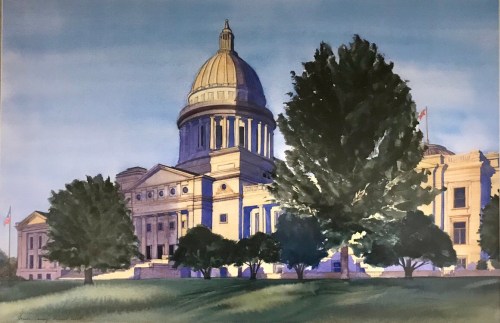
Little Rock, Arkansas

Shaver v. The State, 10 Ark. 259, 263
To read the introduction to this series, CLICK HERE.
Filed under America, Apologetics, Christianity, Faith, politics
There are some people in the Christian world who think making people angry is doing God’s work. Some Christians are convinced that they are fulfilling the Great Commission by crashing public events and barking out, “Repent! Repent!” In reality, many just come off as being inconsiderate, impolite, and obnoxious.
In defense of their actions, many street preachers and their followers (but not all) have suggested the following points:
In response, let me share…
First. In Mark 16:15 Jesus said, “Go ye into all the world, and preach the gospel to every creature.” But in Romans 12:18 we are told, “If it be possible, as much as lieth in you, live peaceably with all men.” Even though we are commanded to preach the gospel, we’re not commanded to stir up strife.
Second. Paul told the Romans, “Let us therefore follow after the things which make for peace, and things wherewith one may edify another (14:19).” Maybe that’s because Jesus said, “Blessed are the meek (Matt. 5:5),” and “Blessed are the peacemakers (Matt. 5:9).”
Third. Even though Jesus never pulled any punches with the Pharisees, it is never recorded where He went to a Pharisee picnic with a bullhorn blasting out “Repent, you serpent-breathed, white-washed tombs!” As a matter of fact, as best I can tell, it was the Pharisees who came to Jesus in order to stir up trouble, not the other way around (Matt. 3:7; 15:1; 16:1; 19:3). It should even be noted that all the words Jesus spoke to the Pharisees in Matthew 23 were spoken in the temple (Matt. 21:23), not on the street.
Folks, it’s really a matter of decency, respect, and good manners. Emily Post said, “Manners are a sensitive awareness of the feelings of others. If you have that awareness, you have good manners, no matter which fork you use.” A Christian should be the most mannerly person in the world! Jesus was never rude or obnoxious, so why should we?
The English novelist and war correspondent Maurice Baring is quoted as saying, “Whoever one is, and wherever one is, one is always in the wrong if one is rude.” That should be a lesson to us.

It doesn’t matter how great the message or how right the cause, rudeness is the Great Negator.
Filed under Preaching, Witnessing

Pheonix, Arizona (Artist: Susan Cassidy Wilhoit)

48th State: Feb 14, 1912 Built: 1901
To read the introduction to this series, CLICK HERE.
Filed under America, Apologetics, Faith

Juneau, Alaska (Artist: Susan Cassidy Wilhoit)

49th State: Jan 3, 1959 Style: Art Deco Built: 1931
To read the introduction to this series, CLICK HERE.
Filed under America, Apologetics, community, Culture Wars, God, politics

Montgomery, Alabama (Artist: Susan Cassidy Wilhoit)

Click HERE to read the introduction to this series.
Since 1978 the Freedom From Religion Foundation (Madison, WI) has fought to completely secularize every aspect of American public life. Part of the Atheist Alliance International and the Secular Coalition for America, FFRF pushes not only a secularist agenda but promotes atheism (“nontheism”) every chance it gets.
Despite the evidence suggesting our founding fathers were far more religious than not, and despite the fact that our Declaration of Independence starts off with the once-common assertion that our “unalienable Rights” are given by God, FFRF claims the very Constitution meant to protect those rights “was very purposely written as a godless document…” Therefore they claim God, faith, and any expression of religion – even cross-shaped memorials for the dead and prayer before local city council meetings – should be eradicated from the public square.
So, in response to their regular attacks on anything religious, and especially in response to what is nothing short of propaganda-like attempts to rewrite history, I felt compelled to respond with series of posts depicting actual history.
Contrary to what many people believe, our nation has a strong foundation of faith, and I want to prove it with some art.
As some of you may know, two of my daughters attend Bryan College in Dayton, TN. Therefore, I have had more than a few opportunities to roam the corridors.
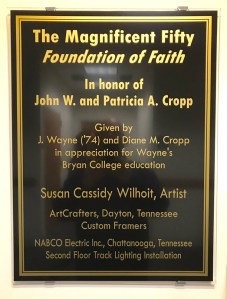 The first two floors of the main building at Bryan (Mercer Hall) house a permanent art exhibit featuring the work of Susan Cassidy Wilhoit. On display are paintings she made of every state capital building, along with a brass placard below.
The art collection is called “The Magnificent Fifty: Foundation of Faith“ because the placard below each painting includes words demonstrating “the foundational belief in and acknowledgment of God’s providence and blessing within each state’s heritage.”
Therefore, tomorrow I am going to begin a series of posts featuring photos I’ve taken of the state capital building paintings (in alphabetical order), along with the words engraved on the placards below them.
The following posts will not attempt to argue that America is a Christian nation, but that our nation’s founding documents were anything but “godless.”
Contrary to what the Freedom From Religion Foundation says, our nation has a foundation of faith.
Tomorrow: Alabama
Back in 2014, during the semifinals of The Voice, “Team Blake” member Craig Wayne Boyd cranked out a fantastic rendition of the classic hymn “The Old Rugged Cross.” Many people – including those who call themselves “Christian” – were shocked. Why did a singer choose to sing this hymn on a national stage – in a competition? I mean, the cross? Really? What was this guy thinking?
Maybe, just maybe, Craig Boyd was letting the world know where he’d lay that crown, should he win it.
You see, it was on the cross of Calvary that the “Dearest and Best” was slain. It was on this cross that the “ordinances against us” were nailed (Col. 2:14). It was on this cross that our Savior promised that if He be lifted up, He would draw all men unto himself. It was on this cross where Jesus said, “Father forgive them, for they know not what they do.”
Without the cross, grace would be a non-issue and the Law would still be my master. Without the cross, Easter would be irrelevant. Without the cross, we’d never been able to witness the most powerful manifestation of love (1 John 4:9-10)the world would ever see.
It was on that old, rugged, blood-stained cross that Jesus paid the penalty for my sin. It was the crossroad of judgment and mercy where the Lamb of God humbled Himself (Phil. 2:8) and purchased my reconciliation with God (Eph. 2:16).
So, why cherish the cross? Because it was and is proof positive that even before I knew Him, even when I was steeped in sin, God loved me enough to die in my stead.
It’s shame and reproach I’ll gladly bear.
Filed under Christianity, Easter, Faith, God, grace, Love of God, worship



Click to Order



 The Recovering Legalist