
Author Archives: Anthony Baker

Anthony Baker's avatar

About Anthony Baker

Husband, dad, pastor, artist, and musician. Time Magazine's Person of the Year in 2006 (no joke!). Loves coffee (big time), good movies, and sarcastic humor. Holds a Doctorate in Ministry. Most importantly, a servant of the Lord Jesus Christ. All glory belongs to Him! Matthew 5:16

Sometimes All You Can Do is Ride the Pieces

Photo by Nadine Biezmienova (free Pexels)

Have you ever thought you were doing well, only to find out you weren’t?

Here’s another question… Have you ever tried to improve yourself, only to find that the improvements you thought you were making were actually counterproductive to your end goals?

Have you ever had the best intentions and done everything right to the best of your ability, only to find yourself making one mistake that dominoes into a pile on the floor?

Believe me, I’ve not just been there, I’m here . . . and I’ve got the t-shirt ordered.

So what now? Question myself even more? Wallow in self-pity or succumb to the darkening clouds of doubt and depression?

What do you do (if, of course, you’ve ever experienced something like this)? How do you deal with it?

How do I deal with it? That’s a great question!

There are times when there’s nothing you can do to fix a problem. We humans – especially men – are all about trying to fix problems. Nevertheless, sometimes the problem is too big to fix, at least by us.

These are the times that I mentioned in a sermon just this past week. These are the times I spoke of (generically speaking) when I outlined the times when Satan will take advantage.

These are the precise times of brokenness, weakness, sadness, futility, and resignation that our Enemy, per his usual mode of operation (the “wiles” of the Devil), attempts to make things even worse by turning our eyes away from Christ and onto the waves about to sink our frail boat.

There are times when it is difficult to say, “Hold on through the night.” No, about the only thing one can do at these times is commit to holding on just beyond the moment we think we can’t hold on any longer. These are the times when we HAVE to depend on God’s strength, His mercy, and His grace.

Friend, you may think all is lost. The truth is that it may be. Yes, that’s what I said. Sometimes all WILL be lost. But that doesn’t mean God is done and everything is over.

There was a time in the life of the Apostle Paul when, as a prisoner, he was aboard a ship that was bound for destruction. Even though everything was done to lighten the ship and keep it afloat through days and days of an unrelenting storm, God told Paul to tell those on the ship that yes, it would eventually sink and be a total loss.

Except – and this is a biggie – no lives would be lost. The only catch was that, at the news the ship was going to crash, no one was to abandon ship. Those that abandoned ship would die. Only those who stayed on the ship till it broke up would survive.

In an attempt to escape from the ship, the sailors let the lifeboat down into the sea, pretending they were going to lower some anchors from the bow. Then Paul said to the centurion and the soldiers, “Unless these men stay with the ship, you cannot be saved.” So the soldiers cut the ropes that held the lifeboat and let it drift away.

Acts 27:30-32 NIV

Crazy, isn’t it?

But that’s what happened. They all stayed on the ship until it ran aground and broke into pieces. The pieces are what they were able to use to float to safety.

But the ship struck a sandbar and ran aground. The bow stuck fast and would not move, and the stern was broken to pieces by the pounding of the surf. The soldiers planned to kill the prisoners to prevent any of them from swimming away and escaping. But the centurion wanted to spare Paul’s life and kept them from carrying out their plan. He ordered those who could swim to jump overboard first and get to land. The rest were to get there on planks or on other pieces of the ship. In this way everyone reached land safely.

Acts 27:41-44 NIV

I get it! I understand exactly what you are going through! Satan will try to get us to jump ship, throw in the towel, give up the mission, abandon the post, or simply walk away into the dark never to be seen again. I mean, what’s the use, right? If the ship is sinking anyway, why ride it into the rocks?

Listen, as one wreck-in-the-making to another, it may be scary, and it won’t be easy, but keep sailing – stay in the ship for a little longer. . . just a little longer than the moment when you think you can’t go on . . .

Because God may have a plan for the pieces of wreck that an intact ship couldn’t accomplish.
Leave a comment

Filed under Depression, Life Lessons, Struggles and Trials

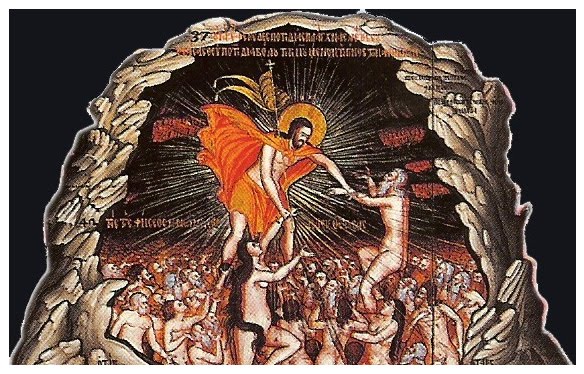
A Mini Commentary, Pt. 9 (Ephesians 4:8-10) Did Jesus Preach in Hell?

This was a more complicated section on which to comment. Frankly, this could have been much longer if I had focused more on the questionable doctrine called the “Harrowing of Hades.” Nevertheless, I hope what I have written will be of some help or encouragement.


See the source image

4:8-10 8Wherefore he saith, “When he ascended up on high, he led captivity captive, and gave gifts unto men.” 9(Now that he ascended, what is it but that he also descended first into the lower parts of the earth? 10He that descended is the same also that ascended up far above all heavens, that he might fill all things.)

v. 8: Wherefore he saith, “When he ascended up on high, he led captivity captive, and gave gifts unto men.”

Point One:     

Who is the one that “saith” in verse 8? For the answer we must go to Psalm 68:18; there we find the words of David describing God as a conquering King who spoils His enemies on the mountain and then distributes the spoils as gifts to the people, including to those who are rebellious.

However, one important question that could be asked is: to what extent do we take this comparison? In other words, how specifically analogous is the story of the conquering King to the argument that Paul is making regarding the gifts and the purposes of giving them by Jesus to the Church?

Some have suggested that what is being spoken of is Christ’s ascension to the cross, while others have suggested that after descending to the “lower parts of the earth” Christ rescued those held captive in Paradise and took them “captive” to heaven.

[Note: This teaching is also called “The Harrowing of Hades” and finds support in the Apostles’ Creed: “He descended into Hades.”]

Nevertheless, it would seem the best course of action to simply keep a consistent contextual reading in mind: one that of unity within the Church and individual gifts of grace which Jesus imparts, both to His friends and those who are rebellious, to exemplify His glory and wisdom.

Point Two:     

Beginning with verse seven, the context of Paul’s argument is the supplying each individual the things it needs to function properly in the Body of Christ, the Church. Are there deeper truths to be uncovered? Most certainly? However, we must not carry the analogy too far.

For as long as the author can remember, nearly every time the resurrection of Christ has been preached, the subject of Jesus descending to Paradise and taking the Old Testament saints out of there and up to heaven. The only problem is that there is nothing in the context of Ephesians 4:1-16 that addresses Paradise, hell, heaven, or even death! All that Paul addresses in these sixteen verses is the subject of unity.

Another passage that is linked to this verse is 1 Peter 3:19: “By which also he went and preached unto the spirits in prison.” But what is often never included with verse 19 is verse 20, which reads [emphasis added]: “Which sometime were disobedient, when once the longsuffering of God waited in the days of Noah, while the ark was a preparing, wherein few, that is, eight souls were saved by water (1 Peter 3:20 KJV).

It is quite puzzling why 1 Peter 3:19 would be used as a supporting text (along with Luke 23:43, Psalm 68:18, and Ephesians 4:8-10) for a teaching claiming Jesus went to deliver the saints, when those to whom Jesus preached were the “disobedient.”  It is therefore illogical to deduce from this passage in Ephesians that Paul was speaking of anything other than the unity of the Body of Christ, the power of God, the Kingship of Jesus the Conquering King, and Christ’s generosity.

v. 10b: …that he might fill all things.

            Building on the image of the king that ascended to conquer his enemies, Paul speaks of Jesus’ all-encompassing Lordship with a parenthetical explanation of the logical comparison being made (beginning in verse 9). This imagery of Jesus’ omnipresent authority and power in this passage can be compared to other verses, such as: Eph 1:20-21(in the heavenly places, far above all principalities); Heb 4:14 (we have a great high priest that is passed into the heavens); Heb 7:26 (a high priest became us and made higher than the heavens).

2 Comments

Filed under Bible Study, Christian Unity, Christianity, Theology

A Mini Commentary, Pt 8 (Ephesians 4:7)

OK, so now it gets even better! Paul brings it down to the personal level.


4:7 “But unto every one of us is given grace according to the measure of the gift of Christ.”

Photo by Flo Maderebner on Pexels.com

But unto every one of us

            After stressing unity in the Body, Paul now changes direction and tightens his focus onto the individual, including himself. In verses 1-6 Paul addresses the Church as a whole, the Preacher to the congregation. But now in verse seven we see Paul moving away from the plural “you”, using instead “every one” and “we.”

            Christianity is about God’s love for the Church, the Bride of Christ, the Body of Christ, but it’s also about the individual member of the Body. The hope of the believer is not to be swallowed up into God as a Hindu might believe, but to be eternally loved by a personal God, one who has even reserved a special name on a white stone that only the Father and His child will know (Revelation 2:7). Yes, God loved the world so much that He gave His only begotten Son, but the offer of salvation is to “whosoever believeth” (John 3:16). The individual is uniquely important and particularly gifted for the work and the health and the unity of the Body.

            It also should be noted that the “us” to whom Paul is speaking is the Church, the body of believers. This is an important observation to make because only those within the Body of Christ can experience being part of the Body of Christ.

is given grace

            It is wonderful to read these words! It is much more wonderful know that it’s true! Who receives the gift of grace? It is the Church as a whole? Are those who are in the Church (i.e., baptized into the Roman Catholic Church) guaranteed a gift of grace from the Father? No, it is unto “every one of us” (v. 7a) that grace is given as a gift. The personal aspect of the relationship of the Father to His children should not be overlooked nor discounted.

            Paul will go on to refer back to Psalm 68:18 in the next verse when he describes David’s description of Yahweh as a conquering King. But here what we have is the declaration that the gifts to be given are based not on our good works or position, but in the goodness and graciousness of God.  The noun χάρις (charis) “is related to the verb χαρίζομαι (charizomai), which conveys the general concept of giving generously or forgiving a debt or a wrong.”[1] There are none who can say they deserve grace, for grace is “unmerited divine favor, arising in the mind of God and bestowed on his people.”[2] The idea that grace can be earned is contrary to the reality that the only thing earned by ungodly man is judgment.

There is also no maintaining of biblical unity without grace, for the natural man gives according to merit and expects to receive for the same reason. If God gave us grace according to measure of our good deeds, we would be doomed. But He gives grace to every man, not only to exhibit His mercy, but to manifest unto the greatest example of forgiveness and compassion which, if followed, will help the individuals within the Church to “keep the unity of the Spirit in the bond of peace” (v. 3).

according to the measure of the gift of Christ.

            Here we find one of those lines in Scripture that seems simple enough, but upon deeper study, especially of the original languages, it is not simple in the least. As a matter of fact, “according to the measure of the gift of Christ” can be understood in different ways, leaving the context to be the only real determiner of the author’s meaning. For example, who is it that is to be giving the graces? Christ? God the Father on behalf of Christ? And what of the “measure” that is spoken? Is grace given to us based on a standard “measure,” that of the gift of Christ? Or is grace dispersed according to how Christ determines to mete (measure) it out? The best way to determine the meaning is to consider the context.

            As has been mentioned earlier, verse seven shows us that God’s concern and work is not limited to the Church as a whole, but it also stretches to the individual and his place in the Body or Building. Not all bricks in a building are the same. And even if most of the bricks in a wall were made exactly alike, the positioning would be unique, for no two bricks could occupy the same space in the wall.

Unto “every one of us” is given grace (not saving grace, but special grace) according to the great architectural design of the Builder, Jesus Christ (“I will build my church” – Mark 16:18). As commentator Ernest Best explained, the giving is not random nor arbitrary, nor is it given in abundance for no reason; “he apportions gifts to believers”[3] in order to accomplish His architectural plan for the Church. Therefore, everyone is given special graces, such as will be touched upon in the next two verses, but they are not all the same, nor in the same amount.


[1] Joshua G. Mathews, “Blessing,” ed. Douglas Mangum et al., Lexham Theological Wordbook, Lexham Bible Reference Series (Bellingham, WA: Lexham Press, 2014).

[2] Gary S. Shogren, “Grace: New Testament,” ed. David Noel Freedman, The Anchor Yale Bible Dictionary (New York: Doubleday, 1992), 1086.

[3] Ernest Best, A Critical and Exegetical Commentary on Ephesians, International Critical Commentary (Edinburgh: T&T Clark International, 1998), 377.

Leave a comment

Filed under Bible Study, grace

A Mini Commentary, Pt 7 (Eph. 4:6)

I’m so glad it’s Friday! Aren’t you?

But I’m not just happy it’s Friday, I’m happy that Friday means tomorrow is Saturday, then Sunday! In other words, it’s great to have something to look forward to each day of the week.

We now continue with a short commentary on Ephesians 4:6.


Photo by Brett Sayles on Pexels.com

4:6 “One God and Father of all, who is above all, and through all, and in you all.”

One God and Father of all,

            The seventh unifier of the Church is the fact that we all worship the same God and Father of all. Making up the third triad, Paul goes on to describe God our Father as above, through, and in us all. But note that Paul does not use just one or the other in the labeling of the Supreme Being; He’s both God and Father. What a glorious thought when one considers that the Creator is also our Abba! For the one outside of the Body, learning of an omnipotent and omnipresent entity from which they cannot run or hide might be terrifying! However, quite the opposite is true for the child of God. Knowing that God is not just King, Judge, and Executioner, but He’s our loving, all-caring, gracious, merciful Father full of love and pity for His own.

who [is] above all,

            Now describing the God and Father of all, first Paul describes Him as “above all.” We must never forget who God is. He is the wholly “Other” in that He is Holy like no other. There is none like Him. There is none that compare. He is above and beyond anything our imaginations can conceive and the only One to whom the angels cry day and night, “Holy, holy, holy, Lord God Almighty!” (Isaiah 6:3; Revelation 4:8).

and through all,

            But far from the God of Deism (a God who is distant and totally transcendent, without concern for His creation), this God is ever near. Unto every one of us, as Paul told the Athenians on Mars Hill, He is so close that if we would just reach out we would find Him (Acts 17:27).

and in you all.

According to Rick Brannon and Israel Loken, “Most early manuscripts have the general statement, ‘and in all,’ but some early manuscripts and related later witnesses personalize the statement to the readers with ‘and in you all.’”[1] The idea is that God is not distant, though He be far above us; He’s not unreachable or out-of-touch with His creation, for His presence can be seen and felt through it all; and more than a God “out there,” He is personal and cares about the “you.”


[1] Rick Brannan and Israel Loken, The Lexham Textual Notes on the Bible, Lexham Bible Reference Series (Bellingham, WA: Lexham Press, 2014), Eph 4:6.

Leave a comment

Filed under Bible Study, God, Theology

A Mini Commentary, Pt 6 (Eph. 4:5)

As we continue to work through this passage of Ephesians, think about where you’ve heard this verse before. How was it used? What was the point? Was it used as a tool to attack denominations? Was it used as a tool to excuse doctrinal error? Think about it as you read this part of the commentary.

As always, I’d be happy to hear your thoughts.


4:5 “One Lord, one Faith, one baptism,”

One Lord,

Here begins the second triad, that of one Lord, one faith, and one baptism.

Just as the Body of Christ, the Church, is not a self-existing, self-sustaining entity that can exist without the power of the Spirit. It is not free to do as it wills. What also unifies the Church is one Head, one Lord, and that is Jesus. He is in complete control by virtue of the price He paid, and He is the “one who is in charge by virtue of possession, owner.[1]

Jesus in our Lord, our Kyrios, our Master. All authority is His. All dominion is His. And the work and life of the Body is His, also. Therefore, anytime we say “our church” or “my church,” we should remind ourselves that what binds us together is not the confederacy of churches but the united body of the Church which belongs to the Lord, Jesus, and no other.

one faith,

            The “faith” that is spoken of here is not that of a particular dogma, catechism, creed, or religious convention. “It refers to the principle of faith by means of which all the saints enter into salvation.”[2] The Apostle Paul spoke of this faith earlier in the letter when he said:  “For by grace are ye saved through faith; and that not of yourselves: [it is] the gift of God: Not of works, lest any man should boast” (Ephesian 2:8-8). What unites us as a body of believers is not our works, anything we have done, good or bad, but the same entry requirement: faith in Jesus Christ for salvation.

one baptism,

            Here the translators transliterate the Greek words εἷς βάπτισμα (heis baptisma) as “one baptism.” Even though the words carry the meaning of being immersed into water, literal water baptism is not what is being addressed. This is a spiritual baptism, a placing of the believer in the Body of Christ. Only the Holy Spirit can do this. Paul referenced this “baptism” when writing to the Corinthians: “For by one Spirit are we all baptized into one body, whether [we be] Jews or Gentiles, whether [we be] bond or free; and have been all made to drink into one Spirit” (1 Corinthians 12:13).


[1] William Arndt et al., A Greek-English Lexicon of the New Testament and Other Early Christian Literature (Chicago: University of Chicago Press, 2000), 577.

[2] Kenneth S. Wuest, Wuest’s Word Studies from the Greek New Testament: For the English Reader, vol. 4 (Grand Rapids: Eerdmans, 1997), 96.

Leave a comment

Filed under Bible Study, Christian Unity, Christianity

A Mini-Commentary, Pt 5 (Ephesians 4:4)

I hope you all had a wonderful long weekend (here in America), because I sure did! Beside having a wonderful service Sunday morning, my family and I came together in Atlanta, GA, to attend a major-league baseball game between the Atlanta Braves and the Miami Marlins…and the Braves WON!…Twice in the same game!

Today, let us look at verse 4 in Ephesians 4. Keep in mind that the Body of Christ (the Church) may be one, but it contains individual parts, each part of an overall design, and each part performing a prescribed function. We will go deeper into that aspect a little later.

4:4 There is one body, and one Spirit, even as ye are called in one hope of your calling.

See the source image

[There is] one body,

            Here the Apostle Paul, speaking of the Church as the unified Body of Christ, begins the first point in “Seven Particulars”[1], the culmination of the last making up three different triads. The first triad is that of “one body…one Spirit…one hope of your calling.” See also 1 Corinthians 12:13.

The second triad is formed from “one Lord…one faith…one baptism.” The third triad is found in verse six where, when describing God the Father, the seventh “particular,” he declares that He is “above all…through all…in you all.”

            Paul continues to use the analogy of the body to describe the importance of healthy unity. Unity in the body, especially peaceful unity (v.3) is critical for effectiveness. Although a human body be unified, all individual members working together for the common life of the body, if one member be sickly or “angry,” the rest of the body, however healthy, will ultimately be affected and the work of the body will be hindered. There are a great many truths associated with the Church being the Body of Christ on the earth, and here is no exception. But what Paul does in the next few verses is take both a wide-angle view and one that is microscopic: he speaks of the common unity we have as the Body, but he also stresses the importance of the individual member (v.7).

and one Spirit,

            What is a body without life? What is a body without a spirit that animates it? Similarly, what is the Body of Christ without the life-giving, resurrecting power of the Holy Spirit? Not only are believers part of one body, but they are also empowered by the indwelling Pneuma (the Holy Spirit; the breath of God). “For by one Spirit (Pneumati) are we all baptized into one body…” (1 Corinthians 12:13).

            It must be understood that without the presence of the Spirit, the Church would not be the living Body, Jesus Christ being the Head. Therefore, as the Body is united, and as it works, individual members will have different responsibilities, such as feet help the body to stand while the fingers grip the hilt and the arm swings the sword. Yet, all will receive their strength from the Holy Spirit. The same Spirit that flows through one part of the Body is the same that flows through another whose Head is Jesus Christ. “But ye are not in the flesh, but in the Spirit, if so be that the Spirit of God dwell in you. Now if any man have not the Spirit of Christ, he is none of his” (Romans 8:9 KJV). See also 1 Corinthians 12:13.

even as ye are called in one hope of your calling;

            The unified, universal Church is one Body, has only one life-giving and empowering Spirit and only one hope: “the glorious appearing of the great God and our Saviour Jesus Christ” (Titus 2:13 KJV). Those who have put their faith in Jesus Christ have a calling – a “vocation” – for which they have been called. Therefore, in everything we do, at home or at work or school, each believer has been issued a vocation in the Kingdom, and that is to point people to the only Hope of the World.

            It must be noted, however, that a careful reading of this part of verse four shows that “even as ye are called in one hope of your calling” is a phrase which helps modify the previous “There is one body, and one Spirit.” Notice how that Paul says that there is one body and one Spirit, “even as…” Therefore, a comparison is being made between the two phrases, which could even lend to the argument that there is not really a triad in this section, only a couplet modified by a couplet.

            So, what is really being said? How do we make the comparison between the two? The body needs a spirit to animate it, to make it alive; the “vocation” has only one “hope.”


[1] H. D. M. Spence-Jones, ed., Ephesians, The Pulpit Commentary (London; New York: Funk & Wagnalls Company, 1909), 147.

Leave a comment

Filed under Bible Study, Christian Unity, Christianity, Church, Uncategorized

How to be a Free and Happy Nation

Ever wonder what preachers used to preach around this time of the year? Check out a few excerpts from a message preached only 18 years after the signing of the Declaration of Independence.

We could learn a few things.

“A people under a free government will be happy, as long as they are virtuous and wise.  They may become vicious and corrupt.  They are then liable to be influenced by private connections, party spirit, bribery or flattery, promises or rewards, or the artifice and intrigue of crafty and designing men.

When this is the case, they give up their security, lose their liberty, and sink into slavery….

“…Our free government was a happy, but a costly purchase; let it not be lost by drowsy inattention, and implicit confidence…

The day is coming, when liberty and peace shall bless the human race.  But previous to this, truth and virtue must prevail, and the religion of Jesus must govern men’s hearts. Then the horrors of war will cease, and the groans of slavery will no more be heard.  The rod of the oppressor will be broken, and the yoke will be removed from the shoulders of the oppressed.  The scepter will be wrested from the hands of the wicked, and the pomp of  the proud will be brought down to the dust.  The whole earth will rest and be quiet: they will break forth into singing…” 

– from “The Happiness of Free Government and the Means of Preserving It,” preached by JOSEPH LATHROP, D. D. on July 4th, 1794

I think the “vicious and corrupt” are now running the show. As a result of our “drowsy attention” we have elected men and women of the lowest character, thereby giving up our security, our liberty, and the hope of freedom-loving people around the world who look to us as a shining city on a hill.

We are sinking into slavery.

Leave a comment

Filed under America, current events, the future, voting

A Mini Commentary (Pt. 4)

Are we having fun, yet!

I am!

Let’s jump back into the deep water this morning and look at Ephesians 4:3. It’s all part of a short commentary on Ephesians 4:1-16 entitled,

“The Edification of the Body of Christ by the Gifts Given by Jesus to the Church.”

But hey! When you are finished reading today’s study, leave a comment and let me know your thoughts.

Tomorrow is the 4th of July, so I’ll be sharing a post relating to that subject, not this. But check back on Monday to pick it up again as we look at Ephesians 4:4.


4:3 “Endeavouring to keep the unity of the Spirit in the bond of peace.”

Endeavouring

            Here the Apostle Paul uses a word that adds urgency to the “vocation.” To endeavour (σπουδάζω, spoudazō) is to use make haste to do what you need to do. Even more, the sense of urgency implies that one should do everything he can as soon as he can and not waste time.

Or, as the Pulpit Commentary described, “Σπουδάζοντες is stronger than the A. V. ‘endeavouring,’ and denotes an object to be carefully and earnestly watched for and promoted.”[1] Consider how the same word is used in 2 Timothy 4:9 when Paul asked Timothy, “Do thy diligence (spoudazō) to come to me shortly.” And, again, in verse 21 of the same chapter, “Do thy diligence to come before winter…” We can sense the urgency. However, as much as the word could convey a sense of urgency, it can also point to great desire, like the heartfelt longing Paul expressed in 1 Thessalonians 2:17 where he said:

1 Thessalonians 2:17 KJV – But we, brethren, being taken from you for a short time in presence, not in heart, endeavoured[G4704] the more abundantly to see your face with great desire.

Considering how Paul used endeavoured in other places, it would be safe to conclude that the unity to which he is referring should not only be striven for with urgency, but with great desire.

To keep the unity of the Spirit

Photo by Daniil Ustinov on Pexels.com

            What does it mean to “keep” something? The word translated here can be used to describe keeping, watching over, or guarding something.[2] It could also be used with the meaning of keeping something in a particular state or condition. However, what needs to be stressed is that unity is not something that happens naturally, at least not in the spiritual body. When we seek our own devices, we cause disunity, strife, and internal conflict. Therefore, we must “endeavor” to watch over and guard our unity. The Enemy seeks to divide and conquer, but we are stronger when we are unified.

In the bond

            The word “bond” (σύνδεσμος sýndesmos, soon’-des-mos) is an important word to know, for used in the context of unity and the body, it refers to a joint or ligament that holds the individual members of the Body together. It is figurative language, yet it is fitting considering the Church is a living body, not simply a building. The joints are therefore flexible as well as strong, but like any other living tissue in a body, it must receive nourishment, and that must come from the life-giving Spirit.

Peace

            The unity of the Spirit is kept by the bond of “peace.” As with the human body, the spiritual body, both of local congregations and of the Church, are complicated structures with many members which act symbiotically to maintain a container for life. The Church contains the Spirit, and it must endeavor to maintain unity, an unbroken body, in order to keep it (like trying to keep a physical body in one piece in order to maintain the life of the body). And what is it that keeps the body together and working? It is the bonds, the ligaments. And what are the bonds, the ligaments, in this spiritual entity? They are peace. Peace is the bond, the ligament, that binds together the individual members for the work which the body was designed to do.

            Peace is the Greek word εἰρήνη (eirēnē) – Strongs G1515 – and can refer to either a “state of national tranquility” or “peace between individuals.” The effectual working of the Body of Christ (the Church) in the world desperately depends on healthy and strong bonds of peace, yet this unity is fragile and often neglected with most of the attention and energy directed members instead of what binds them.

“Unity is maintained by the Spirit. Unity is preserved as believers make peace with one another their major priority instead of acting selfishly for personal gain and honor. Our call is not to create spiritual unity but rather to manifest spiritual unity by relational unity. Paul calls for unity in the third verse and spends the next thirteen verses elaborating on it.”[3]


[1] H. D. M. Spence-Jones, ed., Ephesians, The Pulpit Commentary (London; New York: Funk & Wagnalls Company, 1909), 147.

[2] William Arndt et al., A Greek-English Lexicon of the New Testament and Other Early Christian Literature (Chicago: University of Chicago Press, 2000), 1002.

[3] Max Anders, Galatians-Colossians, vol. 8, Holman New Testament Commentary (Nashville, TN: Broadman & Holman Publishers, 1999), 149.

Leave a comment

Filed under Bible Study, Christian Unity, Church

A Mini Commentary (Pt. 3)

Photo by Markus Winkler on Pexels.com

Thank you for coming back!

This is Part 3, but today we are going to be looking at the second verse of Ephesians 4. My hope is that for some of you this develops a desire to go deeper in your own study of Scripture.

Again, I’d love your feedback. Leave a comment and I really would appreciate it.


4:2 “With all lowliness and meekness, with longsuffering, forbearing one another in love;”

With all lowliness and meekness, with longsuffering

            Before anything else, it is important to note the prepositional phrases which include the words lowliness, meekness, and longsuffering. In actuality, the second prepositional phrase (“with longsuffering”) modifies the first (“with all lowliness and meekness”), both being prerequisites for “forbearing one another in love.” Matthew Henry commented: “The first step towards unity is humility; without this there will be no meekness, no patience, or forbearance; and without these no unity.”[1] It is with humility (lowliness) that we withhold or set aside our rights or desires for vindication, thereby creating the ability to be patient and “longsuffering” with those who may abuse or misuse us, as even our own brothers and sisters often do.

  • Lowliness

            Lowliness can also be translated as humility. It is “the quality of humility— ‘humble attitude, humility, without arrogance.’”[2] Humility is the fertile soil in which meekness and longsuffering can grow.

  • Meekness

            Meekness is not weakness; it’s mildness and gentleness.[3] In Matthew 11:29 we read that Jesus was “meek and lowly.” Therefore, having the attribute of meekness should in no way imply weakness or impotence. For the Christian, meekness models Christ in that He could have claimed His rights, yet He endured with patience for the sake of others.

  • Longsuffering,

            The Greek word translated as “longsuffering” (μακροθυμία, makrothymia G3116) is found fourteen times in the King James Version of the Bible, and of those fourteen times it is only translated as “patience” twice. However, nearly every other translation of the Bible besides the NKJV and the ASV renders makrothymia as “patience” in this verse. To be fair, patience is the major meaning of this word, but it is also more.

If we look at this old word of “longsuffering,” we may notice that it is made up of two English words: long and suffering. Patience may be equal to suffering, but how long should one be patient? The prefix makro answers that question: a long time. Therefore, longsuffering should be understood to convey a sense of endurance of pain or suffering for a longer period. The same word is used by Paul in 1 Corinthians 13:4 when, describing charity (love), he says it “suffereth long.”

forbearing one another in love;

            It might seem that longsuffering and forbearing are words so similar that using them both is almost redundant. However, Matthew Henry aptly distinguishes the two:

“Long-suffering implies a patient bearing of injuries, without seeking revenge. Forbearing one another in love signifies bearing their infirmities out of a principle of love, and so as not to cease to love them on the account of these.” [4]

To forbear is to endure the undeserved pain and suffering inflicted by the actions or consequences of others’ actions with intent, and in this case the intent being love. The important difference between forbearing with or without love (agape) is how it can affect the one forbearing. One could forbear, patiently bear the burden, the load caused by another, with bitterness, guilt, or resignation and add suffering to suffering. On the other hand, as Paul beseeches the reader, we could forbear one another’s inflictions with a love that demands nothing in return. What joy is had by the latter in contrast to the former!


[1] Matthew Henry, Matthew Henry’s Commentary on the Whole Bible: Complete and Unabridged in One Volume (Peabody: Hendrickson, 1994), 2312.

[2] Johannes P. Louw and Eugene Albert Nida, Greek-English Lexicon of the New Testament: Based on Semantic Domains (New York: United Bible Societies, 1996), 747.

[3] Henry George Liddell et al., A Greek-English Lexicon (Oxford: Clarendon Press, 1996), 1459.

[4] Matthew Henry, Matthew Henry’s Commentary on the Whole Bible: Complete and Unabridged in One Volume (Peabody: Hendrickson, 1994), 2312.

Leave a comment

Filed under Bible Study, Christian Unity, Christianity

A Mini Commentary (Pt. 2)

Welcome back to part 2 in this series of posts focusing on a particular section of the book of Ephesians, Paul’s letter to the Church at Ephesus.

Yesterday I shared with you the Introduction. Now, let’s jump right into it with the very first verse, Ephesians 4:1


4:1 “I therefore, the prisoner of the Lord, beseech you that ye walk worthy of the vocation wherewith ye are called,”

I therefore,

The first thing to consider in this verse are the words “I therefore.” As an old saying goes, whenever we see the word therefore, we need to ask what it is there for? Here, therefore is referring us back to the previous chapter, arguably to the very beginning of the letter.

the prisoner

Paul referred to himself as a “prisoner” (δέσμιος) five different times in his letters (Eph. 3:1; 4:1; Phm. 1:1 and 1:9; 2 Tim. 1:8). Interestingly, maybe even ironically, the idea of the word desmios is that of one who has actually committed a crime and is a “person who is under custody in prison—‘prisoner.’”[1] In any other situation, to be a guilty prisoner should expect judgment and condemnation, except the Lord (κύριος) to whom he is a prisoner is Jesus Christ, as seen in 3:1. Because of this, Paul doesn’t recoil from the idea of being a prisoner – he revels in the fact, for it is only THIS Lord who has paid Paul’s debt and imputed His own righteousness. Though a prisoner, he is free.

of the Lord,

The difference between using “Jesus Christ” and “Lord” in 3:1 and 4:1 can be seen in the differing contexts; one being the context of a Messiah for all, the other being the context of those answering to the Master for the task we have been given. Both aspects will contribute to the foundation of Paul’s later argument for unity. Jesus is not only the Messiah for the Jews, but also the Savior of the Gentiles. Yet, as implied in 4:1, Jesus is also our Master. The implication is that what Paul is about to address will be something for which we will be held accountable.

What about the preposition in relation to the prisoner? The KJV renders ἐν as “of,” but according to the Pulpit Commentary, Paul’s prisonership is more than one of association, but partnership: “Not merely “of the Lord,” but ἐν Κυρίῳ, the usual formula for vital communion with Christ, indicating that his captivity was the captivity of a part or member of the Lord.”[2] Here with this preposition we see a foundational stone in the building of Paul’s argument for unity in the Body of Christ, for we are all part of that Body.

beseech you

Speaking to all the Christians who would hear or read this letter, Paul showed concern and passion as he “beseech”-ed the Church to “walk worthy.” The word παρακαλέω (Strong’s G3870) was used by Paul fifty times in his letters and epistles. Sometimes the word was translated as “comforted” (1 Corinthians 14:31) or “exhort” (2 Corinthians 9:5). Yet, more often parakaleo was used with the meaning of “to ask for something earnestly and with propriety.”[3] However, it would be too simple to conclude that Paul’s beseeching was simply “begging” people to do something. The depth of parakaleo implies that Paul was speaking as a friend, a companion on the same journey, to those he called to his side to impart wisdom. One could almost sense that the Apostle couldn’t tell them everything he wanted to, but could only simply say “…please, I beg of you, for your own good…”

that ye walk worthy of the vocation wherewith ye are called,

            The Apostle Paul wrote to the Philippians, “Only let your conversation be as it becometh the gospel of Christ…” [4] Here in Ephesians 4:1 as also in Philippians 1:27, Paul uses the word ἀξίως (axios), which is an adverb modifying the verb “walk.” With the idea of one’s walk being his way of living and choice of conversation, his “walk” should be one that reflects positively on both the calling and the Christ who issued it. Paul goes on in the next verses to give examples of what a “worthy” walk would include.

  • Vocation

 The first thing that probably comes to mind when we see this word is one’s career or job. Some may be familiar with “vocational schools,” places where students learn skills which they will apply in their career, their vocation. When it comes to the Christian, all work should be considered sacred, and every “vocation” should be understood as a calling.

 Translated as “vocation,” κλῆσις (klēseōs Strong’s G2821) means more than one’s career choice, “but invitation to experience of special privilege and responsibility, call, calling, invitation.”[5] Used nine times by the Apostle Paul (Rom. 11:29; 1 Cor. 1:26, 7:20; Eph. 1:18, 4:1, 4:4; Phil. 3:14; 2 Thess. 1:11; 2 Tim. 1:9), once by the writer of Hebrews (Heb. 3:1), and once by the Apostle Peter (2 Pet. 1:10), it’s only in 4:1 that we see κλῆσις translated as “vocation”; every other time it is translated as “calling.” However, if we were to replace calling with vocation in several of these other verses, it might help shed light on the sanctity of work.

Romans 11:29 KJV – For the gifts and [vocation] of God are without repentance.

1 Corinthians 7:20 KJV – Let every man abide in the same [vocation] wherein he was called.

Philippians 3:14 KJV – I press toward the mark for the prize of the high [vocation] of God in Christ Jesus.

Those in ministry often refer to their vocation as a “calling,” i.e., they were “called” into the ministry of the Gospel. When we consider that vocation is another word for calling, every vocation is a calling from God to be a witness where He places us. However, in the context of this passage, part our job description is to “forebear one another” and “endeavor” to keep unity in the Body of Christ.”


[1] Johannes P. Louw and Eugene Albert Nida, Greek-English Lexicon of the New Testament: Based on Semantic Domains (New York: United Bible Societies, 1996), 485.

[2] H. D. M. Spence-Jones, ed., Ephesians, The Pulpit Commentary (London; New York: Funk & Wagnalls Company, 1909), 146.

[3] Johannes P. Louw and Eugene Albert Nida, Greek-English Lexicon of the New Testament: Based on Semantic Domains (New York: United Bible Societies, 1996), 407.

[4] The Holy Bible: King James Version, Electronic Edition of the 1900 Authorized Version. (Bellingham, WA: Logos Research Systems, Inc., 2009), Php 1:27.

[5] William Arndt et al., A Greek-English Lexicon of the New Testament and Other Early Christian Literature (Chicago: University of Chicago Press, 2000), 549.


Leave a comment

Filed under Bible Study