Several days ago, an article was published by Popular Mechanics and posted online by MSN.com. The title was: “All life on Earth comes from one single ancestor. And it’s so much older than we thought.“
This story is about a lengthy research paper published back in July of 2024 by an international group of scientists. Here’s the citation, should you need some reading material before you go to sleep.
Moody, E.R.R., Álvarez-Carretero, S., Mahendrarajah, T.A. et al. The nature of the last universal common ancestor and its impact on the early Earth system. Nat Ecol Evol8, 1654–1666 (2024). https://doi.org/10.1038/s41559-024-02461-1
Look, I’m gonna be completely honest… I could barely understand anything these people (in the actual study) were saying. I sucked in biology (and math). When it came to scientific experiments, the only ones I enjoyed were the ones that involved rapid exothermic reaction and fragmentation, but those were not conducted in controlled environments and it’s just possible a few laws were broken (but that’s the nature of the redneck life).
So, upon reading some of the research material and upon viewing several of the very complicated charts, it became clear that I am in no position to argue the science. These guys could think circles around me and correctly pronounce words I can’t even spell. In comparison, I’m a dummy.
However…..
How is it that my 138-millionth grandparent (based on generational averages and 4.2 billion years), LUCA, came to be? I am not really sure that’s explained, but like I said earlier, I’m a dummy.
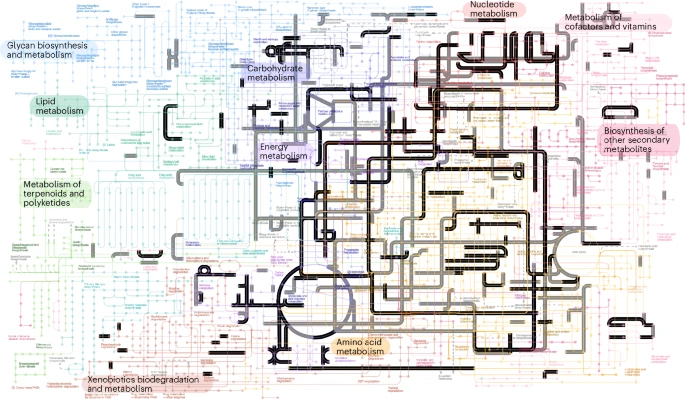
Probabilistic estimates of metabolic networks from modern life that were present in LUCA.
But how is it that LUCA (Last Universal Common Ancestor), although the first of a long line of my ancestors, didn’t just pop into existence, but popped into a system already in place to not only to support LUCA’s life, but for LUCA to have purpose?
Consider the following excerpt from the scientific paper’s abstract (italics added):
Our results suggest LUCA was a prokaryote-grade anaerobic acetogen that possessed an early immune system. Although LUCA is sometimes perceived as living in isolation, we infer LUCA to have been part of an established ecological system. The metabolism of LUCA would have provided a niche for other microbial community members and hydrogen recycling by atmospheric photochemistry could have supported a modestly productive early ecosystem.
I don’t know about you, but something sounds a little strange. Maybe it’s the dummy in me thinking out loud. Didn’t the Popular Mechanics tell us that “All life on earth comes from one common ancestor…“? Then what am I to make of “an established ecological system“? I mean, honestly, how did this system come to be? How long did it take to get “established” and how did the “community members” get by without LUCA?
I’m beginning to wonder if Susan Vega is somewhere behind this. Reference too vague?
Well, one thing’s for sure, and it’s not that LUCA got a black eye by being clumsy (see earlier vague reference). Somebody needs to do in investigation to find out where LUCA’s community went! If all life on earth came from our 138-millionth ancestor, I first grandparent might have been the very first serial killer!
But don’t listen to me, I don’t know anything. It’s just, I mean, you know…
Systems are not random. Non-life can’t produce life. Something can’t come from nothing, for if it did, that nothing would be something. And as best I can tell, the Genesis account of human life (my real ancestors) does describe a first ancestor entering an already established ecosystem. Interesting, eh?
You all know the old saying, “If it looks like a duck, etc…it is a duck,” don’t you? When we see something that looks and acts like another something with which we are already very familiar, the most logical explanation for the similarity is to initially assume is that the two somethings are, in fact, alike. They don’t have to be exactly alike to be of the same something, just like a ball is a ball regardless of the size, texture, or chemical makeup. Even my 2 year-old granddaughter, based on her short life experience, is not wrong when she notices a spherical object, points, and yells out, “Ball!”
We carry with us information and definitions acquired through experience, along with developed presuppositions When we observe a buzzing factory, we assume it to be a buzzing factory based on what we already know from experience about building or making things. To describe the factory, then, as something other than what is observable and recognizable as a place of production would require one of two things: either the observer has never seen or had any concept of manufacturing and assembly, or that he is being intellectually dishonest.
One would have to have never tied a shoe, prepared a meal, or completed any task requiring a process to not recognize a factory for what it is. At the very least the observer should be able to recognize the industrial process as being similar to other processes with which he is already familiar: the kind when going step-by-step makes a thing. Therefore, to observe a factory in operation and then declare that the factory, even the whole process of manufacturing, including subcontracting and logistics, is nothing more than an illusion of design and a product of chance is to throw out rationality in favor of a presumed belief.
It amazes me how that one can learn more and more about the complexities (yes, even irreducible complexities) of the human cell and still maintain random chance and time created and honed everything, from the machines down to the software in a factory which purpose is to make a thing.
It is easy to simply claim there is no Designer or Creator behind the unfathomable complexities of human existence. All one needs is the presupposition that no matter what one encounters, it is NOT what it may appear to be. If we first presuppose there is no God, then what may appear to be the result of vision and design can be waved off as only an illusion, a false equation, or the projection of a preconceived delusion acting as a coping mechanism.
However, living in a modern, industrial world, I find it hard to understand how anyone with any amount of intelligence can maintain “natural selection,” copious amounts of time, and blind chance are the architects of anything, much less the preliminary mechanisms and processes which bring about its construction.
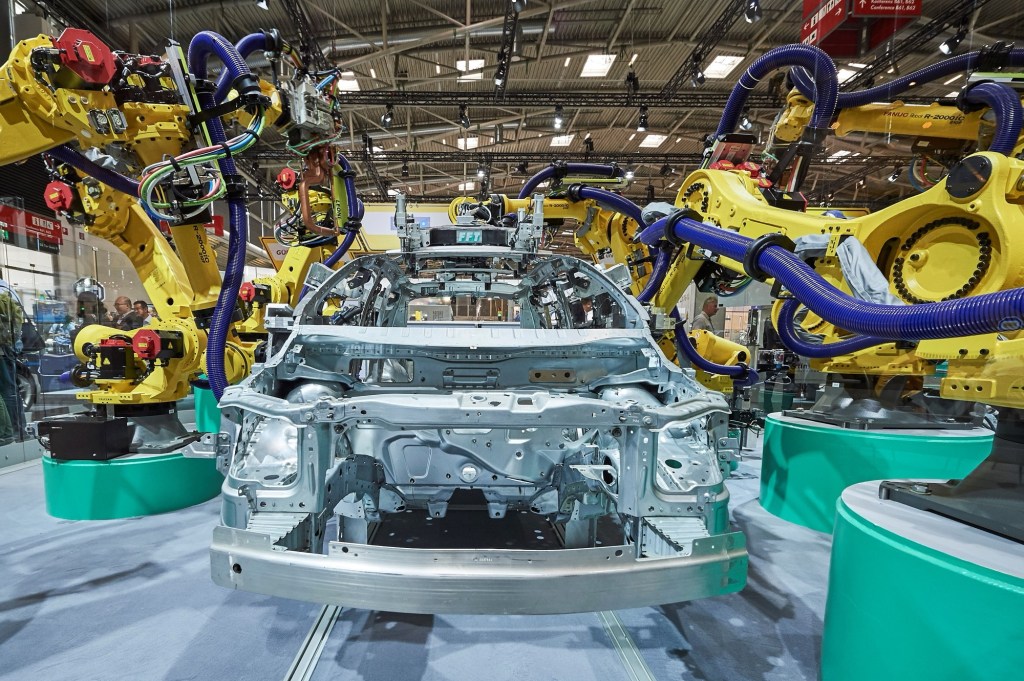
I actually work in an automobile manufacturing plant. I have witnessed the entire process of building a Volkswagen Atlas. Even more, I have participated with my own hands in the making of these vehicles. I have been involved in the logistics of securing parts of all kinds and placing even the smallest in precise positions for robots to weld. In order for one functioning vehicle to roll off the assembly line, the things that must take place in the right way at the right moment and in the right amount are just staggering. And we are only talking about a car, not the human body and each cell!
2025 Volkswagen Atlas Peak Edition 
For just a moment, think about that 2025 VW Atlas with all the bells and whistles of a luxury SUV. Imagine it painted your favorite color as it is cranked and driven out the big bay doors toward the staging area where it will be shipped. Should you spend your $50,000 to buy one, you will expect it to perform at a certain level while maintaining its structural integrity. After all, the lives of your family and yourself will depend on it.
Now, imagine that SUV backing into the proving and detailing area once again. Then, imagine it backing up to the automated assembly line where it is once again placed on the moving floor. Keep reversing until the vehicle is completely disassembled, stripped of paint and sealer, even un-welded (if that was possible) and reduced to small stamped pieces of sheet metal that make up the body. Are we done? No.
Credit: plastonline.org
Look around at all the bins full of sheet metal parts, plastic spacers, barrels of sealant, bolts, nuts, and even the box of tiny copper tips for one of the thousand-plus $200,000-dollar robots spot-welding 24/7 according to software monitored 4,000 miles away. How did all that get there? If left alone, would a VW Atlas once again roll out the door? Even in a billion years?
Even more, consider all the things that must take place in the process of manufacturing the individual components. For every piece of that vehicle (about 5,000) there is a company, a business plan, a CEO, workers, machines that must be maintained, and materials which must be ordered and stocked. And then there are the truck drivers and the forklift drivers and the mechanics who keep those machines running and those parts on schedule.
Parts must be made according to specific tolerances. Parts must be assembled in a certain way. People have to do their assigned duties with quality, safety, and integrity. Everything must go a certain way, or else the very integrity of the vehicle could be compromised. Nothing, and I mean NOTHING is unplanned and left to chance when literal lives could be at stake.
How long would it take for a brand new Volkswagen to roll off the assembly line on its own? Any answer other than “never” would be absurd. And why is that? Because nothing in the observable world testifies to this being possible. From experience and observation we have acquired enough wisdom to determine two things: first, a car doesn’t design and build itself; and second, an expertly built and functioning vehicle must not be the result of design-less, random chance.
Therefore, it is not irrational, when we observe what appears to be design and purpose, to assume there was a Designer with a plan for how the thing would function. Everywhere else in creation and everyday life we observe the natural rhythms of cause and effect. When we see a jet flying in the sky above us, we take for granted the craft was designed and built in a factory, it’s going somewhere, and that people are on it. Even when a rock hits our windshield, we know something caused the rock to leave the pavement.
It’s only the one who cannot, no matter the evidence, no matter the logic, accept that there’s a Watchmaker in the history of the watch on the shore. He asserts there is no evidence for the Watchmaker; there is nothing about the Watchmaker that he’d like should he exist; that not enough jewels were in the movement to signal true intelligence; and that though it may look like a watch and function like a watch, we don’t know for sure what we think a watch is, or whether it is actually represented in the thing on the shore.
For all we know, the supposed watch somehow came from the depths by some means not yet discovered.
“All we can know for sure,” he would say, “is that there appears to be a thing on the shore with interesting similarities to other observable things, but whatever it is, it is because it is and that’s it. To entertain any other conclusions might lead to inconvenient truths, and we can’t go there.”
All I know is that even though I’m not a biologist, I’m pretty certain I can recognize a duck when I see it.
In my last post about the possibility of Biden listening to and acting upon questionable or sinister science, I might have given the wrong impression. I say that based on a comment I received from a friend, Joel Ziegenmier.
If Joel was correct, then I do apologize for the confusion or spurious impression. Please allow me to clarify my stance on science and faith.
I believe that science and faith are completely compatible and non-exclusionary. Both can exist side-by-side without conflict. Why do I believe that?
First of all, we must understand what faith and science are. Once we do that, everything will become a little more clear.
Science, unlike what it’s made out to be in the news media, is a process of acquiring knowledge. It is not dogma, doctrine, philosophy, or religion. All it is – or what it is supposed to be – is a process through which knowledge and understanding can be acquired through theorizing, testing, observing, repeating and replicating, and so on. The scientific method is not a Truth in itself, but a process by which we discover and make application.
Faith is trusting in something. Blind faith is putting one’s trust in something without any evidence that the thing is trustworthy. On the contrary, orthodox Christianity is not a religion or set of beliefs based on a blind faith, but on tangible, historical, and verifiable evidence and Truth claims.
Science and faith are not opposites, but complimentary. Where faith can be tested, it should welcome it. Where science yields information, faith is placed in the interpretation of the evidence obtained.
Certain things, however, are beyond the realm of the scientific method. Those things that are supernatural (outside of the realm of what is considered naturally possible) cannot be observed, tested, and repeated, especially if the supernatural event is beyond natural capability.
Science, too, is limited in its ability. A prime example is the question of the origin of the universe. Although observable and repeatable theories can be applied to current natural processes, science in and of itself cannot observe and test the origin of the universe, nor account for where natural law may have been broken. Ironically, it takes faith for both the Christian and the naturalist or atheist to make dogmatic claims about the origin of all that is.
But for the Christian, science is not an enemy; it is only a tool. Thanks to a quick Google search, I was easily able to find a list of famous scientist whose works contributed to the way we live today, and each one was a Christian. They include the likes of Robert Boyle, Michael Faraday, Arthur Compton, Gregor Mendel, Isaac Newton, George Washington Carver, Francis Collins, and winner of the Nobel Prize in Physiology or Medicine John Eccles.
So therefore, it’s not a matter of whether or not Joe Biden listens to the scientists, for that’s a fine and noble thing to do. The problem is which scientists he’s listening to. Every scientist has presuppositions and assumptions. Every scientist has a personal worldview. Are the scientists that Biden trusts knowledge seekers or agenda pushers? Are they rabid naturalists who deny their own presuppositions and assumptions, or simply honest men and women who simply go where the facts lead them?
I’m not trying to be hyperbolic, but just keep in mind that it was the “scientists” of the 1930s and 1940s who concluded that a perfect and superior race was achievable through the elimination of all who were sick, retarded, deformed, homosexual, and Jewish.
It’s when “science” determines that faith is a detriment to society, a scourge on humanity, or a drug from which society must be weened for its own sake, that we have a problem.
It’s happened before. It’s been observed. It can be repeated.
Lately, it’s been both a jab and a stinging response, the punchline of President Trump’s that’s become sort of a campaign slogan for Joe Biden: “He’ll listen to the science.”
Trump’s point is that Biden will make decisions based on bad science from bad scientists; Biden’s point is that Trump doesn’t care about scientific facts.
In my opinion, neither their arguments are going to make much of a difference right now. However, there’s a much more disturbing truth to the statement that, if Biden really does “listen to the science,” could potentially lead us down a very dark and sinister path.
Which Science?
To be fair to President Trump, it’s not that he doesn’t listen to science, it’s that he listens to the science he believes.
Stop for a moment and think about what is really meant when we use the word science. Science is NOT truth. Science is NOT immutable. Science is NOT determined by consensus (or vote). Scientific data CAN be interpreted differently.
When a person says he will listen to science, what exactly does that mean? Let us not forget the facts of “science” have often changed. Consider this tiny list of examples:
The coming ice age
The earth is flat
Piltdown Man
The benefits of smoking
Bloodletting
So, it’s certainly forgivable and understandable for the President to question certain scientists and listen to others. What proof does Biden have that his scientific advisors are infallible?
The More Serious Question
But what really scares me is that Joe Biden says that yes, he WILL listen to science. And based on what I’ve already heard and read, if current science (or should I say, “scientists”) believe it or promote it, then that’s all ol’ Joe needs. Listening means acquiescing.
Therefore, even if the “science” proves valid, what of the ethics? What of the morality? That’s the serious question.
Already it’s been announced that – because of science – Biden will make all sports and restrooms accessible to transgender and gender-fluid students. Because of science, abortion will be allowed far beyond any previous limitations. And based on the scientific advisors around him, Biden will more than likely impose a national mask mandate and mandatory shutdowns.
Disturbing? Yes! Because if all it takes to enact public policy is the consensus of politically motivated scientists, then what is out of the question? What moral or ethical line is out of bounds?










 The Recovering Legalist