Tag Archives: Jesus

OH! What a Savior!

The video I have attached was recorded 2 years ago this month while I was still pastor at Riverside Baptist Church. Katie’s voice is even better, now, after 2 more years at Bryan College pursuing her Music Ed degree (she just finished her senior year, btw, and is now in her 5th and final year). Oh, if you haven’t yet seen it, here is a link to Katie’s blog, Shutter Elf.

All I can say is that I love this song. Jesus means more to me now than ever.

Oh, what a Savior is mine!

3 Comments

Filed under music

Barriers to Church Growth. #5 (Honoring Self)

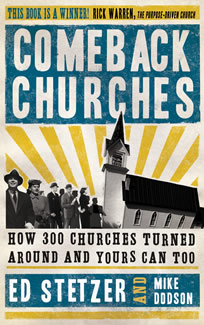
A very revealing study was done, leading to a book detailing how 300 churches went from declining or dying, to growing. In Comeback Churches, written by Ed Stetzer and Mike Dodson, there is a list of 30 different barriers to church growth. Having received permission from the publisher (B&H Publishing Group), I would like to discuss a few of them.

“People do works for their own honor and not the glory of God (Matthew 5:16).”

“Let your light so shine before men, that they may see your good works, and glorify your Father which is in heaven.” – Matthew 5:16

Why do we do good works? Why do we feed the poor, shelter the homeless, tend to the elderly, etc? Do we do these things so that our Father will be glorified, or do we do them in order to get glory for ourselves?

To be Seen.

Some people do good works with the sole intention of being seen and considered especially spiritual. Jesus said that “Everything they do is for show” (Mt. 23:5 NLT). Jesus spoke of those who wanted to be seen as pious and holy by wearing boxes containing Scripture on their foreheads or arms. The bigger the box the better. All this was in an attempt to say, “I am keeping the law better than you!” (See Deuteronomy 6:5-9)

Then there are other people who do plenty of good deeds without even acknowledging God. For example,  go to any charity ball held by your local “high society” club. There you will find plenty of people who willingly give thousands to worthy causes but smile as big as they can when the magazine photographers come around.

They may even be members of local churches and give large offerings to the building fund (as long as it’s named after them); buy the pastor a new car, or pay for a youth mission trip. “And they love to sit at the head table at banquets and in the seats of honor in the [congregation].” – Matthew 23:6 NLT

To be Accepted

Some people do good works in order to be accepted by God. They give away fortunes and spend their lives doing good deeds, but not to be seen by men. They want to be seen by God and thought of as worthy of His love. The only problem is that salvation is “not of works, lest any man should boast.” They work themselves to death in order prove their loyalty, thereby supposedly ensuring a place in heaven. But the glory goes not to God, for attached to the works is an expectation of reward based on merit.

Soli Deo Gloria

All glory should be to God alone. If our works are done in order to receive praise, then God is not getting the glory. If our works are meant to earn credit with God, then God is not getting the glory. If we work ourselves silly to meet the legalistic requirements placed on us by men, then God is not getting the glory. However, if out of a heart of love we do good works without expectation for reward, recognition, or acceptance, then God will receive the glory.

When all glory, honor, and praise is given to the Lord, He will draw all men unto Himself. Church growth will be unstoppable. Yet, if we expect credit for anything, then what should we expect but further decline? “For mine own sake, even for mine own sake, will I do it: for how should my name be polluted? and I will not give my glory unto another.” – Isaiah 48:11 KJV

We want others to see our good works, but not for our own glory. May they “glorify [our] Father which is in heaven.”

2 Comments

Filed under book review, God, legalism, Uncategorized

If a Monkey Can Do It, Why Can’t We?

Free Movies

One of the great things about modern cable networks is the ability to watch free movies on demand. It’s a great thing, but I guess it’s also a bad thing, too. Free movies mean lots of wasted time in front of a television – because there’s always something to watch.

Well, sorta.

I mean, it’s precisely because I am NOT paying for these movies that the selection is a tad bit limited. When you get what you pay for, and you pay nothing, then you get what you pay for.

So, that’s why I found myself watching “Oz the Great and Wonderful” late Sunday night. I’d forgotten that I’d already seen it back in 2014.

Finley the Flying Monkey

Anyway, even though the movie was rather lame, there were a few well-acted scenes. I especially liked Mila Kunis as Theodora: the creepy, emotionally-ill, heartbroken witch that later became the wicked witch of Dorothy fame. She became the prime reason I will never trust an attractive woman dressed in red that just so happens to greet me in the middle of the woods.

But of all the scenes, one stood out immediately (at least this time around when it was free), and that was the following scene where Finley the monkey indebts himself to Oz.

When I saw this Sunday night, I immediately thought of my Lord and Saviour, Jesus Christ.

I was once trapped and bound by sin. A lion that had been seeking me out to devour me was just about to pounce. I cried out to the only One who could save me, and he did – except in my case, He took the lion’s bite for me.

Why is it so hard to understand that I owe him my life? Oh, I know I do, but do I ever really go about it in the way that Finley the monkey did? Do you?

You do realize, don’t you, that without Jesus we would be dead – eternally so. The life we live is only because of the grace of God. The least we can do is echo the words of Finley and say, “You saved my life, oh Jesus. So, I hereby swear a life debt to you. From this moment on, I shall be your loyal and faithful servant until death.”

I am crucified with Christ: nevertheless I live; yet not I, but Christ liveth in me: and the life which I now live in the flesh I live by the faith of the Son of God, who loved me, and gave himself for me. – Galatians 2:20

If a monkey can do it, why can’t we?

1 Comment

Filed under animals, Christianity, grace, Movie review, salvation, worship

He Lives!

We celebrate many holidays in this world, but one stands out among the rest…

Easter.

Now, I know that some of the more legalistic among us will label all the celebrations “moot” because of certain “pagan” links, like that to Ishtar and fertility rites. The unbelievers will laugh off this day with arrogant disdain (especially with it being April Fool’s Day).

But for the majority of Christians around the world, this day is a day to rejoice in the Son of God’s victory over the grave.

We are prone to celebrate many things, like who won a game, that new promotion, or a birthday. We throw parties when political candidates squeak out a win, or when that big contract gets signed. Some will even fire thousands of AK-47 rounds into the air while shouting “Allah Akbar!” at the top of their lungs. But nothing is more worth celebrating than Jesus keeping His word and rising from the dead to secure eternal life for those who trust in Him.

Today, as I stand before a congregation, I will attempt, in the power of the Spirit, to stir the imagination, to take us back in time, to recreate a fraction of the excitement that must have been felt when those who were convinced of defeat were shocked by the greatest come-from-below victory of all time.

Today, before all those present, whether in flesh or spirit, I will celebrate victory over sin, death, and hell. The Enemy has been defeated, his tools are obsolete, for Jesus died and rose again.

He Lives!

Click on the link to listen to my favorite Resurrection Day song, “Gone!” (sung by Teddy Huffam).

Also, here’s a group that’s new to me singing a medley of Easter-related songs (none of them about a bunny).

3 Comments

Filed under Easter, Faith, God, Preaching, salvation, worship

Barriers to Church Growth. #1

A very revealing study was done, leading to a book detailing how 300 churches went from declining or dying, to growing. In Comeback Churches, written by Ed Stetzer and Mike Dodson, there is a list of 30 different barriers to church growth. Having received permission from the publisher (B&H Publishing Group), I would like to discuss a few of this barriers.

“Churches aren’t concerned about God’s glory, believing the church is just for them (Isa. 42:8; 48:11).”

I [am] the LORD: that [is] my name: and my glory will I not give to another, neither my praise to graven images. – Isa. 42:8

For mine own sake, [even] for mine own sake, will I do [it]: for how should [my name] be polluted? and I will not give my glory unto another. – Isa. 48:11

When we read the above verses it should be very clear to us that God is not interested in sharing His glory. Yet, too many times we rob God of the glory that is due Him by seeking it for ourselves. We do this in many ways, including the reason many of us go to church.

Lest we forget, “it’s not about us.” However, if you polled the majority of church-goers, I believe you’d find that the reasons for attending congregational worship are more selfish than we’d like to admit. To many believers, church is about what one can get, as opposed to what one can give.

The Tale of the Hymns

Have you ever stopped to listen to the words of those old-time hymns many of us grew up with? You may have sung them all your life, but stop and think about the following: “This world is not MY home, I’m only passing through. / My treasures are laid up somewhere beyond the blue…;” “I’ll Fly Away;” “I’ve got a mansion just over the hilltop;” “All I Need.” What is the common denominator of these lyrics and titles? “Me, me, me.”

If the Church Hymnal (© 1951,1979) was used as a tool to determine what we think of church, stop and think about this: there are 80 hymns with a title that starts with the words, I, I’m, I’d, I’ll, I’ve, or My. In contrast, less than 10 contain the word glory. Those that do include “Glory Hallelujah In My Soul” and “I’ll Live in Glory.

I think it is pretty obvious that many of us come to church to get from God, not to give to God. He deserves our worship and our praise. He deserves all the glory because His is God, and not man (Hosea 11:9). We deserve nothing, yet His grace and mercy bestow upon us all the treasures we enjoy. Why do we come expecting anything?

Surely our churches would grow if God was glorified. Imagine a congregation of people who came together to lift up praise and adoration to Jesus for His glorious love. Imagine a group of folks who set aside all their own desires and petty differences in order to lift up holy hands unto the King of Glory. What did Jesus say? “If I be lifted up…I will draw all men unto me.”

So, what do you think? How could we do better in giving the glory to the One who truly deserves it?

Related Post: Un-“Christian” Ministry?

6 Comments

Filed under Christian Maturity, General Observations, God, Uncategorized, worship

Unashamed Of the Cross

Back in 2014, during the semifinals of The Voice, “Team Blake” member Craig Wayne Boyd cranked out a fantastic rendition of the classic hymn “The Old Rugged Cross.” Many people – including those who call themselves “Christian” – were shocked. Why did a singer choose to sing this hymn on a national stage – in a competition? I mean, the cross? Really? What was this guy thinking?

Maybe, just maybe, Craig Boyd was letting the world know where he’d lay that crown, should he win it.

You see, it was on the cross of Calvary that the “Dearest and Best” was slain. It was on this cross that the “ordinances against us” were nailed (Col. 2:14). It was on this cross that our Savior promised that if He be lifted up, He would draw all men unto himself. It was on this cross where Jesus said, “Father forgive them, for they know not what they do.”

Without the cross, grace would be a non-issue and the Law would still be my master. Without the cross, Easter would be irrelevant. Without the cross, we’d never been able to witness the most powerful manifestation of love (1 John 4:9-10)the world would ever see.

It was on that old, rugged, blood-stained cross that Jesus paid the penalty for my sin. It was the crossroad of judgment and mercy where the Lamb of God humbled Himself (Phil. 2:8) and purchased my reconciliation with God (Eph. 2:16).

So, why cherish the cross? Because it was and is proof positive that even before I knew Him, even when I was steeped in sin, God loved me enough to die in my stead.

It’s shame and reproach I’ll gladly bear.

2 Comments

Filed under Christianity, Easter, Faith, God, grace, Love of God, worship

It Only Happened Once

“Why do bad things happen to good people? That only happened once…and He volunteered.”

Livingwaters.com

2 Comments

Filed under Christianity, grace

“By” or “Through”: That’s the Question (An Examination of John 1:3)

Introduction

Tuesday morning, after a cup of coffee with some great, godly men in our community, I was standing out in the parking lot of a local restaurant discussing the morning’s plans. It was during this short conversation that the subject matter briefly switched to that of Bible translations.

There we were, standing by the cab of a pickup truck when one of these men – a great friend to our family and church – said something akin to the following:

“The reason I will only use the King James Bible can be illustrated by the change in one word, and that word is found in the first chapter of John. There, the King James Version says, ‘all things were made by Jesus,’ but every other version – every single one – changes that word ‘by’ to ‘through.’ I have a problem with that. As I see it, there’s a big difference between ‘by’ and ‘through.’ Either everything was made by Jesus, or it wasn’t.” (Again, this was not an exact quote, but close.)

Therefore, it might take more than the average 500-word blog post to unpack, but I want to address this apparent conflict between “by” and “through” as found in John 1:3.

Doing the Research

You know, the last thing one should do when confronted with an unknown is say to the one making the assertion, “Nuh uh!” Right after my friend said what he did about every other translation of the Bible changing “by” to “through,” I pulled out my iPhone and pulled up BlueLetterBible.com.

Seeing what I was doing, the gentleman goaded me a little and said with a slight chuckle, “You gotta look that one up, don’t ya?” I grinned as I nodded…the subject changed back to hardware for about 30 seconds…then we went our separate ways.

But I did look it up. It wasn’t difficult to do, either. The Bible-study tools we have access to in an instant, even on our smartphones, are literally mind-blowing. At no other time in history have we had so much knowledge available so quickly right in the palms of our hands. Therefore, it didn’t take more than a few seconds to learn that my friend’s assertions were spot on… The KJV was actually the only one to render John 1:3 with a “by,” not a “through.”

For example:

  • John 1:3 (KJV) – All things were made by him; and without him was not any thing made that was made.
  • (NKJV) – All things were made through Him, and without Him nothing was made that was made.
  • (NIV) – Through him all things were made; without him nothing was made that has been made.
  • (ESV) – All things were made through him, and without him was not any thing made that was made.
  • (CSB) – All things were created through him, and apart from him not one thing was created that has been created.

Yes, I did my research, and what I found was that my friend’s assertion was true: every other translation of the Bible changed the word “by” to “through.” However, my research wasn’t complete; it was time to consult the original languages.

It’s All Greek

Like I said above, the study tools we have these days are amazing, and there’s really no good excuse for any Bible student to claim ignorance. For example, if all one had was access to one online tool such as BlueLetterBible.com, then what used to take hours of study could be done in mere moments. Then if you add to that all the other free websites available, including what’s available from online libraries, and then throw in some relatively inexpensive (but voluminous) programs like Logos, oh… my… goodness! It’s hard to comprehend how blessed we are!

So, when it became obvious that “by” had been replaced by “through,” I decided to take the next logical step and look up the source of the translations in question: the original Greek word, διά (dē-ä’).

It may sound unbelievable to you, but there are still people out there who think Jesus spoke Elizabethan English. However, the Bible was not originally written in the language of Shakespeare. In actuality, John 1:3 was written in Greek, so “by” and “through” are only translations of the Greek word διά (Strong’s G1223).

The next question should then be: “What does dia mean?”

Grab Your Concordance

Well, every Bible student should have a Strong’s Concordance in his personal library, even if his library only consisted of a Bible and one other book. Therefore, let’s take a look at Strong’s and see what we find.

G1223: διά diá, dee-ah’; a primary preposition denoting the channel of an act; through (in very wide applications, local, causal, or occasional):—after, always, among, at, to avoid, because of (that), briefly, by, for (cause) … fore, from, in, by occasion of, of, by reason of, for sake, that, thereby, therefore, × though, through(-out), to, wherefore, with (-in).

According to Strong’s Concordance, dia is a word that denotes “the channel of an act; through…” Therefore, is it really an act of theological sabotage to translate John 1:3 with through instead of by?

Is it possible that Jesus was the One through whom God the Father made all things?

You see, it is not heresy to say that the Father made all that is through Jesus, the Word of God. No, it is actually MORE theologically sound and true to Jesus’ own words to say that He was the agency or “channel” of creation, rather than the one acting unilaterally in creation. Why do I say this? Consider the actual words of Jesus as recorded by John…

  • John 4:34 (KJV) – Jesus saith unto them, My meat is to do the will of him that sent me, and to finish his work.
  • John 5:19 (KJV) – Then answered Jesus and said unto them, Verily, verily, I say unto you, The Son can do nothing of himself, but what he seeth the Father do: for what things soever he doeth, these also doeth the Son likewise.
  • John 6:38 (KJV) – For I came down from heaven, not to do mine own will, but the will of him that sent me.

If Jesus had acted alone and created all things by Himself, then His own words would expose a critical inconsistency. The fact seems to be that even though Jesus was and is God, the Second Person of the Trinity, He still had to act in accordance with the will of the Father, and therefore saying “all things were created through Him” is more theologically consistent with the nature of the Trinitarian understanding of the Godhead.

A Dose of Commentary

I learned a long time ago that commentaries can be very useful if used properly; I go to them after I have already read the Scripture and done all the exegesis I can do with the study tools at hand. Therefore, it was only after I did the above study that I consulted several scholarly commentaries. For the benefit of this discussion and for your edification, allow me to share the following directly from the sources.

The New American Commentary: John 1-11

The preposition dia (“through”), used in connection with creation here, should not be taken to mean that the Logos is essentially inferior to God, as the Arians argued. But the early Christians, in attempting to discuss simultaneously the work of both the Father and the Son in creation, sometimes tried to hold both together through the use of two prepositions. The Father’s activity was linked with the preposition ek, which carries the sense of “origin,” and the Son’s activity was linked with the preposition dia, which carries the sense of “mediation” (e.g., the early Christian creedal statement in 1 Cor 8:6; also see Heb 1:2 for the use of dia).

The Pulpit Commentary: St. John (Vol. 1)

In asserting that the Logos is he or that through whom all things were made, the writer does not lower the dignity of the Logos by regarding him merely as the οργανον of the Father, because the same preposition is used of the relation of the Father to the world or to his servants (Rom. 11:36; Gal. 1:1; Heb. 2:10). Elsewhere St. Paul powerfully affirms the same application of διά (1 Cor. 8:6) to Christ’s part in the Creation, reserving for the One God, the Father, the preposition ἐκ. From God and by or through God are all things, still “all things” derive their existence “through” the activity, the will, the thought, of the Logos.

Word Studies in the New Testament (Marvin R. Vincent)

By Him (διʼ αὐτοῦ). Lit., through him. The preposition dia is generally used to denote the working of God through some secondary agency, as διὰ τοῦ προφήτου, through the prophet (Matt. 1:22, on which see note).* It is the preposition by which the relation of Christ to creation is usually expressed (see 1 Cor. 8:6; Col. 1:16; Heb. 1:2), though it is occasionally used of the Father (Heb. 2:10; Rom. 11:36, and Gal. 1:1, where it is used of both). Hence, as Godet remarks, it “does not lower the Word to the rank of a simple instrument,” but merely implies a different relation to creation on the part of the Father and the Son.

Again, it would seem to me that it is more theologically sound to translate John 1:3 the way all the other translations do it as opposed to the KJV.

Right or Wrong?

But after all that has been said, was the King James Version’s translators wrong in their use of the word by instead of through? Actually, no.

You see, the whole reason we have newer translations of the Bible is because the English language changes over time. Some words have different meanings today than they used to, and that is why we rarely speak of wearing our “gay clothing” to church, or “fetch[ing] a compass” as we travel (Num. 34:5).

At the time the KJV translators did their work, the meaning of “by” was probably more nuanced than today and would have been understood by the reader of the day to have the same depth of meaning as “through.” However, for the modern reader, by implies more of a literal meaning. For example, if my daughter made a wooden elephant figurine, and if you asked who made it, I could answer, “It was made BY Haley.” If we applied the same meaning to the “by” in John 1:3, then we would literally be on the road to heresy, for Jesus did not act unilaterally (own His own), but by the will of the Father (John 5:19).

So, by may have been the best word for the verse in the 17th-19th centuries, but through better conveys the Truth to those in the 21st.

Conclusion

Without a doubt, the translators of the 1611 King James Version of the Bible were men of superior capability. I dare say that finding modern scholars and intellects with similar credentials would be exceedingly difficult. Therefore, because they did such a great work, it would be wise to consider their words when debating the heart of this discussion.

Translation it is that openeth the window, to let in the light; that breaketh the shell, that we may eat the kernel; that putteth aside the curtain, that we may look into the most Holy place … Indeed without translation into the vulgar tongue (the modern, common way of speaking), the unlearned are but like children at Jacob’s well (which was deep) [John 4:11] without a bucket or something to draw with…”

“For is the kingdom of God become words or syllables? why should we be in bondage to them if we may be free…?”

 – from: “The Translators to the Reader,” a prefix attached to the original 1611 edition.

It really boils down to this: What does the Bible really say? Sometimes we have to set aside our preconceived notions in order to honestly exegete Scripture. The last thing we want to do is let a literary bias lend support to a faulty theology, even if our intentions are noble.

Ultimately, though, Jesus is the Door “through” whom we must enter; there is no other Way to the Father. If a translation can’t make that clear, then we have a problem.

So, let me say “Thanks” to my friend. Without his comment, I’d never walked down this rabbit trail 😉 

10 Comments

Filed under Bible Study, Theology, translations

Do You Hate to Sin?

I hate it when I sin.

Some people hate to get caught, but I wasn’t caught. No one saw or heard or anything – only God.

I hate it when I sin because of the feeling it leaves, the drain on emotions, and the sense of powerlessness that leads to feelings of failure, defeat.

I hate it when I sin because I knew better! I knew better! It’s not like I didn’t know the consequences. It wasn’t like this was something I’d never before encountered. I just walked right into the sin and just committed it, just like it was the natural thing to do.

Oh, but that’s the issue, isn’t it? Nature. That battle between the redeemed and the unredeemed, the spirit and the flesh. How I look forward to the day when this tent in which I dwell is redeemed, also!

I hate it when I sin!

But you may be asking, “Aren’t you a pastor? Aren’t you supposed to be a spiritual and religious leader? How can you be talking about ‘sin’ like this? Won’t it hurt your reputation?”

If we say that we have no sin, we deceive ourselves, and the truth is not in us. – 1 John 1:8

The Truth is in me. I’m not perfect, just forgiven.

And that’s really why I hate it when I sin; it’s because I know I’m forgiven! Yes, I’m already forgiven! I’ve been saved, justified, reborn, adopted, and have received the righteousness of Christ…and I know a little about what it took for that to happen…

“Forgiven” by Thomas Blackshear

It took the Cross! It took Calvary! It took Jesus bearing my griefs…carrying my sorrows…being stricken and smitten of God…being afflicted…being wounded for MY transgressions…being bruised for MY iniquities…accepting MY chastisement…and taking MY stripes so that I could walk away free (see Isaiah 53:4-5).

He – Jesus – did all that for me…all because of my sin…because He loves me (Romans 5:8).

But you may ask: “If you know you are already forgiven, then what keeps you from going out and sinning all you want?”

Two reasons. First, my “want to” has been changed. Second, it’s like the Apostle Paul said it: the love of Christ constraineth me (2 Corinthians 5:14). The thought of His love for me…what it took to redeem me from sin…to purchase my salvation…what He endured on that cross…the scourging He willingly accepted…it’s like ropes wrapped around me, binding me, “constraining” me.

Nevertheless, there are times when I sin. And I hate it. Romans 7:15-25 just about sums it up.

I thank God that where my sin did abound, grace…OH! What a word!…did much more abound (Romans 5:20)!

Then you may ask: “Well, if there’s more grace than there is sin to forgive, why not just keep sinning so that grace may ‘abound’ even more?”

Read Romans 6, is all I can say.

If you sin just because you can…there’s probably something major you’ve missed along the way. Maybe there’s nothing “constraining” you.

I hate it when I sin.


God, create a clean heart for me and renew a steadfast spirit within me. Do not banish me from your presence or take your Holy Spirit from me. Restore the joy of your salvation to me, and sustain me by giving me a willing spirit. Then I will teach the rebellious your ways, and sinners will return to you. – Psalm 51:10-13 CSB

4 Comments

Filed under Christianity, grace, Love of God, Struggles and Trials, Theology

Do You Have Hope Without Jesus?

In Acts 16:30 the Philippian jailer asked, “What must I do to be saved?

“Forgiven” by Thomas Blackshear

William MacDonald wrote the following comment in his commentary:

“This question must precede every genuine case of conversion. A man must know he is lost before he can be saved. It is premature to tell a man how to be saved until first he can say from his heart, I truly deserve to go to hell…Many people today seem to have difficulty knowing what it means to believe. However, when a sinner realizes he is lost, helpless, hopeless, hell-bound, and when he is told to believe on Christ as Lord and Savior, he knows exactly what it means. It is the only thing left that he can do!” (MacDonald, W & Farstad, A. Believer’s Bible Commentary: Thomas Nelson or Logos)

Do you have hope without Jesus? Then you’re without hope. Simply hopeless.

And that breaks my heart.

“Believe on the Lord Jesus Christ, and thou shalt be saved…” – Acts 16:31


If you would like to talk with someone, there is a phone line open 24 hours a day. Call 1-800-NEED-HIM (1-800-633-3446). Someone will be happy to show you how to be sure you have eternal life. Don’t wait.

2 Comments

Filed under Christianity, salvation