Let’s jump back into the deep water this morning and look at Ephesians 4:3. It’s all part of a short commentary on Ephesians 4:1-16 entitled,
“The Edification of the Body of Christ by the Gifts Given by Jesus to the Church.”
But hey! When you are finished reading today’s study, leave a comment and let me know your thoughts.
Tomorrow is the 4th of July, so I’ll be sharing a post relating to that subject, not this. But check back on Monday to pick it up again as we look at Ephesians 4:4.
4:3 “Endeavouring to keep the unity of the Spirit in the bond of peace.”
Endeavouring
Here the Apostle Paul uses a word that adds urgency to the “vocation.” To endeavour (σπουδάζω, spoudazō) is to use make haste to do what you need to do. Even more, the sense of urgency implies that one should do everything he can as soon as he can and not waste time.
Or, as the Pulpit Commentary described, “Σπουδάζοντες is stronger than the A. V. ‘endeavouring,’ and denotes an object to be carefully and earnestly watched for and promoted.”[1] Consider how the same word is used in 2 Timothy 4:9 when Paul asked Timothy, “Do thy diligence (spoudazō) to come to me shortly.” And, again, in verse 21 of the same chapter, “Do thy diligence to come before winter…” We can sense the urgency. However, as much as the word could convey a sense of urgency, it can also point to great desire, like the heartfelt longing Paul expressed in 1 Thessalonians 2:17 where he said:
1 Thessalonians 2:17 KJV – But we, brethren, being taken from you for a short time in presence, not in heart, endeavoured[G4704] the more abundantly to see your face with great desire.
Considering how Paul used endeavoured in other places, it would be safe to conclude that the unity to which he is referring should not only be striven for with urgency, but with great desire.
What does it mean to “keep” something? The word translated here can be used to describe keeping, watching over, or guarding something.[2] It could also be used with the meaning of keeping something in a particular state or condition. However, what needs to be stressed is that unity is not something that happens naturally, at least not in the spiritual body. When we seek our own devices, we cause disunity, strife, and internal conflict. Therefore, we must “endeavor” to watch over and guard our unity. The Enemy seeks to divide and conquer, but we are stronger when we are unified.
In the bond
The word “bond” (σύνδεσμος sýndesmos, soon’-des-mos) is an important word to know, for used in the context of unity and the body, it refers to a joint or ligament that holds the individual members of the Body together. It is figurative language, yet it is fitting considering the Church is a living body, not simply a building. The joints are therefore flexible as well as strong, but like any other living tissue in a body, it must receive nourishment, and that must come from the life-giving Spirit.
Peace
The unity of the Spirit is kept by the bond of “peace.” As with the human body, the spiritual body, both of local congregations and of the Church, are complicated structures with many members which act symbiotically to maintain a container for life. The Church contains the Spirit, and it must endeavor to maintain unity, an unbroken body, in order to keep it (like trying to keep a physical body in one piece in order to maintain the life of the body). And what is it that keeps the body together and working? It is the bonds, the ligaments. And what are the bonds, the ligaments, in this spiritual entity? They are peace. Peace is the bond, the ligament, that binds together the individual members for the work which the body was designed to do.
Peace is the Greek word εἰρήνη (eirēnē) – Strongs G1515 – and can refer to either a “state of national tranquility” or “peace between individuals.” The effectual working of the Body of Christ (the Church) in the world desperately depends on healthy and strong bonds of peace, yet this unity is fragile and often neglected with most of the attention and energy directed members instead of what binds them.
“Unity is maintained by the Spirit. Unity is preserved as believers make peace with one another their major priority instead of acting selfishly for personal gain and honor. Our call is not to create spiritual unity but rather to manifest spiritual unity by relational unity. Paul calls for unity in the third verse and spends the next thirteen verses elaborating on it.”[3]
[1] H. D. M. Spence-Jones, ed., Ephesians, The Pulpit Commentary (London; New York: Funk & Wagnalls Company, 1909), 147.
This is Part 3, but today we are going to be looking at the second verse of Ephesians 4. My hope is that for some of you this develops a desire to go deeper in your own study of Scripture.
Again, I’d love your feedback. Leave a comment and I really would appreciate it.
4:2 “With all lowliness and meekness, with longsuffering, forbearing one another in love;”
With all lowliness and meekness, with longsuffering
Before anything else, it is important to note the prepositional phrases which include the words lowliness, meekness, and longsuffering. In actuality, the second prepositional phrase (“with longsuffering”) modifies the first (“with all lowliness and meekness”), both being prerequisites for “forbearing one another in love.” Matthew Henry commented: “The first step towards unity is humility; without this there will be no meekness, no patience, or forbearance; and without these no unity.”[1] It is with humility (lowliness) that we withhold or set aside our rights or desires for vindication, thereby creating the ability to be patient and “longsuffering” with those who may abuse or misuse us, as even our own brothers and sisters often do.
Lowliness
Lowliness can also be translated as humility. It is “the quality of humility— ‘humble attitude, humility, without arrogance.’”[2] Humility is the fertile soil in which meekness and longsuffering can grow.
Meekness
Meekness is not weakness; it’s mildness and gentleness.[3] In Matthew 11:29 we read that Jesus was “meek and lowly.” Therefore, having the attribute of meekness should in no way imply weakness or impotence. For the Christian, meekness models Christ in that He could have claimed His rights, yet He endured with patience for the sake of others.
Longsuffering,
The Greek word translated as “longsuffering” (μακροθυμία, makrothymia G3116) is found fourteen times in the King James Version of the Bible, and of those fourteen times it is only translated as “patience” twice. However, nearly every other translation of the Bible besides the NKJV and the ASV renders makrothymia as “patience” in this verse. To be fair, patience is the major meaning of this word, but it is also more.
If we look at this old word of “longsuffering,” we may notice that it is made up of two English words: long and suffering. Patience may be equal to suffering, but how long should one be patient? The prefix makro answers that question: a long time. Therefore, longsuffering should be understood to convey a sense of endurance of pain or suffering for a longer period. The same word is used by Paul in 1 Corinthians 13:4 when, describing charity (love), he says it “suffereth long.”
forbearing one another in love;
It might seem that longsuffering and forbearing are words so similar that using them both is almost redundant. However, Matthew Henry aptly distinguishes the two:
“Long-suffering implies a patient bearing of injuries, without seeking revenge. Forbearing one another in love signifies bearing their infirmities out of a principle of love, and so as not to cease to love them on the account of these.” [4]
To forbear is to endure the undeserved pain and suffering inflicted by the actions or consequences of others’ actions with intent, and in this case the intent being love. The important difference between forbearing with or without love (agape) is how it can affect the one forbearing. One could forbear, patiently bear the burden, the load caused by another, with bitterness, guilt, or resignation and add suffering to suffering. On the other hand, as Paul beseeches the reader, we could forbear one another’s inflictions with a love that demands nothing in return. What joy is had by the latter in contrast to the former!
Welcome back to part 2 in this series of posts focusing on a particular section of the book of Ephesians, Paul’s letter to the Church at Ephesus.
Yesterday I shared with you the Introduction. Now, let’s jump right into it with the very first verse, Ephesians 4:1
4:1 “I therefore, the prisoner of the Lord, beseech you that ye walk worthy of the vocation wherewith ye are called,”
I therefore,
The first thing to consider in this verse are the words “I therefore.” As an old saying goes, whenever we see the word therefore, we need to ask what it is there for? Here, therefore is referring us back to the previous chapter, arguably to the very beginning of the letter.
the prisoner
Paul referred to himself as a “prisoner” (δέσμιος) five different times in his letters (Eph. 3:1; 4:1; Phm. 1:1 and 1:9; 2 Tim. 1:8). Interestingly, maybe even ironically, the idea of the word desmios is that of one who has actually committed a crime and is a “person who is under custody in prison—‘prisoner.’”[1] In any other situation, to be a guilty prisoner should expect judgment and condemnation, except the Lord (κύριος) to whom he is a prisoner is Jesus Christ, as seen in 3:1. Because of this, Paul doesn’t recoil from the idea of being a prisoner – he revels in the fact, for it is only THIS Lord who has paid Paul’s debt and imputed His own righteousness. Though a prisoner, he is free.
of the Lord,
The difference between using “Jesus Christ” and “Lord” in 3:1 and 4:1 can be seen in the differing contexts; one being the context of a Messiah for all, the other being the context of those answering to the Master for the task we have been given. Both aspects will contribute to the foundation of Paul’s later argument for unity. Jesus is not only the Messiah for the Jews, but also the Savior of the Gentiles. Yet, as implied in 4:1, Jesus is also our Master. The implication is that what Paul is about to address will be something for which we will be held accountable.
What about the preposition in relation to the prisoner? The KJV renders ἐν as “of,” but according to the Pulpit Commentary, Paul’s prisonership is more than one of association, but partnership: “Not merely “of the Lord,” but ἐν Κυρίῳ, the usual formula for vital communion with Christ, indicating that his captivity was the captivity of a part or member of the Lord.”[2] Here with this preposition we see a foundational stone in the building of Paul’s argument for unity in the Body of Christ, for we are all part of that Body.
beseech you
Speaking to all the Christians who would hear or read this letter, Paul showed concern and passion as he “beseech”-ed the Church to “walk worthy.” The word παρακαλέω (Strong’s G3870) was used by Paul fifty times in his letters and epistles. Sometimes the word was translated as “comforted” (1 Corinthians 14:31) or “exhort” (2 Corinthians 9:5). Yet, more often parakaleo was used with the meaning of “to ask for something earnestly and with propriety.”[3] However, it would be too simple to conclude that Paul’s beseeching was simply “begging” people to do something. The depth of parakaleo implies that Paul was speaking as a friend, a companion on the same journey, to those he called to his side to impart wisdom. One could almost sense that the Apostle couldn’t tell them everything he wanted to, but could only simply say “…please, I beg of you, for your own good…”
that ye walk worthy of the vocation wherewith ye are called,
The Apostle Paul wrote to the Philippians, “Only let your conversation be as it becometh the gospel of Christ…” [4] Here in Ephesians 4:1 as also in Philippians 1:27, Paul uses the word ἀξίως (axios), which is an adverb modifying the verb “walk.” With the idea of one’s walk being his way of living and choice of conversation, his “walk” should be one that reflects positively on both the calling and the Christ who issued it. Paul goes on in the next verses to give examples of what a “worthy” walk would include.
Vocation
The first thing that probably comes to mind when we see this word is one’s career or job. Some may be familiar with “vocational schools,” places where students learn skills which they will apply in their career, their vocation. When it comes to the Christian, all work should be considered sacred, and every “vocation” should be understood as a calling.
Translated as “vocation,” κλῆσις (klēseōs Strong’s G2821) means more than one’s career choice, “but invitation to experience of special privilege and responsibility, call, calling, invitation.”[5] Used nine times by the Apostle Paul (Rom. 11:29; 1 Cor. 1:26, 7:20; Eph. 1:18, 4:1, 4:4; Phil. 3:14; 2 Thess. 1:11; 2 Tim. 1:9), once by the writer of Hebrews (Heb. 3:1), and once by the Apostle Peter (2 Pet. 1:10), it’s only in 4:1 that we see κλῆσις translated as “vocation”; every other time it is translated as “calling.” However, if we were to replace calling with vocation in several of these other verses, it might help shed light on the sanctity of work.
Romans 11:29 KJV – For the gifts and [vocation] of God are without repentance.
1 Corinthians 7:20 KJV – Let every man abide in the same [vocation] wherein he was called.
Philippians 3:14 KJV – I press toward the mark for the prize of the high [vocation] of God in Christ Jesus.
Those in ministry often refer to their vocation as a “calling,” i.e., they were “called” into the ministry of the Gospel. When we consider that vocation is another word for calling, every vocation is a calling from God to be a witness where He places us. However, in the context of this passage, part our job description is to “forebear one another” and “endeavor” to keep unity in the Body of Christ.”
[4]The Holy Bible: King James Version, Electronic Edition of the 1900 Authorized Version. (Bellingham, WA: Logos Research Systems, Inc., 2009), Php 1:27.
A month or two ago I was happy to announce that I would be returning to the blogging community with new content and would be reading your stuff again. Well, it’s taken longer than I planned.
Have you ever noticed how life can get a little busy?
Anyway, today I want to start a short (maybe) series of posts based on some study I did in the 4th chapter of Ephesians. It was a short (mini) commentary that was, among other things, required for me to complete my Doctorate of Ministry (D. Min.).
So, without further ado, let’s begin with the beginning: the title and a short introduction.
“The Edification of the Body of Christ by the Gifts Given by Jesus to the Church”
The following exposition focuses only on one small section of the Apostle Paul’s letter to the church at Ephesus. This section uses the metaphor of a human body to explain the truth that the Church is the Body of Christ. But even more, he delineates between the corporate truth and the individual truth: that the Body is being built up and matured, but that God is also concerned about the individual member’s development.
This section is also where we find an explanation of the “grace” gifts to the Church Body and members in particular. These are the Apostles, Prophets, Evangelists, Pastors, and Teachers. As Paul explains, it is these gifts that are necessary for growth.
Paul then details the progressive steps toward growing “up into Christ” as not only the supreme Example, but the very Framework and pre-determined Design for the Church and individual member alike.
Ephesians 4:1-16 is the blueprint for a successful and healthy Church, where the rest of the chapter focuses on the individual member of the Body’s walk. Yet, these sixteen verses are full of encouragement and hope. No matter our station, no matter our abilities, we are all designed by God, equipped by God, placed by God, and are guaranteed to grow with the Body through the enabling power of the Holy Spirit.
But key to our success is the faithful application of the gifts He has given us. They cannot be ignored, kept to ourselves, or prohibited. In whatever measure we are given these gifts, the ultimate goal is not self-edification, however important in its own right; the ultimate objective is the edification – the building up into Christ – of the Church, the Body of Christ. Only by seeking to edify the Body can individual gifts find their greatest fulfilment.
Come back tomorrow for Part 2 in this series.
If any of it is a blessing or an encouragement, I’d love to hear about it.
If you think the title for this post was long, get ready for some seriously beyond-the-normal word count 🙂
Up until this Sunday evening, I had never preached a sermon or taught the Bible straight from a manuscript. This was the first time.
The only reason I did this was because a shut-in lady requested that I send her written transcripts so that she could take the time to read what I was preaching and be able to make notes and take her time through it. She said that she was really interested in Ephesians and wanted to do more than just listen on Facebook.
So, it took a little while to write it up, but the process, as I expected, was not only refreshing and fun (yes, fun), but it did cause me to hone my focus and build a better foundation for other doctrines yet to be discussed.
So, what I’m going to do for you guys is post the written text of the sermon. However, should you want to actually watch the video on Facebook, you can go to our church’s Facebook page and watch it there. It is @BethlehemBaptistWarthen. Or, I guess I could just go ahead and post the link. Why make it difficult, right?
Sunday Evening, Feb. 28, 2021 Bethlehem Baptist, Warthen, GA Pastor Anthony Baker Ephesians 2, Pt. 1
I have not preached a sermon from this passage, yet. However, since I will be preaching it this coming Sunday night, I might as well do my best to write it down for you. I pray that it is a blessing and an encouragement.
As we begin looking at chapter two of Ephesians, note that it can be divided up into three or more, maybe even five different word pictures. In other words, the Apostle Paul uses words, he uses illustrations, he draws pictures in our minds with words to help us understand, a little better, at least, the deep mysteries of salvation and the work of the power of Christ in us.
The first section can be seen in verses 1-10. In these verses Paul paints the picture of dead bodies being raised to life, not of their own power, nor by anything good they could do, but by the grace of God.
The second section can be seen in verses 11 and 12, followed by a third in verses 13-18. The second section illustrates the division that Gentiles once had with the Jews and the covenants of God. He does this as he brings up the issue of circumcision. In the third section, Paul mixes metaphors as he illustrates the bringing in of Gentiles through the picture of the “middle wall” being torn down and the making of one body out of two which led to peace with God. We will get to these things in more detail in time.
Then, in a fourth section, Paul references citizenship, followed by comparing us to building blocks in a holy temple built on top of the foundations laid by the holy prophets, Jesus Christ being the Chief Cornerstone.
In a sort of humorous kind of way we can almost laugh at the words of Paul in the beginning verses of chapter three when he says that because of all these previous descriptions of such a great mystery, previously hidden from those in other ages (3:5), he has become a “minister” (3:7) to us of the “unsearchable riches of Christ”! Well, hallelujah! I’m glad, Paul! Because a lot of us are already confused. Amen?
But it was important for you to know these things – what Paul is doing with his words – so that you don’t single out one illustration or metaphor and build a false doctrine around it. Again, this is why I always stress context, context, context! Without studying Scripture in the context of the whole connecting passage – in this case, from verse one of chapter two to verse seven of chapter three – we might miss the whole point that the author is trying to make and possibly make a major mountain out of a minor metaphor.
So, let’s now go to the first verse in chapter two:
Ephesians 2:1 KJV – And you [hath he quickened], who were dead in trespasses and sins;
Before we do any further reading, it will be very helpful to once again look at some words. If we misunderstand the words that are written here by Paul, but translated into English – and old English, at that – then we could easily misunderstand the meaning of the text and even fall prey to bad theology.
The first word we should look at is the word “quickened.”
Now, what is interesting is that if you are looking at a King James Version you will see that this word, actually several words, is in italics. The reason, as we have discussed before, is that the word is not in the original text, but the translators added it to help clarify the original text. What IS there is simply the Greek word ὤν (spelled “on” in English). All it means is that the “You” being spoken to “are.”
Yes, the Greek word on implies being, existence, and such. So, what Paul was really saying has been better translated in other versions such as the NIV, ESV, and CSB. The NIV reads: “As for you, you were dead in your transgressions and sins.”
Of course, this is not changing the Bible; this is what the Bible originally said. What the translators of the King James Version did was try to clue us in to a truth that is mentioned farther down in Paul’s description of those who are saved. It is all the way down in verse 5 where he finally uses the word that is rightfully translated as “quicken.”
Ephesians 2:5 KJV – Even when we were dead in sins, hath quickened us together with Christ, (by grace ye are saved;)
Back to the first verse, now. Paul, as we have already seen, is speaking to Christians. He is speaking to those who are “in Christ.” He is speaking to those who had been lost and now are saved. But it is in these verses where he describes what being lost is really like. What it really is.
The next word we will look at is the word “dead.”
Paul said that “you” (you could even apply that to us and say “we’) were DEAD in trespasses and sins. Yet, when we look at verse 2 we see something interesting. He says, that while we were dead, we “walked.” What? Dead people walk? That’s what he said!
Could it be that when Paul was talking about being dead, he didn’t mean it the same way we understand the word to mean, at least when we talk about dead people in the grave? I think it’s important that we think about this, for it makes a huge difference in how we look at other teachings of Paul, especially in the book of Romans, chapters eight and nine.
The Greek word Paul uses in verse two that is translated in English as “dead” is the word νεκρός (nekros). Have you ever heard of the word “necromancy”? Well, that’s what people do when they try to talk to the dead. Halloween kind of stuff. However, if you notice, necromancy comes from the word nekro, which means “corpse.” A necromancer is one who uses witchcraft to reanimate the dead, that is, to bring a dead corpse back to life as a zombie, or something, or to talk with them to discover the future. Paul is telling us that when we were still in sin, before we were saved, we were corpses – dead people – dead bodies. That is why it took the power of God to give us new life, to bring life to these dead bodies, and that’s what he meant when he said that we are “quickened” to new life.
And, by the way, God doesn’t need witchcraft to raise the dead. And I highly, highly doubt any necromancer ever pulled off a genuine Lazarus story.
But that brings me back to verse two, and even verse three… if we were nothing but lifeless corpses, how then did we “walk according to the course of this world” and have a “conversation in times past”?
What we need to understand before we go any further, which is why I bring up these words, is that Paul was using figurative speech. Paul was not trying to say that we were literally dead and lifeless like a dead body in a casket. Yes, he used the term, but it was meant to be a picture of a larger truth: that we were incapable of living the Christian life, the life of the Christ through the power of the Spirit, if we were “dead,” slaves to sin, full of the world’s filth, wanting nothing of the things of God.
Dead people don’t talk, walk, have conversations, or anything like that. A dead body just lies there and rots. Gross, isn’t it? Yet, still, it is only a picture. You and I weren’t dead bodies. However, we were “dead” in that we had not been transformed by the life of Jesus. And as dead people can’t do anything, not even dig themselves out of the ground, neither can the sinner who is “dead in trespasses and sins” work his way out of death into life.
But God… Ephesians 2:4 starts with two of the most beautiful words in all the Bible – “But God.” You see, we were lost and on our way to hell… but God! We were dead in our trespasses and sins… but God! We were rotting away in the filth of the world… BUT GOD, who is RICH IN MERCY, for His GREAT LOVE wherewith He loved us, QUICKENED us together with Christ (verse 5)!
Do you know the song “Love Lifted Me”?
I was sinking deep in sin, far from the peaceful shore. Buried deeply, stained within, sinking to rise no more. But… But the Master of the Sea… But GOD!… heard my despairing cry! From the waters lifted me, now safe am I!
Love lifted me! Love lifted me! !When nothing else could help, Love lifted me!
Love lifted me! Love lifted me! When nothing else could help… when my works, my deadness, my lifeless separation from God, my sin, my dirty, dead self couldn’t help…Love! Grace! Mercy! Lifted me up to sit in heavenly places in Christ Jesus!
Love lifted me!
Before we close tonight’s study, I want to quickly move on to verses 8 and 9, some of the more famous verses we know.
Ephesians 2:8-9 KJV – For by grace are ye saved through faith; and that not of yourselves: [it is] the gift of God: Not of works, lest any man should boast.
Do you understand what these verses are saying? It amazes me that they can be so clear, so understandable, yet so many people in Christian churches teach that you have to earn, you have work for your salvation. In reality, that’s NOT Christian. That’s like every other religion in the world. If being saved had any need of us “doing” any work of any kind, other than simply placing our faith in Jesus and accepting the free gift of salvation which He bought with His blood, then we might as well say we could have been there with Jesus on the first day of Creation and said, God, let me help out the Word, because He is not sufficient to bring everything into existence by Himself, you know. He needs my help! What can I do? Do you want me to sell something? Do you want me to visit something? Do you want me to join something? Do you want me to help the Logos, the Word, Jesus with his faith in His own words?
C’mon, God, you know the Word can’t create the universe out of nothing and bring into being what isn’t unless I help! You do know that, don’t you?
Yes, I know that sounds silly, but please bear with me and consider just one more word for tonight: ποίημα (poiēma), pronounced poy’-ay-mah.
Notice in verse 10, “For we are his WORKMANSHIP…” That is the word poy’-ay-mah.
Paul only uses this word twice in all of his letters; here, and in Romans 1:20.
Romans 1:20 KJV – “For the invisible things of him from the creation of the world are clearly seen, being understood by the things that are made,[G4161] [even] his eternal power and Godhead; so that they are without excuse:”
Can I share with you one more passage?
John 1:1-3 KJV – In the beginning was the Word, and the Word was with God, and the Word was God. The same was in the beginning with God. All things were made by him; and without him was not any thing made that was made.
God didn’t need us to create the universe and all that is in it. Neither does He need us to save ourselves – lest we boast. Amen!
And, OH, what God has done for us! He has set us up with Jesus in the heavenlies so we can have a high enough seat in the stands to view the entire display of God’s grace! But that parade alone will take ages! Hallelujah!
Dear Father, thank you for your grace! Amen!
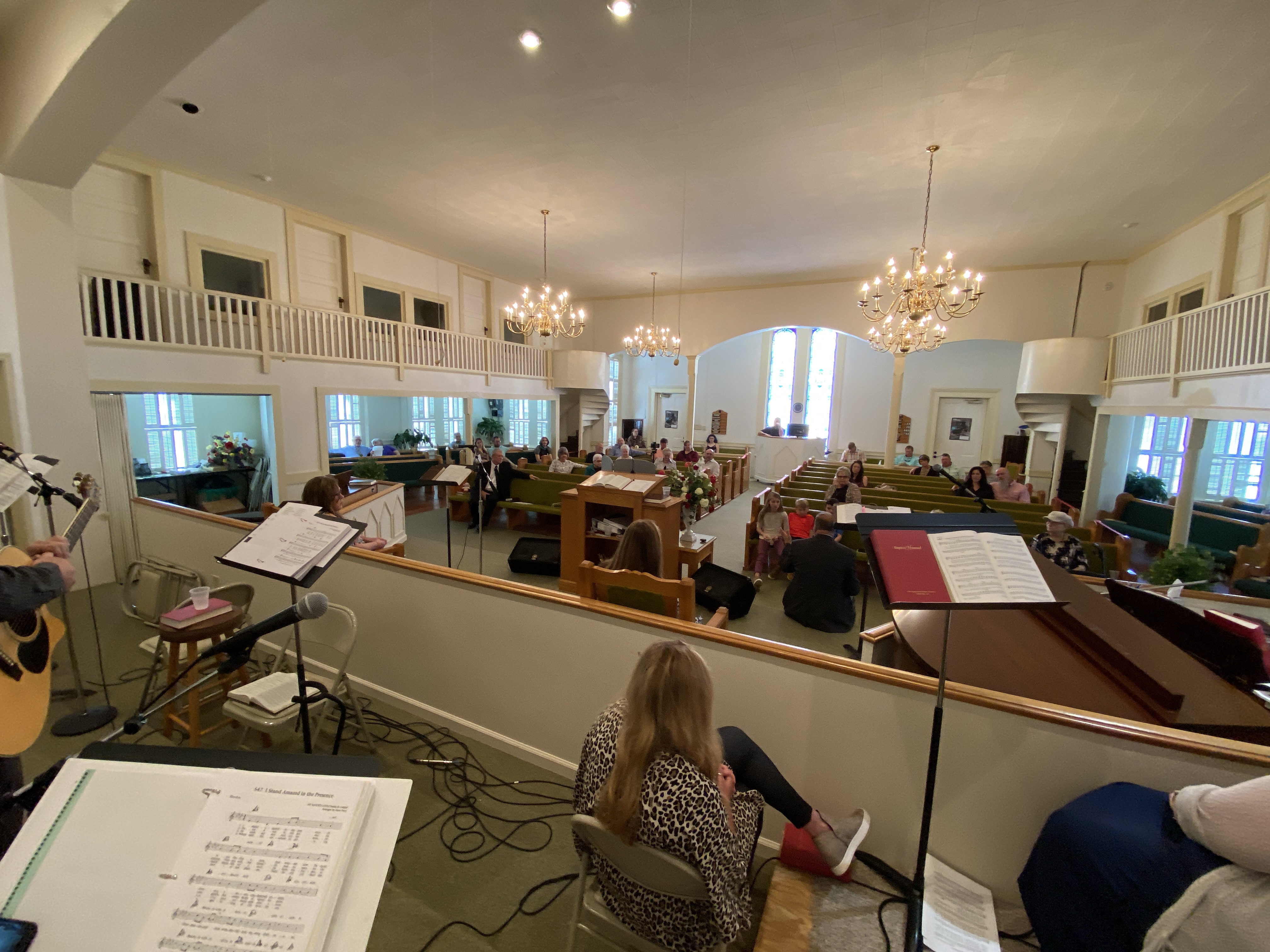
The view Sunday morning from where I play my bass.
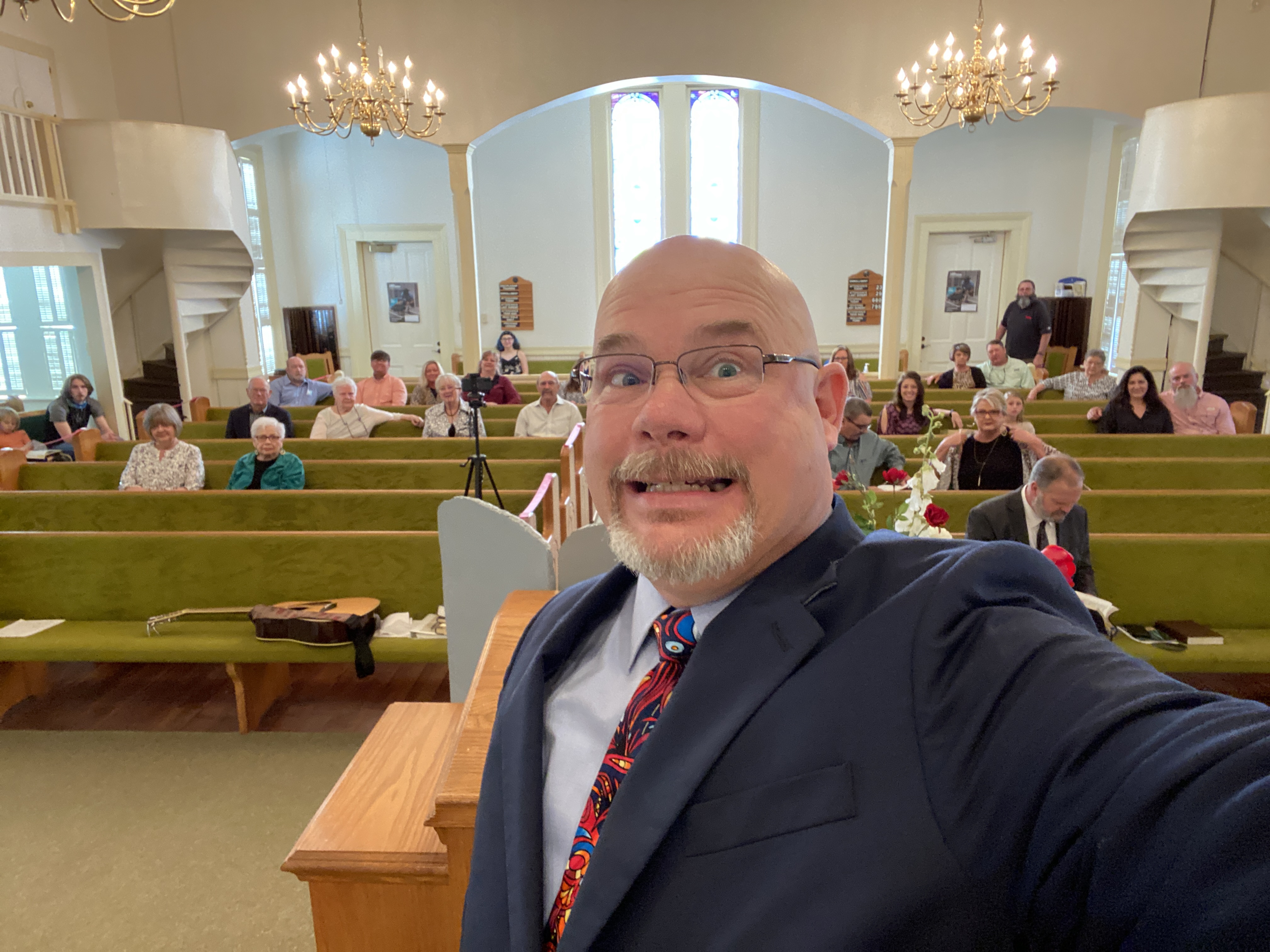
Selfie time! Or, “Make the congregation wonder about your sanity time.”
Not long ago I was involved in a back-and-forth comment thread with a subscriber named Stephen. Maybe you’ve read the comments. If not, they are still there and available for your viewing.
At one point I decided to end the back-and-forth commenting and commit to a post in which I would address the plethora of accusations and mischaracterizations Stephen was making. I even backed off from writing a great deal in order to focus on this piece. To be specific, 2 weeks ago I wrote:
“… I am going to take very seriously my responses to your questions, including your – let’s be honest – angry and mean-spirited attacks on my character and intelligence.Also, in order to achieve maximum transparency and allow for others to judge our arguments against the Word of God (our only source of authority), I will be copying and pasting the most pertinent of your previous remarks into a series of new blog posts.”
However, after reviewing eleven (11) pages of comments, and after being advised by several friends and relatives to stand down, I think it wise to keep my response “limited.”
The reason for keeping things confined to maybe just one blog post is that spreading out the discussion would risk the potential of getting off track. It would also potentially fuel a long-running debate that would prove worthless.
The Sermon
On Sunday morning, January 10, 2021, I preached a sermon from the seventh chapter of Matthew. Jesus said in the 24th verse: “Therefore whosoever heareth these sayings of mine, and doeth them, I will liken him unto a wise man, which built his house upon a rock:” Note, the wise man whose house will stand through the strongest storm is one who not only hears the words of Jesus, but does them.
And what were the “sayings” to which Jesus was referring? They go all the way back to Matthew 7:1. From verses 1-21 there are seven (7) main points, the “sayings” of Jesus. You can find them in verses 1,5,6,7,13,15, and 21.
However, it was verse 6 that the Holy Spirit used to speak to my heart (and other social media users in the congregation). It was also this verse that was often quoted by those advising me to stand down:
Give not that which is holy unto the dogs, neither cast ye your pearls before swine, lest they trample them under their feet, and turn again and rend you. – Matthew 7:6 KJV
Now, before anyone – including Stephen – gets offended, I am NOT calling anyone a dog or pig! Neither was Jesus.
The meaning of this verse has to do with giving things of great value to those who by nature will see no use for them and in turn, instead of thanking you, will continue with their attacks.
You see, swine cannot deduce the value of a shiny, costly, and rare pearl; all they see is something to munch on like a nut. It is not in their nature to appreciate rarity and beauty. Likewise, the one who is hostile to the Word of God, who refers to it as a “dead book” written by “fallible and evil men” is hardly going to appreciate any explanation he’s already deemed valueless and tasteless.
Therefore, I’m torn. Do I respond or not? Do I defend the Bible, the organized Church, pastors, paid ministers, even myself? Do I respond to Stephen’s over-generalized accusations?
Another question: Will it matter? When it is unlikely that Stephen will (if he’s still reading at this point) take the time to respond in a calm, respectful, rational, non-hateful, non-smart alec, humble way, what’s the point of investing hours of my valuable time into writing the likes of multiple research papers?
If the 11 pages of comments tell us anything, Stephen’s likely response will be to belittle my hard work and say as many atheists do when offered evidence of Intelligent Design: “That’s not evidence.”
It’s a tough, tough decision to make.
Who Is Stephen?
So, who is this Stephen person? Why take all this time to address his comments? What makes his arguments and accusations worthy of rebuttal? Why not simply say “whatever” and ignore or block him? After all, I normally block comments from people who are so disrespectful that they call me a “POS.”
I guess it’s because I know that others are reading the comments, too. I know that there are those who will never write anything but read what we write when we go back and forth. I know this because several have told me through email and in person.
It’s also a fact that Stephen is a real human being with real emotions, feelings, and a soul. Stephen also lives in a world where his actions and beliefs will ultimately affect others and possibly generations to come. And it would also be good to remember that Stephen is not alone in his beliefs; there are many, many others who think and feel the way he does.
Where there is one Stephen, there are others. Therefore, by taking the time to rebut false assumptions and dangerous theologies, we may or may not be able to affect a change in Stephen, but others may come to know the Truth.
My Observations
I guess it would be good at this point to offer some observations that I’ve made as I have reviewed Stephen’s comments from last year. Since you may have not read them all, the following summary will give you a better understanding of the tone and substance of Stephen’s comments, along with a better understanding as to why I feel addressing all his arguments might be fruitless.
Again, the following bullet points contain Stephen’s actual comments and are contextually accurate. In no way have I cut and pasted his words in order to frame him in a negative light. His comments can speak for themselves.
Derogatory Ad Hominem Attacks are Common – I counted at least 22 personal swipes at my character or the character of others who joined conversations. With only assumptions and obvious bias as his foundation, Stephen was quick to use the following derogatory descriptors, to mention a few…
Hireling
“…the honest [pastors] have left the world of religion.”
“legitimate” pastors don’t “carry the labels, nor were they employed in religion.”
“The cognitive dissonance required to sit through a sermon and not puke is astronomical. But then as we all know, the psychopath target the weak. Perhaps your time would be better spent pontificating to your flock Mel. I don’t have much patience for manipulators.”
“…you chauvinistic POS.”
“…2 bit evangelical religious leaders such as yourself.”
“A couple of 2 bit religious business owners about their own agenda is what the both of you are.”
“As for your religious business, Baptists are no different than any other denomination or non denomination, it’s all a business, whether you manage it or own it, it’s all witchcraft.”
“…why don’t you mind your own family instead of perpetuating religious business that abuses childrenand those who are weak minded?”
Does Not Believe the Bible is the Inerrant, Inspired Word of God
“…not bound to a book…”
“My authority is Jesus Christ, not a dead book.”
“I do like the bible as it contains many truths and reliable testimonies.”
“As for Where to fine Jesus” words, they’re everywhere but mostly I find them within.”
“I know you disagree all those who belive the infallible, final authority or the word of God must. Their whole faith lies in their belief in the bible. Almost as if, God ceases to exist if the bible has errors.”
“The Jesus of the bible can be many different images to many different people and yet you seem to think a unique revelation is wrong?”
“…but God is not confined to a book written and compiled by man.”
“God has not stopped revealing Himself to men, He doesn’t need a bible to reveal Himself.”
“The bible is subjective…”
Stephen has a strong dislike for Pastors and Preaching.
“I’ve had my fill of men who claim to have the truth.”
“God’s people are everywhere, there’s absolutely no need to pay or put up with pontificating just to hang out with them.”
“Instead of preaching about ‘leading by example,’ it’s time to start doing it.”
“You must assume your position … [use] a couple of bible verses to justify your authority and put me into submission … You must maintain dominance so as to not look weak before your flock.”
“Jesus never spoke of giving pastors or to His people.”
“Any religious leader would have a hard time justifying their position without Paul’s writings so I understand your desire to bind people to the bible.”
“The standards you perceive from the bible are for you, they’re not meant to be legislated and forced onto other, especially if they don’t affect you.”
“And there’s no way preaching the Gospel should be a paid position. Jesus is the model of what the Church should be, not Paul.”
Stephen has a strong dislike for organized religion.
“There is absolutely no difference between the world and those who attend and adhere to organized religion.”
“I’ve tasted the paint religion paints with, and will not be painted with that brush. So I’ll continue to paint with my broad brush.”
“Though most of my mentors never spoke His name or had any part in religion, they lived Christ.”
“…I don’t do religion.”
“No bibles, no church, just faith in God.”
“As for the church model you justify, this model is found no where in the bible.”
“…I’m not a believer that acts is the model for the Church. The Church are those who belong to Christ. We are a living organism and not an organization.”
Stephen has made some potentially dangerous ontological and theological statements about Jesus.
“When we stand before Jesus Christ, we will then know the Truth.”
“I don’t profess Jesus as the only way to God, people can figure that out for themselves. I profess Jesus IS God.”
“My authority is in Jesus Christ, not a dead book.”
“…Jesus Chris revealed Himself to me and taught me that in fact, my conscience was Him speaking to me.”
“After reading the bible 5 times cover to cover, I still wasn’t sure who Jesus was, but He had mercy on me and revealed to me, the scriptures are accurate in their testimony of who He IS. Much like Peter, flesh and blood did not reveal it to me, but my Father in Heaven.”
“The Jesus of the bible can be many different images to many different people and yet you seem to think a unique revelation is wrong?”
“I don’t recall Christ condemning either the woman caught in adultery or the woman at the well. Nor did He defy from doing what they were doing.”
“I hope I’ve made my profession for Jesus Christ alone loud and clear as I learned this from Jesus Christ Himself. This Truth was learned by many and some recorded it. And some of those testimonies were compiled and put in a book that we now call the bible. Fallible men to who’m God revealed Himself to. Go has not stopped revealing Himself to men, He doesn’t need a bible to reveal Himself.”
So, what do I do?
Does Stephen sound like a guy who’s going to respond with grace to someone who gets paid to preach and pastor a church which is linked to an organized religious organization?
If Stephen doesn’t care for the writings of Paul, what good is it to discuss the revelations Jesus made to him as described in the book of Acts and elsewhere in Paul’s letters?
If God has not stopped revealing Himself to men, and if the Bible (I capitalize it because it is a proper noun) is just a compilation of individual and subjective experiences, then to what Authority do I appeal?
If Stephen has already determined that all pastors aside from the “Good Pastor” are hirelings, manipulators, abusers, controllers, practicians of “witchcraft,” and “POS,” what makes me think anything I say, especially if I appeal to a “dead book” written by “fallible and evil men,” will have any affect? Will I only be casting my pearls before someone who cannot appreciate the value?
Personally, I don’t think anything thing I write, whether it be based solidly on the words of Jesus or not, would have any effect on Stephen. After re-reading his comments, it’s hard to imagine he will ever yield the possibility that anything I say could be correct.
HOWEVER, if you would like for me to offer a reasoned response to any of Stephen’s accusations or assumptions, please let me know in the comment section.
In Conclusion
I feel I’d be remiss if I didn’t leave you (and Stephen) with something positive. I’ve talked a lot about Stephen and his beliefs but let me close with a few things I believe.
There is only one way to God and that is through Jesus Christ (“I am the way, the truth and the life; no man cometh unto the Father but by me” – John 14:6).
I believe that Jesus was and is 100% man and 100% God (hypostatic union).
The Bible is our sole source of authority regarding faith and practice, and especially when it comes to understanding who God is.
The Bible is not a “dead book,” but “…[is] quick, and powerful, and sharper than any two-edged sword, piercing even to the dividing asunder of soul and spirit, and of the joints and marrow, and [is] a discerner of the thoughts and intents of the heart.” – Hebrews 4:12 KJV
Scripture is not subjective and open to individual interpretation (Knowing this first, that no prophecy of the scripture is of any private interpretation. – 2 Peter 1:20 KJV).
There must be a point in one’s life when he goes from death to life, from lost to found, from dead to alive, from estranged to reconciled, from being a foreigner to a member of the Family, from being born in the flesh to being born again, from being the enemy of God to being called His friend. In order to be “saved,” there must be a time in one’s life when he recognizes his need of a Savior.
Pastors are gifts to the Church (Ephesians 4:11) and are allowed to be paid for their work (1 Timothy 5:18).
Anything specific I missed? Anything specific you’d like me to address?
If not, I guess I’m done with this project.
Stephen, I do pray that you will grow in a sincere and biblical relationship with Jesus Christ and grow deeper in your understanding and appreciation for the Bible, for it was Jesus Himself who said: “‘O fools, and slow of heart to believe all that the prophets have spoken: Ought not Christ to have suffered these things, and to enter into his glory?‘ And beginning at Moses and all the prophets, he expounded unto them in all the scriptures the things concerning himself.” – Luke 24:25-27
Last week, as I was studying for the upcoming Sunday morning sermon, I had a thought cross my mind, which led to me jotting it down on my desk calendar.
Before long, my “thought” became notes which would affect 6 days’ worth of my calendar and become the source of much discussion between several other pastor friends and myself.
Amused, I picked up my phone and took a picture, then posted it on Facebook. I commented, “This is what having a ‘thought’ looks like.”
So, with no editing or commentary, I’d like to share my “thoughts” with you. All I did was re-write them so that they could be read in this format.
One doesn’t have to have a sin nature to sin. Angels sinned without a sin nature. Adam sinned. But, since Adam, all have sinned (Romans 5:19), whether innocent or not, for their very nature – the sin nature – is not holy as God is.
The true predicament: Are you as holy as God? No, of course not! Then that is sin! The sheer fact that we are anything less than holy defies the holy law of God which is a reflection of His nature.
The Law is not arbitrary, but in conformity with the nature of God. Therefore, no amount of keeping of the Law, even if possible, would make us holy. Only God could keep the law of His own Character, and only God could live holy and without sin, for it is His nature and only His to live consistently holy.
Therefore, no amount of law-keeping could change one’s nature, thereby making him holy, much less to become holy by keeping the law that denotes past imperfection… unholy to holy. This, again, is contrary to the nature of God which would be contrary to His Law. We have no hope! We need a Savior!
Did Adam have a sin nature that led him to sin? Or, did he willfully sin without a sin nature?
Men might be born innocent, but they are not born holy. One could then be at one moment innocent for never having willfully committed a crime, but because he is not holy, and must become holy, he is in contradiction to God’s nature (the Law within Himself) and is, therefore, a law-breaker – a sinner.
Sometimes God uses the smallest things to remind us of His caring love, provision, and strength.
As I look at this recent picture of my little George when he wasn’t feeling well, I can’t help but notice how at rest he is. Look at how little, yet how trusting. Just a tiny little guy, but he knows where he is loved, safe, and taken care of.
In reality, how much bigger is God than us? How much more capable is He than me when it comes to protecting, providing, and comforting? Why is it I run around the yard in a panic like a little dog with no home?
Trust – the word so often missing in our relationship with our heavenly Father. But with trust (and unconditional love) comes a readiness to lay our head on God’s strong arm. There we will find rest.
Isaiah 41:10 – Fear thou not; for I am with thee: be not dismayed; for I am thy God: I will strengthen thee; yea, I will help thee; yea, I will uphold thee with the right hand of my righteousness.
OK, we are not really going to go shopping, but online shopping is just about the best analogy I can think of for the subject at hand. So, just shop with me for a moment.
Recently, because I sold a couple of things on Ebay, I’m in the market to buy a new watch (and I’ve nearly lost 10 pounds as of this writing!). But ever since I started doing my research a few months ago, the watches I wanted back then are not really the watches I want now. Therefore, I’ve been doing a lot of “window shopping” online.
Sorry, but this was a tiny picture.
But, oh my goodness, every time I click there is another watch option that I haven’t considered. I’m constantly going back and forth, making comparisons between features, cost, and value. However, so that I won’t forget what I’ve looked at and so that I can come back to it later, I have been putting some of those watches in my virtual “cart” for safe keeping.
I may or may not buy one of them, but I will go back and look at those particular selections a little more in detail when I have time.
Reading, Not Meditating or Absorbing
As of this moment, I still have about 11 hours worth of reading to do in order to finish reading through the entire Bible before August 1st, my first anniversary here at Bethlehem Baptist.
As some of you know, almost 3 months ago I set a goal for myself: read the Bible through in 70 days (or at least by the end of August). When I mentioned on Facebook how little time I had left and how much I needed to read, a friend said, “Retention, Anthony, retention!” To which I replied, “Different context, Jim, different context.”
But is it wrong to quickly read through the Bible without taking the time to meditate on the verses or read slowly enough to remember everything I read? Well, it really all depends on the context.
My context is that of shopping through all 66 stores and putting what stands out in the cart for later.
Reading through books of the Bible in one sitting helps you to see things you’ve never seen before. No, it doesn’t give you time to meditate long on any one truth, but the new truths (or questions) that appear while quickly reading through the books are the ones that stand out enough to warrant more in-depth study at a later time.
So far I think I’ve got future study topics from every book of the Bible in my cart. I’m looking forward to going back and digging through that stack!
This is my fourth time preaching/teaching through the book of Acts, and yes, I’m still learning things. Even though it’s all been over Facebook on Sunday evenings, it’s still been exciting (especially chapter 12 – I’ll included a link at the end – you should watch it).
But one person stands out to me, especially at this time in my ministry. How he is described is what I am lacking in my own life. When I read of him and preach about him, I am convicted. Wouldn’t it be nice if people thought my name was different than what it is?
Every pastor, to one degree or another, should be more like Barnabas. Yes, I want to be seen as a reflection of Jesus, but Barnabas was certainly that. So, if they every forget my name, Barnabas Baker would work.
Barnabas
Barnabas was a Levite from the country of Cyprus who became a follower of Christ. He was a generous man, a godly man, and one whose name fit his personality; he was the “son of consolation” (Acts 4:36-37).
Barnabas was the type of guy that truly cared about people and wanted to see them succeed. He was more than just a team player; he was a motivator, the kind of man who would step down from the pedestal so that someone else could shine. As a matter of fact, it was Barnabas who introduced Saul (Paul), the former persecutor of Christians, to the church at Jerusalem (talk about having someone’s back!).
But in preaching through chapter 11 of Acts, I came across a description of Barnabas that left me very convicted. The way Barnabas was described should be how we are described: good people, full of the Holy Ghost, and full of faith (11:24).
A Good Man
The first thing said about Barnabas was that he was “a good man.” Now, a lot of people think they are good people, but not all are. As a matter of fact, there’s no other place in Acts where Luke describes a person as “good.” Only Barnabas gets that distinction.
Being described as “good” meant that he was a man with whom no one could find fault. He must have been a man of strong character, a man who kept his word, and a man who would do anything for anybody, including give the last coin to one in need. He was the kind of man Jesus was talking about when He said, “A good man out of the good treasure of his heart bringeth forth that which is good” (Luke 6:45). Barnabas was genuine, the “real deal.”
Full of the Holy Ghost
Barnabas was also “full of the Holy Ghost.” What does that mean? Well first off, let’s think about the description of “full.”
The Greek word translated as “full” is one that meant not only to be filled up but filled up to the point of overflowing. Barnabas was totally yielded and filled with the Spirit, so much so that His presence spilled over onto others. The “son of consolation” was an encourager, just like the Spirit controlling and empowering him.
Full of Faith
Barnabas was not only full of the Holy Ghost but also of faith. Simply put, Barnabas was fully convinced and persuaded with what he believed to be true. There was no doubting, no hesitation, no reluctance, no hiding, no timidity. Barnabas was sure in the gospel of Jesus Christ, and that is one reason he was sent by the church in Jerusalem to see what was going on in Antioch of Syria.
The Result
Now, let’s look at what happened because of Barnabas’ character, his spiritual power, and his sure faith.
“Who, when he came, and had seen the grace of God, was glad, and exhorted them all, that with purpose of heart they would cleave unto the Lord. For he was a good man, and full of the Holy Ghost and of faith: and much people was added unto the Lord.” – Acts 11:23-24
First, because he was a good man, he was not jealous of the good things happening in Antioch; he rejoiced that the grace of God had been poured out on the believers there!
Second, because he was full of the Holy Ghost, what was in his heart (as Jesus described) had to be shared, so he “exhorted” them and encouraged them in their faith.
Third, because Barnabas knew what temptations and trials could come, especially with the persecution following Stephen’s death fresh on his mind, he encouraged the new believers to be pro-active in their devotion to the Christ. He knew that the only way to have a strong faith is to purposefully “cleave unto the Lord.”
Fourth, many people were added unto the Lord! Because of the spirituality and faith and character of godly Barnabas, not only were new believers in Antioch strengthened, but many more people came to know Christ!
The Challenge
Here’s the thing. Why aren’t more people coming to a saving faith in Jesus? Why aren’t more of our churches encouraged? Why aren’t more Christians spiritually maturing in their faith? It’s because we don’t have enough men and women like Barnabas.
Be a good person! Seriously, be the type of man or woman that people can trust and rely on. Be the type of person that people can tell you care. Be generous, compassionate, trustworthy, and consistent. Be people of honor and character.
Be filled with the Spirit! Do you know what it means to be completely filled with the Holy Ghost of God? It means there are no little rooms, closets, or boxes in your heart where there is written a note to God which says, “Private! Hands off!” Every are of your life – every secret part – should be yielded to and controlled by the Spirit of God. Otherwise, you are self-controlled and rebellious, and thereby powerless.
Be full of faith! Grow your faith. Study God’s Word. Know why you believe what you believe. Don’t be a coward! If you are shy or feel intimidated to share your faith with others, ask yourself why that’s so!
Would you be afraid to warn your neighbor a murderer was crawling through his bedroom window? Would you be afraid to yell “fire!” if flames were engulfing the rooms of a hotel where people were sleeping? It’s only because you are NOT full of faith that you are not bold; you have doubts the fire is real and the murderer really means to harm.




 As I look at this recent picture of my little George when he wasn’t feeling well, I can’t help but notice how at rest he is. Look at how little, yet how trusting. Just a tiny little guy, but he knows where he is loved, safe, and taken care of.
 But in preaching through chapter 11 of Acts, I came across a description of Barnabas that left me very convicted. The way Barnabas was described should be how we are described: good people, full of the Holy Ghost, and full of faith (11:24).





 The Recovering Legalist
A Mini Commentary (Pt. 1)
Hello… Again!
A month or two ago I was happy to announce that I would be returning to the blogging community with new content and would be reading your stuff again. Well, it’s taken longer than I planned.
Have you ever noticed how life can get a little busy?
Anyway, today I want to start a short (maybe) series of posts based on some study I did in the 4th chapter of Ephesians. It was a short (mini) commentary that was, among other things, required for me to complete my Doctorate of Ministry (D. Min.).
So, without further ado, let’s begin with the beginning: the title and a short introduction.
“The Edification of the Body of Christ by the Gifts Given by Jesus to the Church”
(An exposition of Ephesians 4:1-16)
Introduction
The following exposition focuses only on one small section of the Apostle Paul’s letter to the church at Ephesus. This section uses the metaphor of a human body to explain the truth that the Church is the Body of Christ. But even more, he delineates between the corporate truth and the individual truth: that the Body is being built up and matured, but that God is also concerned about the individual member’s development.
This section is also where we find an explanation of the “grace” gifts to the Church Body and members in particular. These are the Apostles, Prophets, Evangelists, Pastors, and Teachers. As Paul explains, it is these gifts that are necessary for growth.
Paul then details the progressive steps toward growing “up into Christ” as not only the supreme Example, but the very Framework and pre-determined Design for the Church and individual member alike.
Ephesians 4:1-16 is the blueprint for a successful and healthy Church, where the rest of the chapter focuses on the individual member of the Body’s walk. Yet, these sixteen verses are full of encouragement and hope. No matter our station, no matter our abilities, we are all designed by God, equipped by God, placed by God, and are guaranteed to grow with the Body through the enabling power of the Holy Spirit.
But key to our success is the faithful application of the gifts He has given us. They cannot be ignored, kept to ourselves, or prohibited. In whatever measure we are given these gifts, the ultimate goal is not self-edification, however important in its own right; the ultimate objective is the edification – the building up into Christ – of the Church, the Body of Christ. Only by seeking to edify the Body can individual gifts find their greatest fulfilment.
Come back tomorrow for Part 2 in this series.
If any of it is a blessing or an encouragement, I’d love to hear about it.
God bless!
Share this:
1 Comment
Filed under Bible Study
Tagged as bible study, Christianity, commentary, Ephesians, Ephesus, Exposition