

Frankfort, Kentucky (Artist: Susan Cassidy Wilhoit)

Frankfort, Kentucky (Artist: Susan Cassidy Wilhoit)
Filed under America, Apologetics, God, politics, The Magnificent Fifty, worship
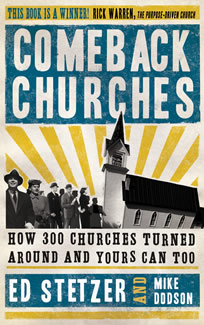
A very revealing study was done, leading to a book detailing how 300 churches went from declining or dying, to growing. In Comeback Churches, written by Ed Stetzer and Mike Dodson, there is a list of 30 different barriers to church growth. Having received permission from the publisher (B&H Publishing Group), I would like to discuss a few of them.
“Let your light so shine before men, that they may see your good works, and glorify your Father which is in heaven.” – Matthew 5:16
Why do we do good works? Why do we feed the poor, shelter the homeless, tend to the elderly, etc? Do we do these things so that our Father will be glorified, or do we do them in order to get glory for ourselves?
 Some people do good works with the sole intention of being seen and considered especially spiritual. Jesus said that “Everything they do is for show” (Mt. 23:5 NLT). Jesus spoke of those who wanted to be seen as pious and holy by wearing boxes containing Scripture on their foreheads or arms. The bigger the box the better. All this was in an attempt to say, “I am keeping the law better than you!” (See Deuteronomy 6:5-9)
Then there are other people who do plenty of good deeds without even acknowledging God. For example, go to any charity ball held by your local “high society” club. There you will find plenty of people who willingly give thousands to worthy causes but smile as big as they can when the magazine photographers come around.
They may even be members of local churches and give large offerings to the building fund (as long as it’s named after them); buy the pastor a new car, or pay for a youth mission trip. “And they love to sit at the head table at banquets and in the seats of honor in the [congregation].” – Matthew 23:6 NLT
Some people do good works in order to be accepted by God. They give away fortunes and spend their lives doing good deeds, but not to be seen by men. They want to be seen by God and thought of as worthy of His love. The only problem is that salvation is “not of works, lest any man should boast.” They work themselves to death in order prove their loyalty, thereby supposedly ensuring a place in heaven. But the glory goes not to God, for attached to the works is an expectation of reward based on merit.
All glory should be to God alone. If our works are done in order to receive praise, then God is not getting the glory. If our works are meant to earn credit with God, then God is not getting the glory. If we work ourselves silly to meet the legalistic requirements placed on us by men, then God is not getting the glory. However, if out of a heart of love we do good works without expectation for reward, recognition, or acceptance, then God will receive the glory.
When all glory, honor, and praise is given to the Lord, He will draw all men unto Himself. Church growth will be unstoppable. Yet, if we expect credit for anything, then what should we expect but further decline? “For mine own sake, even for mine own sake, will I do it: for how should my name be polluted? and I will not give my glory unto another.” – Isaiah 48:11 KJV
We want others to see our good works, but not for our own glory. May they “glorify [our] Father which is in heaven.”
Filed under book review, God, legalism, Uncategorized

Topeka, Kansas (Artist: Susan Cassidy Wilhoit)

Filed under America, Apologetics, God, The Magnificent Fifty

Des Moines, Iowa (Artist: Susan Cassidy Wilhoit)

CLICK HERE to read the introduction to this series of posts.
Filed under America, Apologetics, Culture Wars, God, politics
For every depressing thought that keeps me awake at night, forcing me to stare at a ceiling, a clock, or something worse, there’s a still, small Voice that whispers in rebuttal, “You are not alone, and I care.”
In the middle of the night, when rest should be my reward, the day now spent replays once more. Self-doubt and self-pity weigh on me like a heavy blanket, suffocating me with claustrophobic sorrow. But He says, “I am here, let me handle it.”
It won’t be long till the alarm clock follows its instructions, oblivious to my regret. The day will be longer because of my worrying, and it didn’t have to be. Why did I bother setting it?
Arms of mercy were reaching out to hold me. My Father sought to sing a lullaby of grace over me, but I doubted … in the middle of the night.
Filed under Uncategorized
In a recent study conducted by the survey pro’s at TheRecoveringLegalist.com, pastors from both large and small congregations shared why they thought a small church could be better than a big one.
The survey sample was made up of pastors from various denominations, from different parts of the country, and consisted of men from my personal contact list – and my wife. It was VERY scientific – sorta.
I had my own thoughts, but I wanted to know what others thought, so I asked a question. The question I posed to other pastors went something like this:
“I’m doing a quick, non-scientific survey for a blog post (no names will be mentioned). Can you give me 1 or 2 reasons why a small church could be better than a big church?”
Within moments I received multiple replies through text, email, and Messenger. It took them very little time to respond, like it was something they didn’t even have to think about, and the answers they gave were practically the same.
If the answers from the pastors in the survey I conducted mean anything, it would seem that smaller churches are the place to be if you want to be:
Other answers suggested that in larger churches it is harder to keep track of what is being taught in “small groups,” while in smaller churches everyone is more on the same page. But overall, the most common reason given for smaller churches being better than bigger churches was knowing and being known by others in the congregation.
As a matter of fact, what the pastors in my survey said echoed the hopeful and encouraging words of Karl Vaters’ article “Why Small Churches Are the Next Big Thing.” Speaking of Millennials, he said:
“[There’s] growing evidence this new generation will bring the greatest opportunity for small church ministry in 2,000 years.
Why? Because, as the first generation with a majority born and raised outside traditional marriage, genuine relationships and intimate worship—what small churches do best—will matter more to them than it did to their parents.” [emphasis added]
So you see, even though larger churches offer a lot – unlimited numbers of ministries in which to get involved; professional-quality childcare; servant pastors for every niche; and the best technology money can buy – many people are coming to understand there’s something special about the community of a small, loving congregation.
Should you surmise that intimate, supportive relationships, accountability, and being able to talk with your pastor without an appointment are the only qualities that make small churches better than bigger ones, think again. There’s more! Much more!
The following are 8 more reasons why small churches could actually be better than large ones, at least for some people:
Seriously, I have nothing against large churches – every pastor would love his church to be one. However, most churches average no more than 80 members, and they are where the majority of solid, faithful, salt-of-the-earth Christians still attend.
So, are small churches really better than big ones? Well, that all depends on where God wants you. But if you don’t want to get lost in the crowd – or in the parking lot – a small church just might be what you need.

Y’all are welcome any time! (11055 Dayton Pike, Soddy Daisy, TN)

Indianapolis, Indiana (Artist: Susan Cassidy Wilhoit)

Note, the Indianans of the 1850’s understood that the right to choose their own form of government was one given by God, not man. Yet, again, we have people from the FFRF (btw, they claim only 20k members) wanting to erase God from every vestige of public life. Where would our public life be without God at the foundation? The founding fathers of Indiana would tell you, “Nowhere.”
Filed under America, Apologetics, community, God, politics, The Magnificent Fifty

Springfield, Illinois (Artist: Susan Cassidy Wilhoit)
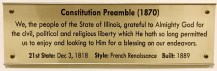
Amazing how so many of our states’ constitutions recognize the existence of God, isn’t it? Yet, the Freedom from Religion Foundation and their kind want nothing less than to scrub that fact from history. The purpose of this series of posts called “The Magnificent Fifty” is being published in an effort to combat that. Please share them.
CLICK HERE to read the introduction to this series.
Filed under America, Apologetics, The Magnificent Fifty
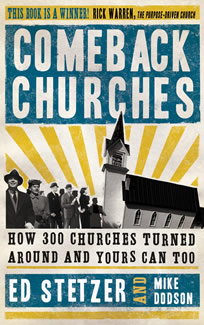
A very revealing study was done, leading to a book detailing how 300 churches went from declining or dying, to growing. In Comeback Churches, written by Ed Stetzer and Mike Dodson, there is a list of 30 different barriers to church growth. Having received permission from the publisher (B&H Publishing Group), I would like to discuss a few of them.
“People are unwilling to take hold of God (Isaiah 64:7).”
“And there is none that calleth upon thy name, that stirreth up himself to take hold of thee: for thou hast hid thy face from us, and hast consumed us, because of our iniquities.” – Isaiah 64:7 KJV
Every time we heard a gospel song that had words similar to “hold on to God,” or “hold to His hand,” my parents quickly reminded us that “we don’t hold God’s hand – He holds ours.” Understandably, what my parents were referring to was salvation. In that sense, we are held and He will never let go.
But that is not what this verse is talking about. Isaiah is saying that part of the problem his people were facing was the fact that none had the desire, nor even the desire to have a desire, to grab hold of God. If that is true today, then it may not only be a huge barrier to church growth, but to individual growth as well.
It is interesting and revealing when we look at this phrase and compare its usage to other places in Scripture. To begin with, the word chazaq (Strong’s H2388) essentially means “to tie fast, to bind bonds strongly” (Gesenius’s Lexicon). It is a verb that is translated into English as words such as strong, retain, urgent, and caught. Here are just a few examples.
“And the LORD said unto Moses, Put forth thine hand, and take it by the tail. And he put forth his hand, and caught[2388] it, and it became a rod in his hand:” – Exodus 4:4
“And the Egyptians were urgent[2388] upon the people, that they might send them out of the land in haste ; for they said , We be all dead men.” – Exodus 12:33
“Then said his wife unto him, Dost thou still retain[2388] thine integrity? curse God, and die .” – Job 2:9
Moses “caught.” Look at the first verse. Moses had been commanded by God to throw down his rod, after which it became a serpent. Then, against all logic, God told him to pick it up again, but this time by the tail (riiiiigghht!). I would have had to be seriously “stirred up” to pick up a deadly snake by the tail – it BITES! Yet, that’s what Moses did. He “caught it” by the tail.
The Egyptians were “urgent.” Next, after suffering under all the plagues, the Egyptians “were urgent” in there pushing the Israelites out of town. They had come to realize that their own lives were in jeopardy if the Jews stayed one day longer. It was imperative that they are pushed out as quickly as possible.
Job “still retained.” Now, look at poor Job. He had lost everything dear to him, including his health, and then came his wife telling him to curse God and die. She couldn’t believe that he could just sit there and hold on to his belief that God was worth serving. “After all this, are you still holding on to your integrity? What for? What’s the use? Quit putting yourself through this nonsense and just curse God and die!” Yet, he held on.
When we view Isaiah 64:7 in the light of the verses above, what we have is astounding and convicting. Let’s see if we can work it all together:
1) Taking hold of God is something that we should take seriously, not flippantly. Don’t reach out for Him in a way that implies half-heartedness. Take hold like you mean it! Who do we think God is, a stick to be used by us in our own power to accomplish our own desires? NO! He is alive and dangerous. As Aslan in The Chronicles of Narnia, He is NOT tame. He is not here to be played with.
2) Do we not understand that without the power and presence of God we will die? “In Him we live, move, and have our being” (Acts 17:28). There should be an urgency in our desire for Him, no less than the kind the Egyptians had to expel the Jews from their land. Do we want to live? We must urgently “take hold.”
3) We must hold on to God even when it seems insane to others. We must consider our relationship with our Heavenly Father so precious that even when Hell seems to be winning, faith tells us otherwise. Like Job of old, we should hold on to God even when we lie broken and wasted amid the ashes of seeming defeat. Our Redeemer LIVES!
If we are to see growth in our churches, not to mention our own lives, we must seek after God with urgency, intensity, and passion. He must be sought after and adhered to like no other treasure on earth. Anything less betrays our divided, adulterous hearts. God will bless and grow a people who “take hold.” No church will grow who only takes hold of God when it is convenient, fun, or fashionable.
Time is filled with swift transition
Not of earth or moon can stand
Build your hope on things eternal
Hold to God’s unchanging hand
Hold to God’s unchanging handTrust in Him who will not leave you
Whatsoever years may bring
When my earthly friends forsaken
Still more closely to Him clingHold to God’s unchanging hand
Hold to God’s unchanging hand
Build your hope on things eternal
Hold to God’s unchanging hand
Hold to God’s unchanging hand
We must cleave to Him. It IS a matter of life or death.
Filed under book review, Christian Maturity, God, Uncategorized, worship

Boise, Idaho (Artist: Susan Cassidy Wilhoit)

 Folks, I hope this series of posts is opening a few eyes. The whole point is to counter the idea that our nation (and states) were founded on “godless” principles. To the contrary, these posts featuring The Magnificent Fifty: Foundation of Faith art collection at Bryan College show that faith – not godlessness – was very much a part of the fiber of our nation. To deny this exposes one of two things: an ignorance of history, or the willful desire to rewrite it.
Filed under America, Apologetics, Faith, The Magnificent Fifty



Click to Order



 The Recovering Legalist