For several months we have been using our Sunday School hour to go over each article in The Baptist Faith and Message 2000. This morning the subject will be biblical cooperation between believers. Southern Baptists believe that where there is no risk of theological compromise, we should seek to cooperate with fellow believers in Christ when seeking a common goal.
However, there are others who preach a “Doctrine of Separation” that forbids cooperation of any kind, even with members of the Body of Christ, when even the slightest difference is observed. It is with this unbiblical “Doctrine of Separation” that I take exception and want to dispell.
Therefore, I want to acquaint you with the following article I wrote in an effort to help promote biblical unity within the Church. It can also be found under a tab at the top of the main page.
Feel free to share the body of this post as you see fit. I simply ask that you include the source.
“The Doctrine of Separation Examined”
By: Anthony C. Baker, M.Min.
Introduction
During most major holidays, especially Christmas and Thanksgiving, it is customary for families to gather around a table to share a traditional meal. And, when looking around the typical table, it is not uncommon to find relatives, people who would normally never speak to each during the rest of the year, smiling and enjoying themselves. They do this because at the head of the table sits the patriarch or matron of the household, the one who brought them into the world. Out of respect for the parent, even the estranged siblings attempt to fellowship in peace. Sadly, this is not the case with many children of God.
The Doctrine of Separation, based on 2 Corinthians 6:17, has led many to avoid other believers, their brothers and sisters in Christ, despite the expressed desire of their elder Brother (Jesus) that they “be one” (John 17:11). Therefore, this paper will attempt to show that even though it is Christ’s desire for the family of God to be one, the doctrine of separation, as generally applied, is resulting in unnecessary, even destructive division, especially with Baptists. However, even though the author’s intent is to shed light on the divisive tendencies associated with the misuse of a particular teaching, in no way does he intend to promote the darkness-inspired synchronistic tendencies of the modern church; biblical unity within the family of God is the ultimate goal.
Definitions
 If one were to ask the average church member to define the Doctrine of Separation, or if one were to Google the term, the answers would initially be quite similar in nature. What most professing Christians believe is not much different from the rest of American society, simply because the term is associated with the oft-debated Establishment Clause within the first amendment to the United States Constitution. There, the Constitution states that “Congress shall make no law respecting an establishment of religion…” Therefore, when questioned, this is typically the first thing that comes to the mind of the average church-goer. When asked if one is familiar with the Doctrine of Separation, if the response is “yes,” the definition is usually linked to the separation of church and state, a political issue.
However, there are some within the body of Christ that not only know how to define the Doctrine of Separation but take that definition to extremes. They use it to bolster a sectarian mindset which excludes from fellowship any that differ, even in the slightest way, and have gone to great lengths to separate from others who do not strictly observe certain “fundamentals” of the faith.
So, to begin with, let us look at some definitions. By doing that we may better be able to determine if the Doctrine of Separation is properly being applied by certain Baptists who refuse to co-operate with others.
What is the Doctrine of Separation? The Doctrine of Separation is a teaching based primarily on one verse found in 2 Corinthians. Below is the verse (17) in its immediate context.
“Be ye not unequally yoked together with unbelievers: for what fellowship hath righteousness with unrighteousness? And what communion hath light with darkness? [15] And what concord hath Christ with Belial? Or what part hath he that believeth with an infidel? [16] And what agreement hath the temple of God with idols? For ye are the temple of the living God; as God hath said, I will dwell in them, and walk in [them]; and I will be their God, and they shall be my people. [17] Wherefore come out from among them, and be ye separate [emphasis added], saith the Lord, and touch not the unclean [thing]; and I will receive you (2 Cor 6:14-17 KJV).”
The idea is that in order to maintain a right relationship with God one must separate oneself, or “come out from among” anyone, or any organization, that would seem to be in accord, friends with, or even remotely associated the “unfruitful works of darkness.”
The Doctrine of Separation can be divided into two separate categories: ecclesiastical and personal. In order to understand how specific this doctrine can be, it might be helpful to read how one Independent Fundamental Baptist (IFB) church defined ecclesiastical and personal separation in its doctrinal statement published on its website.[1] The following is a word-for-word copy of their definitions, and it is typical of most Baptist separatists.
Ecclesiastical Separation. We believe that we must stand up against and separate from all Apostasy, Liberalism, Modernism, Ecumenism, Charismatic influences, Neo-Orthodoxy, Neo-Evangelicalism, and Neo-Fundamentalism, as well as all groups, mission boards, organizations, churches, and cults that would compromise, cooperate and fellowship with such that do not uphold the historic Christian fundamentals of the faith as expressed by the Bible. II Corinthians 6:14-7:1; I Thessalonians 1:9,10; II Timothy 3:1-5.
Personal Separation. We believe that every Christian is to keep himself unspotted from the world, and in so doing must deny various practices, sinful habits, and worldly dress; and that a proper standard and example must be raised to the lost world and to weaker Christians. James 1:27; I Peter 2:11; Romans 6:11-13.
Notice that the call to be separate must include separation from both groups and individuals. It calls for strict standards of conduct and dress, prohibitions against working with other denominations, and an implied understanding of what exactly is correct behavior. The problem that arises, however, is when certain practices, habits, and dress are dictated by the church, not a Spirit-led conscience freed by grace. One man’s standard must then be applied to another, thereby legalistically judging him either fit for fellowship or to be labeled as “liberal” or “modern.” The application of this doctrine can become very legalistic, and below are three concerns which should be brought out.
Issues of Concern
First, the issue that causes most concern with the author is that in no place does the above standards of separation make an exception for the fact that sometimes members of the same family do not always agree. To totally separate one’s self from other believers, only because they have a different understanding or conviction for what constitutes “worldly dress” or “sinful habits” is a sin in its self. So often members of churches that prohibit women from wearing pants, for example, look at others who do with contempt. They do so because they believe that their own “dress code” is less “spotted by the world,” and thereby spiritually superior to the one which would allow “modern” and “liberal” dress. The author can vividly remember times from his own past when, all because a particular pastor’s wife was seen wearing pants to an evening service, the offending pastor and wife were deemed “liberal” and “not right with God.”
Another problem with the above list is that it does not take into account that many churches that do subscribe to conventions and associations, which may be liberal, are still autonomous and actually hold to the key fundamentals of the Baptist faith. And this is a key issue. There are certain fundamental truths of Christianity which cannot afford to be compromised, for if they are, then the compromiser can no longer be considered an orthodox Christian. What are the fundamentals of the faith that are non-negotiable? According to Ed Dobson, Ed Hindson, and Jerry Falwell, there are five fundamentals that are at the heart of Christian Fundamentalism: 1) the inspiration and infallibility of Scripture; 2) the deity of Christ (including His virgin birth); 3) the substitutionary atonement of Christ’s death; 4) the literal resurrection of Christ from the dead; and 5) the literal return of Christ in the Second Advent. Don’t the separatists understand that within the community they are trying to reach there may be a congregation from a different denomination which still holds true to the above fundamentals?
Thirdly, there is the interesting fact that the fifth fundamental, one of the key beliefs of orthodox Christianity, the belief in the literal return of Jesus Christ (the second coming; or as some would define it: the Rapture) was never used by Paul as a litmus test for fellowship. What many have never stopped to notice is that in two specific instances the Apostle Paul dealt with believers who thought that the resurrection had already taken place (see 1 Cor. 15:12; 2 Thess. 2:2-3). In neither of these situations, Paul encouraged separation. “The Corinthian Christians were told in a clear, unmistakable command to ‘remove the wicked man from among yourselves’ in their assembly,” said Robert Lightner in A Biblical Perspective on False Doctrine in reference to the man guilty of immorality in 1 Cor. 5:13.[2] He went on to point out that the “saints at Thessalonica were told also to ‘keep aloof’ [withdraw, KJV] from every brother who leads an unruly life…” Yet, “interestingly when Paul wrote to the same Christians in Corinth and Thessalonica concerning two specific doctrines which were being denied…he did not command to separate.” Why is it, then, that if such a key fundamental was believed back then, and Paul did not command the church to separate, do fundamentalists find it necessary to break fellowship with and label “liberal” and “modernistic” those who have a different view of eschatology?
Baptist History
Baptists (especially those of the IFB persuasion) are famous/infamous for their sectarian, separatist stands. Yet, even though they may be the largest group and the one to be featured more predominately in this paper, they are not alone. Within every denomination of believers, there are separatists. As a matter of fact, there are more denominations of Christianity in America than anywhere else in the world, and many of them were formed when separation was thought the only means to preserve orthodoxy. Each of these groups claims a biblical mandate (2 Cor. 6:14-17) to “come out from among” those who seem to be going in the wrong direction. The problem, however, lies not only in the ability to define but in the application of the doctrine. A careful look at the Scripture passages they use, especially in light of other words from the Apostle Paul and Jesus, show that separation from members of the same family may be necessary in extreme cases, but every attempt should be made to maintain fellowship at the Father’s table.
Baptists have had a long history of separating on the basis of key doctrinal issues, and for this we owe them a great debt of gratitude. Long before arguments over dress codes and Bible translations, the Anabaptists put their lives on the line over the issues of baptism, the mass, and an ecclesiastical, state-run church. They were the first separatists, for no longer could they accept the position of the Reformers. Unlike great men such as Luther, Calvin, and Zwingli, the Anabaptists would have no part of a church that taught unbiblical doctrine. They felt the state church was a fallen church, and from such only separation was appropriate. In February of 1527, in a document called The Schleitheim Confession, Michael Sattler wrote:
“We are agreed [as follows] on separation: a separation shall be made from them and from the wickedness which the devil planted in the world: in this manner, simply that we shall not have fellowship with them [the wicked] and not run with them in the multitude of their abominations . . . To us then the command of the Lord is clear when He calls upon us to be separate from the evil and thus he will be our God and we shall be His sons and daughters.”[3]
In modern times, Independent Baptist churches were founded in the second half of the twentieth century as a response to a growing trend toward liberalism and ecumenism that was begun a century earlier by men such as Hegel (1770-1831), F. C. Baur (1792-1862), Frederick Schleiermacher (1768-1834), and Ernst Troeltsch (1865-1923).[4] No longer was there a mother church from which to separate, as did the Anabaptists from the Reformed church (reformed, but not completely separated from the ecclesiastical ways of the Catholic Church). Now the call was sent out for all those who held true to the Fundamentals to separate themselves from those within. Those with liberal leanings were to be marked and avoided (Rom. 16:17-19). The peak of resistance toward modernism from “fundamentalists” came in the 1940’s and 1950’s with the rise of the Billy Graham and the New Evangelicalism. It was at this time so many militant steps were made toward separating from the world, worldliness, and any modern approach toward evangelism, especially if it involved working together with those who may have differed on a belief or two, especially when it came to music and Bible versions. Billy Graham did, and still does bear the brunt of many senseless attacks.
Billy Graham, the Enemy
If a poll were taken today asking people who they thought was the most important and influential religious leader of the last fifty years, one name would probably rise to the top – Dr. Billy Graham. Actually, the Barna Group recently did conduct a study of Americans and found that nearly twenty percent of adults identified Reverend Billy Graham as the “most influential Christian leader in the U. S. today.”[5] Ironically, however, it was Billy Graham, along with other Christian leaders such as J. Vernon McGee, Howard Hendricks, and W. A. Criswell (all conservative giants), that biblical separatists accused of “building bridges of compromise and apostasy by their middle-of-the-roadism.”[6] Was Dr. Graham perfect? Did he make the best judgment calls in every situation? Of course not, and pity the man who thinks he is strong enough to stand in the places Dr. Graham has stood without succumbing to the flesh. Yet, it was considered unconscionable for Christians to try new methods of outreach, or work with leaders of other denominations, in order to reach greater crowds with the life-changing gospel of Jesus Christ.
No, true to their heritage, fundamental, independently-minded Baptists could only see a devaluing of key, non-negotiable doctrines in favor of a more ecumenical approach to evangelism. So, from these men, especially Dr. Graham, fundamentalist Baptists broke fellowship. Even today, after all the souls that have been won to the Lord, there are Independent Baptists who still think Billy Graham is a liberal enemy of the church. For example, in 1992 this writer personally witnessed a Baptist pastor chastise a Romanian couple in their home (both of whom lost their engineering careers as a result of being publically baptized for their faith in Jesus) for nothing more than having an LP recording of a Billy Graham crusade. This arrogant American pastor would have never sat across the same table with Dr. Graham, or fellowshipped with those who did.
United Baptists
Not all Baptists have sought to separate, however. Some have sought to come together in unity for the cause of Christ. It is common knowledge that there is strength in numbers, and when it comes to Christian congregations, co-operation can lead to expanded ministry and encouragement. Even though the IFB churches in America have gained a reputation for being separatists, other Baptists have put aside minor differences for the common good, much like the family that seeks peace at the dinner table for the Father’s sake.
The Southern Baptist Convention (SBC) makes up the largest Protestant denomination in North America. But in Canada, there is the Convention of Atlantic Baptist Churches who struggled for years before three separate denominations (the Maritime Convention of Maritime Baptists, the Free Baptists of New Brunswick, and the Free Baptists of Nova Scotia) formed the United Baptist Convention of the Maritime Provinces in 1906. For a while, at least since the late 1800’s, many denominations had been pursuing unification, such as with the Canadian Baptists.[7] But there was and is a difference between the conventions, a difference worth noting. Baptists in America hold tenaciously to one of the most cherished fundamentals of Baptist doctrine, the autonomy of the local congregation. Canadian Baptists, on the other hand, possibly because of their monarchal heritage, allow the convention some control over the local congregation. For example, in order to be licensed and ordained to pastor a church in the NABC, the candidate must complete mandatory studies at a specific Canadian seminary, Acadia Divinity College.[8]
Most Independent Baptists consider conventions (like the SBC) to be unbiblical precisely because of their belief that all conventions assert control over local congregations. However, this is not the case with all, as seen above. For better or worse, many Christians felt that a unified Church was better than a divided one. However, the practical result was a watering down of fundamental beliefs in order to keep from offending those seeking unity. Strict standards of morality, which had been the norm for so long, were beginning to loosen; biblical inerrancy was being questioned, and mass evangelism was on the rise. The question of what was considered “essential and non-essential” came to the forefront of discussion. And even though attempts have been made by the author to co-operate in a community ministry with an IFB church, all efforts have failed. Because of the Doctrine of Separation, because it is believed unbiblical to co-operate with other believers who do not hold to all of the “fundamentals,” division continues.
Ecumenism
One of the great enemies of the Fundamentalists is Ecumenicalism. One of the big reasons, as could be inferred from previous reading, is that those who seek to unify the church as a whole, in many cases, want to compromise on key doctrines essential to Christianity, such as biblical inerrancy and the divinity of Christ. However, one ecumenical author made an astute observation that can tie directly into the discussion of “biblical separation.” In The Unfinished Reformation, Charles Morrison wrote how that he noticed a tendency by separatists to use the Bible to say what was “biblical” without actually proving it literally so. He said that “anything, however trivial or fantastic or commonplace, that one could dig out of the Bible by however ingenious a manipulation of its texts and words was claimed to be authorized by Christ, and was made constitutive of a church ‘founded on the Bible.’”[9]
Much of what divides believers and congregations is based on teachings supposedly founded on Scripture and considered “biblical,” yet, in reality, are only based on culture or personal opinion, or even worse, misinterpretation. One good example is the belief that a church “founded on the Bible” should expect its men to wear pants and its women to wear dresses. Anything different would be considered rebellion to God’s commands found in the Bible. Anyone found in rebellion should, therefore, be marked and avoided. Yet what does the Bible actually say? “The woman shall not wear that which pertaineth unto a man, neither shall a man put on a woman’s garment: for all that do so [are] abomination unto the LORD thy God” (Deut. 22:5). Here the Bible is used to enforce a cultural style. Nowhere does Moses say a woman should wear a dress and a man should wear pants. All it says is that the man and women should dress in ways that “pertaineth” to their respective gender. In other words, a woman should look like a woman, not a man, and vice versa.
Family of God
The family of God is much bigger than one denomination. Before there were conventions and associations, there was the church. Before the Anabaptists, the Calvinists, the Arminians, and the Modernists, there were believers who loved the Lord and worshipped in one accord. They weren’t known for their building programs or bus ministries. They didn’t split over the color of the carpet or whether or not the pews were padded; they just wanted to stay alive. Why is it that so many put such a high priority on denomination, rather than unity? Does unity have to be synonymous with compromise? What kind of compromise is it to dwell in peace with a brother or sister in the presence of a loved earthly parent, even when differences are known to exist? Does compromise for the sake of fellowship change relationship? If a stranger were to sit at the mensam gratias (Latin, “table of thanks”), would his presence at the meal change the blood flowing through his veins? No, it would not. And striving for unity in the family will not change the relation of the true child to that of the Father. Therefore, when and if we find a brother or sister in the same family of Christ, should differences we have, however striking, prohibit us from attempting to share in some common way?
In Chattanooga, Tennessee, the churches of like faith in one community have met together every year for a Thanksgiving service. The author has participated in these services on multiple occasions. However, what has been lacking is any participation from the local Independent Baptist churches. Their absence is always noticed, and the message received is that all who are gathering must be those who would “compromise, cooperate and fellowship with such that do not uphold the historic Christian fundamentals of the faith as expressed by the Bible.”[10] Their conspicuous absence sends a message that says, “We are more spiritual than you.” Their continual refusal shows the community at large that denomination is more important than family, fellowship, and the opportunity to show the world that we can be one in the Spirit, for that is where genuine unity exists.
The Prayer of Jesus
Jesus made it very clear, as recorded in the book of John, that He wanted the world to see believers come together in love. In a special moment Jesus even spoke of Christians today when He said, “Neither pray I for these alone, but for them also which shall believe on me through their word; that they all may be one; as thou, Father, [art] in me, and I in thee, that they also may be one in us: that the world may believe that thou hast sent me” (John 17:20-21). Our unity within the family of Christ is to be a form of evangelism, “that the world may believe.” And how arrogant are we when, in the face of an actual prayer of Jesus, we say that fellowship is impossible? First, where did Jesus mention the name of any denomination or association? All he spoke of were those in his presence and them “which shall believe on [Him] through their word.” Second, has there ever been a prayer of Jesus unanswered? Did Jesus pray “that they all may be one” in vain? The day may come when He has to force us to drop our labels and institutional names in favor of a discrete and secret meeting place underground. There, with no $20,000 sign flashing out front, the true family of God may have to get back to the way it was before the King James Version was printed.
Early Church Example
Francis Schaff, in volume two of History of the Christian Church, relates the following description of a people unconcerned with denominations, unaware of the “fundamentals,” but always ready to live in such a way that others knew they were not of this world. Quoting an unknown author describing the church in the early part of the second century, he writes:
The dwell in the Grecian or barbarian cities, as the case may be; they follow the usage of the country in dress, food, and the other affairs of life. Yet they present a wonderful and confessedly paradoxical conduct. They dwell in their own lands, but as strangers. They take part in all things, as citizens; and they suffer all things, as foreigners . . . They are in the flesh, but do not live after the flesh. They live upon the earth, but are citizens of heaven . . .They love all, and are persecuted by all. They are unknown, and yet they are condemned . . .They lack in all things, and in all things abound . . .They are cursed, and they bless.[11]
Why is it that we cannot try to emulate that kind of spirit? Does anyone seriously think the same description could apply to the Christian church of today?
Thankfully, there are those within the Baptist church who understand that the prayer of Jesus for unity was not just words. Thankfully, there are some out there that are striving to work with believers across denominational lines in an effort to reach the lost and dying, while at the same time recognizing there are doctrinal differences which must be taken into account. These people are not in the business of compromising Truth; they are in the business of fulfilling the Great Commission. One such group of people is the Southern Baptists.
Conclusion
If more IFB churches could be made aware of how conservative the SBC has become, maybe they would stop labeling them as liberal and start working more closely together. It is in the Baptist Faith and Message of 2000 that an encouraging statement is made which tempers the Doctrine of Separation. Under section fourteen, entitled “Cooperation,” the following words can be found:
Members of New Testament churches should cooperate with one another in carrying forward the missionary, educational, and benevolent ministries for the extension of Christ’s Kingdom. Christian unity in the New Testament sense is spiritual harmony and voluntary cooperation for common ends by various groups of Christ’s people [emphasis added]. Cooperation is desirable between the various Christian denominations, when the end to be attained is itself justified, and when such cooperation involves no violation of conscience or compromise of loyalty to Christ and His Word as revealed in the New Testament.[12]
Is this not what Jesus wants? Is this not the way the family of Christ should conduct its self? Oh that the body of Christ would come together in true, biblical unity! Even the “black sheep” of the family are welcome at the Father’s table.
One more thing…
Many who hold to a legalistic view of the Doctrine of Separation are regularly guilty of hypocrisy. How could this be? Consider the fact that many of the “separated” churches have active members, deacons, and pastors who are fully-participating members of fraternal organizations, such as the Masons and Shriners. The irony is that according to the writings of one of the “great” leaders and teachers of Freemasonry, Albert Pike (1859-1891), Christians regularly enter into binding agreements, oaths, and common works, even using the term “brother,” with men from any number of other religions, including that of the eastern cults! He said, “We belong to no one creed or school. In all religions there is a basis of Truth; in all there is pure Morality. And all that teach the cardinal tenets of Masonry we respect; all teachers and reformers of mankind we admire and revere.”[13]
Family should come before fraternity, the Church before the Lodge; yet, how quickly some will deny fellowship with those clothed in the righteous of Christ, preferring unity with those wrapped in an apron.
Again, how ironic.
Footnotes
[1] Heritage Baptist Church, “Declaration of Faith,” http://www.heritageministries.com/doctrine.html
[2] Robert P. Lightner, “A Biblical Perspective on False Doctrine,” Bibliotheca Sacra (March, 1985), 20
[3] Ernest D. Pickering, Biblical Separation: The Struggle for a Pure Church (Schaumburg, Ill.: Regular Baptist Press, 1979), 52.
[4] George W. Dollar, A History of Fundamentalism in America (Greenville: Bob Jones Press, 1973), 8-11
[5] http://www.barna.org/culture-articles/536-us-lacks-notable-christian-leaders
[6] George W. Dollar, 280
[7] Daniel C. Goodwin, “Maritime Baptist Union and the Power of Regionalism,” Journal of Ecumenical Studies, 2004.
[8] http://www.baptist-atlantic.ca/documents/ProceduresForOrdinationBrochure.pdf
[9] Charles Clayton Morrison, The Unfinished Reformation (New York: Harper and Brothers, 1953), 209.
[10] Heritage Baptist Church
[11] Francis Schaff, Ante-Nicene Christianity: From the Death of John the Apostle to Constantine the Great [A.D. 100–325], Vol. 2 of History of the Christian Church (Peabody: Hendrickson Publishers, 2002), 9-10
[12] SBC, Baptist Faith and Message, 2000 (Nashville)
[13] Albert Pike, Morals and Dogma of the Ancient and Accepted Scottish Rite of Freemasonry, (Richmond: L. H. Jenkins) 311
Bibliography
Dobson, Ed, Ed Hinson, and Jerry Falwell, The Fundamentalist Phenomenon: The Resurgence of Conservative Christianity, 2nd ed. Grand Rapids: Baker Book House, 1986.
Dollar, George W. The Fight for Fundamentalism: American Fundamentalism, 1973–1983. Sarasota: Dollar, George W., 1983.
Goodwin, Daniel C. “Maritime Baptist Union and the Power of Regionalism.” Journal of Ecumenical Studies 41.2 (2004): 125+. Religion & Philosophy Collection. Web. 8 Apr. 2012.
Heritage Baptist Church. “Declaration of Faith.” http://www.heritageministries.com/doctrine.html (accessed April 9, 2012).
Lightner, Robert P. “A Biblical Perspective on False Doctrine.” Bibliotheca Sacra 142, no. 565 (January 1, 1985): 16–22. ATLA Religion Database with ATLASerials, EBSCOhost (accessed March 17, 2012).
Morrison, Charles Clayton. The Unfinished Reformation. New York: Harper and Brothers, 1953.
Pickering, Ernest D.. Biblical Separation: The Struggle for a Pure Church. Schaumburg: Regular Baptist Press, 1979.
Pike, Albert. Morals and Dogma of the Ancient and Accepted Scottish Rite of Freemasonry. Richmond: L. H. Jenkins, Inc., 1960
Schaff, Philip. Ante-Nicene Christianity: From the Death of John the Apostle to Constantine the Great [A.D. 100–325], Vol. 2 of History of the Christian Church. Peabody: Hendrickson Publishers, 2002.
Southern Baptist Convention. “The Baptist Faith and Message.” http://www.sbc.net/bfm/bfm2000.asp (accessed March 18, 2012).

 The truest test of real friendship is how he/she responds when you say things you may regret. This is where Job’s friends fell behind.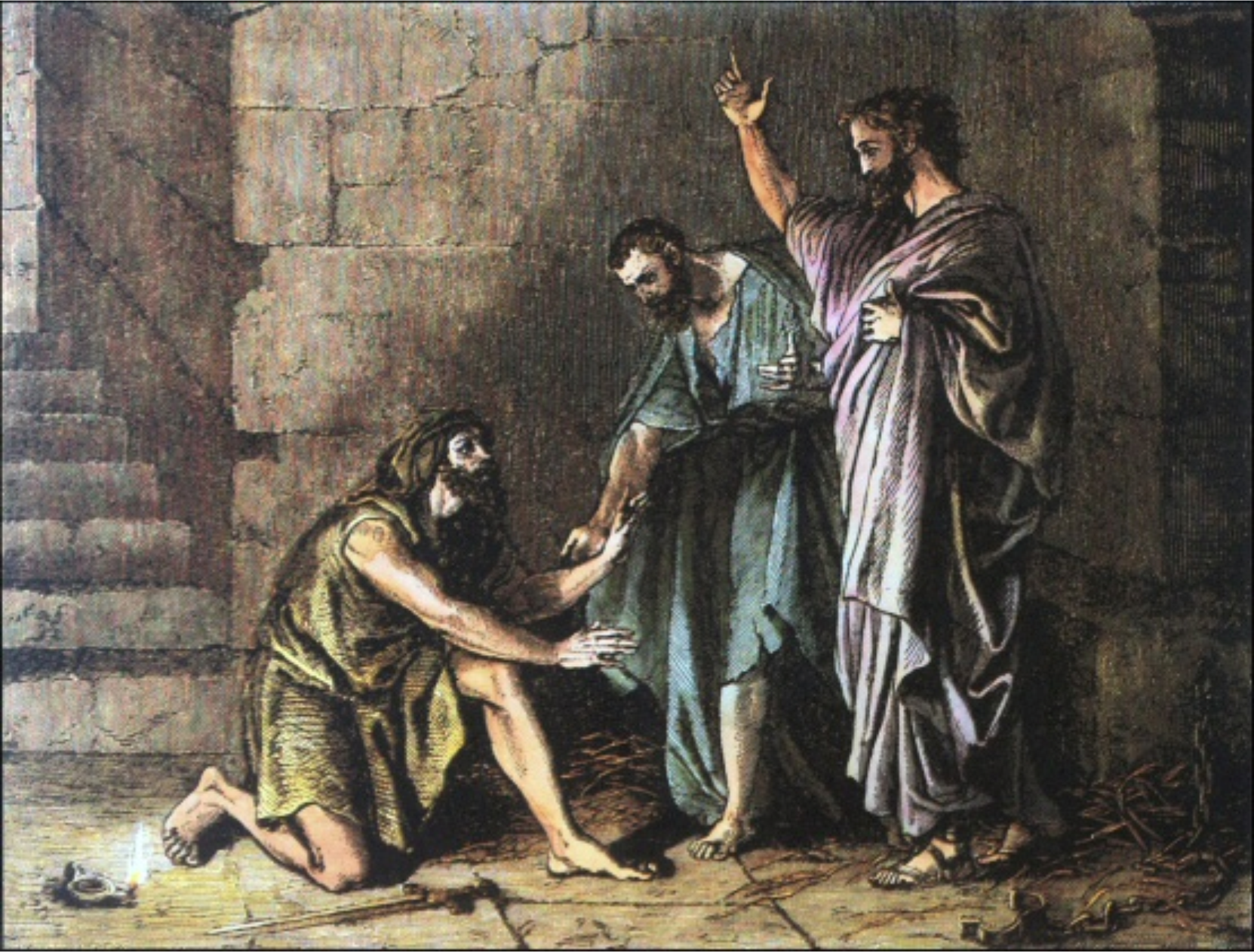










 The Recovering Legalist