From Tarvin, England, my great-great-great-grandfather eventually settled in Georgia. In the 1830s, with the help of a dozen men, he dug a “big hole” in search of gold.
Long before the California gold rush, gold was discovered in Cherokee country—specifically, middle Georgia. After arriving in the U.S., John Hockenhull made his way south and acquired the Battle Branch Mine. Hoping to strike it rich, he and his team dug a massive, fruitless hole.
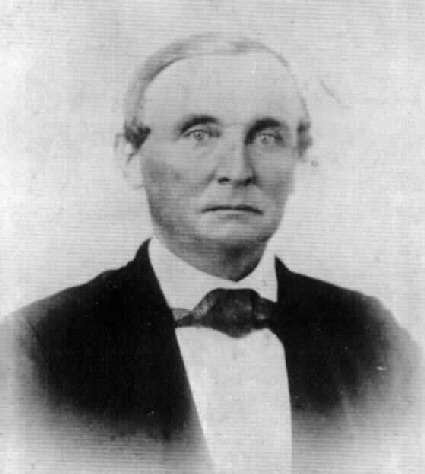
Maj. John Hockenhull, Sr.
Striking Gold Against All Odds
Nearly broke, Hockenhull released his men, promising to pay their back wages someday. All but one, John Pasco, left.
Then, like something out of a movie, Hockenhull and Pasco struck gold. On that first day, they found nuggets the size of peas and acorns. The Battle Branch Mine became the richest in the state. In a moment, my grandfather went from nearly bankrupt to wealthy.
From Gold to Bricks—Built by Slaves
With his fortune, Hockenhull entered the brick-making business. As was common at the time, he used enslaved labor—up to two dozen individuals by some estimates.
He used his bricks to build the first brick home in Dawson County, Georgia. More significantly, the bricks made by his slaves were used to construct the Dawson County courthouse in 1858. That courthouse still stands today.
Dawson County Courthouse
Remembering the Past
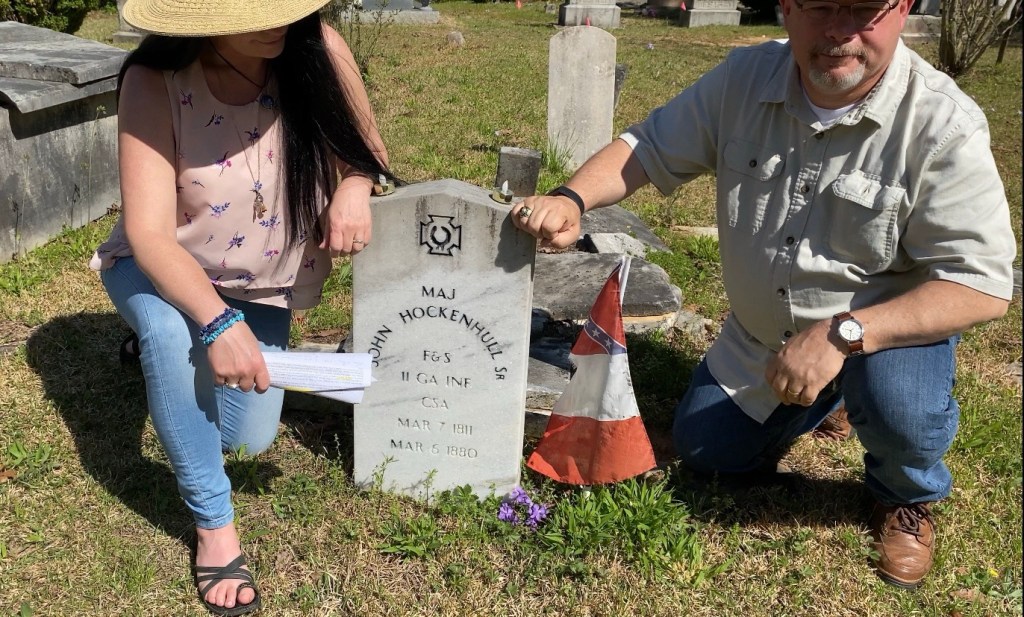
Years ago, my sister and I visited it—along with our grandfather’s grave. We couldn’t visit his home; the land is now owned by the Department of Defense.
When the Civil War broke out, Hockenhull joined the Confederacy, earning the rank of Major due to his status and business experience. He survived the war and died in 1880 at age 68.
Why Share This?
So why share this story? Am I ashamed? Trying to erase guilt? Not at all. I haven’t benefited from my ancestor’s sins, nor do I carry his guilt.
But slavery hasn’t disappeared. It just moved.
Modern Slavery in Pakistan
Today, in the brick kilns of Pakistan, entire families—men, women, and children—are trapped in generational debt slavery, making bricks in inhumane conditions.
Here’s the painful irony: in 1858, my grandfather sold bricks for $8 per 1,000. That’s around $300–$500 today. In 2025, in Pakistan, 1,000 bricks sell for just $6.
Six. Dollars.
Some try to justify American slavery by claiming slaves were “treated well.” That’s a lie. Yet, having seen it firsthand, I can say that modern-day brick kiln workers often endure even worse conditions.
Min. quota is 1,000 bricks per day
What We Can Do Now
That’s where we come in.
Through the incredible work of Grace Charity School in Toba Tek Singh, and Redeeming Love Missions—our nonprofit ministry at [Redeem.Love](https://redeem.love)—we’re rescuing entire families from modern-day slavery and giving their children a chance at education and dignity.
Instead of arguing over reparations, why not make a real difference for real slaves—right now?
Go to [Redeem.Love](https://redeem.love) and give whatever you can. We can’t change the past—but we can help change the future.
I really enjoy creating content for YouTube. However, it may only be something I enjoy, not what is needed or wanted. It may even be doing more harm than good if God’s hand is not in it.
Therefore, I’m going to draw the line at 100 videos. After that I will only do the video shorts. 100 episodes should be a fair gauge of the impact these videos are making, wouldn’t you think?
If after 100 videos this channel has only 50 subscribers and an average of less than 10 views per episode, it’s probably not having an impact and my time should be directed elsewhere. It may be that I should stick with writing (which doesn’t require locations, lighting, microphones, audio, and hours of editing).
Maybe I should just do the job I have and leave this kind of “work” to those much more gifted and capable. There’s already many other Christian channels providing high-quality content, and their numbers are a tangible reflection of that.
I just don’t want to be like that 5-member church unwilling to say enough’s enough because the pastor is unwilling to step down.
Yes, this is meant for my fellow ministers of the Gospel. However, feel free to make use of this advice wherever it is applicable.
You may have not given the subject a lot of thought, but if you are new to public speaking or preaching, you may have experienced the struggle to find good illustrations. But don’t worry, that’s OK! Even veteran public speakers usually have at least one or two books of illustrations in their library.
However, it is very important to distinguish between a story, a joke, and a true illustration. They are not all the same. Depending on the context, using one at the wrong time or the in wrong place in your sermon may do more harm than good, if not outright damage.
Comedians like to say, “timing is everything.“ But when it comes to sermon illustrations, timing is not as important as making the truth understandable. The difference a story or a joke and an illustration is that the story informs; the joke elicits a response (a laugh); while the illustration helps to clarify or illuminate.
So be careful. Icebreakers meant to warm up a crowd or not illustrations. In most cases, jokes are not illustrations. A story, unless it helps the listener to better understand or apply the truth that you are trying to communicate, is not an illustration, but a time waster.
Keep in mind that time is irreplaceable. It may be necessary to break the opening tension with a joke or a story that relates to your audience, but understand that you only have so much time to communicate a life-changing truth. The reason rabbit trails should be avoided is because even though what you say might be important or even entertaining, it may not serve to communicate the main point of your sermon. In all likelihood, it will only distract.
You don’t have time for that.
Bovinating: verb: derived from bovine (cow); meant to express in a more elegant way the slang term BS (“You’re just bs-ing me.”). Not to be confused with Bloviate.
Another pastor was asked to resign. Why? Because of moral failure? No. Because of unethical practices? No. Because of poorly performing his duties? No.
He changed some things. He wanted to do some things that the deacons didn’t. Oh, it didn’t matter what the congregation thought or what impact the pastor’s ministry was making on the community; he went afoul of the deacon body and was asked to resign.
Men … and I’m talking to all you deacons out there… you seriously need to go back to the locker room, sit down on the benches, and let your Coach – GOD – explain to you how the game is supposed to be played. He wrote the Rules, rules which are never to be overruled by your bylaws.
First, there is no place in all of Scripture where you will find justification for deacons running a church. The fact that so many do is a sad testament to how poorly the Word of God has been taught in so many of our congregations. If you really want to get specific, there are no biblical examples of committees making unilateral decisions, either. The ONLY biblical example is that of pastoral leadership with deacon support WHEN NEEDED. See the 6th chapter of the Book of Acts.
Second, should a congregation follow the biblical guidelines and select men to be deacons, they should only do so because the administration of resources meant to minister to the needy within the congregation has become too burdensome for the pastoral leadership and is thereby distracting from the study of the Word and prayer. There is NO biblical precedent for the pastoral leadership of a congregation to be in any way handicapped by the decisions of those elected to serve the congregation and assist the pastoral leadership. There is NO biblical precedent for committees within the congregation to have veto power over pastoral leadership, either.
Third, there is very little evidence in Scripture to support unlimited tenure for those who serve in the role of deacon. On the contrary, biblical precedent leans more heavily toward deacons serving only when there is a need, and only when the pastoral leadership deems it necessary (again, see Acts 6). There is even reason to argue that new deacons should be selected by the congregation and approved by the pastoral leadership every time there is a change in pastoral leadership (compare Acts 6 with 1 Timothy 3).
Fourth, there is no biblical precedent for deacons to be self-governed, mutually accountable, or convenable as a body. Doing so adopts a secular business model that may promote efficiency and manageable productivity, but it in nowise mirrors the pattern of congregational and pastoral oversight as found in Acts 6.
Fifth, the spiritual requirements of deacons (AND their wives) should be taken as seriously as that of a pastor.
Therefore, based on the above points, there is no more biblical support for a group of deacons – servants – to request the resignation of pastor any more than they would request the revocation of a fellow congregant’s membership within the local assembly of believers. It is not the role of the servant to negate the role of the one/ones served.
To conclude, in local congregations where the ecclesiastical structure is autonomous and limited (i.e., Baptist, etc.), thereby affording the body the right to elect the pastoral leadership deemed sent by God and affirmed by the Holy Spirit, beware how you treat the man of God. Although he be only a man, by your common vote you have affirmed before God and heavenly witnesses that he is to be your shepherd, subject to the Great Shepherd, and that you will submit to his leadership where it is biblical, and Spirit led. To conspire, undermine, and circumvent his leadership is to invite discipline from the one who sent the “gift” (Ephesians 4:11-12) to you.
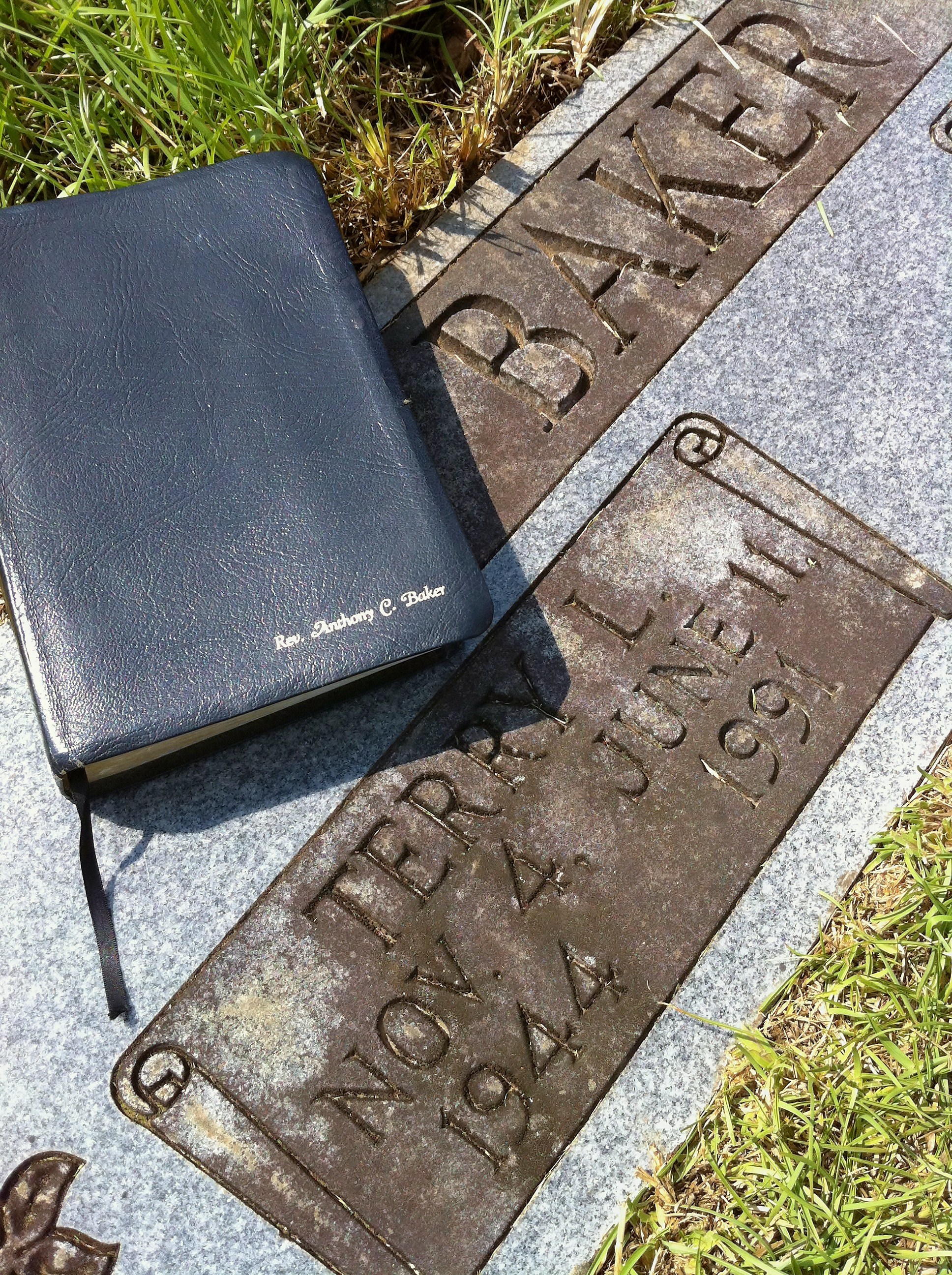
Today, June 11, is the anniversary of the death of a mighty man of God: a preacher, a pastor, my father. He died the week before Father’s day.
Several years ago I went to his grave and placed my Bible on his tombstone. There, glistening in the sun, were the gilded words “Rev. Anthony C. Baker.” It was a symbolic answer to a question I had received more than a few times. 
You Still Preaching?
I don’t hear it too much anymore, but I used to hear it rather frequently. Family members, old friends, former acquaintances, and the average person I never wanted to see again would come up to me and ask, “Hey, you still preaching?”
Maybe it’s the thing to do. Maybe it is customary to ask a person if they are still doing what they were doing the last time you saw them. I guess it makes sense.
But it’s when they ask if I’m still preaching that hurts on several different levels. Is it something I’d actually stop doing?
Some Statistics
In reality, it’s not that unreasonable to ask someone who once accepted the call to ministry if he is still preaching. Even though it sorta feels like an insult, I shouldn’t be surprised by other people’s shock. I mean, it has been 40 years since I made my calling public. I’ve known more than one who has walked away the first year.
If more people knew the statistics, few would ever enter the ministry. Stop and think about it, would you enter a career with the highest rate of heart attacks? Would you take out student loans for a degree that demands you work multiple jobs? Consider these sad facts…
70% felt God called them to pastoral ministry before their ministry began, but after three years of ministry, only fifty percent still felt called.
80% of pastors’ spouses wish their spouse would choose another profession.
70% of pastors constantly fight depression.
80% of adult children of pastors surveyed have had to seek professional help for depression.
70% of pastors do not have a close friend, confidant, or mentor.
80% of seminary and Bible school graduates who enter the ministry will leave the ministry within the first five years.
Still Preaching
Yet, even though I am longer in the pastorate, I’m still preaching. It may surprise people who haven’t seen me in a while, but I’m still doing the Lord’s work and still following the call I first heard when I was 16. It may sound strange, but I can’t help it.
“But if I say I’ll never mention the LORD or speak in his name, his word burns in my heart like a fire. It’s like a fire in my bones! I am worn out trying to hold it in! I can’t do it!” – Jeremiah 20:9 NLT
“For though I preach the gospel, I have nothing to glory of: for necessity is laid upon me; yea, woe is unto me, if I preach not the gospel!” – 1 Corinthians 9:16 KJV
That old Bible has a lot more wear on it since I took that picture years ago. But that’s OK, I’ve got a few cracks in my leather, too.
But Dad, two things remain true, despite all these years: that grave won’t always hold you, and I’ll keep preaching until we meet again. 
When in ministry, full-time or not, there are moments when we must move from one field to another. Sometimes it’s planned and orderly, while other times we find ourselves making that move unexpectedly, or at least sooner than we planned. However, the one encouraging truth for those who love God and are called according to His purpose is that “all things work together for good.”
It’s a Romans 8:28 day every day!
Regardless, moving from one place to another is never easy, especially when you’ve grown to love the people and the place where you’ve been serving. That’s the current situation facing my wife and me.
The Ups and Downs
For the last three years (three years and six weeks, to be exact), we have been living and ministering in Warthen, GA at Bethlehem Baptist Church. The last three years have been anything but normal, but I do believe that’s been part of what has endeared us to the area. It was so nice to experience a genuinely small-town atmosphere, especially during COVID.
But don’t misunderstand me, there are downsides to living and ministering in a small community. For one, having to drive an hour and a half to go to the hospital or to a doctor for anything other than a sniffle got a little old. My wife and I would schedule our appointments and shopping on the same day so that we wouldn’t have to make multiple trips . . . three hours on the road for one appointment was insanity.
Another downside is the simple fact that everyone in a small community either knows everyone else or they’re related in some way. This makes talking with someone in secret nearly impossible. And for the love of all that’s civil, NEVER say anything bad about somebody unless you want everyone to know.
But everyone knowing everyone is also a sweet and wholesome thing, too! Sure, the slightest misspoken word can bring all hades down on one’s head, but everyone being in everyone else’s business can also prove beneficial when times are hard. The willingness to help each other out of a jam is not something you find as often in larger communities.
A Special Breed
However, when it comes to pastoring a small church in a small community, it takes a special breed of person to succeed. Evidently, I’m not that kind of person.
Small churches in small, rural communities more often desire a pastor who:
assumes the role of fun uncle, wise grandfather, or ever-present brother-in-law who stops by unannounced to see what’s for dinner
is always soft-spoken and deliberate with his words, never blunt
charms the non-attending church members into returning
says the most comforting things at all funerals (yes, even for the heathen)
has a working understanding of all outdoor activities, including, but not limited to, hunting, fishing, trucks, factory work, grilling, the military life, chainsaws, and deep-frying turkeys
and rarely preaches Greek and Hebrew-free sermons that are longer than 25 minutes.
So, does that mean that I’m not called to the pastorate if I’m not like the gentle shepherd above? Heavens, no!
Granted, if I’m to be honest, being told more than once that I’m not the “best pastor” led to some depressing days. Honestly, it stung. I even found myself doing some self-re-evaluations.
The conclusion was that yes, I’m called; I’m just different.
My Calling
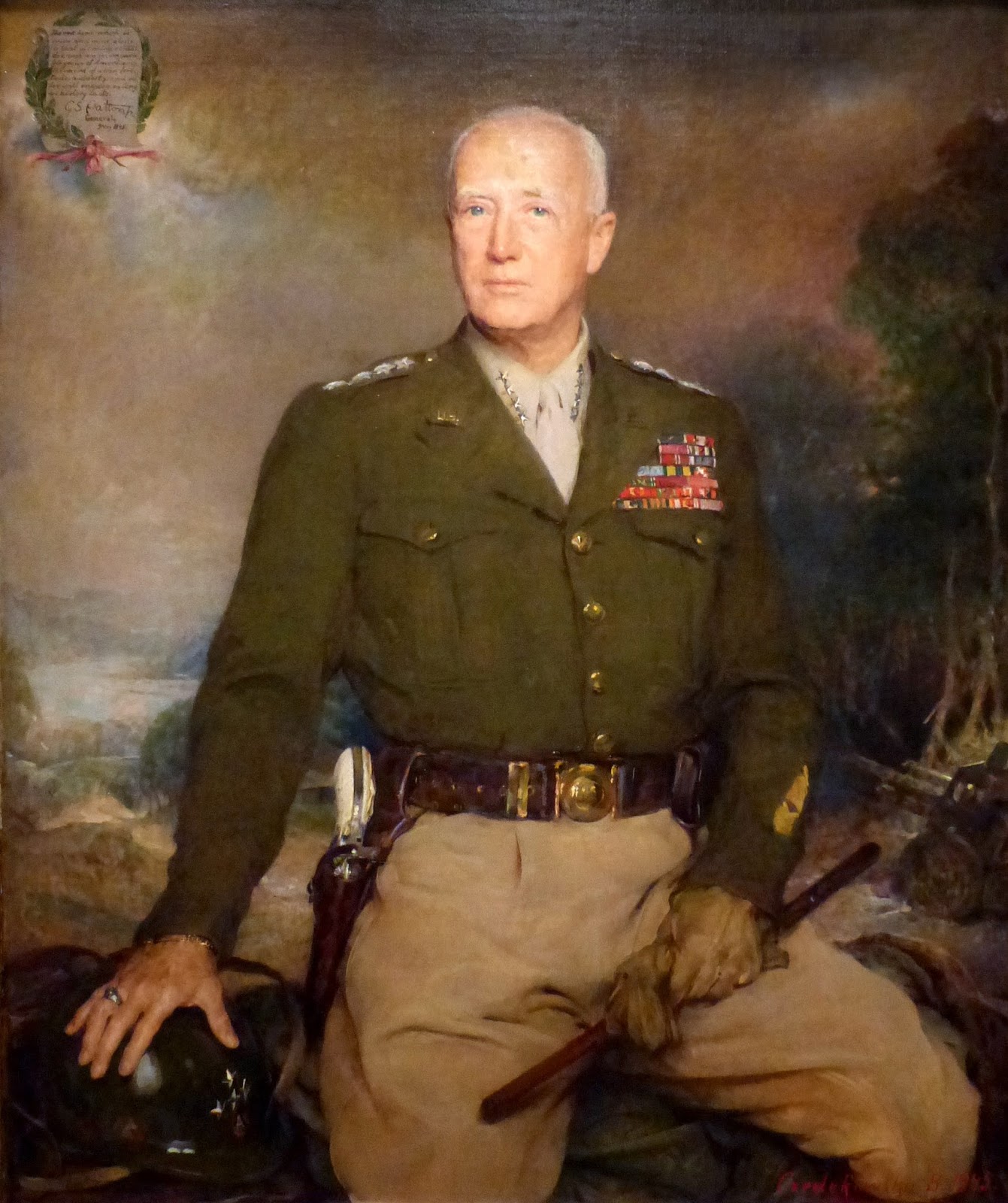
Official George S. Patton portrait
I sometimes think of the World War 2 generals like Eisenhower and Patton. If you know your history, General Dwight D. Eisenhower and General George S. Patton were both super patriotic military geniuses, but their personalities couldn’t have been more different. One was a calm, calculated, diplomatic leader whose gifts and abilities led him to be selected as the Allied Supreme Commander during WWII. The other was a complicated, often eccentric, warrior who loathed cowardice and felt destined for glory on the field of battle.
I might be more of a Patton than an Eisenhower, just without the cursing and all the reincarnation beliefs. However, if there was any general with which I would aspire to be compared to, it would be General Robert E. Lee, a man of utmost loyalty and conviction who led an army of men willing to follow him into the mouth of hell itself. He was both a warrior AND a gentleman.
But I’m not called to be a general.
My calling is to preach and teach the Word of God without apology or intimidation. More than an itinerate evangelist, my calling extends to laying doctrinal foundations on which can be built the solid and grounded faiths which can withstand the strongest storms of life. So, this kind of teaching and preaching requires time with a congregation and cannot be achieved through one or two series of sermons.
I’m a Stirrer
What’s more, when I first arrived at Bethlehem Baptist, it wasn’t long before one of our deacons gave me the nickname of “Spoon”. . . because I had the tendency to “stir things up.” It wasn’t that I tried to cause problems or move too quickly; it was just my personality. As much as I believe in tradition, “the way things have always been” can be the enemy of souls and the waster of precious, irreplicable time.
When things are left to sit and settle for too long, the ingredients separate and lose their combined effectiveness. Sometimes stirring or shaking things up involves nothing more than reawakening the inherent abilities already present. Remember what Paul told Timothy?
Wherefore I put thee in remembrance that thou stir up the gift of God, which is in thee by the putting on of my hands.
2 Timothy 1:6
And let’s not forget the words of Peter.
Yea, I think it meet, as long as I am in this tabernacle, to stir you up by putting you in remembrance . . . This second epistle, beloved, I now write unto you; in both which I stir up your pure minds by way of remembrance . . .
2 Peter 1:13; 3:1
Please don’t misunderstand me, I think it is important for every God-called pastor to show love and compassion to his flock by being there for them through the ups and downs, the joys and sorrows of life. However, there is a reason that in Acts chapter 6 the infant Church in Jerusalem was instructed to select the first official deacons. I like the way it reads in the following translation.
So the Twelve called a meeting of all the believers. They said, “We apostles should spend our time teaching the word of God, not running a food program. And so, brothers, select seven men who are well respected and are full of the Spirit and wisdom. We will give them this responsibility. Then we apostles can spend our time in prayer and teaching the word.”
Acts 6:2-4 NLT
Note, the apostles had no problem “running a food program” in the beginning. It only became a problem when it began to take away from their primary responsibilities: prayer and teaching the Word.
How We’ll All Be Happy
Don’t expect me to show up to your home unannounced.
Don’t expect me to visit you in the hospital if I don’t know you’re there.
Don’t expect me to stalk you and show up uninvited to all your activities. Invite me and I will come!
I mean, seriously, do you REALLY want me showing up when you least expect it?
That’s a job for a deacon 😉
Therefore, give me a place where I can pray, study, teach and preach the inerrant, all-sufficient Word of God, or as the apostle Paul would say, “the whole gospel,” and I will have found my happy place.
I am sure I’m not the only one who finds it a little odd that we celebrate a day by not doing what the day honors. Yet, on the very day we are supposed to give honor to labor, or work, we take a day off!
Oh, but you say, “It’s not about the celebration of work; it’s about celebrating the worker.” Yeah, well if that’s true, then why not call it Laborer Day?
Labor Day is a holiday that was founded by the unions, which in turn were founded by those with “collective” and “progressive” ideologies. From a purely ideological perspective, the whole holiday is one in which the worker is supposed to feel free to snub his nose in the face of evil, greedy, imperialistic corporations and fat rich people and say, “This is my day! No profit for you!”
Essentially, our Labor Day was designed to be a watered-down version of International Workers Day (the Communist May Day holiday). Therefore, even though it is a noble thing to stand up for workers’ rights, there is room to evaluate the intent of some who would move our nation down the path toward socialism (hello AOC and Bernie).
However, my purpose here is not to bash Labor Day; it’s to encourage a holy perspective!
A Holy Day
What if we Christians did things differently? What if, like with Christmas and Easter, we take a pagan holiday and turn it into a Christian holy day?
Celebrating the birth of Christ is a good thing, so we read Scripture about it, sing carols, and dress up like barn animals in church plays. Easter is the highest holy day because it’s the day we celebrate the resurrection of Jesus Christ from the grave – without which our faith would be in vain.
Why not celebrate work, labor, our jobs, with a day that focuses on the spiritual and biblical truths relating to it? Why not celebrate and proclaim the holy aspects of labor?
A Holy Thing
It may be hard to get your mind around it, but work is a good thing. As a matter of fact, even in Heaven, there will be work to do (Revelation 22:3). The reason is that God is the one who created work (Genesis 2:15), and it was meant for our good.
Some people call what they do in the workplace secular. They tend to separate what they do at their job from what they might do at church or on the mission field. However, all work is holy if we are children of God, and all of our labor should be for His glory (Ephesians 6:5-9).
“The maid who sweeps the kitchen floor is doing the will of God just as much as the monk who prays – not because she may sing a Christian hymn while she sweeps, but because God loves clean floors. The Christian shoemaker does his Christian duty not by putting little crosses on the shoes, but by making good shoes, because God is interested in good craftsmanship.”
Martin Luther
Working Together
It may sound a little odd, but God is still at work, today. Yes, He rested on the seventh day after Creation, but He’s been at work in the hearts of men and women ever since. And what’s awesome is that for some reason He has chosen us to have a part in His work – not in the saving part, but in the gathering.
Then he said to his disciples, “The harvest is abundant, but the workers are few. “Therefore, pray to the Lord of the harvest to send out workers into his harvest.” – Matthew 9:37-38 CSB
No matter what kind of work you do, you work for the Lord. No matter where you labor, you are in the fields for the Lord. And, no matter what kind of product you produce or service you provide, if Jesus is with you, the ultimate aim is to collect the produce of heaven – the souls of men.
It may be on the kitchen floor, Or in a busy store, Or teaching, nursing, day be day Till limb and brain almost give way; Yet if, just there, by Jesus thou art found The place thou standest is Holy Ground.
– M. Colley (1939)
Labor is a HOLY thing, so let’s celebrate it with a HOLY day!
For many years I was under the impression that pastors were closer to God than the rest of us church goers. My father, already my hero, was a pastor, so thinking that way probably came naturally.
However, over the past few decades of ministry I’ve come to realize there is very little in the average pastor that’s different from anyone else. We have our times of frustration, moments of self-doubt, and occasionally mess up. We don’t have all the answers, nor do we know all the questions to ask. We are only human.
Yet, what is true for the pastor is true for everyone; we are called to be holy. In 1 Peter 1:16 we read, “…be ye holy, for I am holy.” This is impossible, of course, without Jesus Christ living within us. He not only makes us holy (set apart) by giving us His life, but His life lived through us makes us more and more like Him. The new life we have in Jesus, living and working through us, along with our obedience to the Word of God, not only sets us apart from the world; it makes us capable of reaching the world!
This week someone asked me, “How do you preach?” “Well, I don’t scream hell fire and damnation, if that’s what you mean,” I replied. “However, I call sin what it is when I need to,” I continued. “But the big difference is that I try to preach like I’m the one sitting in the pew.”
Look, if you think I look down from the pulpit with a holier-than-thou attitude, trust me, I don’t. As a matter of fact, it is only by the grace of God that I am where I am. He has called me and gifted me for a specific role, but that doesn’t make me a better person, only one whose house is made of glass (figuratively, of course). Just ask my wife and daughters.
No, because I’m a sinner saved by grace, the call to be “holy as I am holy” is as convicting to me when I preach it as when I’m in the pew on the receiving end. The difference between the congregation and myself, as with any pastor, is that I have been given the responsibility to share the message faithfully and boldly. God is holding me accountable.
This Sunday don’t think of your pastor as a man who’s “preaching” at you; think of him as a fellow servant of God trying to complete the task before him with faithfulness to the message, even if it preaches at him.
If you are already following my other blog, WallHoleCoverings.com, then you have probably already seen a post about this painting.
If you have not seen the other post, then please KEEP READING.
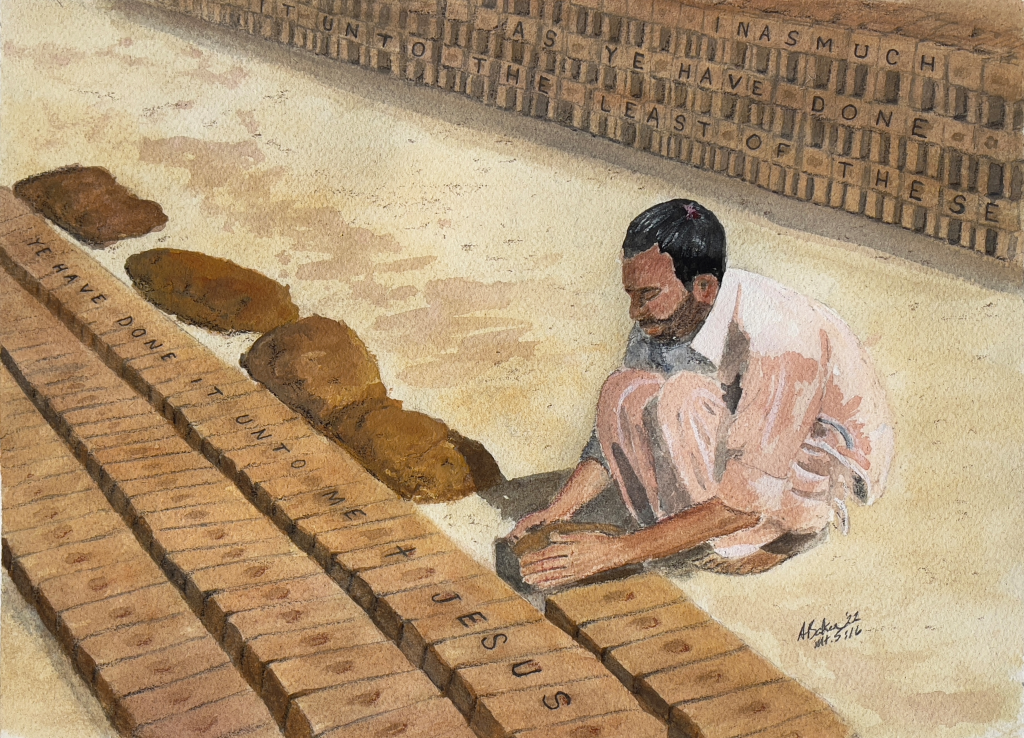
Last night I finished a piece I have entitled “The Least of These.” I based it on a photo I took of a Christian worker in a Muslim-owned brick kiln in Pakistan.
My hope is to raise funds to help buy people like this brother and his family out of debt and out of this literal slavery.
So many people in Pakistan live in poverty. Of the Christians that live there, the majority of them live in abject poverty. This is not simply a matter of choice, but opportunity. With a near 98% Muslim population in a Muslim country, the Christians are not afforded the same opportunities and are often forced to do the hardest work.
Those who work at the kilns are required to have their whole families live there in horrible conditions. They live there until the debt they owe is paid off. That, of course, is the catch. Most often, even though the goal might have been to pay off a small loan for food or medical expenses (usually no more than $200), families wind up working for generations paying off accumulated fees and additional loans attached to the little salary they receive.
Working with Grace Charity Schools in Toba Tek Singh, Punjab, I will be using funds raised from the sale of this and other paintings and prints to rescue these families from indentured slavery and help them start over.
For every gift from $20-$50, I will send you a simple semi-matte print in your choice of size (5″x7″ and up), shipping included.
For every gift OVER $50, I will send you an 8.5″x11″ Sommerset Giclee reproduction print.
For any gift of $75 or more, I will send you a signed and artist-enhanced Sommerset Giclee reproduction (I will enhance the print with actual paint).
Please click on the following link to visit Wall Hole Coverings if you would like to donate. You will see a PayPal link at the bottom of the post.












 The Recovering Legalist