Author Archives: Anthony Baker

Anthony Baker's avatar

About Anthony Baker

Husband, dad, pastor, artist, and musician. Time Magazine's Person of the Year in 2006 (no joke!). Loves coffee (big time), good movies, and sarcastic humor. Holds a Doctorate in Ministry. Most importantly, a servant of the Lord Jesus Christ. All glory belongs to Him! Matthew 5:16

They Decry What Preserves


“Without morals a republic cannot subsist any length of time; they therefore who are decrying the Christian religion, whose morality is so sublime & pure, [and] which denounces against the wicked eternal misery, and [which] insured to the good eternal happiness, are undermining the solid foundation of morals, the best security for the duration of free governments.”

 – Charles Carroll of Carrollton (Signer of the Declaration of Independence)

(Source: Bernard C. Steiner, The Life and
Correspondence of James McHenry
 (Cleveland: The Burrows Brothers, 1907),
p. 475. In a letter from Charles Carroll to James McHenry of November 4, 1800.)

Leave a comment

Filed under America

Chivalry

Like every summer, more articles have been published by young women who think modesty is overrated, if not harmful, and that men should just get a grip. Seriously, it’s like “Let me go naked in public, but don’t question my judgment, and by all means don’t lust, creep!” I’ve heard the arguments, but I just don’t get it.

Well, what you have here is a post by a different kind of girl, one who understands freedom and grace, but also self-worth and dignity – and yes, modesty. Therefore, it doesn’t surprise me that she considers the following picture her favorite out of hundreds taken over 26 days throughout Europe.

In a world that is going mad, this post is a quick breath of fresh air.

Katie Marie's avatarShutter Elf

DSC_0262 Civalry in Verona

This was my proudest moment in all of my tour of Europe. The young men here are Eric (left) and Jeremey (right). We were at the home of Juliet in Verona, Italy, and this is the statue people visit there. The tradition is that you are to place your hand on her breast for good luck and fortune, but these guys were the two in the whole place that wanted to show her – a statue – what respect and love is.

View original post

3 Comments

Filed under Uncategorized

Scriptural Unity Isn’t Based On Doctrine?

While going through the list of blog posts I never published, I came across this timely piece from all the way back in March of 2012. So, with some minor modifications, I will now bring it to life after five long years in the the “Draft” folder 🙂


Did he really say that? 

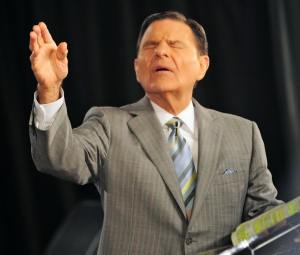
In today’s edition of his online devotional (3/23/2012), Kenneth Copeland said the following:

“What they don’t realize is this: scriptural unity isn’t based on doctrine…Winds of doctrine, according to Ephesians 4:14, are childish. Winds of doctrine don’t unify. They divide and blow people in every direction. The Word doesn’t say anything about us coming into the unity of our doctrines. It says we’ll come into the unity of the faith.” – Kenneth Copeland

In a Facebook post, a friend of mine referenced the above devotional. The part that encouraged him was the suggestion that Christians should unify around our faith and not be separated by insignificant differences. However, doctrine is NOT insignificant! Rather, it’s absolutely crucial to true unity.

Sadly, Copeland portrayed “doctrine” as what divides the Church. Referencing Ephesians 4:14, he equated doctrinal differences with childish man-made doctrines. He took the verse out of context to say (paraphrasing), “Hey, don’t worry about doctrine, our unity is not based on doctrine; only worry about the unity of the faith.” For some reason, however, the Apostle Paul seems to disagree with Copland…

Romans 16:17 – Now I beseech you, brethren, mark them which cause divisions and offences contrary to the doctrine which ye have learned; and avoid them.

1 Timothy 4:6, 13, and 16 – If thou put the brethren in remembrance of these things, thou shalt be a good minister of Jesus Christ, nourished up in the words of faith and of good doctrine, whereunto thou hast attained. (13) Till I come, give attendance to reading, to exhortation, to doctrine. (16) Take heed unto thyself, and unto the doctrine; continue in them: for in doing this thou shalt both save thyself, and them that hear thee.

If doctrine is not important, does that mean that we can unify with anyone? What if their doctrine says that we are all gods; that we can command God to answer our prayers; or that our very own words can literally create what we will, just as long as we have faith in our own words? …um, in case you didn’t know, that’s what Kenneth Copeland teaches.

Believe me, I’m all for genuine, biblical unity that crosses denominational boundaries and man-made, legalistic standards. Non-essentials have for too long kept the family of God separated and at odds with each other. But what about the essential doctrines of the faith?

Do we throw all doctrine out the window for the sake of unity?

No! Absolutely not.

Besides, even if I did become unified with the teachings of Kenneth Copeland, I doubt he’d let me ride in his jet.

Click here to view previous post on The Doctrine of Separation.

1 Comment

Filed under cults, Theology

Been There, Done That…Now Listen

As many of you know, I now do a radio program that is a knock-off version of ProverialThought.com, my other blog.  What I do is share thoughts and reflections on a different proverb each week, and some of the content is based on what I’ve already written.

Well, in preparation for this Sunday’s broadcast, I was doing a little study this morning on Proverbs 4:11-12. There’s a lot in these two verses, and I’m looking forward to unpacking them.

The following is what I wrote back in 2012 for ProverbialThought.com (which is also included in the book).


Proverbs 4:11-12

“I have taught thee in the way of wisdom; I have led thee in right paths. When thou goest, thy steps shall not be straitened; and when thou runnest, thou shalt not stumble.”

A Way Walked

The first part of this passage is fairly simple to understand. In a moment of recollection, Solomon is reminding his children that he has given them good instruction; that he has led them.The best teachers are those who can say, “I have been down that road.” Sure, it is easy to give directions, but how much more valuable is the instruction when the teacher can relay first-hand experience?

As a bus driver, I drive the same route every day. I could draw a map that would be as accurate as one printed. But the difference between my map and an image from a satellite would be my knowledge of hazards unique to the vehicle. Unlike automobiles, 40 foot buses aren’t able to straighten some curves, or go under some bridges. Maps don’t usually show those things; but experience will.

Solomon is telling his children, as God is telling us, that the way ahead will be much easier if we listen to those who have gone before.

A Parental Challange

One interesting thing to note is where Solomon says “I have taught thee…” A deeper look at the word taught will show that it also means “to throw, to shoot.” Let this be a reminder – children are ours for a purpose.

In Psalm 127:5 David refers to children as “arrows” in a quiver. Arrows are worthless unless they are used. Arrows are worthless unless they are sharp, straight, and designed for a specific target. Children are to be considered tools with a mission, and we are to train them and keep them until we launch them toward their goals.

Straight, or Not?

Another interesting thing to consider is the word “straightened.” At first glance, we might consider the word here to mean the same as implied in the phrases “straight and narrow,” or “straight as an arrow.” Why, then, does Solomon say “thy steps shall not be straightened?” Does he want them to encounter curves along the way?

Actually, the word here is yatsar (Strong’s H3334), which can mean “to bind, be distressed, be in distress, be cramped, be narrow.” In reality, Solomon is saying that if one follows wise instruction, the way ahead will be less stressful, less binding, less depressing.

Thinking about this, I am immediately reminded of a particular place on the path through Rock City (a tourist attraction near Chattanooga, TN). It is called “fat man’s squeeze.” Seriously, if you are over 250 pounds, you might not make it through this narrow passage between two huge walls of rock. Yet, if you follow the signs along the way, you will be led to a different way around this “squeeze.”

If we would just follow wise counsel, the chances are much better that we will reach our goals, instead of stumbling or getting stuck along the way.

Leave a comment

Filed under Bible Study

The Parsonage Project

What I’m Doing

I would really appreciate your prayers. Pray that God would give me wisdom and a steady mind. Pray that I will keep my eyes fixed on Jesus, the Author and Finisher of my faith, for stormy waves are trying to distract my focus. Pray for me, if for nothing else, that I will myself remain in constant prayer.

This week the house that we are living in will be listed on the market to be sold, and we are not as ready as we would like to be. On top of that, the house in which we are planning to move is the parsonage of the church where I now pastor – but it is FAR from being ready.

Right now I am having to work a job and pastor a church; record a weekly radio broadcast; record lectures at the seminary; move a lot of stuff into storage; see that a house is ready to be seen by buyers; and oversee the restoration of an old house – a restoration which costs more money than we have and will have to incorporate the expertise of many people. That doesn’t count being a parent and a husband. Can you see why I wanted people to send me guest posts?

That’s why prayer is so important. In James 4:2 we read that we have not because we ask not, so I’m asking – pray for us.

The Parsonage

It is a well-known fact among pastors and their families that parsonages are a mixed blessing. For one thing, when you live in a parsonage (a house owned by a church, but meant to house the pastor), you live in a house that is not your own. Secondly, living in a parsonage usually means that you are not building up any equity or means to move into a normal home. So, what happens is that when the pastor ends up leaving the church where he pastors, if nothing else is done, he and is family are effectively homeless.

But, there are times when a parsonage can be a blessing, like for us, because without it we would have no place to live at this point. Also, the parsonage, if used properly, can be a tool for evangelism and discipleship. The parsonage can also show that the pastor and his family are personally invested in the health of the congregation he shepherds. Therefore, if the church does have a parsonage, it should be well-maintained in order to make full use of its potential.

Unfortunately, the parsonage at the church where I now pastor has fallen into serious disrepair. I am working with different groups and individuals in order to restore the old house, but that will take time, manpower, and a lot of something we (the congregation) don’t have…money. One group of men estimated that it would take $10,000 to make the parsonage livable. On the other hand, I was told by someone else that the costs would be closer to $30,000. And right now this little upstart of a little church only runs around 15 in a decent Sunday!

The Video

Below is a video I made last Sunday. In it I take you through the parsonage and let you see for yourself what needs to be done. Look, Nehemiah rebuilt a wall which his enemies swore would fall down if only a fox pushed against it. Noah built a huge ark with the help of fewer men than volunteers I will have. What needs to be done will get done, but this ship won’t sail without a strong wind of prayer.

If all things were easy and well within our own power, we wouldn’t need God’s help. But, when things seem impossible, we call upon the Lord to do for us what we cannot do (Psalm 57:2), thereby allowing Him to get the glory and praise.

The more impossible the project – even a parsonage project – the more praise, glory, and honor is due our Savior and King.

7 Comments

Filed under Christian Living, Christian Unity, Church, Prayer, Preaching, Relationships and Family

Dusty Keys

Katie Marie's avatarShutter Elf

DSC_0010 (2)

Never lose the passion.

View original post

Leave a comment

Filed under Uncategorized

Stepping Stones

Another post from my daughter, Katie Marie. Have you ever thought about steps?

Katie Marie's avatarShutter Elf

DSC_0297.JPG Colosseum in Verona

The day that I went to Verona, Italy I was able to see the colosseum where opera productions are now held. As we were there, my small group walked around and climbed up to the top in several places. We ate lunch and fought the birds that were wanting a taste of the packed meal. But we never really discussed the historical impact of the structure. We mostly stayed quiet or pointed out how the rows of chairs at the bottom looked funny or how strange some people appeared to be.

Still, I thought about it. In the confinds of my mind I was thinking about how many people over hundreds of years – centuries – would climb these same steps and watch the slaughter that might have happened within its walls. I wondered how much torment took place and how many people cheered at the sight…

View original post 10 more words

1 Comment

Filed under Uncategorized

A Universal Gospel?

The following is an outline (nothing but an outline) that I prepared to preach one Sunday several years ago. I found it while searching through some documents on my computer and felt led to share it with you. Feel free to use it, if that’s what you do. Other than that, maybe you could use it as a study tool. 


“Examining the Universality of the Gospel”

I.   Introduction

Luke 2:9-10. Is the Gospel good news for all people?

The word “people” was “pointing specially to the people of Israel.”

II.  What does it mean to be universal?

The term universal is described by one dictionary as an “adjective relating to or done by all people or things in the world or in a particular group; applicable to all cases.”

III. What is the Gospel?

Dictionary Definition:

The gospel is the The Eng. word “gospel,” i.e. “good message,” is the equivalent of euangelion (Eng., “evangel”). In the NT it denotes the “good tidings” of the Kingdom of God and of salvation through Christ, to be received by faith, on the basis of His expiatory death, His burial, resurrection, and ascension, e.g., Act 15:7; 20:24; 1Pe 4:17.[3]

Paul’s Definition: In 1 Corinthians 15:1-4 Paul makes it very clear that the gospel is simple, not complicated, and consists of two central features:

  • Jesus the Messiah died on the cross and
  • He rose from the dead according to the Scriptures.[4]

IV. Objections and False Gospels  Some object to a Universal Gospel because race, culture, past experiences, etc.

  1. From those who have been hurt or don’t understand. “You say that you are sent to instruct us how to worship the Great Spirit agreeably to His mind; and, if we do not take hold of the religion which you white people teach we shall be unhappy hereafter. You say that you are right and we are lost. How do we know this to be true? We understand that your religion is written in a Book. If it was intended for us, as well as you, why has not the Great Spirit given to us, and not only to us, but why did He not give to our forefathers the knowledge of that Book, with the means of understanding it rightly. We only know what you tell us about it. How shall we know when to believe, being so often deceived by the white people?”[5] – Chief Red Jacket, 1805, in a speech to the Six Nations and an American missionary, Mr. Cram.
  2. The Jews. In the eleventh chapter of the book of Acts, for instance, we read how that Peter, when he went to Jerusalem, “contended” with the Jews over the issue of the gospel being presented to the Gentiles. In 1 Thessalonians 2:14-16 Paul mentioned those who forbade him to “speak to the Gentiles that they might be saved.”
  3. Prosperity Gospel. It is certainly not a gospel that expects “blessing and favor” as evidence of God’s grace.

V.   A Gospel that IS Universal

  • Not limited by race, gender, age, nationality, boundary of any kind, or economic status. It is truly “good news” to anyone and everyone as long as they first realize they have a need for it.
  • Meet the most basic needs of Humanity.
  1. Sin. All men have sinned and fallen short of the glory of God (Rom. 3:23). Because of Adam, sin entered the world, and death by sin; therefore death has passed as a consequence upon all men (Rom. 5:12). Jesus Christ died for the sins of all, and whosoever shall call upon the name of the Lord shall be saved (Acts 2:21; Romans 10:13).
  2. The gospel is universal because it addresses the world we all live in. It answers the questions of pain and suffering. It gives meaning to the struggles of life. The gospel is not a drug or panacea of some sort; it is a reality pill.
  3. Love and Compassion. Mother Teresa said, “Maybe they are starved for bread in Africa. You are starved for love in the United States.”[6] What greater message of love can one share than that of the gospel of Jesus? “Hereby perceive we the love of God, because he laid down his life for us: and we ought to lay down our lives for the brethren” (1 John 3:16).

 VI. Conclusion  The gospel that is truly universal in its scope and application.

  1. All men are born in sin – Romans 5:12
  2. There is none righteous – Romans 3:10
  3. All have sinned – Romans 3:23

But…

  1. Jesus is the only Way – John 14:6
  2. One day ever knee will bow and ever tongue will confess – Phil. 2:10-11

“And he said unto them, Go ye into all the world, and preach the gospel to every creature.” – Mark 16:15 KJV

A message of love to every “creature” (κτίσις , εως f creation, what is created, created order, creature [7]) – how much more “universal” can a gospel get?


[1] Marvin Richardson Vincent, Word Studies in the New Testament (New York: Charles Scribner’s Sons, 1887), Lk 2:10.

[2] Catherine Soanes and Angus Stevenson, Concise Oxford English Dictionary, 11th ed. (Oxford: Oxford University Press, 2004).

[3] W. E. Vine, “Gospel (Noun and Verb: to Preach)”, Vine’s Expository Dictionary of New Testament Words. Blue Letter Bible. 1940. 24 June, 1996 3 Dec 2012.

[4] Donny Mathis, “Gospel” In , in Holman Illustrated Bible Dictionary, ed. Chad Brand, Charles Draper, Archie England et al. (Nashville, TN: Holman Bible Publishers, 2003), 671.

[5] Bryan, William Jennings, ed. The World’s Famous Orations. New York: Funk and Wagnalls, 1906; New York: Bartleby.com, 2003. www.bartleby.com/268/. [Accessed Dec. 2, 2012].

[6] G. Curtis Jones, 1000 Illustrations for Preaching and Teaching (Nashville, TN: Broadman Press, 1986), 257.

[7] Barclay M. Newman, Jr., A Concise Greek-English Dictionary of the New Testament. (Stuttgart, Germany: Deutsche Bibelgesellschaft; United Bible Societies, 1993), 104.

Leave a comment

Filed under Church, Preaching

Freedom

Another beautiful post by my daughter, Katie.

Katie Marie's avatarShutter Elf

DSC_0341

At what price does your freedom cost, if you consider to have freedom at all?

I have heard all of my life that freedom comes with a price and salvation, which allows for “freedom” was “free.” How can this be? Freedom, no matter what kind, was always paid for and always will be. Whether you or another person pays for it, the debt is owed.

The price of salvation was blood sacrifice. Yes, that sounds extreme because it is. The blood sacrifice of a being which was perfect and innocent in every way was required to pay the amount in full for the purchase of our souls’ freedom, and that saccrifice was supposed to be dear. It was to seal the covenant of redemption permenantly until the day of atonemnet, and it was the only way that there would be certainty of a life after death. The one person that was…

View original post 193 more words

Leave a comment

Filed under Uncategorized

I’m Not a Superhero

Email Ads

I don’t know how it happens, but somehow my email gets flooded with “half-off” offers and all such craziness. Even though I delete cookies, unsubscribe to stuff, and threaten friends, people still send me links to things I can’t afford.

Now, honestly, not all of the ads are worthless. As a matter of fact, if I had the money, I’d take advantage of some of the Groupon offers. Come to think of it, I should have taken advantage of some of those coupons before my last anniversary! Dang it! Why didn’t I think of that?

Once, on Facebook, someone sent me a link to a company selling t-shirts. The one that caught their attention was one that read, “I’m a School Bus Driver. What’s your superpower?” I thought that was cool! Alas, I didn’t have $20 to spend on a t-shirt, even though I wanted it.

However, it was not long after the offer for the first t-shirt that I got another offer. This time I wasn’t so happy.

Super Pastor

Dear reader, dear friend, dear occasional stalker, etc., I am not a superhero!

photoFor those of you who may be having this read to you, to the right is a picture of the advertisement as it appeared on my cell phone. It shows a black t-shirt that has printed on the front: “I’m a PASTOR, what’s your SUPERPOWER?”

Unlike when I saw the one about being school bus driver, when I saw this t-shirt design, I didn’t laugh, smile, or even grin; it ticked me off.

Folks, I don’t even joke about this. Pastors are already placed on unwanted pedestals, live in glass houses, and are thought of as superhuman. We, along with our families, are expected to have special powers of some kind, almost like Baptist wizards, impervious to the spells of the dark lord.

But, we are not special, only our calling is. Pastors are not gifted with superpowers, and to suggest that only adds to the expectation that we can do everything perfectly, never getting tired, never mouthing off to our kids, and always having the right answer for everything.

Super Savior

The only thing I can say is that God called me to a humbling “profession.” I did not choose to do what I do; He put the desire in my heart. And unlike other careers, like bus driver, fire fighter, school teacher, etc., no amount of education, training, or experience can make us successful at what we pastors do; only the living presence of Jesus can do that.

I have no super power other than the power of Christ within me. As a matter of fact, the weaker I am – the more the “kryptonite” affects me – the more He is able to work through me (Phil. 4:13).

And my speech and my preaching was not with enticing words of man’s wisdom, but in demonstration of the Spirit and of power: That your faith should not stand in the wisdom of men, but in the power of God. – 1 Corinthians 2:4-5 KJV

I am only human. I have no superpower. All I have is a Super Savior.

8 Comments

Filed under ministry, Preaching