Tallahassee, Florida (Artist: Susan Cassidy Wilhoit)


Tallahassee, Florida (Artist: Susan Cassidy Wilhoit)

Filed under America, Apologetics, The Magnificent Fifty
We celebrate many holidays in this world, but one stands out among the rest…
Easter.
Now, I know that some of the more legalistic among us will label all the celebrations “moot” because of certain “pagan” links, like that to Ishtar and fertility rites. The unbelievers will laugh off this day with arrogant disdain (especially with it being April Fool’s Day).
But for the majority of Christians around the world, this day is a day to rejoice in the Son of God’s victory over the grave.
We are prone to celebrate many things, like who won a game, that new promotion, or a birthday. We throw parties when political candidates squeak out a win, or when that big contract gets signed. Some will even fire thousands of AK-47 rounds into the air while shouting “Allah Akbar!” at the top of their lungs. But nothing is more worth celebrating than Jesus keeping His word and rising from the dead to secure eternal life for those who trust in Him.
Today, as I stand before a congregation, I will attempt, in the power of the Spirit, to stir the imagination, to take us back in time, to recreate a fraction of the excitement that must have been felt when those who were convinced of defeat were shocked by the greatest come-from-below victory of all time.
Today, before all those present, whether in flesh or spirit, I will celebrate victory over sin, death, and hell. The Enemy has been defeated, his tools are obsolete, for Jesus died and rose again.
He Lives!
Click on the link to listen to my favorite Resurrection Day song, “Gone!” (sung by Teddy Huffam).
Also, here’s a group that’s new to me singing a medley of Easter-related songs (none of them about a bunny).
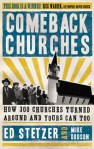
A very revealing study was done, leading to a book detailing how 300 churches went from declining or dying, to growing. In Comeback Churches, written by Ed Stetzer and Mike Dodson, there is a list of 30 different barriers to church growth. Having received permission from the publisher (B&H Publishing Group), I would like to discuss a few of them.
“Take heed, brethren, lest there be in any of you an evil heart of unbelief, in departing from the living God. But exhort one another daily, while it is called To day; lest any of you be hardened through the deceitfulness of sin.” – Hebrews 3:12-13 KJV
Have you ever thought it possible for a church to be given over to sin? I am not talking about the “liberal” church down the street (every town has one, I suppose), but your church – my church. Is there no growth taking place? Maybe it is because of sin. Maybe it’s because of a hardened heart.
Do churches sin?
You know they do. Many times, however, the sin is not viewed as such. It is seen differently from something that smacks of unbelief. It is rarely seen as a departure from God. More often than not, the sin that churches commit is hidden or disguised with terms or labels meant to justify “an evil heart of unbelief.” Here are a few phrases you may have heard. If so, it might be time for a hard-heart check.
Can churches have their hearts softened?
Absolutely! God is in the forgiving business, you know. All it would take is our churches turning away from the sins that so easily beset us, like legalism, traditionalism, racism, envy, and pride…not to mention the fear that God will not provide for us the ability and means to accomplish His work.
“Let us search and try our ways, and turn again to the LORD.” – Lamentations 3:40
“Seek ye the LORD while he may be found, call ye upon him while he is near: Let the wicked forsake his way, and the unrighteous man his thoughts: and let him return unto the LORD, and he will have mercy upon him; and to our God, for he will abundantly pardon.” – Isaiah 55:6-7
It is time for us to repent.

Dover, Delaware (Artist: Susan Cassidy Wilhoit)

To understand the purpose of these posts featuring state capital buildings, read the introduction to this series.
Filed under America, Apologetics, Culture Wars, Faith, God, politics, The Magnificent Fifty
The other day I heard a man,
A man of radio fame,
A man who wrote a book about God, Faith, and Reason.
It really doesn’t matter his name.
This man has degrees; he’s paid his dues.
I’m sure he could teach us some lessons.
But this worldly-wise man proved unwise indeed
When he posed the following question…
“What is good about Good Friday?”
It wasn’t a joke, please understand;
He genuinely wanted to know!
This educated doctor with millions of books sold
Was clueless on his radio show.
What is good about Good Friday?
The greatest crime committed by man…
A day which should be most infamous
Was the bait and switch that fooled the Devil
And set up the Day most glorious!
On that Friday God’s love was manifest
The greatest Love in history.
But this man with one question exposed his ignorance
When the Cross to him was a mystery.
-Anthony Baker
Filed under Easter, Jesus, Love of God, poetry

Hartford, Connecticut (Artist: Susan Cassidy Wilhoit)


Image credit: Wikipedia
If it wasn’t clear enough, here is what Wikipedia has to say about the history of Connecticut’s state motto:
History of motto
The current motto looks a little different than the 1639 version (c.f. Sustinet qui transtulit). It was first seen in the colonies in 1639 on a seal brought from England by Colonel George Fenwick. The meaning of the motto was explained on April 23, 1775 in a letter stamped in Wethersfield, Connecticut: “We fix on our Standards and Drums the Colony arms, with the motto, Qui Transtulit Sustinet, round it in letters of gold, which we construe thus: God, who transplanted us hither, will support us”.
However, this explanation for the origin of the motto is questionable. In 1889, State Librarian Charles J. Hoadly published an article, “The Public Seal of Connecticut” that indicated the 80th Psalm as a possible source. The article stated:
“The vines [on the State Seal] symbolize the Colony brought over and planted here in the wilderness. We read in the 80th Psalm: ‘Thou has brought a vine out of Egypt: Thou hast cast out the heathen, and planted it” – in Latin, ‘Vineam de Aegypto transtulisti, ejicisti gentes et plantasti eam’; and the motto expresses our belief that He who brought over the vine continues to take care of it – Qui transtulit sustinet“
To read the introduction to and purpose of this series of posts, CLICK HERE.
Regardless, I’m rather enjoying countering the nonsensical notion that faith (specifically a Judeo-Christian kind) had little to do with our nation’s founding. It’s obvious that if one wanted to eradicate God from the public square, he’d have to do a lot more than silence voices; he’d have to take a chisel or sledgehammer to the stone of our state capitals.
Filed under America, Apologetics, Christianity, Culture Wars, Faith, politics, The Magnificent Fifty
A very revealing study was done, leading to a book detailing how 300 churches went from declining or dying, to growing. In Comeback Churches, written by Ed Stetzer and Mike Dodson, there is a list of 30 different barriers to church growth. Having received permission from the publisher (B&H Publishing Group), I would like to discuss some of these barriers.
“For all seek their own, not the things which are Jesus Christ’s.” – Philippians 2:21
How sad is it to think that you can’t trust a man of God? Very! But, obviously, there are many men out there who care more about their own interests than for the church.
In the second chapter of Philippians, Paul was faced with this problem. According to the Apostle, Timothy was the only one he could trust with the care of this church, because all the others sought their own, “not the thing’s of Jesus Christ.” Imagine, there were others capable of doing the work, but only Timothy proved selfless.
What an indictment! What a troubling accusation to cast upon men of God! Shouldn’t the very fact that we are called and equipped for the task of shepherding sheep qualify us for the work? Not if the work is only a tool for self-gratification or gain.
Humility Needed
What kind of pastor was Paul looking for when he finally decided on Timothy? All one has to do is examine the previous verses and see that he was looking for a man with a heart and mind like that of the Savior. “Let this mind be in you, which was also in Christ Jesus: Who…made himself of no reputation, and took upon the form of a servant…humbled himself…unto death (2:5-8).”
Jesus was the highest example of a man who could have taken advantage of His position; yet, He was the one who washed others’ feet; wore the same clothes; never demanded special treatment; allowed Himself to be abused and mistreated; even went to a cross. How would modern pastors fare if asked to be more like Him?
The Man Paul Picked
Think about Timothy for a moment. When you do, what kind of mental picture comes to mind? Did he wear the nicest suit? Did he drive a new car? Did he publish a new book every week, or host 15 conferences listing his name on neon parchment?
Did Timothy get offended when not addressed by the correct title? Did Timothy have an “earned doctorate?” Would you have had to make an appointment to see him in his office? If you did, would you have felt intimidated by his presence and demeanor? I don’t get this picture when I think of Timothy, but I do about a lot of preachers.
Self-Examination
What kind of pastor am I? Am I a barrier to church growth? This is a question I have to ask myself, even though it may dig up some stuff of which I am ashamed.
You see, the church is more important than my ego. It is more important than what people think of me. The church was not put here for my benefit. I was sent to care for them. I was sent to feed and protect the sheep, not sell them off to make a profit. They don’t belong to me. They belong to Jesus Christ.
Do I look at every church as a stepping stone? Do I view people as objects, or worse, servants? Am I willing to sacrifice my pride, even my life, for the sake of those for whom Christ died? If not, then I don’t deserve this “good work” (1 Timothy 3:1). Unless I want to be like Christ, as modeled in the life of Paul and Timothy, then I desire the work for the wrong reasons, which would make me a “barrier to church growth.”
Dear friend in ministry, whatever your role, are you more concerned with self? Go back and read Philippians 2 and see how your intentions stack up. Like me, you may find some barriers that need to be torn down.
Filed under book review, Christian Maturity, God, ministry, Preaching, self-worth, worship

Denver, Colorado (Artist: Susan Cassidy Wilhoit)


Image credit: Wikipedia
To read the introduction to this post, CLICK HERE.
Filed under America, Apologetics, community, Culture Wars, Faith, God, politics, The Magnificent Fifty

Sacramento, California (Artist: Susan Cassidy Wilhoit)

Devin Walker v. First Orthodox Presbyterian Church, 760-028.9
To read the “introduction” to this series, CLICK HERE.
Filed under America, community, Culture Wars, politics, The Magnificent Fifty
A very revealing study was done, leading to a book detailing how 300 churches went from declining or dying, to growing. In Comeback Churches, written by Ed Stetzer and Mike Dodson, there is a list of 30 different barriers to church growth. Having received permission from the publisher (B&H Publishing Group), I would like to discuss a few of this barriers.
“Churches aren’t concerned about God’s glory, believing the church is just for them (Isa. 42:8; 48:11).”
I [am] the LORD: that [is] my name: and my glory will I not give to another, neither my praise to graven images. – Isa. 42:8
For mine own sake, [even] for mine own sake, will I do [it]: for how should [my name] be polluted? and I will not give my glory unto another. – Isa. 48:11
When we read the above verses it should be very clear to us that God is not interested in sharing His glory. Yet, too many times we rob God of the glory that is due Him by seeking it for ourselves. We do this in many ways, including the reason many of us go to church.
Lest we forget, “it’s not about us.” However, if you polled the majority of church-goers, I believe you’d find that the reasons for attending congregational worship are more selfish than we’d like to admit. To many believers, church is about what one can get, as opposed to what one can give.
The Tale of the Hymns
Have you ever stopped to listen to the words of those old-time hymns many of us grew up with? You may have sung them all your life, but stop and think about the following: “This world is not MY home, I’m only passing through. / My treasures are laid up somewhere beyond the blue…;” “I’ll Fly Away;” “I’ve got a mansion just over the hilltop;” “All I Need.” What is the common denominator of these lyrics and titles? “Me, me, me.”
If the Church Hymnal (© 1951,1979) was used as a tool to determine what we think of church, stop and think about this: there are 80 hymns with a title that starts with the words, I, I’m, I’d, I’ll, I’ve, or My. In contrast, less than 10 contain the word glory. Those that do include “Glory Hallelujah In My Soul” and “I’ll Live in Glory.”
I think it is pretty obvious that many of us come to church to get from God, not to give to God. He deserves our worship and our praise. He deserves all the glory because His is God, and not man (Hosea 11:9). We deserve nothing, yet His grace and mercy bestow upon us all the treasures we enjoy. Why do we come expecting anything?
Surely our churches would grow if God was glorified. Imagine a congregation of people who came together to lift up praise and adoration to Jesus for His glorious love. Imagine a group of folks who set aside all their own desires and petty differences in order to lift up holy hands unto the King of Glory. What did Jesus say? “If I be lifted up…I will draw all men unto me.”
So, what do you think? How could we do better in giving the glory to the One who truly deserves it?
Related Post: Un-“Christian” Ministry?
Filed under Christian Maturity, General Observations, God, Uncategorized, worship