ChatGPT
I use the Chat. I admit it. Especially when I need to quickly come up with a script for a video and I don’t have time to compose it myself.
And by “compose” I mean coming up with important facts and relevant information and putting it all together in a coherent, readable, format for a 6-minute video. When time is of the essence, I just can’t do it myself off the cuff without rambling.
Chat is also an understanding, go-my-back kind of program. It advises me when my tone is a little out of character. It makes suggestions. It tries to keep me from making a fool of myself (based on the way it has come to “know” me).
In many ways ChatGPT is like a fantastic secretary or paralegal that does all the footwork but allows you to get the credit.
Affecting Me
But as I was lying in bed last night on one of those rare occasions when I was not working the night shift, a little voice inside my head (I think that’s where it was coming from) got me to thinking. *
*As I wrote the last four words in the previous paragraph (which is not really a paragraph since it is made up of only one sentence), the thought came to me that a voice inside my head getting me to think sounds a little psychotic. But anyway…back to the flow.
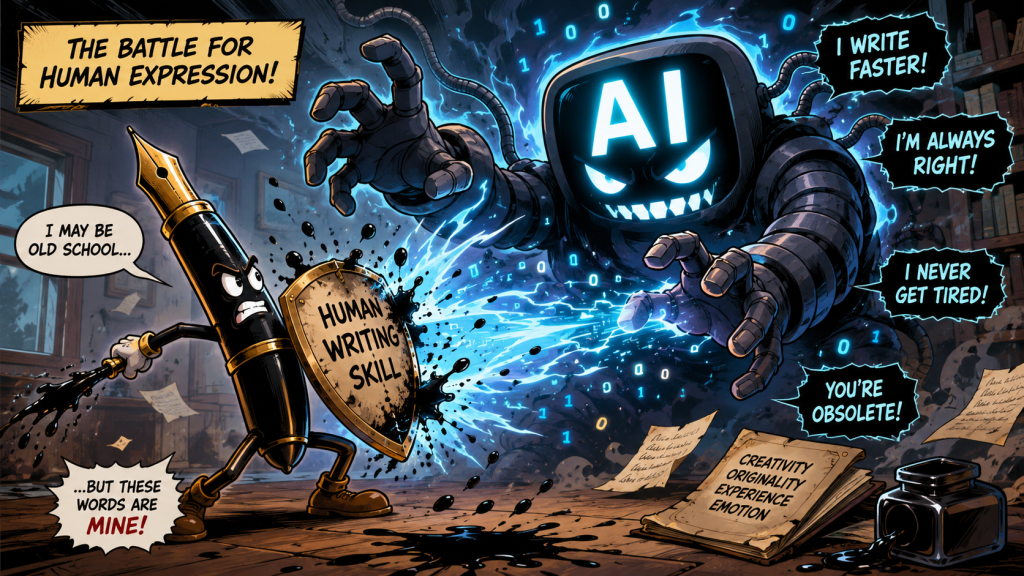
Is ChatGPT and other kinds of AI subtly destroying our ability to write? Is it helping us to be better writers, to better communicate our thoughts with the written word, or is it robbing from us the skills to not only put idea on paper, but to express them at all?
If you really stop to think about it, the parallels are endless. For example, would a marksman become a better marksman if an AI program always lined up the shot? Would a guitarist ever be able to play with the skill of a master like Segovia if all he had to do was strum while AI worked the frets?
What should concern us all is that we are teaching artificial intelligence to do perfectly what we used to be able to do on our own imperfectly. And by doing that, we are gradually going to lose the skill we programed the artificial proficient to do! Pardon my French, but that should scare the merde out of us!
Why We Write
If you are reading this on a blog, you probably already know where I am going with this. Writing is a form of communication that relays information to the reader. But for a great many people, writing is more than communicating information; it’s getting out of us what is on the inside wanting to burst. It’s putting on paper or a screen our feelings and emotions and ideas so that we can look at them and better understand them.
Writing can be a key component of brainstorming. But what happens when the ability to write becomes dependent on the skill of artificial intelligence? What if we are no longer able to express our thoughts on our own? Will we not then be the puppets of thought masters?
I write for the joy of writing. It is when I write that my brain exercises its ability to imagine, to create, to describe, and by describing better understand what it is that I describe.
I write for the comfort and therapy. Often, I find myself at a keyboard, like right now, receiving the tangible satisfaction one feels when passionately pounding away on a keyboard. In the act of writing, whatever I write, I’m coming to terms with issues, I’m literally facing (looking at the words) what was heretofore stuffed inside.
What will happen…where will we be as humans…when computer chips are crafting our expressions? What happens to us when we filter our expressions of emotion (such as pain, fear, trauma, hope, and faith) through the “suggesting” and “protecting” brain of Artificial Intelligence?
It’s Really Me
I give you my word, other than for the spelling suggestions, every word you are reading has been composed by me. I unloaded every thought and physically typed them into this program on a 7-year-old Dell laptop. No AI program had anything to do with it.
If there are mistakes, then yay! I make mistakes! I am human! The real me is imperfect, flawed, yet always trying, still kicking, still surviving.
But what I am afraid of – for all humanity’s sake – is that even the “real me” within us all will be impossible to recognize as distinct from the personas developed through our use and dependency on Artificial Intelligence.
Let me know what you think …. the real you.
Let’s Experiment
As I was typing in the last few words in the above post, I thought it might be interesting and illustrative to copy the article to a few different AI programs, then ask to offer their “thoughts” about the content in 200 words or less.
Below are excerpts from each.
ChatGPT
I think this is a strong and genuinely worthwhile post, especially because you’re not writing as an anti-AI crusader. You openly admit that you use ChatGPT and explain why. That gives the argument credibility. You’re essentially saying, “I love this tool—and that’s precisely why I’m worried about what it might do to me.” That is a much more interesting argument than “AI is bad.”
The strongest section, in my opinion, is “It’s Really Me.” The line “If there are mistakes, then yay! I make mistakes! I am human!” gets to the heart of the whole piece. Your concern isn’t really about writing ability; it’s about human agency and identity. That’s much deeper.
I would make one significant change: tighten the middle. You make essentially the same argument several times—AI does something for us, therefore we may lose the ability to do it ourselves. The marksman and Segovia examples are excellent, but you don’t need quite as much repetition afterward.
I also love the final challenge:
“Let me know what you think …. the real you.”
Keep that.
Perplexity
The post also makes an important distinction between writing as producing information and writing as a human practice. For many people, writing is how they think, process emotion, develop ideas, and understand themselves. If AI replaces that process entirely, it could weaken more than grammar or structure—it could reduce opportunities for reflection and self-expression.
Still, AI need not become a replacement for a writer’s voice. It can function more like an editor, research assistant, or sounding board, provided the writer remains responsible for the ideas, judgments, experiences, and final message. The danger is not necessarily using AI; it is surrendering authorship to it.
Grok
The blog post raises a legitimate worry: over-reliance on AI tools like ChatGPT risks atrophying the very human skills of composing, refining, and expressing thought. The marksman and guitarist analogies land well—outsourcing the hard practice can leave us less capable when the tool is unavailable. Writing is not just output; it is thinking made visible, a form of self-clarification and emotional processing that AI cannot fully replicate for the writer.
Yet the concern can be overstated. Calculators did not erase mathematical understanding for those who still practice it; spellcheck and search engines did not end literacy. AI is a powerful assistant, not an inevitable replacement. The author himself demonstrates the point by producing this piece without it—imperfect, personal, and unmistakably human. Skill loss occurs mainly through disuse, not through occasional leverage of better tools.
The deeper risk is cultural: if we stop valuing the struggle of original expression, we may gradually prefer polished proxies over authentic voices. The remedy is deliberate practice—writing without AI often enough to keep the muscle strong—while still using the tool where speed or structure helps. Human imperfection remains a feature, not a bug.