Tag Archives: Christianity

God Is My What?

“God is NOT my co-pilot; He’s the Designer, the Draftsman, the Engineer, the Builder, the Insurer, the Ticket Agent, the Server, the Security, the Navigator, and the Captain, not to mention the Maker of the wind, the Power to take off, and the Writer of the laws of gravity and flight! Friend, I’m not the pilot of anything; I’m just an unworthy passenger along for the ride!”

– A. Baker

35k ft. somewhere over Ethiopia.

2 Comments

Filed under Christianity, God, salvation

Can You Start Anywhere? 

How well do you know your Bible?

I know it sounds like a loaded or trick question, but it’s not.

I’m not asking if you can name all 66 books, the 12 disciples, or all of the 10 commandments. It’s certainly not as complicated as asking you to define Biblical inerrancy, the offices of Christ, or the perseverance of the Saints.

My question is simply this: Do you know your Bible well enough to lead someone to Jesus – starting at any place in the Bible?

As I was teaching through the book of Acts the other day, one particular verse jumped out at me, practically taking me out behind the woodshed for an old-fashioned tail whipping.

Then Philip opened his mouth, and began at the same scripture, and preached unto him Jesus. – Acts 8:35 

You see, there was this Ethiopian official, a eunuch from the court of the queen, who was sitting in a chariot while reading from the book of Isaiah. God sent Philip into the desert to meet up with him, and when he did he asked, “Do you understand what you are reading?”

Unlike the average atheist who’s read the Old Testament so many times he’s come to the conclusion there’s no God, much less the God of Christianity, the Ethiopian eunuch replied to Philip, “How can I, except someone guide me?” Then he invited Philip to come sit with him in the chariot for an impromptu desert Bible study.

But the thing that stood out this time as I read through the verse was that when given the opportunity, Philip didn’t ask the eunuch to flip over to another passage; he began right there in Isaiah 53 and began to share Jesus.

So, what’s my point? How well do you know your Bible? Could you, if someone was just sitting on the tail gate of his Ford truck reading from the Old Testament, begin at whatever passage he was reading and take him to Jesus?

Isaiah 53 is an easy one, frankly. What about Psalm 23 or 22? What about Genesis 1 or John 1? Better yet, could you lead someone to Jesus if you had to begin at Nehemiah 6 or 1 Chronicles 3?

Is it that we only think the New Testament speaks of Jesus? Are you so stuck on the “Roman’s Road” that you can’t take a detour through Ruth? Jesus said ALL the scriptures testify of him (John 5:39), not just the gospels.

As a matter of fact, the standard was set by Jesus himself when he met two men on the road to a place called Emmaus. It was while talking to them, Jesus, “…beginning at Moses and all the prophets…expounded unto them in all the scriptures the things concerning himself” (Luke 24:27).

In other words, Jesus went from Genesis to Malachi showing how all of Scripture taught that the Christ must suffer, so it shouldn’t have been a shock or surprise to anyone. He said:

O fools, and slow of heart to believe all that the prophets have spoken: Ought not Christ to have suffered these things, and to enter into his glory? – Luke 24:25-26

So, I will ask again, how well do you know your Bible?

I’d bet we all need to do a little more study.


5 Comments

Filed under Bible Study, Christian Maturity, Theology

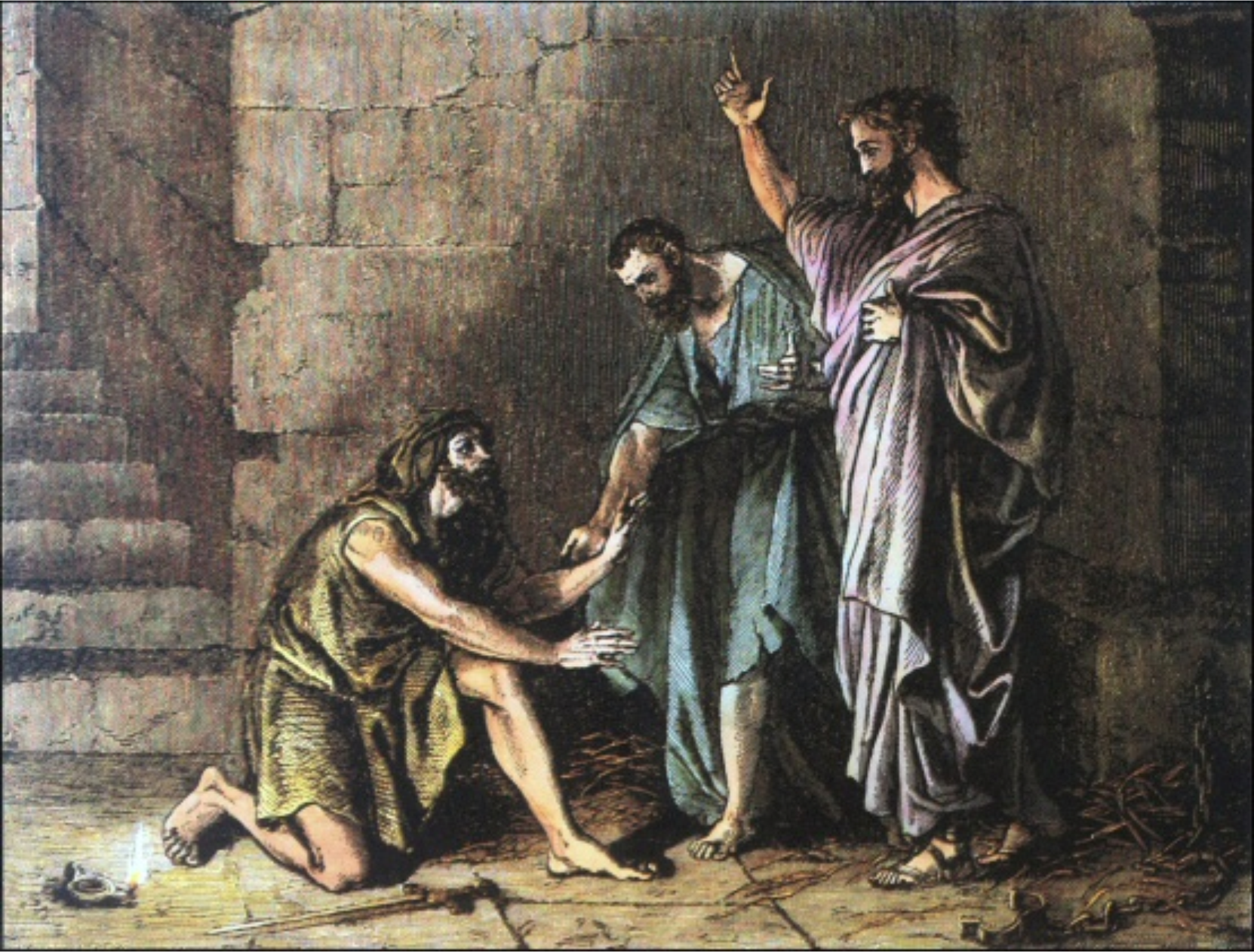
The Answer to a Jailer’s Question

The Philippian jailer trembling before Paul and Silas

Credit: Holman Bible Handbook

A jailer in the ancient city of Philippi once asked Paul and Silas a question that is still being asked today: “Sirs, what must I do to be saved?” (Acts 16:30)

Have you ever asked that question? Maybe the following post will provide you with an answer.

“Now is our chance to choose the right side. God is holding back to give us that chance. It won’t last forever. We must take it or leave it.” – C. S. Lewis

My Story

One day, when I was a boy, I took the chance. I placed all my eggs in one basket. The fate of my eternal soul, as much as I could grasp the idea, was placed in the control of a Man I had never seen in person, nor had heard with my ear, but I believed loved me and died for me.

Today, as a man, I can use words I never knew back then, such as justification, atonement, and propitiation. But the simple truth that led me to surrender my heart and soul to this Man can still be explained with simple words…words written thousands of years ago… “For God so love the world, that He gave…

What did God give?

Do you know what a gift is? Sure you do. It is something you give to another when you care. It is something you give with no expectation of payment in return. It is best when it is something that required some sacrifice, but it was a joy to purchase. It means even more when you know the gift was something needed, but unexpected.

A gift is something that is received. I have a man who has no more family, so for Christmas he goes out and buys things for his self, wraps them, and places them under a Christmas tree. On Christmas morning, all alone, he opens them. How sad is that? Those are not real gifts – he bought them!

According to God, as written in His Word, the Bible, eternal life is a gift. That’s right, a gift. In the letter to the Romans we read that the “gift of God is eternal life…” (Romans 6:23). God is offering it to you for the taking. He is offering it to you for free! But it wasn’t cheep; it cost him his Son.

God loved the world so much, that He gave his only begotten Son…” (John 3:16). Why did God give his Son? Well, so that you and I could be rescued from the eternal penalty we owe for our sins (breaking of God’s laws). Our lies, our lusts, our broken promises, you name it: all of these things are sins. Each one deserved separation from a holy God. But God “so loved the world, that he gave his only begotten Son (Jesus), that whosoever [puts his whole faith] in Him, would not perish (be separated from God), but have eternal life.

Why did He give it?

All men and women have broken God’s laws. And even though you may have not actually committed murder, or robbed a bank, or abused a child, James 2:10 (RSV) says, “For whoever keeps the whole law but fails in one point has become guilty of all of it.” So, you see, we need a Savior. We need the Gift that God is offering. Won’t you accept it?

The whole verse in Romans (6:23) goes like this: “The wages of sin is death, but the gift of God is eternal life, through Jesus Christ our Lord.” This is why C.S. Lewis said those words above. Eternal life is a gift, but it will not be offered indefinitely. You see, all of us will die, one day. Hebrews 9:27 says that it “is appointed unto man once to die; but after this, the judgment.” One day we must either give an account for our lawbreaking, or rest in the fact that our account has already been settled by putting our faith in Jesus.

“From death to life”

Jesus said, “I tell you the truth, whoever hears my word and believes him who sent me has eternal life and will not be condemned; he has crossed over from death to life” (John 5:24 NIV).

Jesus also said, “Whoever believes in the Son has eternal life, but whoever rejects the Son will not see life, for God’s wrath remains on him” (John 3:36 NIV). And to those that put their faith in Jesus, he said, “I give unto them eternal life; and they shall never perish, neither shall any [man] pluck them out of my hand” (John 10:28 NIV).

The apostle John wrote, “And this is the testimony: God has given us eternal life, and this life is in his Son. He who has the Son has life; he who does not have the Son of God does not have life” (1 John 5:11-12 NIV).

The Invitation

What can I say about the greatest gift ever, especially in a thousand words, or so? I can’t cover all the bases, answer every question, or defend every point – but I can offer you Jesus.

Have you been searching for meaning, for hope, for unconditional love, for eternal life? Give your heart to Jesus, confess your sins to Him, repent of the things that caused Him to have to die so that you could have life, and cross over “from death to life.”

For whosoever shall call upon the name of the Lord [Jesus] shall be saved(Romans 10:13).

You could even pray a prayer, in your own words, similar to this: “Dear Jesus, I believe you are God’s Son, and that you died for me, and rose again, that I might have eternal life. I know I have sinned, and I confess. I also confess that I cannot earn heaven on my own. I need You! Please take my life. I freely give it to you. Be my Lord, and my God. Amen.

If you prayed this prayer, honestly, and from your heart, then I would love to hear about it! I am sure many others would love to hear about it, too! If you accepted God’s gift of eternal life, let the world know in the comment section below.

If you would like to talk with someone, there is a phone line open 24 hours a day. Call 1-800-NEED-HIM (1-800-633-3446). Someone will be happy to show you how to be sure you have eternal life. Don’t wait.

1 Comment

Filed under God, salvation, Witnessing

A Saturday Business Meeting (2-25-17)

First order of business…

Encourage a blogger. Not every blogger get a lot of views on Saturdays. Why not go to a blog or two and find a post, or just the “about” page, and leave a nice word of encouragement? It doesn’t have to be about something they’ve written, just something positive.

Kicked out of the house and in need of wifi, the blogger will do anything to maintain his habit of changing the world one post at a time.

Kicked out of the house and in need of wifi, the blogger will do anything to maintain his habit of changing the world one post at a time.

Believe me, a kind word at the appropriate time can mean more than the world – and you never know what a person is going through.

Second order of business…

Go to church tomorrow (Sunday)!

Yes, I said it. Go where there is a community of Jesus-following believers who study God’s Word and enjoy some real, honest, down-to-earth fellowship.

There are many of you out there (you know who you are) who think church is a thing of the past, or worse, not necessary. Oh, how wrong you are! Not only is it something needed today, but it is something loved by Jesus and commanded by Scripture.

Bass Boat Baptist? Give me a break! Some of you may think that you can worship by yourself, at home, at the lake, in the garage, hung over under a table after a party the night before, etc. Well, with exception of the “under the table” part, maybe; however, there is a big difference between “personal devotions” and corporate worship. Believe it or not, you need more than yourself and a fishing pole to “have church.”

Don’t believe in “organized religion?” Why? Is it because of some bad examples you have witnessed? I hope so, because surely you’re not using Jesus as an excuse, are you? It was Jesus, remember, who came “not to destroy the law, but to fulfill the law.” Jesus wasn’t some unwashed, long-haired, holy man who wandered the streets talking nonsense. Jesus was called “Rabbi.”  He preached in the synagogues and the temple, too; not just house fellowships, or in one-on-one conversations.

Don’t need a preacher? It’s hard to argue there’s no need for a  pastor/teacher when the Holy Spirit thinks he’s needed  (Ephesians 4:11). Are you a loner? A Christian mercenary? Not biblical. Consider the following words from the Apostle Paul to the “pastors” from Ephesus…

(17)And from Miletus he sent to Ephesus, and called the elders of the church. (28) “Take heed therefore unto yourselves, and to all the flock, over the which the Holy Ghost hath made you overseers, to feed the church of God, which he hath purchased with his own blood. (29) For I know this, that after my departing shall grievous wolves enter in among you, not sparing the flock.” – Acts 20:17, 28-29

It’s about others, too. Find a place where God’s word is faithfully taught, without apology, and learn from those whom God has gifted for this holy purpose (1 Timothy 5:12-12; Hebrews 13:17). Then, consider this: by going, you just may encourage someone else in the process.

And let us consider one another to provoke unto love and to good works: not forsaking the assembling of ourselves together, as the manner of some [is]; but exhorting [one another]: and so much the more, as ye see the day approaching. – Hbr 10:24-25

P.S. Listen to me on WFLI AM1070 at 5pm Sunday if you’re in the Chattanooga area 🙂

5 Comments

Filed under Christian Unity, God, Preaching, Uncategorized, worship

How Do You Treat a Gift from God?

Remember, dear believer, if your pastor is a “gift” to your congregation (Ephesians 4:11), how you treat him says a lot about your relationship to the Giver.  – A. Baker

2 Comments

Filed under Church, ministry

How Do You Want to be Known?

It’s not often I post a video of me preaching, but I hope this one is a blessing. A couple of weeks ago I was invited back to Mile Straight Baptist Church to preach for the evening service. It’s always an honor when Dr. Tom Goss extends the invitation.

That night I felt led to preach a sermon based on one of my personal ministry objectives. The title of the sermon was “How Do You Want to be Known?”

So, if you’ve ever wondered what I looked like preaching, this is me…who needs to lose a little weight.

1 Comment

Filed under Preaching, Southern Baptist

Is It Enough to be God-Centered?

The Prayer

A while back I asked the Lord to make me a “characteristic example of a life centered on God.” But as soon as I prayed that prayer, another thought came into my mind…

Maybe being “God-centered” is not enough.

God-Centered Living

You may be asking, “What is wrong with that?” Well, there is nothing wrong with living a God-centered life, generally speaking. On the other hand, there is more to being a Christian than being “God-centered.”

“Outrageous!” “That’s blasphemy,” you say. Well, is it? Stop and think about it for just a moment. Start with thinking about what being “God-centered” actually means.

Does someone have to be a true Christian in order to live a God-centered life? You may think so, at first, but there may be a few church folk fooling themselves. Don’t believe me? Read what Paul wrote to the Church…

“Examine yourselves, whether ye be in the faith; prove your own selves. Know ye not your own selves, how that Jesus Christ is in you, except ye be reprobates?” – 2 Corinthians 13:5 KJV

Why would the Apostle tell church people to “examine” and “prove” whether or not they were in the faith? Could it be that there were some who were going through all the motions, but were never converted, never born anew? Could it have been possible that there were some doing all the right things, for the right reasons, but not right with God? He says that the answer to the test will be whether or not “Jesus Christ is in you.”

Can people live God-centered lives and still be lost? To help answer this question, consider the following people (names are fictitious). Do their actions guarantee salvation?

  • Bob goes to church every day the doors are open, including every other function on every other day
  • Henry gives 20% of his income and 10% of his time to the church. If there is a need, ask Henry for help.
  • Margaret goes to a Fundamental church, has the right translation of the Bible, and never wears pants – ever.
  • Mary would never say a dirty word, tell an off-color joke, or even permit foul language in her presence.
  • Sharon put aside marriage and gave her life to helping orphans on the streets of Mumbai, India.
  • Scott and Karen have Bible studies in their home, take the kids to Sunday School, and even have gold crosses in every room of their home, not to mention on their necks.
  • A rich young ruler keeps all the commandments (not just the Big 10) from his youth.

If these people were to examine themselves, as Paul asked, what might be missing? Colossians 3:23 says, “And whatsoever ye do, do [it] heartily, as to the Lord, and not unto men.” Is it not possible that someone could do everything for God’s glory (live a God-centered life), but still die without Christ?

What are your thoughts?

Have you “proven” whether you “be in the faith?”

Do you know of Scripture that supports a “God-centered” life being proof of salvation?

The Realization

When contemplated what I had asked of God (to make me characterized by a God-centered life), the mental picture of a wheel came to mind. It was the picture of a wheel with a center hub and spokes, much like a bicycle or wagon wheel. As I thought about this, however, something seemed wrong. Something seemed almost selfish.

You see, when you look at a wheel, especially the kind with spokes and a hub, it may not be obvious at first, but there are parts. In such a wheel I can distinguish the spokes from the hub, and the rim from the spokes. I can even see that there are spaces in between the spokes that are empty and not attatched or filled with anything – just empty. If God is supposed to be represented by the hub, the center of the wheel, then the wheel is not really all about the hub, but the wheel itself.

It’s about Jesus

The Apostle Paul told the Athenians (Acts 17:28) that in Jesus we “live, and move, and have our being.” In a letter to the Galatians he said “I am crucified with Christ: nevertheless I live; yet not I, but Christ liveth in me” (Galatians 2:20). It would seem to me that Jesus should be more than our “hub.” He should be our “ALL.”

That is when I thought of a different picture. This time I imagined a solid circle – a disk. Unlike the other picture where God was the center of everything, yet separate, here was a picture of wholeness. In this picture, if my life is this type of wheel, people won’t notice anything about me, just Christ.

All of the spokes (my life, my dreams, my habits and hobbies, my talents, and my desires); the empty spaces (the areas of my life that seem irrelevant); and the rim (the total expanse of who I am – my identity, my sphere of influence); each part is now inseparable from the life and power of Christ who lives within me.

May they see Jesus

So, I no longer want to be characterized as a man with a God-centered life. I want to be a man characterized by the life of Christ. When people look at me, I don’t want them to say, “Hey, that guy really knows how to serve God,” or “Hey, that guy really loves the Lord.” Even though there is nothing wrong with those things, how much better would it be if they could say, “Hey, I met this guy… at first I thought he was that man they call Jesus.

Remember, it was to the Church at Corinth that Paul said, “Examine yourselves, whether ye be in the faith; prove your own selves.” There must have been some hearing this letter read who were deceived. Don’t be like them. Make sure your life is in Christ, and He is in you.

May your activities be “God-centered;” but your life “Christ-filled.” May the world see Jesus in you.

For Discussion:

Can you distinguish between a God-centered and a Christ-filled life? What characteristics would you expect to see?

Do you think someone could live a God-centered life and still be unsaved?

Your comments would be appreciated. 

2 Comments

Filed under Christian Living, Christianity, God, Jesus, Theology

YHWH vs BAAL: Should God Be an “Option”?

Last week I mentioned in a sermon how that I believed the different baals were actually one god, not multiple deities. Because my statement sounded controversial, I thought it might be good to repost something from a while back.

The following was part of a paper I wrote for a class atcTemple Baptist Seminary back in 2012.

Introduction

The question that needs to be asked is: did the people of Israel ever offer Yahweh as an alternative to Baal? Much of modern Christianity has resorted to offering Christ as an alternative to the gods of this world. They say, “Choose Christ,” or “Give Jesus a try.” But did the ancient followers of Yahweh do this? Did they ever consider their God one of many choices? Did they try to convince the Baal worshippers of the day that God was a “better” God to worship? Or, did the children of Israel present God as the only God to which there was no alternative?

On the third of December, 2008, Pastor Rick Warren appeared on the Fox News program “Hannity and Colmes.” During an interview promoting his new book, The Purpose of Christmas, co-host Allan Colmes questioned Warren about his [Warren’s] belief in Jesus. Colmes asked, “All right. Let me ask you: you talk about, OK, so you think everybody needs a savior.” Warren responded with an “I do.” “Well, what about those people who don’t — you know, I happen to be Jewish? … What about — what does it say for all those people who do not accept Christ as their personal savior?”

Pastor Rick Warren: Wikipedia

Pastor Rick Warren: Wikipedia

The response that Rick Warren gave to Allan Colmes’ question on national television stunned many evangelicals. He said, “I’m saying that this is the perfect time to open their life, to give it a chance. I’d say give him [Jesus] a 60-day trial.” “Like the Book of the Month Club,” said Colmes. “Give him a trial,” replied Warren. “See if he’ll change your life. I dare you to try trusting Jesus for 60 days. Or your money guaranteed back.”[1]

Where does the Christian church of today find biblical support for such statements? Was that the kind of offers being made to the inhabitants of the Promised Land? Did Joshua ever tell the 12 tribes of Israel to go out into the land which the LORD had given them and offer a 60-day trial membership? Well, if they offered Yahweh as a “choice” among other gods, then they might have served well at Saddleback, Pastor Rick Warren’s church.

Let us therefore examine some of the differences and similarities between Yahweh and Baal; compare how each was worshipped; and then consider whether or not followers of Yahweh might have given the followers of Baal a “60-day challenge.”

Baal – The Canaanite god

By Unknown - Jastrow (2006), Public Domain, https://commons.wikimedia.org/w/index.php?curid=723538

By Unknown – Jastrow (2006), Public Domain, https://commons.wikimedia.org/w/index.php?curid=723538

Baal was the proper name of the primary competition to the God of Israel, Yahweh. However, it might be a little confusing to see both Baals (Heb. be˓ālîm, e.g., Judg. 2:11; 3:7; 8:33; KJV “Baalim”) and Baal (e.g., 6:25, 28; 1 Kgs. 16:32; 18:21) as worshipped by the surrounding peoples in the Old Testament.[2] Both were the names for the same deity, but one (Baalim) was the plural form, similar, but not exactly like Elohim. We also read in the Bible of Baal-hazor (2 Sam. 13:23) and Baal-hermon (Judges 3:3), and what has been assumed is that Baal was a generic term used for local gods, the last part of the name (such as Hermon and Hazor) being the city in which that local god was associated. However, recent scholarship has come to favor the idea that “only one deity specifically named Baal was worshipped in each region,” and the different names were only a reflection of that fact.[3] Baal, then, was probably not many different gods, but one male deity, with the additional suffixes attached to describe associations with regions where he was worshipped.

The idea that Baal was simply the name given to local idols and false gods does not give credit to the meaning of the name. The Hebrew word ba’al  carries with it the idea of a god that is multi-regional and overarching, not just one of many lesser gods. The name Baal means “master,” “possessor,” and “husband.”[4] Some have suggested that Baal was one of the classical gods of mythology, such as Zeus, Jupiter, or Hercules,[5] but the evidence to support that theory is lacking. More than just a local deity, or a small god, Baal was evidently thought of more as a god over all things, the supreme god, even amidst a polytheistic culture.

What made Baal worship so attractive to the Canaanites, and also the Israelites? Baal worship attracted the Canaanite, as well as the Hebrew, because the benefits promised appealed to natural needs and base senses. Essentially, it was a fertility cult. The “promise of agricultural, animal, and human fertility…sacred prostitutes, sexual activity, and imitative magic to insure fertility in every area of life”[6] made Baal worship not only hard to resist, but seem more exciting than Judaism. The three basic elements of the theology of Baal worship (Relation to cycles of nature; Immortality; and Polytheism) further enhanced its appeal.[7] But nowhere is it suggested in scripture that Baal worship was to be exclusive. Even though Baal may have been the chief god in the Canaanite pantheon, [8] other gods were also worshipped. It was not uncommon, even, for later Hebrew kings to attempt to serve both Baal and Yahweh.

YHWH – The Hebrew God

The God of the Hebrews, and consequently the God of the Old Testament, was and is Yahweh. The name, spelled Yahweh today, was not the way it was originally spelled, because the original Hebrew did not include vowels. Known as the Tetragrammaton (meaning “four letters”), Yahweh was spelled YHWH.[9] The only thing is that because of such commands as not to take the Lord’s name in vain (Exodus 20:7), Jews started using the word Adonai (Lord) in the place of YHWH, which was spelled with all capital letters in most English translations as LORD. No one really knows, though, how YHWH is to be pronounced. However, “most scholars today believe that YHWH was probably pronounced Yahweh (Yahʹ weh).”[10] Jehovah (Jĕ hōʹ vah) is the English transliteration of Hebrew text’s current reading of the divine name Yahweh. [11]

Like with Baal, there are multiple names found in the Hebrew Scriptures for God. However, YHWH, or Yahweh (also spelled Jehovah) is the supreme name given by God to describe Himself to Moses.

“And Moses said unto God, Behold, when I come unto the children of Israel, and shall say unto them, The God of your fathers hath sent me unto you; and they shall say to me, What is his name? what shall I say unto them? And God said unto Moses, I AM THAT I AM: and he said, Thus shalt thou say unto the children of Israel, I AM hath sent me unto you.” – Exodus 3:13-14 KJV

“The name was given by God to Moses at the burning bush, and was linked to the Hebrew verb hāyāh (‘to be’). God defines himself as ‘I am’ and the word YHWH therefore means ‘he who is’.”[12] This name is then linked to other names, therefore describing the eternal characteristics of His nature, such as Jehovah-Heleyon, the high and lofty One that inhabits eternity (Isaiah 57:15), and  Jehovah-M’Kaddesh, the LORD who sanctifies (Leviticus 20:8).[13] The difference between Yahweh and Baal, however, is that each of these names is linked to one of His attributes and the way he deals with men and women, not simply the name of a location in which He is served.

An even greater distinction between Baal and Yahweh is that God desired to be personal in His relationship to His people, Israel (and by extension, all those who follow after the faith of Abraham). God told Moses, “And I will take you to me for a people, and I will be to you a God: and ye shall know that I am the LORD your God [YHWH], which bringeth you out from under the burdens of the Egyptians” (Exodus 6:7). In Numbers 15:41 Yahweh said, “I am the LORD your God, which brought you out of the land of Egypt, to be your God: I am the LORD [YHWH] your God.” And instead allowing for the idea of polytheism as with Baal, YHWH demanded total allegiance when He said, “Thou shalt have no other gods before me” (Exodus 20:3). Why did God bring Israel out of Egypt? It was so that Israel “might know that the LORD is God; there is no other besides him” (Deut. 4:35 ESV). God chose Israel that all the people “may know, from the rising of the sun and from the west, that there is none besides me; I am the LORD, and there is no other.” (Isa. 45:6 ESV).

YHWH an Option?

So, now the question should be asked, “Would the children of Israel, the Hebrew people called out of slavery by YHWH, the One who said, ‘I am the LORD, and there is no other,’ ever offered Him as a ‘choice’ among many gods, including Baal? Is it conceivable that the Hebrew people would have gone into the Land of Promise and said, “Try YHWH for sixty days, and if you don’t like Him, if He doesn’t meet your self-defined needs, then ask for your money back?” It seems highly unlikely, that is for sure. In Deuteronomy (6:13-14) we read where the LORD said, “Thou shalt fear the LORD thy God [YHWH], and serve him, and shalt swear by his name. Ye shall not go after other gods, of the gods of the people which are round about you…” The God of Israel went on to say in verse fifteen that “the LORD thy God is a jealous God among you,” so the option to serve other gods would have been out of the question, “lest the anger of the LORD thy God be kindled against thee, and destroy thee from off the face of the earth.” If YHWH was so particular about the fact that He was the only God, then what purpose would it have served to offer the option of anything other than total worship? It is the author’s opinion that Yahweh was never offered as an alternative or option to the gods being served by the Canaanites, rather He was introduced to the Canaanites as the ONLY God. There was “no other.”

The modern idea of offering God as an “alternative” or “option” among many other choices (gods), in the author’s opinion, would have been out of the question in Joshua’s day. The children of Israel were chosen by God to take the glory of His name unto all the nations, to declare Him as the only God, and to declare all other gods dead, dumb idols made by men. The Hebrew mind would have thought completely heretical the idea of offering a trial relationship with the great “I AM.” Why then should the modern believer in Jesus (who said, “Before Abraham was, I AM”) offer Him with a “money-back” guarantee? Jesus said, “If any man will come after me, let him deny himself, and take up his cross, and follow me” (Matt. 16:24). Nothing about being nailed to a cross implies a temporary trial relationship. Following Christ, as was following Yahweh, is a total commitment. And part of that commitment is the understanding that there is “no other gods” from which to choose.

Presenting Jesus Christ should never be done in such a way that implies that other gods could, in theory, be a better alternative. To offer Jesus as an “option” who could be “tried” for a period of time implies that the one offering may concede that other options may be “better,” hence the offer of a “money-back” guarantee. Worshipers of Yahweh knew better. So should we.


[1] The transcript for this conversation can be found at http://www.foxnews.com/story/0,2933,461685,00.html.

[2] Allen C. Myers, The Eerdmans Bible Dictionary (Grand Rapids, MI: Eerdmans, 1987), 113-14.

[3] Myers, Eardmans, 113-14.

[4] D. F. Payne, “Baal” In , in New Bible Dictionary, ed. D. R. W. Wood, I. H. Marshall, A. R. Millard et al., 3rd ed. (Leicester, England; Downers Grove, IL: InterVarsity Press, 1996), 108.

[5] James M. Freeman and Harold J. Chadwick, Manners & Customs of the Bible (North Brunswick, NJ: Bridge-Logos Publishers, 1998), 167-68.

[6] Lamar Eugene Cooper, vol. 17, Ezekiel, The New American Commentary (Nashville: Broadman & Holman Publishers, 1994), 26.

[7] Cooper, The New American Commentary, 26.

[8] Holman Illustrated Bible Dictionary, ed. Chad Brand, Charles Draper, Archie England et al. (Nashville, TN: Holman Bible Publishers, 2003), 1172.

[9] Holman Illustrated Bible Dictionary, 1695-96.

[10] Ibid., 1696.

[11] Ibid., 878.

[12] New Dictionary of Biblical Theology, ed. T. Desmond Alexander and Brian S. Rosner, electronic ed. (Downers Grove, IL: InterVarsity Press, 2001).

[13] Stelman Smith and Judson Cornwall, The Exhaustive Dictionary of Bible Names (North Brunswick, NJ: Bridge-Logos, 1998), 86.


Bibliography

Cooper, Lamar Eugene. Vol. 17, Ezekiel. The New American Commentary. Nashville: Broadman & Holman Publishers, 1994.

Freeman, James M. and Harold J. Chadwick. Manners & Customs of the Bible. North Brunswick, NJ: Bridge-Logos Publishers, 1998.

Holman Illustrated Bible Dictionary. Edited by Brand, Chad, Charles Draper, Archie England et al. Nashville, TN: Holman Bible Publishers, 2003.

Myers, Allen C. The Eerdmans Bible Dictionary. Grand Rapids, MI: Eerdmans, 1987.

New Dictionary of Biblical Theology. Edited by Alexander, T. Desmond and Brian S. Rosner. electronic ed. Downers Grove, IL: InterVarsity Press, 2001.

Smith, Stelman and Judson Cornwall. The Exhaustive Dictionary of Bible Names. North Brunswick, NJ: Bridge-Logos, 1998.

The Holy Bible: English Standard Version. Wheaton: Standard Bible Society, 2001.

The Holy Bible: King James Version. electronic ed. of the 1769 edition of the 1611 Authorized Version. Bellingham WA: Logos Research Systems, Inc., 1995.

Wood, D. R. W. and I. Howard Marshall. New Bible Dictionary. 3rd ed. Leicester, England; Downers Grove, IL: InterVarsity Press, 1996.


1 Comment

Filed under Bible Study, God

“Let God be True, and Luther a Liar”

The following post (and it’s a long one) was written 6 years ago in 2011, shortly after returning from Florida where I officiated a beach wedding.

Being that it was just Martin Luther King, Jr’s birthday, I thought this piece might be a nice reminder that racism, regardless of the race, is sin. Dr. King knew that in order to change things, men’s hearts had to change. Unfortunately, the best we can do is still going to be flawed. Our only hope is found in God, our Mighty Fortress and Strength.

St. Petersburg, FL

Forgive me, but I am not a big fan of St. Petersburg, especially in the winter when it is 45 degrees. To me, Florida is supposed to be HOT. The warmest it got last week was in the low 70’s. The water on both coasts was terribly cold; therefore, sightseeing was more appropriate than sunbathing on the beach (which I don’t prefer, anyway). But aside from all of that, I still don’t think I would have liked St. Petersburg, even if it had been in the dead of summer.

However, they did have a few nice museums.

From books to iPhones

One museum we (Katie and I) enjoyed was the Museum of Fine Arts (http://www.fine-arts.org/). Believe it or not, it was the first time that I ever had the chance to stand in a room full of paintings by Monet. It was impressive, especially when you consider how close a teenager could stand next to objects worth multiple millions of dollars. Fortunately for the paintings, teenagers have touch-screen phones to keep their fingers occupied.

Another place we went, at my insistence, was the Florida Holocaust Museum (http://www.flholocaustmuseum.org/). I felt that it was important for the girls to see with their own eyes what true hatred and bigotry, even false religion can do. Not as big, nor as impressive as the museum in Washington, D.C., this museum still told the story well and featured an original cattle car that once carried Jews to the concentration camps.

Amelia Island, FL

When we left St. Petersburg, in order to find another beach to help Haley with her science project, at the advice of my brother-in-law, we went to Amelia Island in Fernandina, Florida. Now THAT was a change from St. Petersburg. Through priceline.com we even got a 3-star hotel for $52 a night! Not bad for a place with a huge, clean beach and a small-town feel.

“Big Guns on the Wall”

The highlight to the trip, for me, was when we got to visit Fort Clinch on Amelia Island. The fort was built back in the 1800’s and served both the Conferderate (1861) and the Union troops. It was a massive, red brick fortress overlooking the Atlantic ocean, and was meant to protect the Cumberland Sound. Fully restored, with reenactors playing the part, it was meant to give you the feel of stepping back in time to 1864.

I was really impressed with the fort. Even my wife was amazed. As I stood on its walls with huge canons, or on its proud bastions, I could not help but remember the words to the famous hymn by Martin Luther, “A Mighty Fortress.”


“A mighty fortress is our God,
A bulwark never failing.
Our helper He amid the flood
Of mortal ills prevailing.”

A Painful Thought

But while at Fort Clinch a painful thought crossed my mind. Just the day before, my girls were able to read other words from Martin Luther in the Florida Holocaust Museum. You see, even though Luther has been regarded as the father of the Reformation, he was a rabid anti-semite. In one display chronicling centuries of hatred toward the Jewish people, the words from Luther’s book, “On the Jews and Their Lies,” was written in bold for every Christian to see. Here are some quotes from that book:

“He who hears this name [God] from a Jew must inform the authorities, or else throw sow dung at him when he sees him and chase him away.”

“If we wish to wash our hands of the Jews’ blasphemy and not share in their guilt, we have to part company with them. They must be driven from our country.”

“Moreover, they are nothing but thieves and robbers who daily eat no morsel and wear no thread of clothing which they have not stolen and pilfered from us by means of their accursed usury. Thus they live from day to day, together with wife and child, by theft and robbery, as arch-thieves and robbers, in the most impenitent security.”

“My essay, I hope, will furnish a Christian (who in any case has no desire to become a Jew) with enough material not only to defend himself against the blind, venomous Jews, but also to become the foe of the Jews’ malice, lying, and cursing, and to understand not only that their belief is false but that they are surely possessed by all devils. May Christ, our dear Lord, convert them mercifully and preserve us steadfastly and immovably in the knowledge of him, which is eternal life. Amen.”

What a contrast! One moment I am being inspired by a fortress that reminds me of the greatness of God, the next I am being reminded of the painful truth that men are sinners – all with the same song. How could the words of one man inspire both the Church and the Nazi party at the same time?

Martin Luther

Martin Luther wrote “A Mighty Fortress” based on Psalm 46:11, “The LORD of hosts [is] with us; the God of Jacob [is] our refuge. Selah.” God is our refuge and our hope in time of trouble. The Psalmist also said, agreeing with Luther,

I will say of the LORD, [He is] my refuge and my fortress: my God; in him will I trust. – Psa 91:2 KJV

What are we to make of this, then? Is my hope in God supposed to be dashed all because of the actions of some (or all) of his followers? Are we to assume the truth of God is a lie because of the hateful words of Luther, as opposed to his hymns and 95 theses? Martin Luther was terribly wrong in his observations of the Jews. For that matter, David wasn’t perfect, either. No, God is God. Man is man. That is why it is so important to keep in mind the following words from the Apostle Paul:

…[Let] God be true, and every man a liar…” – Romans 3:4 KJV

When Peter got it right, Jesus called him “blessed” and praised the fact that the Father gave him the words (Matthew 16:17). However, when Peter spoke in the flesh, out of his own selfish desires, Jesus said, “Get thee behind me, Satan!” (verse 23). When we speak out of hand about God, that does not change the truth about God.  Luther got some things right.  Luther also got some things wrong in a very bad way.

My God IS a mighty fortress…and He loves the people of Israel.  He has made that abundantly clear, despite the ramblings and false doctrines of men. God said, “And I will bless them that bless thee, and curse him that curseth thee: and in thee shall all families of the earth be blessed.” – Gen 12:3 KJV  Nothing has changed.  Let God be true, and Luther be a liar. Let God be true, and Peter a liar. Let God be true, and every one of us a liar. God is Who He is, whether we get it right or not. But because of Luther’s mistaken words, may we be ever more diligent to heed these words:

Study to shew thyself approved unto God, a workman that needeth not to be ashamed, rightly dividing the word of truth. – 2Ti 2:15 KJV

Why? Because Jesus said it right, and He ALWAYS got it right, when He said, “Sanctify them through thy truth: thy word is truth.” – Jhn 17:17 KJV

Every word of God proves true; he is a shield to those who take refuge in him. Do not add to his words, lest he rebuke you and you be found a liar. – Pro 30:5-6 ESV

7 Comments

Filed under God, Martin Luther, salvation, Uncategorized, World View

Is Your Christianity a Sham?

Adorable Sin

It may come as a shock to some, but many who claim to be Christians are not, actually. It is obvious because of their unrepentant love of sin.

For example, I know a person who willfully admits his failures and flaws (which is a good thing), but happily continues to do the very things he knows are wrong. He says, “I know I have a problem with (blank), but I know I’ll never change, so I’ll just have to keep asking for forgiveness.” In reality, the problem is that he loves his sin, and therefore refuses to truly repent and “turn from his wicked ways.” His particular sin is his claim to fame, his identity. Without it, he wouldn’t be noticed.

Am I suggesting that Christians NEVER sin? Of course not! The Bible plainly tells us that if we say we never sin, “we deceive ourselves, and the truth is not in us” (1 John 1:8). Furthermore, just two verses later the Apostle John declares that if we say have have no sin we make God a liar!

But what about 1 John 5:18? Does it not clearly state that “whosoever is born of God sinneth not?” Yes, in the Authorized Version it does. However, the NIV renders the first part of 1 John 5:18 as: “We know that anyone born of God does not continue to sin [emphasis added]…” Similarly, the NLT says that someone who is born of God (a Christian) does not “make a practice of sinning…

No, I’m not saying Christians never sin. What I am saying is that if you are a true follower of Jesus Christ, sin may happen, but it’s not what you’re known for. What is being expressed here is the idea of continual, habitual sin – the kind one has no desire to change and even brags about it.

Advice for the Soul

depressorsMy advice to you, dear reader, is that you take a moment and conduct a spiritual self-examination.

David prayed, “Examine me, O LORD, and prove me; try my reins and my heart” (Psalm 26:2). The Apostle Paul even urged church members to “Examine yourselves to see if your faith is genuine” (2 Corinthians 13:5a NLT).

The hard, cold truth is that when one claims to be a believer, a Christian, yet habitually, characteristically, and proudly continues in the practice of a particular, obvious sin, his salvation/conversion/Christianity is most likely a sham.

Christianity is not just a label one wears, but a change that is made, both initially and on-going, in the life of the believer. Sin may happen, but when it does, a sorrowful and repentant heart is the result.

Please understand, I only wrote these things “that your joy may be full” (1 John 1:4). 


*Originally published in 2015 – but the truth is still the truth.

5 Comments

Filed under Christian Living, salvation