Category Archives: Bible Study

Just Be Thankful You’re Alive

It is a little after 1 PM in the afternoon, and I’m sitting in our van reading my Bible. Not long from now I will go back to work and drive the school bus, completing my afternoon routes. 

As I was reading I came across a verse in the book of Lamentations, and I thought I would share it with you. 

Lamentations 3:39 (CSB) Why should any living person complain, any man, because of the punishment for his sins?

Here the idea is that if you have been punished for your sins by a Holy God, and are still alive, you have nothing to complain about! Seriously, too often we gripe and moan about the circumstances which we must endure, and yet those circumstances are so often the result of our own sinful decisions. Is it not a wonderful thing that we are so loved by our heavenly Father? He does not pour out on us the punishment we deserve, because he is rich in mercy. We are alive! We should be grateful!

Let us search and try our ways, and turn again to the LORD. Let us lift up our heart with our hands unto God in the heavens. – Lamentations 3:41-42

There are so many things in this world we could complain about. So often those who complain the most are the ones who have the most. But if there’s anything worth rejoicing about, it is the fact that we serve a God who is rich in mercy. We don’t deserve anything good, no matter how small or insignificant; we deserve judgement. 

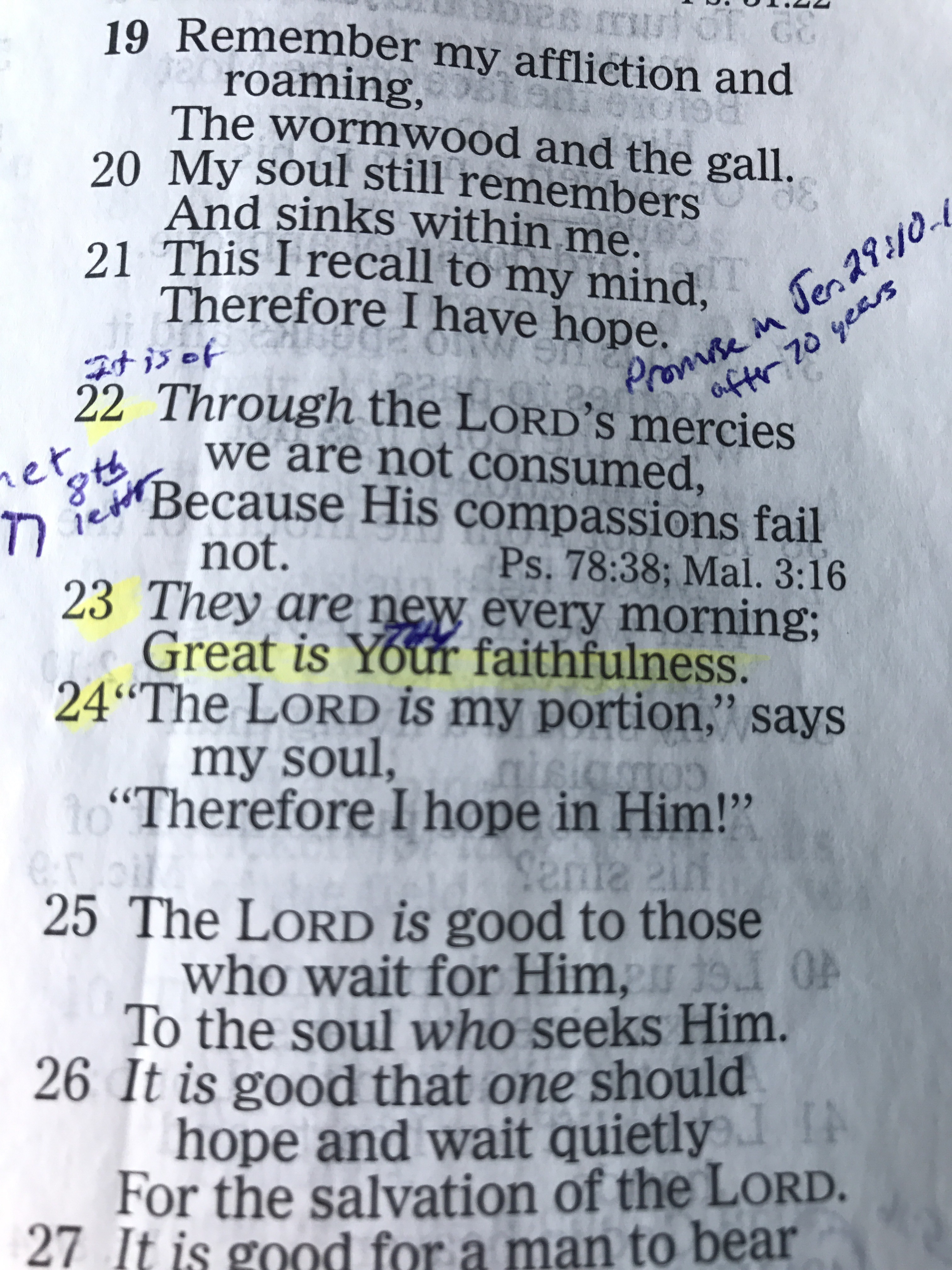
However, if I just turn back one page in my Bible I can read verse 22, where it says, “Through the LORD’S mercies we are not consumed, because his compassions fail not.” And, thankfully, they are new every morning! 

If you are reading this, then you are alive! Why not take a moment and praise Him?

10 Comments

Filed under Bible Study, God, grace, Uncategorized

Birthday Sermon

Even though tomorrow (Sunday) will be my 50th birthday, I am going to resist the temptation to be self-serving; I have decided not to preach a sermon on celebrations and the giving of gifts. 

As a matter of fact, I even decided to avoid making the obvious connection between Pentecost and the 50th year of my life. Low-hanging fruit is too easy. 

No, this Sunday morning I will be continuing a series of expository sermons I’m preaching as we go through the book of Ephesians. This week we will be looking at the 4th chapter of Ephesians, concluding somewhere around verse 8. 

The church fellowship which will immediately follow the sermon should also be considered a run-of-the-mill time of mutual edification. After all, it’s not about me. 

God bless you all (or “y’all” as we say), and have a wonderful weekend and Lord’s Day! 

4 Comments

Filed under Bible Study, Church, Humor, Preaching

If We Could Only Comprehend!

This morning, as I preach from the third chapter of Ephesians, my prayer for you (and myself) will be the same as what the apostle Paul prayed…

I pray that he may grant you, according to the riches of his glory, to be strengthened with power in your inner being through his Spirit, and that Christ may dwell in your hearts through faith. I pray that you, being rooted and firmly established in love, may be able to comprehend with all the saints what is the length and width, height and depth of God’s love, and to know Christ’s love that surpasses knowledge, so that you may be filled with all the fullness of God. – Ephesians 3:16-19 CSB

Oh, that we might comprehend the the width, the length, the height, and the depth of God’s love through Jesus Christ! If we could only even slightly comprehend the vast, expansive spread before us, mercy and grace for every need; the never-ending, eternal, infinite promise of his love and care; the heights to which we are raised, far above the lowly, humble truth of our natural condition and state; and the the depths of Christ’s love – humble depths to which the love of God had to reach down in order to pluck us from the pit of sin… If we could only even slightly comprehend them!

Yet, through His strength (v. 16), and being rooted and grounded in His love (v. 17), it is possible! Hallelujah! Because He “is able to do exceedingly abundantly above all that we ask or think, according the power that works in us! (v. 20 NKJV)

This morning, and every morning, to God the Father be all glory in the church by Christ Jesus, to all generations, wherever they may be, forever and ever, “world without end” (v. 20).

And all the people said… “AMEN!!” 


3 Comments

Filed under Bible Study, Christianity, Church, Faith, God, Love of God, Preaching, worship

Jesus Paid It All and the Payment Was Permanent (Part Seven)

A guest post by Wally Fry

jesus saves

The Doctrine of conditional salvation, or that one can lose their salvation, is a product of Satan himself. I am not saying that those who believe it are of Satan; I am saying the thought is from him. Why would I say such a thing? Allow me to briefly explain. First, let’s take a look at the following passage:

Ephesians 6:17 And take the helmet of salvation, and the sword of the Spirit, which is the word of God:

In that passage, Paul was speaking to saved believers. What he was passing along from God was that we are to put on our helmet, and that helmet is the helmet of Salvation. He simply meant that Satan desperately wants us to be in a constant state of doubting our salvation. Paul was teaching us not to be distracted by those doubts, but to live secure in the assurance of our status as reconciled children of God.

Why does Satan care? The basic reason is that if we rest assured that our salvation is secure, then we can move along to the work God really wants us to do.  If we spend our entire lives in a mad scramble to stay saved, then that is all we can do. I hate to sound repetitive, but it’s not about us! It is about our works done to honor and glorify God and not our efforts either to get saved or to stay saved.

As with works based salvation, works maintained salvation becomes about men rather than God. God has laid out the conditions that must be met for salvation: repentance toward God and faith in His Son Jesus Christ. Any other rules are not God’s rules, they are man’s rules. Who makes any such list of rules and conditions necessary to maintain salvation? Some person, of course. When we follow rules set by man, we begin to abandon God’s guidelines as revealed in His Word. When we do that, we begin to follow men rather than God; worse, we begin to follow ourselves. And that is what got us into trouble in the first place way back in Genesis Chapter 3

Are you saved? If you are, rest assured that your salvation is secure for all eternity. Quit worrying about what you have to do to keep it, and get busy doing the works God has actually called you to do.

Are you lost? Understand that this security can belong to you as well. Admit you are a sinner. Agree with God that He is right and you are wrong. Turn from your sin. Believe that Jesus paid your due penalty on the cross, and accept Him as your Savior and Lord today. Then, pick up your cross and follow Him.

11 Comments

Filed under Bible Study, Christianity, salvation

Humility ~ Part 3

Guest Post by: Donald N. Norris

In my last post, we looked at the concept of humility from the pages of the Tanakh.  In this post, we turn to the Brit Hadashah to help us understand the characteristic of being humble.

Humility Defined

Humility is a personal quality in which an individual shows dependence on God and respect for other persons.  Various Bible translations use humble, meekness, gentleness, tender, mild, afflicted and considerate to describe the characteristic of humility.

Humility in the Brit Hadashah [1]

Yeshua life provides the best example of what it means to have humility.  “Take My yoke upon you and learn from Me, for I am gentle and humble in heart, and you will find rest for your souls.” (Matthew 11:29; see also 1 Corinthians 4:21 and Philippians 2:1-11).

Yeshua preached and taught often about the need for humility.  “Whoever exalts himself shall be humbled; and whoever humbles himself shall be exalted.” (Matthew 23:12 and Luke 14:11; 18:14)  “Sitting down, He called the twelve and said to them, ‘If anyone wants to be first, he shall be last of all and servant of all.’” (Mark 9:35)

Yeshua urged those who desired to live by Kingdom standards to practice humility.  “At that time the disciples came to Jesus and said, ‘Who then is greatest in the kingdom of heaven?’” (Matthew 18:1ff)

A person with humility does not look down on others.  Humility in the Brit Hadashah is closely connected with the quality of “meekness.”  “Blessed are the meek, for they shall inherit the earth.”  (Matthew 5:5 ESV)

While God resists those who are proud, He provides grace for the humble.  “But He gives a greater grace. Therefore it says, ‘God is opposed to the proud, but gives grace to the humble.’”  (James 4:6)

Primary in the Brit Hadashah is the conviction that one who has humility will not be overly concerned about his or her prestige.  Whoever then humbles himself as this child, he is the greatest in the kingdom of heaven.” (Matthew 18:4)   “Be of the same mind toward one another; do not be haughty in mind, but associate with the lowly. Do not be wise in your own estimation.” (Romans 12:16)  “Or did I commit a sin in humbling myself so that you might be exalted, because I preached the gospel of God to you without charge?” (2 Corinthians 11:7)

Sha’ul believed that quality relationships with other people, especially those who had erred spiritually, hinged on the presence of gentleness, meekness or humility (see Acts 20:19; 1 Corinthians 4:21; Galatians 6:1; 2 Timothy 2:25).

Both the Tanakh and the Brit Hadashah affirm that God will exalt those who are humble and bring low those who are proud (see Luke 1:52; James 4:10; 1 Peter 5:6).

The Greek world abhorred the quality of meekness or humility, but the Christian community believed these qualities were worthy (see 2 Corinthians 10:18; Colossians 3:12; Ephesians 4:2).

A humble man is often looked upon as a coward, a cringing, despicable, slavish type of person.  Many men fear humility.  They feel humility is a sign of weakness and will make them the object of contempt and abuse; causing them to be shunned and overlooked.  This is tragic:

  • A humble spirit is necessary for salvation. “Truly I say to you, unless you are converted and become like children, you will not enter the kingdom of heaven. Whoever then humbles himself as this child, he is the greatest in the kingdom of heaven.”  (Matthew 18:3-4)
  • God’s idea of humility is not weakness and cowardice.

God makes people strong.  God infuses a new spirit within a person that causes them to conquer all throughout life.  He does not want the person walking around in pride.  He wants the person to do what the definition says: to offer himself in a spirit of submissiveness and lowliness; not to act high-minded, proud, haughty, arrogant, or assertive.

Humility has the strength to control and discipline; and it does so at the right time.

  1. The humble person has a humble state of mind.
  1. The humble person has a strong state of mind.  It is not a weak mind that ignores and neglects evil and wrongdoing, abuse and suffering.
  • If someone is suffering, humility steps in to do what it can to help.
  • If evil is being done, humility does what it can to stop and correct it.
  • If evil is running rampant and indulging itself, humility actually strikes out in anger.
  1. The humble person has a strong self-control.  The humble person controls his spirit and mind.  He controls the lusts of his flesh.  He does not give way to ill-temper, retaliation, passion, indulgence, or license. (see James 1:21)

In summary, the humble man walks in a but strong state of mind; denies himself, giving utmost consideration to others.  He shows a control and righteous anger against injustice and evil.  A humble man forgives and lives for others because of what Yeshua has done for him.

In my next post, we will explore a concept related to the characteristic of Humility:  Submission and Surrender?


[1] Unless otherwise noted, all scripture references in this series will be from the New American Standard Bible (NASB ~ 1995 Update)

2 Comments

Filed under Bible Study, Guest Posts

Humility ~ Part 2

This is Part 2 in a series on Humility by guest blogger Donald N. Norris.


In my last post, we began to explore the Godly characteristic of humility.  I made my confession that   I certainly don’t have much of a reputation for being humble.  In this post, we will look at the concept of humility from the pages of the Tanakh (Old Testament).

Humility Defined

Humility is a personal quality in which an individual shows dependence on God and respect for other persons.  Various Bible translations use humble, meekness, gentleness, tender, mild, afflicted and considerate to describe the characteristic of humility.

Humility in the Tanakh [1]

The Tanakh connects the quality of humility with Israel’s lowly experience as slaves in Egypt – a poor, afflicted, and suffering people.  And the Egyptians treated us harshly and afflicted us, and imposed hard labor on us.” (Deuteronomy 26:6 emphasis added.) The Hebrew word translated as humility is similar to another Hebrew word meaning “to be afflicted.”  Humility was closely associated with individuals who were poor and afflicted (see 2 Samuel 22:28).

What God desires most is not outward sacrifices but a humble spirit.  “The sacrifices of God are a broken spirit; A broken and a contrite heart, O God, You will not despise.” (Psalm 51:17)

“He has told you, O man, what is good; And what does the LORD require of you But to do justice, to love kindness, And to walk humbly with your God?” (Micah 6:8)

Such a humble spirit shows itself in several ways:

  1. Recognition of one’s sinfulness before a Holy God. “Woe is me, for I am ruined!  Because I am a man of unclean lips, And I live among a people of unclean lips; For my eyes have seen the King, the LORD of hosts.” (Isaiah 6:5)
  2. Obedience to God. “You shall remember all the way which the LORD your God has led you in the wilderness these forty years, that He might humble you, testing you, to know what was in your heart, whether you would keep His commandments or not.”  (Deuteronomy 8:2)
  3. Submission to God. “‘Because your heart was tender and you humbled yourself before the LORD when you heard what I spoke against this place and against its inhabitants that they should become a desolation and a curse, and you have torn your clothes and wept before Me, I truly have heard you,’ declares the LORD.”  (2 Kings 22:19)
  4. “He leads the humble in justice, And He teaches the humble His way.” (Psalm 25:9)

The Tanakh also promised blessings to those who were humble:

  • When pride comes, then comes dishonor, But with the humble is wisdom.” (Proverbs 11:2)
  • “You shall remember all the way which the LORD your God has led you in the wilderness these forty years, that He might humble you, testing you, to know what was in your heart, whether you would keep His commandments or not.” (Deuteronomy 8:2)
  • Good news. “The Spirit of the Lord GOD is upon me, Because the LORD has anointed me To bring good news to the afflicted; He has sent me to bind up the brokenhearted, To proclaim liberty to captives And freedom to prisoners.”  (Isaiah 61:1)  Yeshua quoted this verse in Luke 4:18.
  • “Though He scoffs at the scoffers, Yet He gives grace to the afflicted.” (Proverbs 3:34
  • “The fear of the LORD is the instruction for wisdom, And before honor comes humility.” (Proverbs 15:33)

The experience of many kings indicated that those who humble themselves before God will be exalted (see 1 Kings 21:29; 2 Kings 22:19; 2 Chronicles 32:26; 33:12, 19). Those who do not humble themselves before God will be afflicted (2 Chronicles 33:23; 36:12).

The prophet Zephaniah appealed to the “humble” of the land to seek the Lord.  “Seek the LORD, all you humble of the earth who have carried out His ordinances; seek righteousness, seek humility. Perhaps you will be hidden in the day of the LORD’S anger.” (Zephaniah 2:3) He knew they were the ones who would listen to him and accept God’s message.

The pathway to revival is the way of humility.  If my people who are called by My name humble themselves and pray and seek My face and turn from their wicked ways, then I will hear from heaven, will forgive their sin and will heal their land.”  (2 Chronicles 7:14)

In my next post, we will explore the concept of humility in the Brit Hadashah (New Testament).


[1] Unless otherwise noted, all scripture references in this series will be from the New American Standard Bible (NASB ~ 1995 Update)

Leave a comment

Filed under Bible Study, blogging, Guest Posts


Guest-Post Gamble

As most of you know, I have been making use of guest posts for the last several weeks in order to free up some time during preparation for a move. For the most part, all of the posts submitted by guest authors have been well-written pieces with acceptable content (content that doesn’t conflict with my personal beliefs).

However, just the other day I received a guest post from a blogger friend who has a different take on a particular teaching. His view is that the gift of speaking in tongues (languages unknown to the speaker), as mentioned in the books of Acts and 1 Corinthians, is still applicable and important for verifying the validity of one’s personal faith.

But here’s the thing: I don’t believe that. Shocker?

So, I had a discussion with the contributor of the post and stated that if I published his work without any clarification, there might be some confusion and unwanted repercussions.  Essentially, to publish his post without a caveat would be a big gamble on my part.

Therefore, I have decided to try something… a guest post open discussion on the topic of speaking in tongues.

Loose Your Tongues

Let us have a discussion on the topic of glossalalia (i.e., “speaking in tongues”) within the church. If you have a particular view, why not share it? The only thing I will not permit is attacking each other.

The first post on the topic is going to be the one submitted by David Fuller: “Tongues and the Church Today.” David is not a cessasionist (cessationist = one who believes the gift of tongues has ceased), consequently he will be arguing that the gift of tongues is still alive and well, even under-used.

The next post will come from me, and that post will be a treatment of 1 Corinthians 14:4, the verse where Paul talks about self-edification. That post will be argued from the perspective of a near cessasionist (nearly 100%, but not quite…more like 98%). I’ve yet to write it, but it will be done soon.

After that, I would love to publish more posts from other bloggers willing to enter the discussion. All I ask is that you focus on good scholarship to support your understanding, not attacks on those with different beliefs. The posts will publish as regularly as you submit them.

How This Fits My Blog

You might be wondering, “Why do this?” I mean, why bring up a topic with so much potential for hurting feelings or exposing differences and inconsistencies within the Church? Well, the answer is pretty simple.

  • We don’t all have to agree on secondary issues to be family
  • Open and honest dialogue helps to clear up confusion, not create it.
  • Atheists use our differences to bolster their argument against Christianity; therefore, it benefits the Church and the Gospel to demonstrate how followers of Christ can differ on certain non-essential doctrines and still remain connected by the fundamental and primary doctrines of the faith.
  • An open discussion of this topic will help to combat the legalistic tendencies we all have to lessen the spirituality of others as we judge them through the lenses of our own particular beliefs.

A Challenging Challenge

So, before I publish the first post in this open-ended series, let me issue a challenge to you all (or y’all, if you’re here in the South). When you submit your views on the subject/doctrine of speaking in tongues, remember to exhibit grace.

For example, if you don’t believe the gift of tongues is still in effect, that’s fine, but try to find a way to say something positive about those with whom you disagree. The goal of this series of posts is not to offend, but to build up and encourage each other as we seek to better understand Scripture.

If there be therefore any consolation in Christ, if any comfort of love, if any fellowship of the Spirit, if any bowels and mercies, Fulfill ye my joy, that ye be like-minded, having the same love, being of one accord, of one mind. – Philippians 2:1-2

6 Comments

Filed under Bible Study, blogging, Christian Unity, Guest Posts, legalism, Theology

Humility ~ Part 1

The following is the first post by a new contributor, Donald N. Norris. You can usually find him at My Heart is for Israel, where he regularly impresses me with his in-depth, Israel-loving, Bible study 🙂

Guest Post by: Donald N. Norris

In this post, we will begin to explore the Godly characteristic of humility.  For those that really know me, they are probably wondering why I would even begin to attempt this topic!  I certainly don’t have much of a reputation for being humble.

Confessions of a Self-Centered Man

I have recently come out of my denial and now freely admit that most of my life has been spent as an extremely self-centered man.  It’s all about me!  My over-eating and anger issues are a primary function of my ingrained self-centeredness.

I’m not proud of this at all.  But, with the power of my Savior Yeshua and His indwelling

Ruach, I know in my heart that I have embarked on a recovery journey to transform and renew my mind and my actions to incorporate the Godly character of humility into my walk with the Lord.

After reading my testimony on this blog, you may be wondering how I became so self-centered.  You need look no closer than my given name ~ Donald.  All my life, I have been told that my name means world ruler, leader and overcomer.  Unfortunately, I bought into that, at least the leader and overcomer part.  And it is true that one of my spiritual gifts is leadership.

But despite my self-centeredness, I have always thought of myself as a servant-leader.  One of my favorite hymns, based on James 4:10, has been “Humble Thyself In The Sight of the Lord” by Bob Hudson.  James writes, “Humble yourselves in the presence of the Lord, and He will exalt you. (NASB)  Mr. Hudson wrote:

“Humble Thyself In The Sight Of The Lord”

Humble thyself in the sight of the Lord (echo)
And He shall lift you up
Higher and higher and He
Shall lift you up.

So I will humble myself in the sight of the Lord (echo)
Humble myself in the sight of the Lord (echo)
And He shall lift me up
Higher and higher and He
Shall lift me up.

So I will humble myself in the sight of You, Lord (echo
Humble myself in the sight of You, Lord (echo)
And You will lift me up
Higher and higher
And You will lift me up.

I bought into the servant-leadership style of Yeshua early in my own walk, especially at work and church.  Sadly, I did not buy into it in my own home.  There, I thought I had to be that ‘world ruler.’  It was my way or the highway.  Trust me that didn’t work out well for me or my loved ones.  In many respects, I’m still reaping what I sowed. I’ve had to make my amends and rebuild those relationships.

So, how is it that I came to blog on the topic of humility?  At our church, I am on a team of people developing the curriculum for a disciple-making training program that will take a new believer along a pathway of becoming like Yeshua and eventually be able to replicate their own journey with other new believers; in short, making a disciple to become a discipler.

Since I knew that I needed to learn and live-out the characteristic of humility before I could ever train someone else, I volunteered to write that module.  This series on humility is a result of my exploration of humility from the Word of God.

Humility Defined

Humility is a personal quality in which an individual shows dependence on God and respect for other persons.  Various Bible translations use humble, meekness, gentleness, tender, mild, afflicted and considerate to describe the characteristic of humility.

In my next post, we will explore the concept of humility in the Tanakh (Old Testament).


1 Comment

Filed under Bible Study, blogging, Christian Maturity, Guest Posts

Got Sin?

The following also appears on my other blog, ProverbialThought.com.


Proverbs 28:13

“He that covereth his sins shall not prosper: but whoso confesseth and forsaketh them shall have mercy.”

Hidden Sin

Hidden sin is the stuff we hide from view, maybe even from ourselves. Hidden sin is the kind of sin we don’t want others to know about for fear of being embarrassed, judged, or condemned. Hidden sin could even be what we choose to label “character flaws,” “idiosyncrasies,” or simply “bad habits.” They are buried, closeted, covered, disguised, or even renamed in order to keep from admitting what they really are.


Do you sneak away to where no one will see? Do you wait till the kids are asleep? Do you clean up the mess so no one will know? Do you hide records and notes? Do you cover your tracks? Do you say it with a fake smile? Do you daydream about what you would do if you could get away with it?

Keep on, keep covering and you will never find relief; you will never find peace; you will never lose the weight of guilt; you will never, ever prosper.

Look at It!

There were so many times when I was younger that I was injured and didn’t want to look at the wound. One time I was cleaning an automotive valve grinding machine when I briefly touched my left hand to the sharp surfacing stone that was spinning at 5,000 r.p.m. In a micro second flesh was ground away to the bone and blood began to drip forming a puddle by my feet. I grabbed my hand with my other, called for help, then said, “I don’t want to look!”

Had I kept my hand covered, I would have never seen that the injury was not as extensive as I first thought. But had I kept my wound covered, denied it ever happened, and went on about my day, I could have bled to death, or at least lost my hand to a horrible infection. My life could have been changed forever.

Thankfully, I looked at my wound, then began to feel the pain, but then began a long healing process. Quite frankly, the same thing needs to happen with hidden sin. We need to admit the problem, deal with the pain, and allow others and God to bring healing to our lives.

Need Mercy?

Hidden sin is dangerous for many reasons. Hidden sin eats away at one’s soul and callouses the conscience to the warning signs of life-threatening disease. Though hidden, it is contagious and harms others.

Like the hidden ring in J.R.R. Tolkien’s stories, the longer we keep it, the more deadly it becomes – and the more deadly we become. But to he who confesses, admits what he has, turns from it, and asks for help, there awaits mercy.

Got sin? Need mercy? You know what to do.

Leave a comment

Filed under Bible Study, grace, Life Lessons, wisdom

Jesus Paid It All and the Payment Was Enough for Everyone

A guest post by Wally Fry

jesus saves

Allow me to preface this with the statement that I understand not all agree with this position on this topic. The truth is, several thoughts on this seem to be quite well supported Biblically, and we simply have to conclude that no one can lay claim to their position being proven absolutely by God’s Word. It does, however, represent what I believe to be true based on my reading and hopefully correct illumination by the Holy Spirit.

When Jesus paid it all, He paid it for all of us. Jesus’ sacrifice was sufficient to cover the sin of every human past, present and future.  Before readers get alarmed, please understand I am not saying that everyone from the past was saved, nor am I saying that all will be saved now or in the future.  In fact, the majority of people from the past, people now and those who live in the future will not be saved and enter Heaven. The sad truth is the majority of humankind will spend eternity separated from God in a place of torment called Hell.  So, please do not misunderstand; I am not espousing some form of Universalism, where everybody ends up in Heaven.

What am I saying then? I am simply saying that the quality of Jesus’ sacrifice and payment on the Cross  was enough for all humanity to escape the penalty of their sins. Jesus’ payment was not just for an elect group of people whom God the Father has preselected in eternity past to be eternally with Him in Heaven. Not everyone will agree with that statement, of course, but this is what the Bible teaches.

God’s gift of salvation through the death of His Son Jesus Christ is available to all, but not all will accept it.  Even though it is a free gift, there are terms under which we must accept. What are the terms? Repentance toward God for our sin and belief in His Son Jesus Christ. We must agree with God that our sin is wrong; we have to understand what we deserved as punishment for those sins. That covers repentance toward God. Then we must believe that God, in the form of the man Jesus Christ, came to Earth to pay on our behalf. Not only that He died, but He rose after three days dead thereby conquering sin and death. If we do that and call on the name of the Lord, we will be saved as we clearly learn in Romans 10:13.

How can we know that this salvation is available to all, and that our failure to have it is not because God denied it to us but because we refused it?

To understand this, we have to start at the very beginning. Because of the rebellion of Adam and Eve, we are all sinners by nature and choice. It is never a question of if we sin, but only a question of when. The Calvinists have it right on this point, really; we are so totally depraved that we are not even capable on our own of wanting to be saved from our sin. The sinful state we are born into is made clear in Romans 5:12 and 5:13, which teach us that sin and death entered into the world by one man, Adam.

We do not want to be saved, as we love our sin more. Left to our own devices, we would never seek God. Romans 3:10 and 13 tell us that not only is no one righteous, but none of us seek God. Romans 8:7 is yet more dire, teaching us that not only are we the enemies of God, but we are not even capable of accepting the things of God. In John 6:44, Jesus taught that no one would come to Him unless the Father drew them.

So even though we are not desiring or capable of seeking God, God has made provisions for us in order that we may overcome our inability.  In Matthew Chapter 19 after the rich young ruler left disappointed, Jesus pointed out to His disciples how difficult it was for a man to be saved.  When asked who could be saved, Jesus replied that with men it is not possible, but with “God all things are possible.” (Matthew 19:25,26) So, we see that we would only respond to God if He draws us. The good news is that we hear Jesus say  in John 12:32 “And I, if I be lifted up from the earth, will draw all men unto me.” God also draws all men unto Himself through the light of Jesus Christ; John 1:9 teaches us this light lights all men.

Atonement is not limited. It is available to all men. Scholars get around this clear teaching of Scripture by spinning what the Bible says when it says “all.” Of course any word can have more than one meaning including that one. But nothing in the context of any of the verses below suggest that “all” is limited in any way.

Hebrews 2:9, Jesus did “taste death for every man”
Hebrews 10:10 teaches Jesus body was offered “for all.”
John 12:47, Jesus came to save the World
Romans 5:8, Jesus died for sinners
Romans 5:18, Jesus free gift is offered to “all men”
Romans 8:32, Jesus was delivered up for “us all”
Isaiah 53:6, he bore the iniquities of “all”
2 Corinthians 5:14-15, Jesus died for “all”
2 Peter 2:1, Jesus even died for false teachers and liars doomed for Hell.

So, there you have it. It’s available to everyone. No one is denied it. Repentance toward God and belief in The Lord Jesus Christ and it’s yours.

12 Comments

Filed under Bible Study, Christianity, Faith, salvation