Category Archives: Bible Study

“By” or “Through”: That’s the Question (An Examination of John 1:3)

Introduction

Tuesday morning, after a cup of coffee with some great, godly men in our community, I was standing out in the parking lot of a local restaurant discussing the morning’s plans. It was during this short conversation that the subject matter briefly switched to that of Bible translations.

There we were, standing by the cab of a pickup truck when one of these men – a great friend to our family and church – said something akin to the following:

“The reason I will only use the King James Bible can be illustrated by the change in one word, and that word is found in the first chapter of John. There, the King James Version says, ‘all things were made by Jesus,’ but every other version – every single one – changes that word ‘by’ to ‘through.’ I have a problem with that. As I see it, there’s a big difference between ‘by’ and ‘through.’ Either everything was made by Jesus, or it wasn’t.” (Again, this was not an exact quote, but close.)

Therefore, it might take more than the average 500-word blog post to unpack, but I want to address this apparent conflict between “by” and “through” as found in John 1:3.

Doing the Research

You know, the last thing one should do when confronted with an unknown is say to the one making the assertion, “Nuh uh!” Right after my friend said what he did about every other translation of the Bible changing “by” to “through,” I pulled out my iPhone and pulled up BlueLetterBible.com.

Seeing what I was doing, the gentleman goaded me a little and said with a slight chuckle, “You gotta look that one up, don’t ya?” I grinned as I nodded…the subject changed back to hardware for about 30 seconds…then we went our separate ways.

But I did look it up. It wasn’t difficult to do, either. The Bible-study tools we have access to in an instant, even on our smartphones, are literally mind-blowing. At no other time in history have we had so much knowledge available so quickly right in the palms of our hands. Therefore, it didn’t take more than a few seconds to learn that my friend’s assertions were spot on… The KJV was actually the only one to render John 1:3 with a “by,” not a “through.”

For example:

  • John 1:3 (KJV) – All things were made by him; and without him was not any thing made that was made.
  • (NKJV) – All things were made through Him, and without Him nothing was made that was made.
  • (NIV) – Through him all things were made; without him nothing was made that has been made.
  • (ESV) – All things were made through him, and without him was not any thing made that was made.
  • (CSB) – All things were created through him, and apart from him not one thing was created that has been created.

Yes, I did my research, and what I found was that my friend’s assertion was true: every other translation of the Bible changed the word “by” to “through.” However, my research wasn’t complete; it was time to consult the original languages.

It’s All Greek

Like I said above, the study tools we have these days are amazing, and there’s really no good excuse for any Bible student to claim ignorance. For example, if all one had was access to one online tool such as BlueLetterBible.com, then what used to take hours of study could be done in mere moments. Then if you add to that all the other free websites available, including what’s available from online libraries, and then throw in some relatively inexpensive (but voluminous) programs like Logos, oh… my… goodness! It’s hard to comprehend how blessed we are!

So, when it became obvious that “by” had been replaced by “through,” I decided to take the next logical step and look up the source of the translations in question: the original Greek word, διά (dē-ä’).

It may sound unbelievable to you, but there are still people out there who think Jesus spoke Elizabethan English. However, the Bible was not originally written in the language of Shakespeare. In actuality, John 1:3 was written in Greek, so “by” and “through” are only translations of the Greek word διά (Strong’s G1223).

The next question should then be: “What does dia mean?”

Grab Your Concordance

Well, every Bible student should have a Strong’s Concordance in his personal library, even if his library only consisted of a Bible and one other book. Therefore, let’s take a look at Strong’s and see what we find.

G1223: διά diá, dee-ah’; a primary preposition denoting the channel of an act; through (in very wide applications, local, causal, or occasional):—after, always, among, at, to avoid, because of (that), briefly, by, for (cause) … fore, from, in, by occasion of, of, by reason of, for sake, that, thereby, therefore, × though, through(-out), to, wherefore, with (-in).

According to Strong’s Concordance, dia is a word that denotes “the channel of an act; through…” Therefore, is it really an act of theological sabotage to translate John 1:3 with through instead of by?

Is it possible that Jesus was the One through whom God the Father made all things?

You see, it is not heresy to say that the Father made all that is through Jesus, the Word of God. No, it is actually MORE theologically sound and true to Jesus’ own words to say that He was the agency or “channel” of creation, rather than the one acting unilaterally in creation. Why do I say this? Consider the actual words of Jesus as recorded by John…

  • John 4:34 (KJV) – Jesus saith unto them, My meat is to do the will of him that sent me, and to finish his work.
  • John 5:19 (KJV) – Then answered Jesus and said unto them, Verily, verily, I say unto you, The Son can do nothing of himself, but what he seeth the Father do: for what things soever he doeth, these also doeth the Son likewise.
  • John 6:38 (KJV) – For I came down from heaven, not to do mine own will, but the will of him that sent me.

If Jesus had acted alone and created all things by Himself, then His own words would expose a critical inconsistency. The fact seems to be that even though Jesus was and is God, the Second Person of the Trinity, He still had to act in accordance with the will of the Father, and therefore saying “all things were created through Him” is more theologically consistent with the nature of the Trinitarian understanding of the Godhead.

A Dose of Commentary

I learned a long time ago that commentaries can be very useful if used properly; I go to them after I have already read the Scripture and done all the exegesis I can do with the study tools at hand. Therefore, it was only after I did the above study that I consulted several scholarly commentaries. For the benefit of this discussion and for your edification, allow me to share the following directly from the sources.

The New American Commentary: John 1-11

The preposition dia (“through”), used in connection with creation here, should not be taken to mean that the Logos is essentially inferior to God, as the Arians argued. But the early Christians, in attempting to discuss simultaneously the work of both the Father and the Son in creation, sometimes tried to hold both together through the use of two prepositions. The Father’s activity was linked with the preposition ek, which carries the sense of “origin,” and the Son’s activity was linked with the preposition dia, which carries the sense of “mediation” (e.g., the early Christian creedal statement in 1 Cor 8:6; also see Heb 1:2 for the use of dia).

The Pulpit Commentary: St. John (Vol. 1)

In asserting that the Logos is he or that through whom all things were made, the writer does not lower the dignity of the Logos by regarding him merely as the οργανον of the Father, because the same preposition is used of the relation of the Father to the world or to his servants (Rom. 11:36; Gal. 1:1; Heb. 2:10). Elsewhere St. Paul powerfully affirms the same application of διά (1 Cor. 8:6) to Christ’s part in the Creation, reserving for the One God, the Father, the preposition ἐκ. From God and by or through God are all things, still “all things” derive their existence “through” the activity, the will, the thought, of the Logos.

Word Studies in the New Testament (Marvin R. Vincent)

By Him (διʼ αὐτοῦ). Lit., through him. The preposition dia is generally used to denote the working of God through some secondary agency, as διὰ τοῦ προφήτου, through the prophet (Matt. 1:22, on which see note).* It is the preposition by which the relation of Christ to creation is usually expressed (see 1 Cor. 8:6; Col. 1:16; Heb. 1:2), though it is occasionally used of the Father (Heb. 2:10; Rom. 11:36, and Gal. 1:1, where it is used of both). Hence, as Godet remarks, it “does not lower the Word to the rank of a simple instrument,” but merely implies a different relation to creation on the part of the Father and the Son.

Again, it would seem to me that it is more theologically sound to translate John 1:3 the way all the other translations do it as opposed to the KJV.

Right or Wrong?

But after all that has been said, was the King James Version’s translators wrong in their use of the word by instead of through? Actually, no.

You see, the whole reason we have newer translations of the Bible is because the English language changes over time. Some words have different meanings today than they used to, and that is why we rarely speak of wearing our “gay clothing” to church, or “fetch[ing] a compass” as we travel (Num. 34:5).

At the time the KJV translators did their work, the meaning of “by” was probably more nuanced than today and would have been understood by the reader of the day to have the same depth of meaning as “through.” However, for the modern reader, by implies more of a literal meaning. For example, if my daughter made a wooden elephant figurine, and if you asked who made it, I could answer, “It was made BY Haley.” If we applied the same meaning to the “by” in John 1:3, then we would literally be on the road to heresy, for Jesus did not act unilaterally (own His own), but by the will of the Father (John 5:19).

So, by may have been the best word for the verse in the 17th-19th centuries, but through better conveys the Truth to those in the 21st.

Conclusion

Without a doubt, the translators of the 1611 King James Version of the Bible were men of superior capability. I dare say that finding modern scholars and intellects with similar credentials would be exceedingly difficult. Therefore, because they did such a great work, it would be wise to consider their words when debating the heart of this discussion.

Translation it is that openeth the window, to let in the light; that breaketh the shell, that we may eat the kernel; that putteth aside the curtain, that we may look into the most Holy place … Indeed without translation into the vulgar tongue (the modern, common way of speaking), the unlearned are but like children at Jacob’s well (which was deep) [John 4:11] without a bucket or something to draw with…”

“For is the kingdom of God become words or syllables? why should we be in bondage to them if we may be free…?”

 – from: “The Translators to the Reader,” a prefix attached to the original 1611 edition.

It really boils down to this: What does the Bible really say? Sometimes we have to set aside our preconceived notions in order to honestly exegete Scripture. The last thing we want to do is let a literary bias lend support to a faulty theology, even if our intentions are noble.

Ultimately, though, Jesus is the Door “through” whom we must enter; there is no other Way to the Father. If a translation can’t make that clear, then we have a problem.

So, let me say “Thanks” to my friend. Without his comment, I’d never walked down this rabbit trail 😉 

10 Comments

Filed under Bible Study, Theology, translations

HELL…It’s Not Just a Curse Word

Believe me, it’s not an easy subject to discuss, even though millions of people every day use it as a curse word. However, if Jesus spoke more about Hell than He did about Heaven, don’t you think we should, too?

Some people accuse us preachers of making this stuff up in order to scare people. Others, like Bertrand Russell, reject Christianity because of Christ’s teaching on the subject. Nevertheless, it’s clearly biblical, and it’s clearly horrible, so how can we say we love people if we don’t warn them?

If you can spare the time, I invite you to listen to the sermon I preached this past Sunday morning. Should you become concerned about the fate of your soul, I would encourage you to go to the “Eternal Life” page on this blog for further information.

If you find the attached sermon helpful, please share it with someone who needs to hear.

Click on the picture for link to the audio.


3 Comments

Filed under Bible Study, Life/Death, Preaching

Our Proverbial Future

The Other Blog

Many of you may know that I have another blog, and some of you may take advantage of it on a daily basis.
The other blog is ProverbialThought.com, and it has been a daily/semi-daily part of our lives for several years, bringing to us the wisdom of Proverbs – with a twist.

But here’s the thing… we are coming to an end to another rotation, and I’m wondering what to do next.

The Future of “Proverbial Thought”

If you haven’t yet gone to my other blog – one that has been co-written by some wonderful people – go there now and see what you think.

Where should we go from here?

Start over – again? With a fresh group of contributors?

What about listing all of the past posts in pages, just like I started doing with the first two chapters?

I would love to know what you guys – you other bloggers and readers, you Bible students – think.

10 Comments

Filed under Bible Study, blogging, ministry

I Shocked the Sheriff, But I Did Not Shock the Deputy

Command Staff Meeting

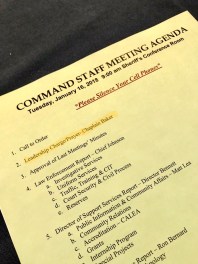
This morning’s agenda. I was #2 on the list.

This morning I was once again honored to offer the “Leadership Charge/Prayer” at the beginning of his weekly Command Staff meeting. It’s just one duty that I perform as a chaplain with the Hamilton County Sheriff’s Office here in Chattanooga.

If you are unfamiliar with what I’m talking about, once a week our Sheriff (Jim Hammond) holds a meeting with his Command Staff (all the captains and chiefs over the different divisions of the department). At each of these meetings one of our chaplains opens up the meeting with a charge/devotion and prayer, then later closes the meeting with prayer. And since the Sheriff is not only an intimidating figure in his own right, but also a student of the Bible, it’s always encouraging when he doesn’t find fault with what we say. LOL!

The Leadership Charge

Since today was the 16th of the month, I decided to see if there was something from the 16th chapter of Proverbs that might be applicable. So, I went to ProverbialThought.com and found the commentary I had written for verse seven.

Proverbs 16:7 became the text, and my post on the verse (click this link to read) became my 5-minute sermonette.

My seat was next to the corner on the left.

There, from my seat at the table, I spoke to the Sheriff, his staff, and his captains of the need to please the Lord, not men. I spoke of God’s commandments and how that when we keep them, even our enemies have a hard time finding fault with us. Then I read a verse from the New Testament:

And whatsoever ye do, do [it] heartily, as to the Lord, and not unto men; – Colossians 3:23

“It comes down to a simple choice,” I said. “Do we try to make people happy, or do we try to please the Lord?” If all we care about is pleasing people, we will always fail; they are too finicky. But if our goal is to do everything we do to please God, He will handle the rest – including our Sheriff’s upcoming election.

So, what about “shocking” the Sheriff and not the deputy? Nobody was shocked, not even the Sheriff; I did what was expected of me.

It was a catchy title for a post, though 🙂 Wasn’t it?


4 Comments

Filed under Bible Study, General Observations, ministry, politics

Hide In the Rock, or Be Wolf Poop…Your Choice

“There be four things which are little upon the earth, but they are exceeding wise: … The conies are but a feeble folk, yet make they their houses in the rocks” – Proverbs 30:24, 36

Conies

The conies are second in the list  “four (little) things” that are exceedingly wise. But what is a coney? Is it a hot dog found on Long Island, New York? Possibly, but only if a legless wiener is capable of wisdom. These conies in this proverb seem to have a defense against being eaten with mustard – they hide in the rocks.

HyraxThe animal described here is the hyrax, or rock badger (no relation to the kind that can chew off your arm). Found in Africa and the Middle East, these cute little critters, weighing an average of 8 lbs., are scavengers which live in groups of 8 to 10 and find refuge in the cracks and crevices of rocky terrain. Though scientists say the hyrax is a close relative to the elephant (it even has tiny little tusks – how cute!), this furry little animal is practically defenseless…at least on its own.

Their Defense System

Even though hyraxes are small, weak, and incapable of fighting off a predator, they are not on the endangered species list. Why is that? The answer lies in where they make their homes – in the rocks – and how they look out for each other.

Being small and rather slow, the hyraxes in Africa are preyed upon by other animals such as wild dogs, leopards, and Egyptian cobras. However, it seems that the conies in Israel, like the ones of which Solomon spoke, have learned how to use the rocks to their advantage, along with a “system of sentries.”

 “In Israel, the rock hyrax is reportedly rarely preyed upon by terrestrial predators, as their system of sentries and their reliable refuges provide considerable protection. Hyrax remains are almost absent from the droppings of wolves in the Judean Desert.” (Wickipedia)

Is it any wonder why Solomon called the conies (hyraxes) “exceeding wise?” Knowing the danger posed by wolves and the like, the defenseless animals band together, watch over each other, and run to the rocks any time there is a threat.

Our Defense

One would have to be blind to miss the parallels here. Why do so many fools fall victim to the ravenous wolves of the world? Their bones are found scattered across the sands of time because they ventured out alone, without the watchful eyes of others, and without the defense available in the true Rock of Ages, Jesus Christ.

Why won’t more people heed the wisdom of Proverbs? Why do so many of us continue to be eaten alive by the enemy when there is a Rock in which to run and hide?

“OH! Rock of Ages, hide thou me!”

4 Comments

Filed under animals, Bible Study, Christian Unity, community, God, Life/Death, Struggles and Trials

Make the Time

There is so much I’ve got to do, and very little time to do it. So many things on my critical to-do list that it’s probably impossible to get them all done.

In the midst of all this I have a small list of things I want to write about, including some more in-depth responses to readers.

But here’s the thing I must remember… I may not have much time to write, but I must make the time to read. My blog is not as important as His book.


7 Comments

Filed under Bible Study

Fear In the Christmas Story

Christmas Sermons

You may have never considered it, but it’s a challenge to come up with Christmas sermons year after year without being too repetitive. Sure, one could simply preach through Luke 2 every year, but a little creativity can go a long way.

This year I will preach a couple of sermons I have preached in other places, but they will be new to the folk here at South Soddy Baptist. The first Christmas sermon of the year will be based on the notes I’m going to share with you this morning.

To Fear, Or Not to Fear

Did you know there are actually some honest-to-goodness phobias related to Christmas? Here are just a few.

  • Selaphobia – the fear of flashing Christmas lights.
  • Ghabhphobia – the fear of presents or gifts.
  • Krikophobia – the fear of church services.
  • Cyssanophobia – the fear of kissing under the mistletoe.
  • Festivalisophobia – a phobia of the whole Christmas thing.

Therefore, it shouldn’t be any wonder that we can find several places in the Bible where angels told people to “fear not.” Folks back in Bethlehem around 2,000 years ago probably didn’t have a fear of kissing under the mistletoe, but they had every reason to be frightened by talking beings clothed in bright light telling them about babies in mangers, virgin births, and wedding plans.

The story of Christ’s birth is associated with great joy, but it was also full of great initial fear. At least one person in the story (King Herod) never got over his phobias and paranoia, but he never heard an angel tell him “fear not,” either.

Below are my notes/outline from which I will deliver this morning’s sermon at South Soddy Baptist Church. When you have a moment, read the Scriptures I reference. See for yourself what the Spirit has to say.

“Fear In the Christmas Story”

1. Luke 1:12  Zacharias (a faithful, praying priest) was “troubled” (G5015, tarasso), and “fear”(5401, phobos) fell upon him.

The angel said, “Fear (phobeo) not…thy prayer is heard.”

2. Luke 1:29  Mary (a confused young girl) was “troubled” (1298, diatarasso)

The angel said, “Fear not, Mary: for thou hast found favor with God.”

3. Matthew 1:20  The angel of the Lord appeared to Joseph (hurt and scared) in a dream and said, “fear (phobeo) not to take Mary thy wife…”

4. Luke 1:65  “Fear (phobos) came on all that dwelt around” Zacharias and Elisabeth when Zacharias’ “mouth was opened…his tongue was loosed, and he spake, and praised God.”

5. Luke 2:9  The shepherds were “sore afraid” (phobeo phobos megas) …see also Daniel 10:7-8 and Revelation 1:17.

The angel said, “Fear (phobeo) not: for, behold, I bring you good tidings of great joy, which shall be to all people.”

6. Matthew 2:3  Herod, because the wise men asked, “Where is he that is born King of the Jews,” was “troubled” (taraso), and all Jerusalem with him.

7. What should we take away from this today?

  1. True holiness will expose humanity’s sinfulness.
  2. Godly fear will be answered with peace, result in obedience, and respond with praise.
  3. The fear of Christmas will manifest itself in hate, a lack of peace and joy, and no hope.
  4. If you trust in Jesus, He promises the peace of Christmas year-round. John 14:27Peace I leave with you, my peace I give unto you: not as the world giveth, give I unto you. Let not your heart be troubled, neither let it be afraid.

Boston Psychotherapist, Dr. Karen Ruskin (an agnostic) said: “[Some atheists are] not unlike the bully who pushes other people down in order to make himself feel better. There are atheists who have a very uncomfortable belief about [their non-belief] they feel the need to push other people down. There is an emotional confusion among some atheists that drives them to promote their product on others [to make them feel better about themselves]. – From an interview on Bill O’Reilly, 12/2/14


5 Comments

Filed under Bible Study, Christianity, Christmas, Church, Preaching

Manipulating the Manna

As we approach the Thanksgiving holiday here in America, I have been studying Exodus 16 and Numbers 11:6-8 for this Sunday morning’s sermon. Over the next few days, I would like to share with you some of the things I’ve learned.

When you have a spare moment, please read these passages (Exodus 15:22-23; Exodus 16; and Numbers 11, particularly verses 6-8) in order to become more familiar with the text from which I am gathering my thoughts.


Manna

After the children of Israel were freed from slavery in Egypt, it took only three days for some of them to start complaining. After only six weeks of freedom from bondage, the whole Israelite camp was “murmuring” against Moses – actually, against God.

Even after all God had accomplished for them, the Israelites were somehow afraid that the One who kept them from all the plagues that befell their slavemasters, the One who had just parted the Red Sea, could not take care of them in the wilderness. Right from the beginning, they began to complain, up until the point where they began wishing they were back in bondage eating the food of slaves.

As you can read in the text, even though God had already done so much, and even though His people were faithless and idolatrous (because covetousness is the same as idolatry – see Ephesians 5:5), the Lord God was faithful to keep His own covenant and miraculously provided food from heaven – manna.

Nevertheless, even though what God provided them was sufficient to meet their needs, over time they once again began to remember with fondness the foods of Egypt. Therefore, as they became weary of the manna – as miraculous as it was – they sought ways to change it, to manipulate it, and to shape it into something akin to what they missed from the years of their captivity.

Manipulating the Gospel

Do we not do the same thing today with the simple, yet wholly-sufficient gospel of Jesus Christ? Is it not sweet and pleasant enough?

When we are forgetful (forgetful of God’s mercy and grace); when we allow discontent to develop in our hearts; when we take our eyes off God; when we doubt His promises and provision; when we selectively remember the variety of lustful pleasures in Egypt that have tainted our palate; the simple, pure, wholesome things of God lose their appeal, leading us to mix and mash the “manna” with things that suit our particular tastes.

Unfortunately, all we end up with is something no one will find palatable or satisfying.


In my next post, I will share with you some actual statistics I uncovered regarding the miracle of the manna in the wilderness. Hint: You’ll need a “boxcar” to walk away with it.

1 Comment

Filed under Bible Study, Theology

I’ve Been Tozered

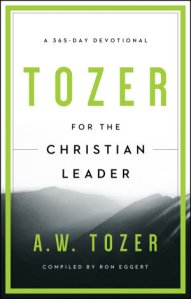
A couple of weeks ago I started reading a new devotional every morning. It is a compilation of writings from A.W. Tozer, and it is meant for the Christian leader.


To be honest, I have been convicted by some of the things that I have read.  Today’s entry alone gave me reason to pause and consider my own carnality.  In the devotion entitled Faith Dares to Fail, Tozer says:

The man who is elated by success and cast down by failure is still a carnal man. At best his fruit will have a worm in it.” Believe me, there are times when I get down.

But it was yesterday’s devontion that stood out the most out of all the ones I have read recently. In Greatness Has Its Price, Tozer uses painful analogy to point out one reason why most Christians (and churches) are pitifully inadequate and effective, the power of the Holy Spirit aside:

The amount of loafing practiced by the average Christian in spiritual things would ruin a concert pianist if he allowed himself to do the same thing in the field of music. The idle puttering around that we see in church circles would end the career of a big-league pitcher in one week. No scientist could solve his exacting problem if he took as little interest in it as the rank and file of Christians take in the art of being holy. The nation whose soldiers were as soft and undisciplined as the soldiers of the churches would be conquered by the first enemy that attacked it. Triumphs are not won by men and easy chairs. Success is costly.”

Yet, even though we are told to “be ye holy, even as I am holy,” we treat our faith like a weekend leisure activity, never caring much about the eternal outcome, only the present pleasure of half-hearted activity and even less commitment. Need proof?

  •  How many verses of scripture have you memorized “that [you] might not sin against God”?
  •  Is your commitment level to a local sports facility more than your commitment level to a local assembly of believers?
  •  Do you brag more about your child’s batting average than his boldness to tell others about Jesus?
  •  When’s the last time you ever voluntarily did any Bible study outside of what was spoonfed to you in church?

Is there any wonder the church, along with most of its members, is weak?  We’ve forgotten what it means to “be sober and vigilant.” We’ve become lazy and insubordinate soldiers in the army of our God,  yet spend millions in research to determine why we’ve lost ground to the Enemy.  We’ve even traded our powerful pulpits for motivational ministries that adjust our “easy chairs.”

Maybe it’s time we take our faith seriously – because the One to whom we will answer to does.

1 Comment

Filed under Bible Study, Christian Maturity, Christianity, Faith

Keep Silent and Hate Your Soul

“Whoso is partner with a thief hateth his own soul: he heareth cursing, and bewrayeth it not.” – Proverbs 29:24

Bewrayeth

When was the last time you used “bewrayeth” in a conversation? I don’t know if I have ever even seen it in a crossword puzzle. But before we go any further, let’s make sure we understand this old English word.

According to Strong’s Concordance,  the Hebrew נָגַד (nagad ) occurs 370 times in the King James Version. Besides “bewrayeth,” nagad is translated most often as “tell,” “declare,” and “shew.” Therefore, it is safe to conclude that “bewrayeth” carries with it the idea of making something known or telling it the way it is.

So, then, what does “bewrayeth’ have to do with partnering with a thief and hating one’s soul?

Partners

First, it must be understood that a partner in crime is just as guilty as his other partner in crime. The one driving the getaway car and the one laundering the money are just as guilty of bank robbery as the one who takes the bag of cash from the safe.

Are you a partner with a thief? Do you recoil at that question? Stop and consider that if you know of someone committing a crime, no matter how small, then you are just as guilty if you keep silent. For instance, do you know of a man who beats his wife and yet have never reported the abuse? If so, then you are enabling him to do his dirty work, which makes you his partner in crime.

Self-Haters

The hard thing to grasp is that when we try to stay out of something by remaining silent, we are not doing ourselves a favor. So many people will witness a wrong or learn of a crime, but keep silent in order to protect themselves. But even though one may stay out of the spotlight or courtroom, the one that “bewrayeth it not” hates his own soul.

What is a worse form of hate: to hate one’s body, or hate one’s soul? Which is worse, the fear of jail time or eternal damnation? Simply put, there are deeper consequences for “not getting involved” than for speaking out in the face of evil.


(The previous was adapted from a post I wrote on 1/01/14 for ProverbialThought.com entitled “When Silence is Self-Hate.”)

1 Comment

Filed under Bible Study, community, Life Lessons, self-worth