Tag Archives: Sheep

“I Just Wanna Be a Sheep”

The following post was written by a fellow blogger from New Zealand, Johanna. Unfortunately, Johanna was not in a place where she could access my blog to add her post, so she emailed me the text. Johanna blogs at Isaiah 41v10. Be sure to pay her a visit…she may have some more shepherding advice on hand 😉


‘I just wanna be a sheep’

I come from a country that is famous for its sheep. New Zealand used to have more than 70 million sheep.  Now the number is about 29 million, according to teara.govt.nz.  August is the best time of year to see the sheep, as it is late winter, when the ewes are lambing. It is delightful to watch the lambs gambolling in the fields playfully, so different from their sedate mothers.

Thinking about sheep gets me pondering all the Biblical references to sheep. The way we farm sheep here in NZ is quite different from 1st Century Palestine or how David cared for his father’s sheep before he became king of Ancient Israel. These differences can teach us something about our relationship with God.

Shepherds in the Bible

It’s clear from reading the Bible texts that the good shepherds in those days (like David) had a small number of valued sheep, each one of which was known by the shepherd, and who knew the shepherd and followed him.

“What man of you, having a hundred sheep, if he has lost one of them, does not leave the ninety-nine in the open country, and go after the one that is lost until he finds it? And when he has found it, he lays it on his shoulders, rejoicing. And when he comes home, he calls together his friends and his neighbors, saying to them, “Rejoice with me, for I have found my sheep that was lost. “ (Luke 15:4-6 ESV)

Jesus also talks about the shepherd’s relationship to his sheep in John 10:3-4, where he says, “The sheep hear his voice, and he calls his own sheep by name and leads them out. When he has brought out all his own, he goes before them, and the sheep follow him, for they know his voice. “

Contrast this with modern farming, where a farmer will often have hundreds, if not thousands of sheep. They live in fields fenced by barbed wire. They are seen as stupid animals, that the shepherd herds by using dogs to make them obey his will. You do not see a shepherd leading his sheep, instead driving them in front of him. They have an eartag with a number to identify them to the sheep farmer.

To me this speaks of two different ways of relating to God.

What kind of sheep are you?

One kind is motivated by fear, and kept safe by barbed wire. These fences are like the extra rules that we make for ourselves or that others make for us, to keep us safe and away from sin. But they also keep us from following the Shepherd to green pastures. Instead we are boxed in where the grass has been overgrazed, living on stale hay.

Some sheep break out, thinking that the grass looks greener elsewhere, and end up on a busy road or in a ditch. This is like those who break away from legalism to do their own thing, or those who fear the Shepherd and his voice, and shipwreck their lives as a result. Both are far from the Shepherd.

The Good Shepherd’s sheep are motivated by love for their Shepherd. They trust him to keep them safe and fed, and they follow him wherever he leads. He leads them to green pastures and restores their souls. He protects them in the darkest valleys and lays down his life for them. Jesus said,  “If you love me, keep my commands. And I will ask the Father, and he will give you another advocate to help you and be with you forever — the Spirit of truth.”

Jesus is not a factory farmer. He wants us to know his voice and follow him out of love. He doesn’t want us to be penned in by traditions or extra rules, but instead to walk with him to green pastures and fresh water.

Will you follow him?
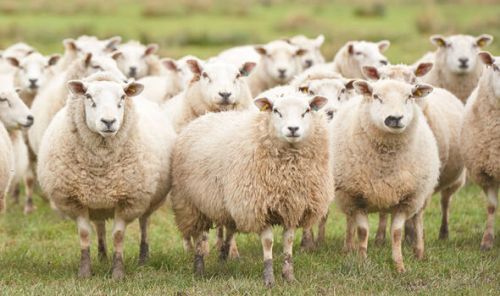
sheep-617128

That’s Anthony on the far left. He always has to get his nose in the picture.

3 Comments

Filed under animals, Bible Study, Christian Living

The Other Side of a Coined Phrase

You can talk all you want about what we’re NOT supposed to do, but we DO it all the time.  Who hasn’t seen the video of the panel of judges that were totally awestruck, not to mentioned very embarrassed, when Susan Boyle began to sing?  Judging by her looks, this was not supposed to be a superstar singer.  The whole crowd was guilty of  thinking the same thing…”What is this ugly woman doing on stage?”  Subconsciously they were thinking, “Only beautiful people can sing beautifully.”  Oh, how wrong they were!

I have heard it said all my life, “Don’t judge a book by its cover.”  Since I have done some research, that would mean I would have to be younger than 70, because that phrase wasn’t even coined until the mid 1940’s.  Anyway, I have been taught, as most people have, that we are not supposed to make assumptions about people simply on the basis of appearances.  As a matter of fact, long before “don’t judge a book by its cover” was coined, Benjamin Franklin said, “Don’t judge men’s wealth or godliness by their Sunday appearance.”  We all know that we shouldn’t judge a man’s character by his appearance (or even by the color of his skin, as Martin L. King, Jr. would have said).  But with all that said,

I can’t help but think that there is another side to this coin (coined phrase, that is).

While it may be true that we shouldn’t come to a conclusion about someone based solely on appearance,  how many books would you pick up and open if on the outside there was nothing describing the inside?  How much money is spent these days on cover design, I wonder.  Go to any bookseller and browse any isle and tell me what you find.  Are any of the books simply bound with only the title and the author printed on front?  Probably not.  Every kind of trick imaginable is employed to catch your eye and cause you to open the cover to see what is inside.  Now, not every cover will appeal to every reader, but the author will know ahead of time what type of audience he is trying to reach, therefore he will have a cover designed to appeal to the reader that will most likely buy the book.  How foolish would the writer be if he spent thousands of dollars for a design that appealed to the wrong crowd?  Even more, what would be the purpose of writing a book that had a cover which said nothing hinting of the content?

The other side to this “book-judging” coin is that even though we should not pre-judge a book by what is on the cover, the cover should give us some clues to what is on the inside.

For example, take a look at the title of the book to the right.  If you were to pick this book up at a book store, you would assume that on the inside there should be at least a hundred recipes, correct?  Really, the title of the book should give you confidence that inside resides the answer to all those questions you’ve had recently about how long you should roast a kangaroo tenderloin.  Shouldn’t it?  It says “How to Cook Everything.”   Well, by dang, I would assume, based on the cover, there should be, by my judgement, a kangaroo recipe in there somewhere.  I don’t know if there is or not, but do you see my point?  If you say you’re something, or if you want to give a certain impression, then be what you say you are, or kangaroo eaters are going to be disappointed.

Now, Jesus did say in Matthew 7:1,  “Judge not, that ye be not judged.”  He also said,  “Judge not according to the appearance, but judge righteous judgment” (John 7:24).  The problem is that when we say that we should not judge a book by its cover, we imply that we can NEVER make ANY judgment based on what we see.  Seriously, how practical is that?  Jesus never said that we could never make righteous judgments.  As a matter of fact, consider these words of Jesus as found in Matthew 7, verses 15-20:

“Beware of false prophets, which come to you in sheep’s clothing, but inwardly they are ravening wolves. Ye shall know them by their fruits. Do men gather grapes of thorns, or figs of thistles? Even so every good tree bringeth forth good fruit; but a corrupt tree bringeth forth evil fruit. A good tree cannot bring forth evil fruit, neither can a corrupt tree bring forth good fruit. Every tree that bringeth not forth good fruit is hewn down, and cast into the fire. Wherefore by their fruits ye shall know them.”

We are not supposed to come to any rash, prejudiced conclusions about people.  That is a fact.  We have no way of knowing whether a nice, fluffy sheep is a wolf, or not.  By outward appearances alone, all we can determine is that if it looks like a sheep and sounds like a sheep, it must be a sheep….until it starts to act like a sheep-eating wolf.  Then, when a sheep starts baring fangs at us, it is safe to judge, and there is no sin to be added to our account.

Righteous judgment, as Jesus mentioned in John 7:24, CAN be made if it is in reference to the fruit being inspected.  The fruit of a wolf is different than a sheep.  But here’s the point:

If a sheep claims to be a sheep, it should act like a sheep, not a wolf!

What is on the cover of a book SHOULD tell what is on the inside.  What we look like on the cover SHOULD make others want to read what is inside.  What we look like on the outside SHOULD mirror the message of the Author’s Word.  As believers in Christ, we claim to be something special.  We have the imprint of our Saviour written on our binding.  Jesus has a reputation as an Author, and what is inside our covers should not bring shame to His writing ability.  It may be wrong to judge a book by its cover, but it is equally wrong to claim to be a book that you’re not.

2 Comments

Filed under Christian Living, General Observations, legalism, World View