7 Words that Distinguish Our Founding Fathers from Modern Americans

“We hold these truths to be self-evident…”

If there were ever any words that are so antithetical to today’s culture, these words from the Declaraton of Independence stand out above them all.

Believe it or not, the founding fathers of the United States of America firmly held to the belief that there are absolute, transcendent truths by which we are able to govern and judge society.

They not only believed there are “truths,” but they believed that these truths are “self-evident.” In other words, they believed that these transcendent truths, rooted in the nature of God, were not hard to find, but plain for all to see, should they only open their eyes. Hence the term self-evident.

Today’s culture has totally rebelled against the concepts of truth and anything that is self-evident. For example, the truth is that God created male and female (Gen. 1:27; Mark 10:6), and what is self-evident are their differences. Yet, modern Americans cannot bring themselves to admit what is obvious, no matter how self-evident.

Just today I read of a transgender activist, Zinnia Jones, who maintains that men who are not attracted to transgender women have “issues”…issues “they should work through.” In other words, Jones believes that biological males who are attracted only to biological females, not trans women, should be relegated to the fringes of society.

In the book of Matthew, chapter seven, we read of two men: a wise man, and a foolish man. Jesus said that a man who listens and does what He says is like a wise man who builds his house on a solid, rock foundation. The foolish man is the one who doesn’t listen to the sayings of Jesus and therefore builds his house on sand. When the storms come, the house built on rock stands firm, but the one built on sand comes crashing down.

A bedrock foundation is un-moving, un-changing, consistent, able to bear weight, and unaffected by the changing weather. However, sandy foundations, although conforming and accommodating, are inconsistent, unable to bear weight, and always changing with the winds of time.

The foundation on which America was built can be found in the “truth” of the Scripture. Without these truths a free, self-governing society cannot not exist for long, if at all.

“[I]t is religion and morality alone which can establish the principles upon which freedom can securely stand. The only foundation of a free constitution is pure virtue.”

“[W]e have no government armed with power capable of contending
with human passions unbridled by morality and religion. . . . Our constitution
was made only for a moral and religious people. It is wholly inadequate to the
government of any other.”

– John Adams, Signer of the Declaration of Independence, 2nd President

Unfortunately, modern Americans are rebuilding America on top of a foundation that is comfortable, conforming, and accommodating, always able to shift with the changing winds of culture. And just like the foolish man that Jesus describe in Mathew 7, our “house” will eventually come crashing down, “and great [will be] the fall of it.”

People wonder how long America will survive. My contention is that it can’t survive much longer. How can it when the very foundational truths on which our liberties are grounded has been reduced to shifting sand?

“We hold no truth, and nothing is self-evident; all is relative to self-identification.” – Modern Americans

6 Comments

Filed under America, Culture Wars

The Pulpit and Freedom: A History of the Black Robe Regiment

Some question the uniqueness of the American “experiment,” but they do so out of ignorance. Should the average American ever learn the real story of the founding of his nation, his sparkling celebrations might lay aside the fireworks and pay tribute to the thunder that once rang from our pulpits.

Christianity is not an American religion. More than that, there should never be anything like an “American Christianity,” for the Gospel of Jesus Christ and the freedom He brings to those who trust in Him are not limited by borders or bound by human law: the Gospel is the same good news to every man, woman, and child, regardless their nationality.

But is was in the days leading up to the American Revolution that the tenets of Christianity and its practical implications for the average citizen were preached by men with iron spines. These were the men of the “black robe regiment,” the clergy who not only talked the talk, but walked the walk on the road to liberty.

Unfortunately, there are those today who are completely oblivious to the effect the pulpit had on our founding, and many want nothing of our founding ever spoken from our pulpits again. However, to be silent in the face of rampant decay and attacks on the very fundamental doctrines of the Faith, especially by those who would like nothing better than to extinguish the flame of liberty, would not only be a dishonor to those men who faithfully preached truth and willingly offered their lives on literal battlefields in the cause of freedom, but it would be an utter failure in the charge to be good stewards of what was bought for us with blood.

“If Christian ministers had not preached and prayed, there might have been no revolution as yet – or had it broken out, it might have been crushed.”  – Bibliotheca Sacra [BRITISH PERIODICAL], 1856

Click HERE ,or on the above picture, to read a little history of what the British called the “black robe regiment.”


Leave a comment

Filed under America, Preaching

They Decry What Preserves


“Without morals a republic cannot subsist any length of time; they therefore who are decrying the Christian religion, whose morality is so sublime & pure, [and] which denounces against the wicked eternal misery, and [which] insured to the good eternal happiness, are undermining the solid foundation of morals, the best security for the duration of free governments.”

 – Charles Carroll of Carrollton (Signer of the Declaration of Independence)

(Source: Bernard C. Steiner, The Life and
Correspondence of James McHenry
 (Cleveland: The Burrows Brothers, 1907),
p. 475. In a letter from Charles Carroll to James McHenry of November 4, 1800.)

Leave a comment

Filed under America

Chivalry

Like every summer, more articles have been published by young women who think modesty is overrated, if not harmful, and that men should just get a grip. Seriously, it’s like “Let me go naked in public, but don’t question my judgment, and by all means don’t lust, creep!” I’ve heard the arguments, but I just don’t get it.

Well, what you have here is a post by a different kind of girl, one who understands freedom and grace, but also self-worth and dignity – and yes, modesty. Therefore, it doesn’t surprise me that she considers the following picture her favorite out of hundreds taken over 26 days throughout Europe.

In a world that is going mad, this post is a quick breath of fresh air.

Katie Marie's avatarShutter Elf

DSC_0262 Civalry in Verona

This was my proudest moment in all of my tour of Europe. The young men here are Eric (left) and Jeremey (right). We were at the home of Juliet in Verona, Italy, and this is the statue people visit there. The tradition is that you are to place your hand on her breast for good luck and fortune, but these guys were the two in the whole place that wanted to show her – a statue – what respect and love is.

View original post

3 Comments

Filed under Uncategorized

Scriptural Unity Isn’t Based On Doctrine?

While going through the list of blog posts I never published, I came across this timely piece from all the way back in March of 2012. So, with some minor modifications, I will now bring it to life after five long years in the the “Draft” folder 🙂


Did he really say that? 

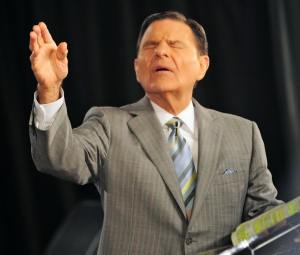
In today’s edition of his online devotional (3/23/2012), Kenneth Copeland said the following:

“What they don’t realize is this: scriptural unity isn’t based on doctrine…Winds of doctrine, according to Ephesians 4:14, are childish. Winds of doctrine don’t unify. They divide and blow people in every direction. The Word doesn’t say anything about us coming into the unity of our doctrines. It says we’ll come into the unity of the faith.” – Kenneth Copeland

In a Facebook post, a friend of mine referenced the above devotional. The part that encouraged him was the suggestion that Christians should unify around our faith and not be separated by insignificant differences. However, doctrine is NOT insignificant! Rather, it’s absolutely crucial to true unity.

Sadly, Copeland portrayed “doctrine” as what divides the Church. Referencing Ephesians 4:14, he equated doctrinal differences with childish man-made doctrines. He took the verse out of context to say (paraphrasing), “Hey, don’t worry about doctrine, our unity is not based on doctrine; only worry about the unity of the faith.” For some reason, however, the Apostle Paul seems to disagree with Copland…

Romans 16:17 – Now I beseech you, brethren, mark them which cause divisions and offences contrary to the doctrine which ye have learned; and avoid them.

1 Timothy 4:6, 13, and 16 – If thou put the brethren in remembrance of these things, thou shalt be a good minister of Jesus Christ, nourished up in the words of faith and of good doctrine, whereunto thou hast attained. (13) Till I come, give attendance to reading, to exhortation, to doctrine. (16) Take heed unto thyself, and unto the doctrine; continue in them: for in doing this thou shalt both save thyself, and them that hear thee.

If doctrine is not important, does that mean that we can unify with anyone? What if their doctrine says that we are all gods; that we can command God to answer our prayers; or that our very own words can literally create what we will, just as long as we have faith in our own words? …um, in case you didn’t know, that’s what Kenneth Copeland teaches.

Believe me, I’m all for genuine, biblical unity that crosses denominational boundaries and man-made, legalistic standards. Non-essentials have for too long kept the family of God separated and at odds with each other. But what about the essential doctrines of the faith?

Do we throw all doctrine out the window for the sake of unity?

No! Absolutely not.

Besides, even if I did become unified with the teachings of Kenneth Copeland, I doubt he’d let me ride in his jet.

Click here to view previous post on The Doctrine of Separation.

1 Comment

Filed under cults, Theology

Been There, Done That…Now Listen

As many of you know, I now do a radio program that is a knock-off version of ProverialThought.com, my other blog.  What I do is share thoughts and reflections on a different proverb each week, and some of the content is based on what I’ve already written.

Well, in preparation for this Sunday’s broadcast, I was doing a little study this morning on Proverbs 4:11-12. There’s a lot in these two verses, and I’m looking forward to unpacking them.

The following is what I wrote back in 2012 for ProverbialThought.com (which is also included in the book).


Proverbs 4:11-12

“I have taught thee in the way of wisdom; I have led thee in right paths. When thou goest, thy steps shall not be straitened; and when thou runnest, thou shalt not stumble.”

A Way Walked

The first part of this passage is fairly simple to understand. In a moment of recollection, Solomon is reminding his children that he has given them good instruction; that he has led them.The best teachers are those who can say, “I have been down that road.” Sure, it is easy to give directions, but how much more valuable is the instruction when the teacher can relay first-hand experience?

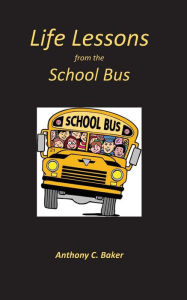
As a bus driver, I drive the same route every day. I could draw a map that would be as accurate as one printed. But the difference between my map and an image from a satellite would be my knowledge of hazards unique to the vehicle. Unlike automobiles, 40 foot buses aren’t able to straighten some curves, or go under some bridges. Maps don’t usually show those things; but experience will.

Solomon is telling his children, as God is telling us, that the way ahead will be much easier if we listen to those who have gone before.

A Parental Challange

One interesting thing to note is where Solomon says “I have taught thee…” A deeper look at the word taught will show that it also means “to throw, to shoot.” Let this be a reminder – children are ours for a purpose.

In Psalm 127:5 David refers to children as “arrows” in a quiver. Arrows are worthless unless they are used. Arrows are worthless unless they are sharp, straight, and designed for a specific target. Children are to be considered tools with a mission, and we are to train them and keep them until we launch them toward their goals.

Straight, or Not?

Another interesting thing to consider is the word “straightened.” At first glance, we might consider the word here to mean the same as implied in the phrases “straight and narrow,” or “straight as an arrow.” Why, then, does Solomon say “thy steps shall not be straightened?” Does he want them to encounter curves along the way?

Actually, the word here is yatsar (Strong’s H3334), which can mean “to bind, be distressed, be in distress, be cramped, be narrow.” In reality, Solomon is saying that if one follows wise instruction, the way ahead will be less stressful, less binding, less depressing.

Thinking about this, I am immediately reminded of a particular place on the path through Rock City (a tourist attraction near Chattanooga, TN). It is called “fat man’s squeeze.” Seriously, if you are over 250 pounds, you might not make it through this narrow passage between two huge walls of rock. Yet, if you follow the signs along the way, you will be led to a different way around this “squeeze.”

If we would just follow wise counsel, the chances are much better that we will reach our goals, instead of stumbling or getting stuck along the way.

Leave a comment

Filed under Bible Study

The Parsonage Project

What I’m Doing

I would really appreciate your prayers. Pray that God would give me wisdom and a steady mind. Pray that I will keep my eyes fixed on Jesus, the Author and Finisher of my faith, for stormy waves are trying to distract my focus. Pray for me, if for nothing else, that I will myself remain in constant prayer.

This week the house that we are living in will be listed on the market to be sold, and we are not as ready as we would like to be. On top of that, the house in which we are planning to move is the parsonage of the church where I now pastor – but it is FAR from being ready.

Right now I am having to work a job and pastor a church; record a weekly radio broadcast; record lectures at the seminary; move a lot of stuff into storage; see that a house is ready to be seen by buyers; and oversee the restoration of an old house – a restoration which costs more money than we have and will have to incorporate the expertise of many people. That doesn’t count being a parent and a husband. Can you see why I wanted people to send me guest posts?

That’s why prayer is so important. In James 4:2 we read that we have not because we ask not, so I’m asking – pray for us.

The Parsonage

It is a well-known fact among pastors and their families that parsonages are a mixed blessing. For one thing, when you live in a parsonage (a house owned by a church, but meant to house the pastor), you live in a house that is not your own. Secondly, living in a parsonage usually means that you are not building up any equity or means to move into a normal home. So, what happens is that when the pastor ends up leaving the church where he pastors, if nothing else is done, he and is family are effectively homeless.

But, there are times when a parsonage can be a blessing, like for us, because without it we would have no place to live at this point. Also, the parsonage, if used properly, can be a tool for evangelism and discipleship. The parsonage can also show that the pastor and his family are personally invested in the health of the congregation he shepherds. Therefore, if the church does have a parsonage, it should be well-maintained in order to make full use of its potential.

Unfortunately, the parsonage at the church where I now pastor has fallen into serious disrepair. I am working with different groups and individuals in order to restore the old house, but that will take time, manpower, and a lot of something we (the congregation) don’t have…money. One group of men estimated that it would take $10,000 to make the parsonage livable. On the other hand, I was told by someone else that the costs would be closer to $30,000. And right now this little upstart of a little church only runs around 15 in a decent Sunday!

The Video

Below is a video I made last Sunday. In it I take you through the parsonage and let you see for yourself what needs to be done. Look, Nehemiah rebuilt a wall which his enemies swore would fall down if only a fox pushed against it. Noah built a huge ark with the help of fewer men than volunteers I will have. What needs to be done will get done, but this ship won’t sail without a strong wind of prayer.

If all things were easy and well within our own power, we wouldn’t need God’s help. But, when things seem impossible, we call upon the Lord to do for us what we cannot do (Psalm 57:2), thereby allowing Him to get the glory and praise.

The more impossible the project – even a parsonage project – the more praise, glory, and honor is due our Savior and King.

7 Comments

Filed under Christian Living, Christian Unity, Church, Prayer, Preaching, Relationships and Family

Jesus Paid It All and Your Payment’s No Good Here

A guest post by Wally Fry

jesus saves

Two Religions

Aside from the obvious non-religions like atheism, humanism and so forth, there are only two actual “religions” in the world.

The first is the religion of good works. Believers in this religion believe that there is something, somehow, that they can do to ensure their own entry in to Heaven. There are subsets of this religion:

  • Some believe sacraments and rituals, if done properly, ensure entrance into heaven.
  • Some believe in the scale of justice theory of salvation, believing that if their good outweighs their bad they can ensure their entry into Heaven.
  • Some believe that if they just do not do anything “really bad” they can ensure their entry into heaven. Adherents of this religion call themselves many different things: New Agers, spiritual, Catholic, Protestant, Mormon, Jehovah’s Witnesses, Buddhist, and even Evangelical Christians.
  • Some may call themselves Methodists, Baptists, or any other name one can call to mind.

On the other hand, there is the true “religion”. This is simply the Faith that teaches that absolutely nothing any human can do is sufficient to pay for the sin we have all committed. Our payment is no good here. In the first article in this series, Jesus Paid it All, we discussed the fact that we can each certainly pay our own way for our own sin. That article can be Read Here:

Jesus Paid It All and you Really Don’t Want to Pay Your Own Way

But, as that article shows, the only way we can pay for our own sin is by death, both physical and spiritual. Eternally we pay our debt by being forever separated from God in a place of torment called Hell. That is the ONLY way we can pay for our own sin.

In other words, we can pay our own debt, but we can never redeem ourselves from the penalty of what we have done.

Ephesians 2:8-9 “For by grace are ye saved through faith; and that not of yourselves: it is the gift of God: Not of works, lest any man should boast.”

That verse is really fairly self-explanatory and says and means exactly what it says. It seems to say it with little ambiguity or room for alternate interpretations. Nonetheless, let’s expand a little on what it is really saying.

Only Grace

We are saved by God’s Grace, through our faith(and even that is given to us by God.) Grace is a free gift of God, not earned by us. No work we might ever do contributes one iota toward our eternal Salvation. We WANT our salvation to be by our works because we really, really like ourselves.

Grace plus nothing equals our Salvation. Jesus Paid it All. He doesn’t need our help to finish the project, His Grace is sufficient. Period and end of the story.

We can’t do enough good to cover our own sin.

We can’t avoid enough bad to cover our own sin.

We cannot do anything in our unsaved state to appear favorable in the sight of a Holy and perfect God.

Our Rituals, Sacraments and Ordinances, while not wrong by any means can never save us.

No sacrifice of any sort can ever save us.

What, then saves us? It starts with Grace. God’s gift of His son who COULD pay for our sin, and did. We simply have to accept the gift by Repentance toward God and believe in His Son Jesus Christ.

5 Comments

Filed under God, grace, Guest Posts, salvation

Dusty Keys

Katie Marie's avatarShutter Elf

DSC_0010 (2)

Never lose the passion.

View original post

Leave a comment

Filed under Uncategorized

Hurting

Guest Post by: Dorissa Vanover


“I’ve lost my song,” my mother-in-law told me, as her tender heart broke into a million pieces.Today, I understand exactly what she meant.

Sometimes the pain seems relentlessly intense and hopelessly never-ending. During those times, the singer can’t sing, the writer can’t write and the artist can’t paint.

Each of us is born with a unique gift or ability, given to us by our Creator, so that we can fully express ourselves. Using the gift is a way of expressing our love and thanks to our Heavenly Father, a way to encourage others we meet along the way, and a way of joyfully immersing ourselves in our passion. We make time, knowing that we affirm ourselves and our God-given abilities as we express ourselves.

And then…unexpectedly, because we are imperfect humans living in a fallen world, we encounter heartbreak so overwhelming, it immobilizes us. We may be able to awaken each morning, get dressed and make it through our day; we may even remember to thank God for the blessings we know are still all around us. Truth is, though, we feel hopelessness inside. While we may be able to continue to function, we are not able to thrive.

Finally, knowing our spirits will break if we don’t get help, we fall to our knees beseeching our Father for the comfort only he can give. We quietly absorb the grace and mercy of being in his presence. His love surrounds us and our burden is lifted. We are renewed.

Once again, the singer sings, the writer writes, and the artist paints. It seems amazing, but the time spent away from the gift seems only to enhance the song, the words, or the painting. Yes, our Father created each of us with a wonderfully unique gift and gives us a time and place to use the gift. The greatest gift he gave each of us, though, is the freedom to have a relationship with him. He alone can replace our brokenness with joy and thanksgiving.

There may be several periods during a lifetime when the hurt seems greater than the hope. We know, though, because we belong to him, he is our hope, and there is nothing greater than him!


4 Comments

Filed under Guest Posts, Life Lessons, Struggles and Trials