Tag Archives: traffic laws

I Need a Lawyer!

Speed Trap

Do you know what a “speed trap” is? Just so we can all be on the same page (or road), let me ‘splain it to you, Lucy.

Wherever you are in the world, if you have an automobile and go anywhere, I’m sure you’ve experienced a speed limit. Somewhere, usually in a visible place beside the roadway, there will be a sign on which is written the speed limit for that stretch of road.

Tracking with me so far?

However, sometimes you will come upon a stretch of road where the speed limit changes abruptly. That’s not unreasonable, especially when conditions demand it.

But when a wide stretch of interstate goes down from 65 or 70mph to 50mph without warning or graduation, THAT’S the definition of a speed trap. And that’s typically where a policeman or state trooper will park their cars and wait for unsuspecting motorists.

Caught In the Trap

You know where this is going, don’t you? Yep, I got caught in a speed trap last week.

It all happened on a stretch of interstate highway I75 in Tennessee, just above the border with Georgia. Come to find out, about a quarter mile into Tennessee, the speed limit drops to 50mph.

Yes, 50mph. On an interstate!

It’s a trap because, yes, there are posted signs, but that kind of speed is so unusual on that kind of roadway, when you see them, your brain ignores them! At best, a quick-thinking brain has to go through extra cognitive steps to process it.

Do you know how fast people here in the South drive on highways through Georgia, Alabama, and Tennessee? No? We don’t either!

The way to stay alive when driving through downtown Atlanta or Nashville, for example, is NOT to obey the posted speed limit. If you do, you’ll likely cause an accident, shut down the highway, and be hated for eternity. NO, you go with the flow of traffic, just like all the other speeders.

So, when I was going from Georgia to Tennessee on I75, I wasn’t really paying attention to the exact speed limit. However, I didn’t think for a moment I was exceeding what was a safe speed – it’s what everyone else was doing.

How fast was I going? More than 50, allegedly.

Legal Help Needed

That’s why I need a lawyer. That’s why I need someone to represent me, to go with me, to stand before the judge in front of me. I need a defender, one who argues my case on my behalf, so that the full weight of the law is not dropped on my head.

Fact is I may have broken the law. The consequences of my alleged offense could be serious should the judge show no mercy.

But if someone comes along on my behalf, someone known and respected by the Court, and that person manages to convince the judge to find a way to avoid serious consequences, I might only receive a small fine, if found guilty, and a warning.

But it won’t be free. Legal help can get expensive. However, the long-term effects of a big speeding ticket could cost a lot more.

My Greatest Defender

What really brought me to the computer, though, was not a grievance—it was gratefulness.

Here I am facing a potential fine and points on my driving record (as of now I have none). And because of the points there could be other ramifications. But all that being said, at least I know I’m not going to Hell.

That’s right! No eternal damnation for me! How’s that, you ask? Because I have the greatest defense Attorney in the entire universe!

Jesus! (see 1 John 2:1-2)

He is like no other!

For one thing, Jesus knows my whole story. He knows me like no other. But more than that, He knows the Judge. They are actually just alike 😉

Secondly, unlike the lawyer I am going to hire, Jesus paid the price, the debt I owed for my transgressions. He doesn’t negotiate a lower fine; He paid the highest fine possible!

What we read in 1 John 1:2 is that Jesus became the “propitiation” for my sin. In other words, He didn’t just pay my fine and accept my punishment, He literally was the payment!

And you know the greatest part of all?

He did the same for you, too!

1 John 2:2 (KJV) And he is the propitiation for our sins: and not for ours only, but also for [the sins of] the whole world.

Oh, and unlike the lawyer that hopefully will handle my case, we don’t have to pay Jesus for his services—it’s a gift by grace through faith (Eph. 2:8-9).

Even His retainer is good for eternity.
Leave a comment

Filed under salvation, Uncategorized

I Went to Pakistan (Part 4): Roads

I love to drive, and I love to drive fast. As a matter of fact, every automobile I’ve owned (with only a few exceptions) has been taken up to 100mph at least once. It’s just a thing I do.

Have you ever driven on a freshly paved road? Remember when in the movie “Cars” they drove around on a freshly re-paved road and loved it? That’s the kind of driving surface that cries out for speed! I love it.

And then there was Pakistan.

Rough Roads

Honestly, the roads in Pakistan were not as bad as some others on which I’ve driven (or ridden). The roads in Zimbabwe were pretty darn rough. They were so rough that guys would sit on the side of the road with air compressors and offer to air up your tires for a dollar. The roads were so bad that your tires would lose pressure!

Then there are also the roads where I live in middle Georgia. The paved roads are just fine; it’s the DIRT roads that are sometimes a challenge. There are a lot of dirt roads in middle Georgia.

However, in Pakistan the roads, on average, were not capable of sustaining any kind of speed. The only time that was possible was when one traveled on the main highway between major cities. That was as nice as a modern American highway.

Rule-less Roads

But it wasn’t the roughness or the smoothness of the Pakistani roads that stuck in my mind. No, what contributed to my PTSD was the fact that there are NO RULES!

Oh, I know what you are probably thinking. You think that I’m overreacting. You think that it’s only because I’m used to the rules of the road in my own country, that there are rules, but I was not culturally sensitive to them.

And you would be wrong. Sorry.

Look, the only – and I mean ONLY – rule I observed over the many hours my life was put in danger was that there were two directions. In other words, when you want to go somewhere in Pakistan, you go in that direction. When you are going in that direction, you and all the other people traveling in that direction are to use only one side of the road. All the people going in a different direction are to use the other side of the road. That’s it!

Oh, wait… I just thought of another one. My bad.

The only other rule has to do with who has the right of way. It’s pretty simple, though. The bigger the vehicle is the more right of way it has. It’s called the “Get out of the way or die!” rule.

Only Guidelines

Now, remind me … did I say that there were essentially only two rules of the road in Pakistan? I’m sorry for misleading you. Actually, there are no rules – they are only guidelines.

Remember how I said that you only need to stay on one side of the road? That’s not entirely true. You know those lines we have in the middle of roads that separate lanes? Not in Pakistan. No, all you have is a road. YOU decide where it is on the road you want to be, depending on who is in front of you.

Here in America, we have rules regarding when it is safe to pass another vehicle. One of the rules of which you might be familiar is “never pass when there is a double yellow line.” Not in Pakistan. When someone is slowing you down, just pass them … even if traffic is coming in the opposite direction. I mean, they will move over into the dirt when they see you coming, so do what you need to do!

Something Strange

But there is something strange about the differences between Pakistani driving and, let’s say, the way people drive in a large American city.

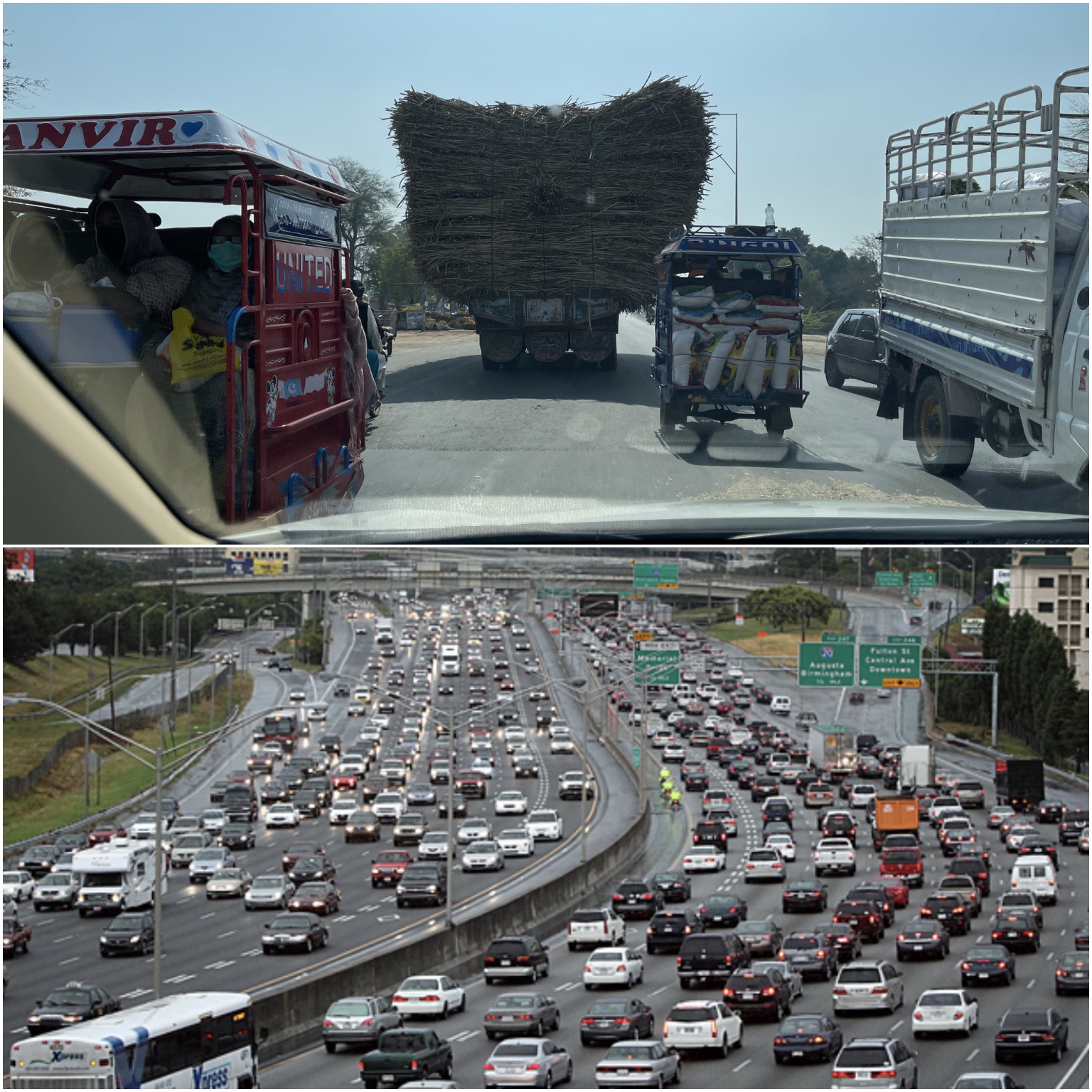
For example, when I drive through cities like Nashville, Chattanooga, Augusta, and Atlanta, what I see are multiple lanes of organized and heavily regulated traffic. Here there are clearly delineated lanes, traffic lights and signs, and even plenty of law enforcement to keep a watch on things.

Pakistan vs. Atlanta, GA

When I traveled on the roads of Pakistan, there were no lines, no regulations, very little law enforcement, and hardly any street/traffic lights or signs.

Yet, the whole time I was in Pakistan – no joke – I never witnessed a single accident. Not one!

THAT should make a person question a lot of things, right?

Travel down any American highway and you will see accidents all the time. Even in the most orderly and regulated settings, somebody is going to do something stupid and crash. And even if you don’t witness cars having a wreck, let somebody cut another person off and you WILL see fingers raised and maybe a little road rage.

Travel in Pakistan and you will see people weaving in and out, cutting others off, driving aggressively and pushing themselves into flow, yet you will never see anyone flipping another off or hear anyone yelling obscenities. No, what you will see is mutual respect, acceptance, understanding, and this attitude of “it’s just the way things are, so don’t get your panties in a wad.”

With all our rules, American drivers are less mature than those with no rules or regulations. Strange.

A Powerful Lesson

So, I think there is a powerful lesson to learn from all this talk about traffic. It has to do with the rules and regulations that are constantly pushed upon us and down our throats.

It’s not only America, but in most all Western nations there is this idea that the government knows best. They treat all us citizens as children, not adults, who need to have our hands held through every facet of life, especially when driving.

One of the greatest examples of this is the traffic camera. Because the government (local and otherwise) cannot trust us to drive responsibly, they put of cameras that check our speed, watch us at intersections, and generally track us wherever we go. It’s like, “I’m giving you rules to show you what you’re allowed to do, but I’m not going to trust you to make the right decisions.”

People who are treated like children will act like children.

But in Pakistan, where there are literally no lines, no lanes, no signs, no lights, and no cameras, the ones treated like responsible adults act like responsible adults – and even in the most dangerous traffic don’t have wrecks.

So, consider the following scriptures. One is from the Old Testament, while the other is from the New Testament (quoting the one from the OT).

But this [shall be] the covenant that I will make with the house of Israel; After those days, saith the LORD, I will put my law in their inward parts, and write it in their hearts; and will be their God, and they shall be my people. – Jeremiah 31:33
For this [is] the covenant that I will make with the house of Israel after those days, saith the Lord; I will put my laws into their mind, and write them in their hearts: and I will be to them a God, and they shall be to me a people: – Hebrews 8:10

Where legalism exists, the one subject to the rules and regulations rarely makes the issues of right and wrong a matter of the heart. No, the primary response to legalism is the temptation to push the limits and/or rebel against the authority. This is why so many people who grow up in overly strict religious environments go hog wild when they get out on their own.

Yet, when people are taught what is right and wrong and eventually trusted to make the right decisions as responsible, mature adults, the “law in the heart” guides even when the cameras are missing.

Your thoughts?

Leave a comment

Filed under America, Christian Maturity, General Observations, legalism, Pakistan, places