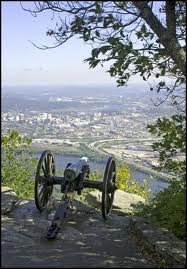
While driving my school bus just the other day, I happened to ask a couple of teenagers about their knowledge of the battle of Lookout Mountain during the Civil War. They had no knowledge that there ever WAS a battle on that mountain! I was completely dumbfounded. Every day we drive across the foot of Lookout Mt., right past monuments and markers, right beneath the cannon placements above, and yet they never even knew there was a battle there! Unbelievable!As I see it, somewhere there was a breakdown in the education these children were given. How is it even possible that teenagers could graduate from schools in Chattanooga and never know that one of the key battles of the Civil War, the very war that liberated their ancestors from slavery (they were African-American), was fought in their own back yard? Mountain during the Civil War. They had no knowledge that there ever WAS a battle on that mountain! I was completely dumbfounded. Every day we drive across the foot of Lookout Mt., right past monuments and markers, right beneath the cannon placements above, and yet they never even knew there was a battle there! Unbelievable!As I see it, somewhere there was a breakdown in the education these children were given. How is it even possible that teenagers could graduate from schools in Chattanooga and never know that one of the key battles of the Civil War, the very war that liberated their ancestors from slavery (they were African-American), was fought in their own back yard?
Was this information not considered important enough to teach in public school?
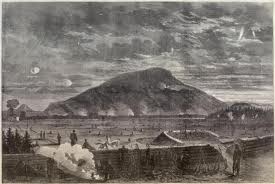
 The Battle of Lookout Mountain When I took just a few minutes to share some facts about what happened in and around Lookout Mountain and Chattanooga, making them look out the windows up to the low-hanging clouds that covered the bluffs, they began to understand some things. When I related how desperate the Union troops were, the seemingly invincible fortress that was Lookout Mountain and Missionary Ridge, and then used the clouds right in front of them to explain the “miracle” that took place, history came alive. I asked them to imagine how scary it was to a guy that may have walked all the way down from New York, just to look straight up that mountain and know that he was going to have to go up it with just a rifle and a bayonet.
Most American young people do not care about history because they have never been led to make a connection with the past. When it becomes personal, either by making it relevant or intriguing, they take ownership. We can’t just sit around and blame our children, or other’s, for not knowing what we do not teach them. The very same thing can be said about our faith and what we believe. Consider the following Scripture:
Joshua 4:4-7 Then Joshua called the twelve men, whom he had prepared of the children of Israel, out of every tribe a man: and Joshua said unto them, Pass over before the ark of Jehovah your God into the midst of the Jordan, and take you up every man of you a stone upon his shoulder, according unto the number of the tribes of the children of Israel; that this may be a sign among you, that, when your children ask in time to come, saying, What mean ye by these stones? then ye shall say unto them, Because the waters of the Jordan were cut off before the ark of the covenant of Jehovah; when it passed over the Jordan, the waters of the Jordan were cut off: and these stones shall be for a memorial unto the children of Israel for ever.
What can we learn from these verses? What principles can we see that could help our youth better understand our Faith, not to mention our history? Here are just a few observations. mention our history? Here are just a few observations.
- “When your children ask in time to come…” If our children are not asking questions, they need to be. We need to lead them to places and discussions that would cause them to ask the right questions that lead them to discover truth.
- “These stones…” There needs to be stones of remembrance, monuments, memorials in each Christian’s life that cause others to ask “the reason of the hope that is in you” (1 Peter 3:15).
- “Then ye shall say unto them…” Do we know what to say when they do ask? We had better! What a loss and a missed opportunity when a child, even an adult, asks “what does this mean,” and we have nothing to say.
- “Your children…” It is our responsibility to teach our children, not the state, nor a stranger. Ultimately, we will be held accountable for what they learn, and from whom.
 I can’t be held responsible for all the children of America, but I will be held responsible for mine (that’s one BIG reason we homeschool). You will have to answer for yours. And when it comes to the others that ride our buses, or mow our lawns, or stand in line, or or sit in our Sunday School classes, or whatever, don’t waste an opportunity to explain the reason for the “stones,” even if it’s a big mountain. I can’t be held responsible for all the children of America, but I will be held responsible for mine (that’s one BIG reason we homeschool). You will have to answer for yours. And when it comes to the others that ride our buses, or mow our lawns, or stand in line, or or sit in our Sunday School classes, or whatever, don’t waste an opportunity to explain the reason for the “stones,” even if it’s a big mountain.
|






 The Recovering Legalist