Category Archives: book review

Barriers to Church Growth. #4 (Hold to God)

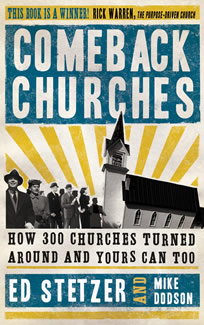
A very revealing study was done, leading to a book detailing how 300 churches went from declining or dying, to growing. In Comeback Churches, written by Ed Stetzer and Mike Dodson, there is a list of 30 different barriers to church growth. Having received permission from the publisher (B&H Publishing Group), I would like to discuss a different barrier each week.
“People are unwilling to take hold of God (Isaiah 64:7).”

“And there is none that calleth upon thy name, that stirreth up himself to take hold of thee: for thou hast hid thy face from us, and hast consumed us, because of our iniquities.” – Isaiah 64:7 KJV

Every time we heard a gospel song that had words similar to “hold on to God,” or “hold to His hand,” my parents quickly reminded us that “we don’t hold God’s hand – He holds ours.” Understandably, what my parents were referring to was salvation. In that sense, we are held and He will never let go.

But that is not what this verse is talking about. Isaiah is saying that part of the problem his people were facing was the fact that none had the desire, nor even the desire to have a desire, to grab hold of God. If that is true today, then it may not only be a huge barrier to church growth, but to individual growth as well.

Take Hold of Thee

It is interesting and revealing when we look at this phrase and compare its usage to other places in Scripture. To begin with, the word chazaq (Strong’s H2388) essentially means “to tie fast, to bind bonds strongly” (Gesenius’s Lexicon). It is a verb that is translated into English as words such as strong, retain, urgent, and caught. Here are just a few examples.

“And the LORD said unto Moses, Put forth thine hand, and take it by the tail. And he put forth his hand, and caught[2388] it, and it became a rod in his hand:” – Exodus 4:4

“And the Egyptians were urgent[2388] upon the people, that they might send them out of the land in haste ; for they said , We be all dead men.” – Exodus 12:33

“Then said his wife unto him, Dost thou still retain[2388] thine integrity? curse God, and die .” – Job 2:9

Moses “caught.” Look at the first verse. Moses had been commanded by God to throw down his rod, after which it became a serpent. Then, against all logic, God told him to pick it up again, but this time by the tail (riiiiigghht!). I would have had to be seriously “stirred up” to pick up a deadly snake by the tail – it BITES! Yet, that’s what Moses did. He “caught it” by the tail.

The Egyptians were “urgent.” Next, after suffering under all the plagues, the Egyptians “were urgent” in there pushing the Israelites out of town. They had come to realize that their own lives were in jeopardy if the Jews stayed one day longer. It was imperative that they be pushed out as quickly as possible.

Job “still retained.” Now, look at poor Job. He had lost everything dear to him, including his health, and then came his wife telling him to curse God and die. She couldn’t believe that he could just sit there and hold on to his belief that God was worth serving. “After all this, are you still holding on to your integrity? What for? What’s the use? Quit putting yourself through this nonsense and just curse God and die!” Yet, he held on.

Making it Apply

When we view Isaiah 64:7 in the light of the verses above, what we have is astounding and convicting. Let’s see if we can work it all together:

1) Taking hold of God is something that we should take seriously, not flippantly. Don’t reach out for Him in a way that implies half-heartedness. Take hold like you mean it! Who do we think God is, a stick to be used by us in our own power to accomplish our own desires? NO! He is alive and dangerous. As Aslan in The Chronicles of Narnia, He is NOT tame. He is not here to be played with.

2) Do we not understand that without the power and presence of God we will die?In Him we live, move, and have our being” (Acts 17:28). There should be an urgency in our desire for Him, no less than the kind the Egyptians had to expel the Jews from their land. Do we want to live? We must urgently “take hold.”

3) We must hold on to God even when it seems insane to others. We must consider our relationship with our Heavenly Father so precious that even when Hell seems to be winning, faith tells us otherwise. Like Job of old, we should hold on to God even when we lie broken and wasted amid the ashes of seeming defeat. Our Redeemer LIVES!

The Barrier that Must Fall

If we are to see growth in our churches, not to mention our own lives, we must seek after God with urgency, intensity, and passion. He must be sought after and adhered to like no other treasure on earth. Anything less betrays our divided, adulterous hearts. God will bless and grow a people who “take hold.” No church will grow who only takes hold of God when it is convenient, fun, or fashionable. We must cleave to Him. It IS a matter of life or death.

Time is filled with swift transition
Not of earth or moon can stand
Build your hope on things eternal
Hold to God’s unchanging hand

Trust in Him who will not leave you
Whatsoever years may bring
When my earthly friends forsaken
Still more closely to Him cling

Hold to God’s unchanging hand
Build your hope on things eternal
Hold to God’s unchanging hand

2 Comments

Filed under book review, Christian Maturity, God, Uncategorized, worship

Barriers to Church Growth. #3

A very revealing study was done, leading to a book detailing how 300 churches went from declining or dying, to growing. In Comeback Churches, written by Ed Stetzer and Mike Dodson, there is a list of 30 different barriers to church growth. Having received permission from the publisher (B&H Publishing Group), I would like to discuss a different barrier each week.

“God withdraws Himself from the church because of sin. He hardens hearts and gives the people over to sin (Isa. 63: 15-19; Heb. 3:12-13).

“Take heed, brethren, lest there be in any of you an evil heart of unbelief, in departing from the living God. But exhort one another daily, while it is called To day; lest any of you be hardened through the deceitfulness of sin.” – Hebrews 3:12-13 KJV

Have you ever thought it possible for a church to be given over to sin? I am not talking about the “liberal” church down the street (every town has one, I suppose), but your church – my church. Is there no growth taking place? Maybe it is because of sin. Maybe it’s because of a hardened heart.

Do churches sin?

You know they do. Many times, however, the sin is not viewed as such. It is seen differently from something that smacks of unbelief. It is rarely seen as a departure from God. More often than not, the sin that churches commit is hidden or disguised with terms or labels meant to justify “an evil heart of unbelief.” Here are a few phrases you may have heard. If so, it might be time for a hard-heart check.

  • “We can’t do that.”
  • “We don’t have the funds for that.
  • “That area of town will never be receptive.”
  • “Maybe we should just pray about it, for now.”
  • “Why do we need to change? They need to change!”
  • “We’ve never done it that way before.”

Can churches have their hearts softened?

Absolutely! God is in the forgiving business, you know. All it would take is our churches turning away from the sins that so easily beset us, like legalism, traditionalism, racism, envy, and pride…not to mention fear that God will not provide for us the ability and means to accomplish His work.

“Let us search and try our ways, and turn again to the LORD.” – Lamentations 3:40

“Seek ye the LORD while he may be found, call ye upon him while he is near: Let the wicked forsake his way, and the unrighteous man his thoughts: and let him return unto the LORD, and he will have mercy upon him; and to our God, for he will abundantly pardon.” – Isaiah 55:6-7

7 Comments

Filed under book review, Christian Living, Christian Maturity, Christian Unity, General Observations, legalism, ministry, Uncategorized, worship

Barriers to Church Growth. #2

A very revealing study was done, leading to a book detailing how 300 churches went from declining or dying, to growing. In Comeback Churches, written by Ed Stetzer and Mike Dodson, there is a list of 30 different barriers to church growth. Having received permission from the publisher (B&H Publishing Group), I would like to discuss a different barrier each week.

“Pastors are more concerned about self-interests than about God and His people (Philippians 2:21).”

 “For all seek their own, not the things which are Jesus Christ’s.” – Philippians 2:21

How sad is it to think that you can’t trust a man of God? Very! But, obviously, there are many men out there who care more about their own interests than for the church.

In the second chapter of Philippians, Paul was faced with this problem. According to the Apostle, Timothy was the only one he could trust with the care of this church, because all the others sought their own, “not the thing’s of Jesus Christ.” Imagine, there were others capable of doing the work, but only Timothy proved selfless.

What an indictment! What a troubling accusation to cast upon men of God! Shouldn’t the very fact that we are called and equipped for the task of shepherding sheep qualify us for the work? Not if the work is only a tool for self gratification or gain.

Humility Needed

What kind of pastor was Paul looking for when he finally decided on Timothy? All one has to do is examine the previous verses and see that he was looking for a man with a heart and mind like that of the Savior. “Let this mind be in you, which was also in Christ Jesus: Who…made himself of no reputation, and took upon the form of a servant…humbled himself…unto death (2:5-8).”

Jesus was the highest example of a man who could have taken advantage of His position; yet, He was the one who washed others’ feet; wore the same clothes; never demanded special treatment; allowed Himself to be abused and mistreated; even went to a cross. How would modern pastors fare if asked to be more like Him?

The Man Paul Picked

Think about Timothy for a moment. When you do, what kind of mental picture comes to mind? Did he wear the nicest suit? Did he drive a new car? Did he publish a new book every week, or host 15 conferences listing his name on neon parchment?

Did Timothy get offended when not addressed by the correct title? Did Timothy have an “earned doctorate?” Would you have had to make an appointment to see him in his office? If you did, would you have felt intimidated by his presence and demeanor? I don’t get this picture when I think of Timothy, but I do about a lot of preachers.

Self-Examination

What kind of pastor am I? Am I a barrier to church growth? This is a question I have to ask myself, even though it may dig up some stuff of which I am ashamed.

You see, the church is more important than my ego. It is more important than what people think of me. The church was not put here for my benefit. I was sent to care for them. I was sent to feed and protect the sheep, not sell them off to make a profit. They don’t belong to me. They belong to Jesus Christ.

Do I look at every church as a stepping stone? Do I view people as objects, or worse, servants? Am I willing to sacrifice my pride, even my life, for the sake of those for whom Christ died? If not, then I don’t deserve this “good work” (1 Timothy 3:1). Unless I want to be like Christ, as modeled in the life of Paul and Timothy, then I desire the work for the wrong reasons, which would make me a “barrier to church growth.”

Dear friend in ministry, whatever your role, are you more concerned with self? Go back and read Philippians 2 and see how your intentions stack up. Like me, you may find some barriers that need to be torn down.

7 Comments

Filed under book review, Christian Maturity, God, ministry, Preaching, self-worth, Uncategorized, worship

Review of “Riven”

Cover of "Riven"

Cover of Riven

Without giving too much away, let me share my thoughts about Riven, a novel by Jerry B. Jenkins.

Earlier this year I attended a pastor’s conference at Tennessee Temple University. As a special gift, all pastors in attendance were given a free, hard-cover copy of Riven. Evidently, someone at the seminary pulled a few strings.

I don’t read too many fiction novels. Most of my time is tied up in other types of reading material, for the time being. But every once in a while one has to take a vacation from non-fiction and feed the imagination. In an essay entitled “Christian Apologetics” C. S. Lewis wrote, “Reality even seen through the eyes of many is not enough. I will see what others have invented…” Fiction feeds the imagination as does buying new colors for your Crayon box. Sometimes it helps to draw with something other than “black and white.”

The Characters

The main characters in this book are a pastor and his wife, Thomas and Grace Carey; their spiritually estranged daughter, Ravinia; and last but not least, a trailer park hooligan with potential, Brady Wayne Darby.

There were other characters that came and went in this novel, but the ones mentioned above figure most into the plot of the story. Each are fleshed out in the first 3-400 pages, leaving the last hundred-plus pages to bring all the background together in a fitting conclusion.

Jenkins does a good job in making the reader feel sorry for everyone in the story, including the bad guys. This is not unjustified, however. The effects of sin, whether committed by self or by others, is a sad thing to witness. Brady Darby is the type of guy that takes a good opportunity and destroys it, while Rev. Carey is just a guy that continually suffers for the “calling.” Ravinia is someone who suffers from her own choices, but also lives in bitterness because of what “church people” have done to her mom and dad. You just can’t help wanting everything to turn out right.

Character Development

Now, I am not a professional writer, by any stretch of the….wait, what am I saying?!! OK, so I do write a little, but I am not on the same level as Jerry Jenkins – you’re free to disagree, however. That being said, I feel the story could have been a little more condensed, at least concerning the Brady Darby character. Because of the time span covered in the book (20+ years), and even though we get the sense of his heart and true intentions, the character development seems lacking. Maybe it’s because of the so many other characters in story that draw one’s attention. Essentially, the story’s breadth, covered in such a few pages (relative to the time line), had a watering-down affect.

The other main character, Rev. Thomas Carey, was more often than not portrayed as a melancholy soul. He was a preacher/teacher/pastor that was never able, until the end, to see any real fruit from his labor. He was frustrated and bitter at times, yet he never gave up on God; even though his faith was strained. However, what I felt missing from his character was intensity. Maybe real life is a slow, down-hill coast to the pharmacy for refills of Prozac; but, this character had so much more to offer. The depth of his struggles and the heights of his victories were never really felt, at least not until the end – and even that was limited.

I think that one of the things that limited the ability to contrast the characters of Darby and Carey was the choice by Jenkins to not use profanity in the text. Granted, Riven is not supposed to be a titillating romp through the bowels of hell; but, in a world where vulgarity is commonplace, especially for those of us who have ministered in prison settings, this fictional work seemed too fictitious. Honestly, it felt like Jenkins used too much Clorox, thereby leaving the story with only a cognizant sense of contrast between good and evil; nothing guttural.

The Story

The story of Riven is that of two opposite characters who live their lives seperately, only to be bound together in the end by a common love for Christ. This love for Jesus leads one of the characters to do something completely unthinkable and unprecedented. Any more than that, which I know is not a lot, could ruin the ending for you. And that’s the key to this whole book – the ending. You have to read the whole story to appreciate the end, and end which should bring emotions to the surface of any true Christian.

Conclusion

Buy the book, even though I didn’t have to, and read it. If you don’t get anything else out of Riven, you should gain a new appreciation for the mercy and grace of our Lord Jesus Christ – His side was “riven” for us.

Leave a comment

Filed under book review, Christian Living, Christian Unity, General Observations