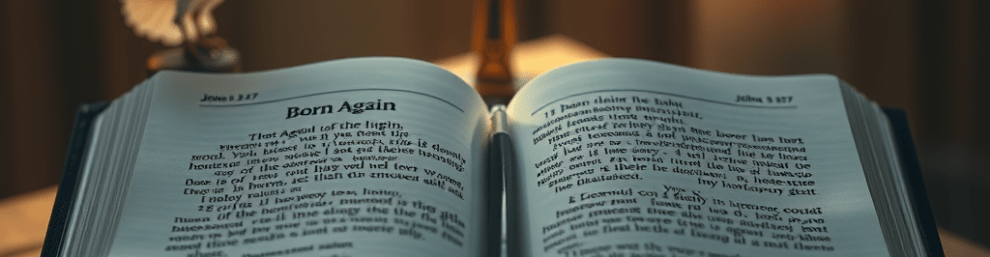
Thank you for reading this. I’m trying something a little different here. I am speaking into text while at work, so I will most certainly need to edit this later. If you find anything totally crazy or uncharacteristic, please extend a little grace—or kindly let me know.
The last thing I want to do is make a theological assertion that crosses into heresy.
Some of my Calvinist and Reformed friends (and I could rightly call them brethren) will likely never read this. I wish they would. The ones who do rarely comment, perhaps for fear of starting a debate.
Let me be clear: I do not want to debate, argue, fight, hurt feelings, or start a war. None of that advances the cause of Christ (2 Timothy 2:24–25).
But I do want to address what appears to me to be an inconsistency in the way many of my Calvinist friends present the gospel. I doubt they are aware of it. If they are, that would be more concerning.
Let me explain.
A Little Personal Background
The first 26 years of my life were spent in churches that identified as IFB (Independent Fundamental Baptist). My father was a preacher and pastor. My mother was always the pianist or organist. If the church doors were open—even for cleaning—I was there.
Because of that upbringing, I am deeply familiar with the words of Jesus to Nicodemus:
“Ye must be born again.” (John 3:7)
Those words were printed on tracts, painted above pulpits and choirs, and preached in countless sermons. Everyone knew what they meant. They were synonymous with being “saved.”
Jesus came “to seek and to save that which was lost” (Luke 19:10).
He came as the propitiation for our sins (1 John 2:2), the Lamb of God (John 1:29), so that we might be reconciled to the Father (2 Corinthians 5:18–19).
It is no wonder that “Ye must be born again” became a well-worn phrase among those who could sing all 50 verses of Just As I Am during an invitation.
When Nicodemus was confused—imagining a second physical birth—Jesus gently corrected him:
“Marvel not that I said unto thee, Ye must be born again.” (John 3:7)
The new birth was not a return to the womb, but the work of the Spirit:
“That which is born of the flesh is flesh; and that which is born of the Spirit is spirit.” (John 3:6)
What “Born Again” Means in Baptist Theology
Whether IFB or now SBC (which I am), Baptists have never implied that being born again involves re-entering a physical womb. Rather, we teach that to be saved, one must be born again.
The phrases are interchangeable.
To be born again is:
- To become a new creature (2 Corinthians 5:17)
- To pass from death unto life (John 5:24)
- To be adopted into the family of God (Romans 8:15)
- To be redeemed (Ephesians 1:7)
- To be grafted in (Romans 11:17)
- To be justified (Romans 5:1)
We are not saved by baptism or by partaking of communion.
We are not saved by works, “lest any man should boast” (Ephesians 2:8–9).
We are saved by grace, through faith in Jesus Christ.
And once saved, we are secure (John 10:28–29).
Spirit baptism places us into Christ (1 Corinthians 12:13), and water baptism pictures that reality.
In short, in this theological framework, being born again is salvation.
The Calvinist Distinction
Here is where the tension arises.
In Calvinist theology, being born again is not synonymous with being saved. It is the prerequisite to salvation.
Regeneration precedes faith.
In that system, one does not believe and then receive new life. Rather, one receives new life so that he can believe.
The terms are not interchangeable.
Yet when listening to a Reformed Baptist or Presbyterian preacher call sinners to repentance—to “seek and save the lost,” to “compel them to come in” (Luke 14:23)—you will often hear the same words:
“Ye must be born again.”
But here is my question: is that consistent with their theology?
If a Calvinist were to frame his appeal strictly according to his system, it might sound something like this:
“If you have been regenerated by God, you will believe on the Lord Jesus Christ as evidence that you were chosen before the foundation of the world” (cf. Ephesians 1:4).
But that is not how the appeal is typically made.
Instead, the language used is almost identical to that of the non-Calvinist evangelist.
Where the Difference Shows
The greatest visible difference between the Calvinist and the non-Calvinist emerges in the appeal to the lost.
The non-Calvinist genuinely believes the lost man can respond. He urges him to repent (Acts 17:30), to believe (Acts 16:31), to receive the free gift of salvation (Romans 6:23). He speaks to him as one who is spiritually dead but able—by grace—to respond to the gospel call.
The Calvinist, however, believes the lost man cannot respond unless first regenerated.
Yet the language in the pulpit often sounds the same.
My concern is this: if regeneration and salvation are not the same thing in one’s theology, should they be spoken of as though they are?
A Plea for Consistency
I write this with hope—not hostility.
If a professing Calvinist happens to read this, perhaps he might consider whether using one set of terms in one setting while defining them differently in another creates confusion.
At best, it may be inconsistent.
At worst, it may blur important theological distinctions.
We owe the lost clarity.
We owe our brethren honesty.
And we owe Christ precision in the proclamation of His gospel (Titus 2:7–8).






 The Recovering Legalist
Well, Anthony, I have never been a Calvinist. I do believe that you can walk away from your salvation if Satan finally dupes you to. Sure, that is probably very rare for a true Believer, but we are still engraved with free will.
Don
LikeLike
I’ve written about that, too 😉
LikeLike
Long time no text.
the above is a bogus way of looking at salvation.
the flesh is lustful and selfish and the spirit is trusting and loyal.
the mind of christ here relates to numbers 21, the snake story, the cosen saved out of egypt grumbled and laked faith, the penalty of those saved persons was death.
mesus was saying born again is a restoration of contemptable adulterous hearts back to trust and singleness of love.
john the baptist, john the apostle and jesus bluntly slell it out and wesley and calvin have nothing to do with it.
LikeLike
Ummm. OK?
But yeah, long time no text. I think I’m going to be writing more now that I’ve put my YouTube channel on hold.
LikeLike
hi pastor baker, wasnt sure if my reply went through. One thing i hated about bibke school and some bible studies was the bent toward traditional theology. This is the same as politics. While some applies most times generally, it becomes the blueprint rather than the mind if christ. What was in his mind. What scriptures was he bringing in and what was the goal.
So no disrespect, i just get a rash when people talk in calvanist vs armenian etc.
glad youre still kickin!
LikeLiked by 1 person
Hi Anthony, thanks for the opportunity to comment on this post.
To summarize before I provide detail:
This is a little different than what I was expecting to reply to, maybe because I misunderstood some of the wording of the FB post, i.e. that being born again preceded faith, and since faith precedes salvation, then being born again also precedes salvation, which is something Calvinists agree with. This left me wondering why the explicit call-out to Calvinists. In this post you specify, “In that [Calvinist] system, one does not believe and then receive new life. Rather, one receives new life so that he can believe.” So ends my confusion.
In any case, the “What ‘Born Again’ Means…” section holds no difficulty for a consistent, honest Calvinist. When you say, “we teach that to be saved, one must be born again,” and then, “in this theological framework, being born again is salvation,” you even seem to be pointing out a conceptual distinction between the two, but not a separation between the two, such that, if one occurs, so does the other – again, no difficulty.
That is, unless you’re saying that ‘being saved’ is actually synonymous with ‘salvation.’ When you say immediately after, that the Calvinist distinguishes between the two, I expect that entails that you, as a non-Calvinist, do not distinguish between them. But then this renders your sentence above as, “we teach that to be saved, one must [be saved].”
You said, “you will often hear [a Reformed Baptist or Presbyterian saying] the same words: ‘ye must be born again.'” I don’t know why this is puzzling, as being born again involves salvation, even if Calvinism them being distinct parts. And this, aside from the fact that the verse appears in their Bible as well – and thus in their theology.
You must truly be born again to see and enter the kingdom of God. This is what Calvinists believe, no tongue in cheek.
You said,
The appeal, whether you’re Calvinist/Provisionist/Arminian, is “believe and repent of your sins, and be saved.” And I’m thankful for that. But, just as we don’t launch into a discourse about the hypostatic union or perichoresis when appealing to sinners to believe in Jesus Who is God, we don’t go into the details God has revealed about his sovereign plan in man’s salvation when calling them to repent.
It’s not that the Calvinist’s appeal sounds like the non-Calvinist’s, period; rather it’s that the non-Calvinist’s sounds like the Calvinist’s / sounds like the Arminian’s / sounds like the Provisionist’s / etc., etc. (within orthodoxy, of course). And again, I’m thankful for that unity.
As to your concern: “My concern is this: if regeneration and salvation are not the same thing in one’s theology, should they be spoken of as though they are?”
Well, if they are the same thing in one’s theology, should they be spoken of as though they’re not? (“we teach that to be saved, one must be born again”). But perhaps both of these things can be answered by my #3 at the top.
Ask a child, “how does the light turn on?”
“I flip the switch.”
“No, the switch being flipped closes an appropriate-material circuit which is also attached to a power source and allows the power to surge from the source through the circuit to a light bulb exciting the filament in the bulb to such a temperature that it glows, and then it’s on.”
It’s not not true, but it’s definitely not false to say, “I flipped the switch.”
Thanks again for the opportunity.
Matthias M.
LikeLike