
First, a couple of videos.
Here’s my take.
You all know the old saying, “If it looks like a duck, etc…it is a duck,” don’t you? When we see something that looks and acts like another something with which we are already very familiar, the most logical explanation for the similarity is to initially assume is that the two somethings are, in fact, alike. They don’t have to be exactly alike to be of the same something, just like a ball is a ball regardless of the size, texture, or chemical makeup. Even my 2 year-old granddaughter, based on her short life experience, is not wrong when she notices a spherical object, points, and yells out, “Ball!”
We carry with us information and definitions acquired through experience, along with developed presuppositions When we observe a buzzing factory, we assume it to be a buzzing factory based on what we already know from experience about building or making things. To describe the factory, then, as something other than what is observable and recognizable as a place of production would require one of two things: either the observer has never seen or had any concept of manufacturing and assembly, or that he is being intellectually dishonest.
One would have to have never tied a shoe, prepared a meal, or completed any task requiring a process to not recognize a factory for what it is. At the very least the observer should be able to recognize the industrial process as being similar to other processes with which he is already familiar: the kind when going step-by-step makes a thing. Therefore, to observe a factory in operation and then declare that the factory, even the whole process of manufacturing, including subcontracting and logistics, is nothing more than an illusion of design and a product of chance is to throw out rationality in favor of a presumed belief.
It amazes me how that one can learn more and more about the complexities (yes, even irreducible complexities) of the human cell and still maintain random chance and time created and honed everything, from the machines down to the software in a factory which purpose is to make a thing.
It is easy to simply claim there is no Designer or Creator behind the unfathomable complexities of human existence. All one needs is the presupposition that no matter what one encounters, it is NOT what it may appear to be. If we first presuppose there is no God, then what may appear to be the result of vision and design can be waved off as only an illusion, a false equation, or the projection of a preconceived delusion acting as a coping mechanism.
However, living in a modern, industrial world, I find it hard to understand how anyone with any amount of intelligence can maintain “natural selection,” copious amounts of time, and blind chance are the architects of anything, much less the preliminary mechanisms and processes which bring about its construction.
I actually work in an automobile manufacturing plant. I have witnessed the entire process of building a Volkswagen Atlas. Even more, I have participated with my own hands in the making of these vehicles. I have been involved in the logistics of securing parts of all kinds and placing even the smallest in precise positions for robots to weld. In order for one functioning vehicle to roll off the assembly line, the things that must take place in the right way at the right moment and in the right amount are just staggering. And we are only talking about a car, not the human body and each cell!

For just a moment, think about that 2025 VW Atlas with all the bells and whistles of a luxury SUV. Imagine it painted your favorite color as it is cranked and driven out the big bay doors toward the staging area where it will be shipped. Should you spend your $50,000 to buy one, you will expect it to perform at a certain level while maintaining its structural integrity. After all, the lives of your family and yourself will depend on it.
Now, imagine that SUV backing into the proving and detailing area once again. Then, imagine it backing up to the automated assembly line where it is once again placed on the moving floor. Keep reversing until the vehicle is completely disassembled, stripped of paint and sealer, even un-welded (if that was possible) and reduced to small stamped pieces of sheet metal that make up the body. Are we done? No.
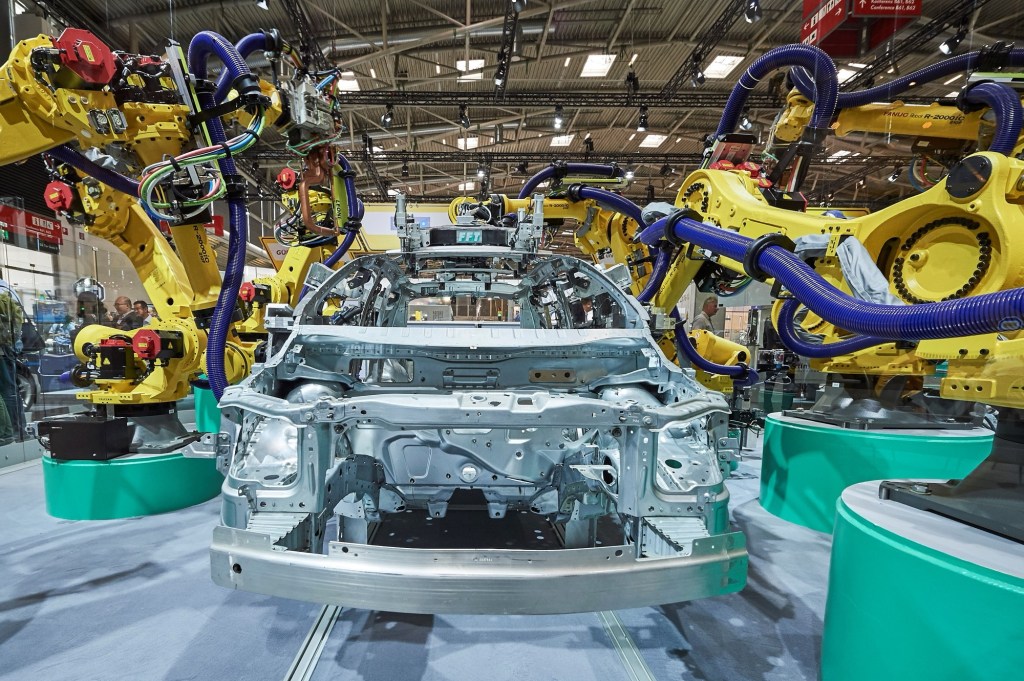
Look around at all the bins full of sheet metal parts, plastic spacers, barrels of sealant, bolts, nuts, and even the box of tiny copper tips for one of the thousand-plus $200,000-dollar robots spot-welding 24/7 according to software monitored 4,000 miles away. How did all that get there? If left alone, would a VW Atlas once again roll out the door? Even in a billion years?
Even more, consider all the things that must take place in the process of manufacturing the individual components. For every piece of that vehicle (about 5,000) there is a company, a business plan, a CEO, workers, machines that must be maintained, and materials which must be ordered and stocked. And then there are the truck drivers and the forklift drivers and the mechanics who keep those machines running and those parts on schedule.
Parts must be made according to specific tolerances. Parts must be assembled in a certain way. People have to do their assigned duties with quality, safety, and integrity. Everything must go a certain way, or else the very integrity of the vehicle could be compromised. Nothing, and I mean NOTHING is unplanned and left to chance when literal lives could be at stake.
How long would it take for a brand new Volkswagen to roll off the assembly line on its own? Any answer other than “never” would be absurd. And why is that? Because nothing in the observable world testifies to this being possible. From experience and observation we have acquired enough wisdom to determine two things: first, a car doesn’t design and build itself; and second, an expertly built and functioning vehicle must not be the result of design-less, random chance.
Therefore, it is not irrational, when we observe what appears to be design and purpose, to assume there was a Designer with a plan for how the thing would function. Everywhere else in creation and everyday life we observe the natural rhythms of cause and effect. When we see a jet flying in the sky above us, we take for granted the craft was designed and built in a factory, it’s going somewhere, and that people are on it. Even when a rock hits our windshield, we know something caused the rock to leave the pavement.
It’s only the one who cannot, no matter the evidence, no matter the logic, accept that there’s a Watchmaker in the history of the watch on the shore. He asserts there is no evidence for the Watchmaker; there is nothing about the Watchmaker that he’d like should he exist; that not enough jewels were in the movement to signal true intelligence; and that though it may look like a watch and function like a watch, we don’t know for sure what we think a watch is, or whether it is actually represented in the thing on the shore.
For all we know, the supposed watch somehow came from the depths by some means not yet discovered.

“All we can know for sure,” he would say, “is that there appears to be a thing on the shore with interesting similarities to other observable things, but whatever it is, it is because it is and that’s it. To entertain any other conclusions might lead to inconvenient truths, and we can’t go there.”
All I know is that even though I’m not a biologist, I’m pretty certain I can recognize a duck when I see it.
And a watch.






 The Recovering Legalist